
Oct 3, 2026
Consider: Every thought you’ve ever had has some specific content, which in most cases is taken to be the totality of the thought itself. Now, not every thought is functionally the same, and indeed most thoughts arise and fall away without much significance, and are happily lost to the ethers like leaves in the wind. Knowing that I had a banana as a part of my breakfast this morning will likely have no bearing on any future decision you make or what kind of person you become…
Yet, other thoughts may indeed have a quality that not only makes them significant for you, but in such a way that they do change something about who you are and who you become, and affect the way you orient yourself in the world. We may consider such thought contents to have, functionally speaking, something like … a bit of magic in them, a bit of transformative power. Maybe an idea like that of Justice, or Truth, or Love. How is this the case?
Well, in addition to the content of a thought, which can relatively easily be made explicit, rendered into words, and given form, we can also bring before ourselves the formING of the thought, the contexts that surround, support, and help the specific thought content come into being specifically in just that way in just that moment, for us. That is to say, we can make an attempt to become aware of not just the form of the thought, but of the process of the thinking, the precipitate of which is the content.
Normally, we are not called upon to reflect upon this more implicit, background, nebulous, interconnected, complex, wiggly, moving, unfolding level of thinking, yet: all thought content has some way of coming to be what it is for us. Now, what happens when we take up the task, as we already are, of thinking about the process of thinking? That is to say, what effects can we observe in our thinking when it takes itself as a content of its own process, when the form is fed back recursively into its own unfolding?
I’d like to offer you a way into this strange domain by way of an experiential method that rides on the back of a particular thought content that has something of that magic quality just referenced. The thought content in this case arises out of the domain of projective geometry, which deals primarily with the invariance of co-incidence of elements under projective transformations.
The specific thought content that forms the basis of the experience I’d like to lead you towards is that of “infinity.” How do you think infinity? I will help you. But, before we begin, I’d like you to check in with yourself, and ask: what is your current understanding of, and relationship to, infinity? Where does it come from? How would you characterize it? If I were to ask you specifically to come up on stage and explain infinity to the group, how would that make you feel?
Okay. There are many ways to approach thinking infinity with projective geometry, but the simplest requires only a few elements…
So put your imaginative geometry hats on and follow me as we go on a little journey. Although it may not seem like it, I promise that you will be doing something philosophically relevant.
So get comfortable, feel free to close your eyes if you wish. Take a deep breath…
…and now let us imagine: a perfect single line we will call line (a) stretching, as it were, horizontally on the ground in front of you, spanning left and right into the distance.
Now remove everything but the line and enter the Platonic space of the form itself, with no other entities yet in this universe. Let this universe be uncurved across all scales (we could curve it later if we wish).
Now imagine point P not on line (a).
Draw a line (z) through P such that it intersects line (a) perpendicularly.
Note lines (a) and (z) now intersect in a new point, X.
That’s the entire setup: a line, a point not on the line, a new line through the point that intersects the first line in a new point. We have exactly two points and two lines.
Now, in your imagination, fix the initial line (a) and point P. They are static.
But, rotate line (z) in a counterclockwise fashion around point P– not too fast, slowly at first, and note the change of position of point X relative to point P.
Continue the counterclockwise rotation of (z) around P, pinning the origin of your focus to P while following exactly what is happening to X.
Soon you will start to lose your sense of the exact position of X; you won’t be able to encompass it’s relative position to P in the same way that you could earlier, when it was “closer.” This is the beginning of transforming your relationship with infinity in reality.
Continue the exercise, filling in with a more exact imagination the relationship of the geometric elements wherever your attention loses focus. Meditate it.
You may find that your attention wants to change it’s scope, orientation, or position. Try to keep your focus so that the locus or origin point of your attention stays constant throughout. Keep yourself at the point P.
Now, rotate (z) until you reach the point of parallelality.
Notice. Notice your noticing and what has changed in it, when you reach this moment.
What has happened to X?
If you were to point to it, how exactly would you do so?
Please, do your best to not make any jumps; no leaps or gaps — if you find yourself making such shifts, do your best to fill in the process with clear, exact thinking. If you find your lines starting to make strange bends, whip them back into their perfectly unwavering straightness and try again.
Now let us reverse the process and rotate (z) clockwise around P until we feel we are back in a manageable situation that we can fully encompass with no loss of clarity at any point.
Was it easier to come back than to go out?
Rest in this more normal situation for a moment.
Now continue the clockwise rotation until we again approach “the problem” of parallelality.
Approach it with a fierce consciousness.
Euclid got here, but he failed to follow the inherent logic he himself had already set up. Perhaps his imagination was not sufficient to follow it through, completely, continuously, and coherently. Also, infinity is scary. In his frustration, Euclid had to add postulate #5 that forever haunted him: the parallel postulate, which he avoided for as long as he could, invoking it only when he had no other choice.
Notice newly: as lines (a) and (z) approach parallelality, X approaches infinity.
Can we do more than “approach”? Can we “arrive”? How?
Notice that as X gets farther and farther away from P we must slow down the rotation of (z) in order to continue following it with the same exactness we did when it was closer. As X goes on its infinite flight, every minor angle of rotation of (z) produces bigger and bigger effects, until …
Place your attention upon the situation where the angle between (a) and (z) is infinitesimally close to zero… the smallest possible further rotation will make them parallel.
What can you say about this situation?
Can you point to X?
Now let us allow ourselves a little leeway, and rotate (z) through the moment of parallelality so that now we are infinitesimally rotated past parallel, without requiring ourselves to account for the position of X exactly at every moment of this smallest–and yet biggest–of journeys.
Now in your mind point to X again.
Let us now hone in on the “problem” of parallelality by saturating our attention on the oscillation of (z) around the moment of parallelality with (a).
See X “jumping” from left to right and back again.
Really push for the smallest imaginable angle away from parallelality and oscillate your attention around it, making the change in angle between (a) and (z) shrink and shrink, all the while following X.
With this saturated consciousness, rest in the moment of parallelality.
Now point to X again.
In what direction are you required to point?
Let us say now that X is “at infinity.”
The finite position of X, made from the intersection of two non-parallel lines, is somehow now an infinite position, still made by the intersection of two lines: two lines that are now parallel.
Lines (z) and (a) never stop meeting; they never cease having a relationship that forms a unique and singular point, even when parallel.
Two lines in a plane meet in a point; it’s as simple as that.
Notice now that our initial point P can be anywhere.
Now unfix and move point P away from line (a).
Does this change anything essential about the situation?
Where do you have to point to find X when (a) and (z) are parallel but farther apart?
What about if you move P infinitely far away from (a)? Does this change anything?
See that all lines that are parallel to each other share a single point at infinity.
Let this sink in.
Notice that there is as yet no coherent way to talk about scale. We simply have coherent relations between geometric elements. Scale does not exist and would have to be created out of relations for us to use it.
And now let us speed up and go farther:
We could have placed our original line in any orientation. Let us place a brand new line (a’) orthogonally to line (a) with a corresponding new parallel line (z’) meeting in a new point at infinity X’.
See that when (a’) and (z’) are parallel, X’ is a different point at infinity than X. What is different is its direction.
Let us be clear: we are now speaking about the very nature of directionality; its source. Remember–no–see that the distance between (a) and (z) is irrelevant. Every line that is parallel to (a) meets at the single point X at infinity. We can “fill in” the plane entirely with lines parallel to (a): they all meet at X. We can even fill the volume of three dimensional space with more parallel lines, all of which still meet at a single point. The same continuation to higher flat dimensions holds (infinitely).
The point X, when it is at infinity, defines an infinite space of directionality. There is something of a “field-like” nature to infinity in this regard. We can say that directionality is constituted solely and essentially by a single point at infinity that defines it–that direction.
But that direction, seen from “here,” from anywhere that is not at infinity, holds within itself a kind of strange duality. Normally when speaking of “a direction” we mean precisely the lack of every other direction. This only works when we ignore infinity. To include it requires that a single direction encompasses what is apparently its exact opposite: for any point X at infinity, from here it is simultaneously in two precisely opposing directions. Or perhaps it is better to say that every ‘single’ direction becomes its opposite through infinity (shades of Jung’s enantiadromia). Another way to say this is that point X at infinity connects to itself through ‘finity’ via all possible lines parallel to and including line (a) (shades of Feynman’s path integral formulation of quantum mechanics). A given line “here” is nothing other than a unique token of the way directionality is made manifest from its single point at infinity. The single point at infinity X, unfolded into finity, is a line.
Ok, take a breath…
Now, place yourself at point X at infinity. You’ll have to jump there, if you can. Shift the locus of your attention so that it is from the perspective of point X when X is at infinity.
Can you feel what it is like to inhabit this point?
Where, now, is the line for which you are the point at infinity?
Can you feel how there is an inversion that happens?
To ‘get’ to infinity we cannot simply move along the line… this would require infinite time to accomplish.
We have to flip over into infinity. Our consciousness cannot maintain coherence through this flip — it goes dark; there is a kind of threshold that prevents us from maintaining the same kind of wakefulness that lawfully got us to the moment of the flip. We have to abandon the very process that was the only reliable source of coherence in order to cross this threshold. But having trained ourselves via the process, we find that what meets us at the threshold is itself lawful, and that to pass through it our consciousness must perform a lawful act. This act is a kind of inversion; an insiding-out/outsiding-in, not just of consciousness but of form and space itself. It is making all the previous distinctions newly, but inversely. What was once approach is now recession. The center and the periphery have flipped into each other.
When looking “from here” we can count steps of a process, we can traverse more or we can traverse less, we have extension and duration and all that comes with relating those together with finite means.
When looking “from infinity” any step is a step “into” the non-infinite, an inversion into space and into process, into differentiable uniqueness. At infinity, uniqueness is, as it were, collapsed into itself; it is no longer expressed outwardly but only inwardly (shades of David Bohm’s implicate order). All the potency spread out through space “here” is concretized inwardly at the infinite. From the perspective of infinity the whole universe is found infinitely far within (shades of the holographic principle…)
It is here that we will have to stop and take off our imaginative geometry hats, although the well of projective geometry runs very deep and there are many other consequences that you can work out yourself if you keep the logic tight and your curiosity tighter.
So let us pause for a moment, take a deep breath, and ground yourself back to this finite place and time, and approach this from a new angle.
<<<<>>>>
Every thought you have about infinity is wrong. Every thought you have about infinity is a dead corpse, a desiccated shell of a movement that is no longer happening. You may have heard that “infinity is not a number” — and this is true — but it is also not a thing, it is not a thought, it is not a concept, it is not an idea about a relation. To ‘have ideas about infinity’ can perhaps at best be a pointing at the moon, while at worst is a veiling of a process so deeply epistemological that it flips into the ontological.
Infinity is rather a mode of inhabiting our own thinking that is inverted from the normal procedure. Whereas our normal thinking is largely apparent to us only when it produces for us a thought-content upon which we can reflect, so we can say to ourselves “ah, I have an idea” — the attempt to think infinity requires us to leave behind all thought-contents, and instead maintain a presence in the activity of the thinking itself. Because the normal mode of thinking is so deeply ingrained, where the activity of thinking only finds its worth when it dies into the products of its own beholding, in practice, when we wish to think infinity we find something more akin to the ‘undoing of thought’ as we are continually led past the limits of what any thought content can hold. In trying to meet infinity, it asks us to uncompromisingly relinquish what we may think we know, reversing the process of knowing into one of active unknowing.
You can’t just think the thought of infinity, you must think your thinking, and this is precisely why infinity is so useful: any attempt to actively embrace it as a whole is met with a perfectly tuned failure mode specific to the exact way in which the thinking process aborts into a thought. It acts as a kind of objective mirror for thinking, reflecting back to us exactly and only what our own thinking is able to accomplish for itself. But it is uncompromising in that it requires us to meet it on its terms, not ours. That is to say: the attempt to think infinity is an attempt at the transformation of thinking, by thinking.
Becoming aware of how thinking specifically abandons itself into thought, done as a practice, forms the foundation of a sense organ — a sense organ made of and tuned to the unfolding of thinking as distinction. Why distinction? Because distinction is the fundamental activity of thinking, and the fundamental activity of thinking is distinction. Following the work of George Spencer-Brown and his curious book Laws of Form, I take distinction as the primal act of epistemology and the primal act of ontology. More on this later. What is important at this stage is simply the recognition that thoughts are the result of some process, which we can call thinking, the inner workings, structure, mechanics, and dynamics of which is largely opaque to us due to the often overwhelming presence of the thought content itself, which has a tendency to immediately overwhelm such subtleties, as our attention, trained by centuries of cultural pressure that values outcomes over journeys, is entrained to only the utility or disutility of the end results. “Thoughting” — this habitual obfuscation of the process of thinking by an overvaluation of only its most obvious and externalizable aspect, is a kind of death process. If only we could just assemble a room full of the right kind of doctors… perhaps we could find a way towards a remedy that could re-enliven thinking for itself. Don’t worry: there is such a remedy.
When thinking takes itself as its own object, something strange occurs; rather than continually shedding thoughts into consciousness and leaving them behind for the next and the next and the next thought to fill the space left by their constant fading, the redirection of thinking back to its own process yields a different kind of thought corpse, the shape of which resonates with the activity that produced it, because it is an instance of itself. This bears some scrutiny.
Most recursive processes end in either self-extinction via reduction through negative feedback or self-extinction via explosion through positive feedback. The recursion of thinking towards itself, when its process is taken as its contents, is different, qualitatively and phenomenologically. There is a word, nay, a veritable science of this balancing act between implosion and explosion; it’s called chaos theory. Thinking that takes itself recursively is a kind of parameter-tuning towards a dynamic state known in chaos theory as “the edge of chaos,” in which complex systems balance between self-limiting and self-expanding processes so as to succumb to neither. It’s a sort of best-of-both-worlds situation, and it turns out that being in this state yields a kind of maximal adaptability, robustly open to even the smallest perturbations, demonstrating both an increased capacity to deal with novel information and the ability to generate novel responses.
When thinking becomes recursive, it structures itself fractally by necessity. It becomes fractal; that is: it finds in itself a scale-invariant structure produced by a recursive, feedback-driven process. I do not mean this in the sense that the brain itself (note the first usage of this term) is demonstrably generated by fractal branching processes. Rather I mean this in a phenomenological way: thinking becomes aware of itself fractally. And while the status quo would generally take the fractal structure of the form of the brain as the basis for the near-critical dynamic regime that gives rise to recursively branching activity cascades in neuronal firing, I would like to propose the exact opposite, although in the interest of time I will have to leave this portion unsaid, and return us back towards the promised remedy.
The production of a widget by a machine does not change the conditions of realization of the process of its own production. Most processes are like this. But some processes are or can become specifically sensitive to what they produce, such that the process is open to change by virtue of what the process yields. Structurally this is recursion. Thinking can have this quality, but only when it can become sensitive to its thoughts about thinking. This leads us back to the formation of thinking as a sense organ; a sense-organ whose domain of distinction is itself.
At a very low level, every next action of a system that could be otherwise because of a distinction made by the system involves cognition. Distinction, following threads from cybernetic epistemology, is a fundamental ontological-epistemological act by which the undifferentiated plenum or void (as these are equivalent) becomes not-itself in just that particular way marked by the distinction. When the consequences of an act of distinction become relevant to the system’s next possible steps, specific limited options for action become newly available to the distinguishing system. We can call the process of this ‘relevancing’ sensation in its most primal form. Sensation is to become sensitive to the relevance of a distinction, that is, to the difference that the distinction makes; this is underlying form of Gregory Bateson’s “difference that makes a difference.” Sensation is thus another recursion; or rather, the same recursion seen from a different spot in the fractal.
When the loop is functionally closed between the system’s ability to distinguish and its sensitivity to the consequences relevanted to the distinguishing system, a sense organ is formed. A sense organ is simply a way to describe the continued action of this recursive functional relation. A sense organ is thus an epistemological-ontological recursive unity, keyed to the domain of differences made available to it through the distinctions with which it is recursively linked. However, in almost all cases this recursive link between distinctions and the activity of the corresponding sense organ is not itself the subject of distinction. In such cases the system is not aware of how it senses, only that it senses some content.
And now we can come full circle back to thinking about thinking, now viewed from the perspective of this new recursive framework, whereby thinking, when it takes itself as its own object, forms a sense organ. Thinking is enlivened when it is not merely self-reflective, but when it is fractally self-generative, understood in this recursive way. The alchemical image of the ouroboros, the snake that eats its own tail, is a potent symbol of this structural form. Thinking dissolves itself into itself in order to form the basis for itself newly. In a strangely literal way we can say that thinking eats its thoughts in order to digest them so as to form its own structure.
The general undertaking and form of this inquiry is an example of what I call aesthetic epistemology. Aesthetic epistemology is a way of knowing about our knowing, developed out of and relying upon the way that thinking can become recursive to itself. It focuses on the recognition and then unfolding of the consequences of the fundamental structural metapattern whereby higher-order activity is recursively linked with lower-order form generated by that activity, the prime example of which we have just seen in thinking itself.
The question of aesthetic epistemology is: “How am I distinguishing?” Because every act, every feeling, and every thought involves a distinction at some level, changing how we distinguish (and therefore what becomes distinguishable for us), is the core focus. It is the study of how our distinctions can change when we distinguish our distinction.
The domain of differences opened by this process of distinction is not merely cognitive or just conceptual (although they are that, too). They are differences that are felt. Aesthetic epistemology is literally a feeling of our thinking, a feeling-thinking, just as much as it is a thinking-feeling, and in the appropriate recursive form is both: a feeling-thinking thinking-feeling, and a thinking-feeling feeling-thinking. And I apologize if that is harder to grasp than infinity.
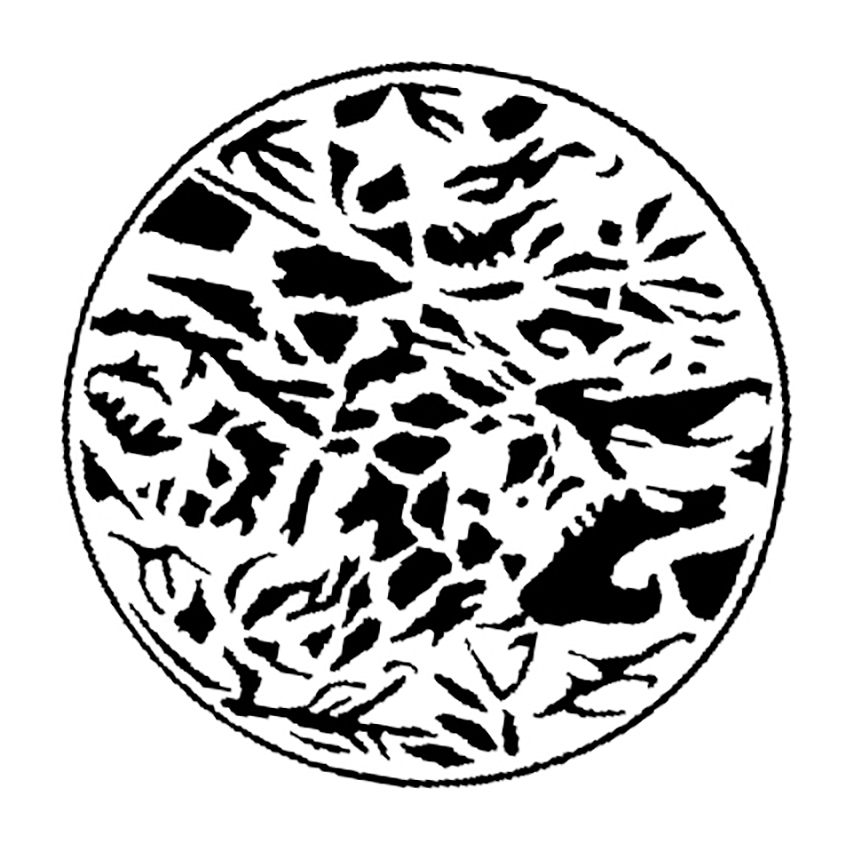
To close I’d like to leave you with another invitation to sense your own thinking and put some of this into practice. As you leave this session, you will notice, on a table somewhere back there, some little circular paper cutouts with a variety of dark blob shapes bounded by a circle. And for our Zoomies, you can get the one on screen and I was told there would be a download link in the session for a PDF version. Please feel free to pick one up on your way out. Your task is the following:
- Attend to your attention as you look at this strange thing before you.
- Distinguish as you can the distinctions made by your thinking, both about the visual stimulus and about the thinking process itself.
- Play with the distinctions; undo them, make new ones, see their effects.
My only request is that you do not inadvertently give anything away to anyone else if something … interesting happens to and in your attention, so as to give everyone an equal opportunity for both ignorance and revelation.
Thank you.

Leave a Reply