Month: December 2009

  • A response to: “Anthroposophy and Waldorf Education: The Web as Will and Idea” – Can Digital Media be Redeemed?

    Web Internet SpiderThe following is my response to a recent article by Eugene Schwartz entitled “Anthroposophy and Waldorf Education: The Web as Will and Idea”, which is Eugene’s response to an article by the renowned anthroposophist Sergei Prokofieff, who wrote a remarkable article entitled “The Being of the Internet”, in which he argued that the digital media are carriers of such darkness that they are unredeemable.  The following will make the most sense if Eugene’s article (and ideally Prokofieff’s as well) is read first, but can still stand on its own as my opinion.

    Eugene has written a timely and well-considered article. As someone who has “grown up” (at the time of this writing I’m currently 33) watching and participating fully in the birth of the internet (I had an email address years before the world wide web existed), I am disheartened when anthroposophists shy away from what I consider to be an important task: the appropriate usage of these new kinds of technology.

    By appropriate, I mean utilizing the technology as a means of furthering a progressive human development. Of course what constitutes “progressive” or “development” can be hotly debated, but for me this involves not just empowering people through providing access to information of an esoteric nature that they might not otherwise have, but in providing the context for the shared creation of meaning in ways that are dynamically capable of leading towards real transformation.

    The ahrimanic nature of the internet lies primarily in the way that supports the decontextualization of meaning-making from the soul lives of its human participants. It allows us to abstract too easily, to decontextualize parts of ourselves in ways that challenge a healthy development. But at the same time the internet is the potential carrier of both luciferic impulses (getting willfully lost in online environments, expressions of rage, rampant self-satisfaction seeking opportunities, etc.) and Christ impulses as well.

    As always, the Christ-like impulses are a bit more subtle, a little less oriented towards appearing with a particular veneer, but no less powerful for all that. I am speaking of how the internet is used to help bring groups of people together in ways that fosters both community and action, and which promote love and change. This occurs not merely through sharing information, but in the literal creation of an in-between space which can be filled with the soul-activity and spirit-light of individual wills. This, I think, is what it looks like to “redeem” the internet. It happens when people are given tools to become active participants in the dynamic creation of meaning that fosters transformation and love.

    The challenge, as with the bringing into one’s heart of any Christ impulse, is that it occurs not by default, and not by control, but through a conscious surrendering of one’s will to a higher will, which is experienced both as a suffering and a redemption. Ahriman, I imagine, would like us to use the internet to manipulate and control so that we forget the much greater power available through this kind of conscious suffering, while Lucifer would be happy if we continued to use the internet to satisfy our desires and create infinite personalities for ourselves.

    The alchemists understood that nothing could go untransformed if the magnum opus is to be achieved. Their saying “As above, so below; as below, so above” was not an academic one about correlation; it meant that in order to reach the highest potential available to us, we had to transform our lowest aspects. This applied too to the outer world: nothing could ultimately go unredeemed, and if we ever decide to “write off” some aspect of reality as beyond hope, beyond action, and beyond transformation, then the forces of darkness will claim a victory.

    We must work together to build the world we wish to live in. It is a horrible mistake to try and divorce technology from morality, and to claim that “it’s all in how it is used.” Some technologies are more evil than others, but the internet is not an atomic bomb. The development of the internet, although beginning as a defense-oriented technology (not incidentally as a technology to help counter the potential effects of nuclear weapons), almost immediately was taken up and used for other means; primarily education. There are countless ways in which both the development and usage of the internet fosters healthy development of human beings–in ways not completely without strings, of course, but also not in ways that make its usage “unredeemable.”

    What we cannot do is let the regressive impulses have their way with the internet and co-opt the minds and souls of human beings for their own uses without a Michaelic challenge, a challenge for the creation of spirit-based groups of individuals (which are different than just ‘groups’), a challenge to permeate the spiritual spaces of the internet with transformed will, with conscious sacrifice, with love of transformation and a transformation of love.

  • The Art of Nature: Alchemy, Goethe, and a New Aesthetic Consciousness

    The Art of Nature: Alchemy, Goethe, and a New Aesthetic Consciousness

    Are you fascinated by the beauty of forms in the natural world?  Do you sense something amazing at work out there, like an intelligence that lies just beneath the surfaces of things?  Then I invite you to read a new essay that explores the building of a new aesthetic consciousness that seeks to connect us with natural processes in a way that is truly transformative.  I follow threads from alchemy into the genius of Goethe, and end with intimations brought forth by Rudolf Steiner, and even include some home-made animations as a part of a practical exercise for you to work with.  You are invited to come and participate in opening a new set of eyes…

    The Art of Nature: Alchemy, Goethe, and a New Aesthetic Consciousness

  • Waldorf Educators: A Light on the Path

    The world has problems; LOTS of them.  But as long as there are people like my friend Nancy, who devote their lives and love to one of the most important and practical callings on the planet, education of our young, I have hope for the future.

    Let me give you a picture, in her own words, of what I mean, as an example of how Waldorf education tries to meet the challenging tasks of our time.  This is but a tiny picture of what is possible–today– for education:

    My class went to our auditorium today and entered in the dark.  The room was covered in pine boughs in the shape of a spiral path.  In the center of the path was one large glowing candle that sat upon a tree trunk covered by a blue cloth with gold stars on it.  It smelled like a pine forest.  The students entered in silence and proceeded to a semi-circular row of chairs to sit down.  Two women, playing penny whistle, violin, and cello began playing various musical selections.

    The first child approached me.  I was standing by a table filled with red apples, each holding a slim candle in a hole carved into it.  Then, one by one, each child took the spiral walk into the center where the light glowed.  Lighting their own small candle from that big central light, they each turned and began walking back out from the center.  At some place of their own choosing along the path, they each picked a spot to place their little light.

    When the last child had gone, I took my candle filled apple and walked the path among the little lights, to the center.  After lighting my own candle, I found a place along the way to place my own light among the others.  It was an extraordinary experience for us all.  The metaphors were flooding my mind as I watched each of these students proceed on this path.  When they were little, their kindergarten teacher or parent held their hand on the way.  Now, they seemed to have grown so tall, only third graders, yet I marveled at how they had gotten so big.

    As I looked at them, a veil was drawn back for me and I could see much more than I could usually see.  Everything was revealed to me in a moment.  It seemed to me, as they walked, that I could sense them as younger children, as who they were now, and even who they were going to one day become.  In the darkness, I really felt I could see their future before my physical eyes.

    When my turn came, I realized that in the last two years of first and second grade, I always had walked the advent spiral first – before they did – so that they could see how to do it again.  This time, they walked confidently alone without my example.  This time, I followed their example.  As I passed by each one of the lights on my way into the middle, I felt as if I were floating along in the starry heavens, each star one of these students of mine that I hold so dear.  Each star lighting my way into the center.  I was so humbled to place my small light, no bigger or smaller than the others, down on the path to join in lighting the room.  I could also feel how profound it was for the students to see their teacher walk this inward path.

    With each eye intently and silently upon me, I felt the connection, the gravity, the grace, the sacredness of the responsibility I carry on their behalf, but also I felt, “I am the so-called teacher this time, but I am really only one of you.  You, who have been my teachers, who will be my teachers in the future.”  What a privilege to live in such light.  Blessings on us all.

  • Consequences of the discovery of perspective in art

    Consequences of the discovery of perspective in art


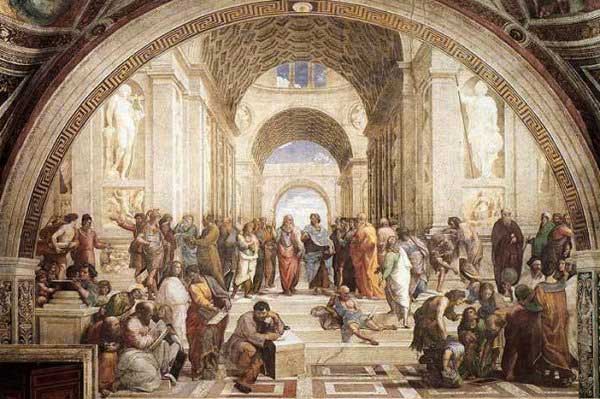
    Raphael: School of Athens
    Raphael: School of Athens

    The “discovery” of perspective was a radical point (pardon the pun) in the development of art, and was intimately tied in with a whole shifting of consciousness during the time of the Renaissance and forward, having correlative expressions in the increasing reliance upon an “objective” perspective from which to view the world.  Science in its modern form arose during this period as a methodological way of systematically removing subjectivity from observations, allowing data to be gathered which was amenable to enumeration and mathematical manipulation.  The abstraction of the observer from the observed and the dissociation of both this abstracted observer and the observed phenomenon from the ever-changing background contexts that held both provided a powerful basis for a new way of being in the world.

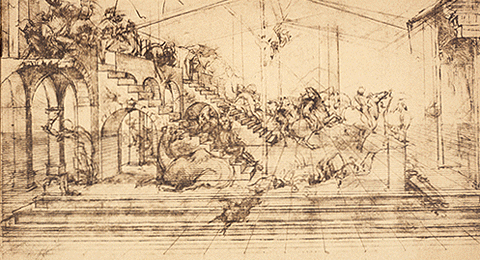
    Leonardo da Vinci: study for adoration of the magi
    Leonardo da Vinci: study for adoration of the magi

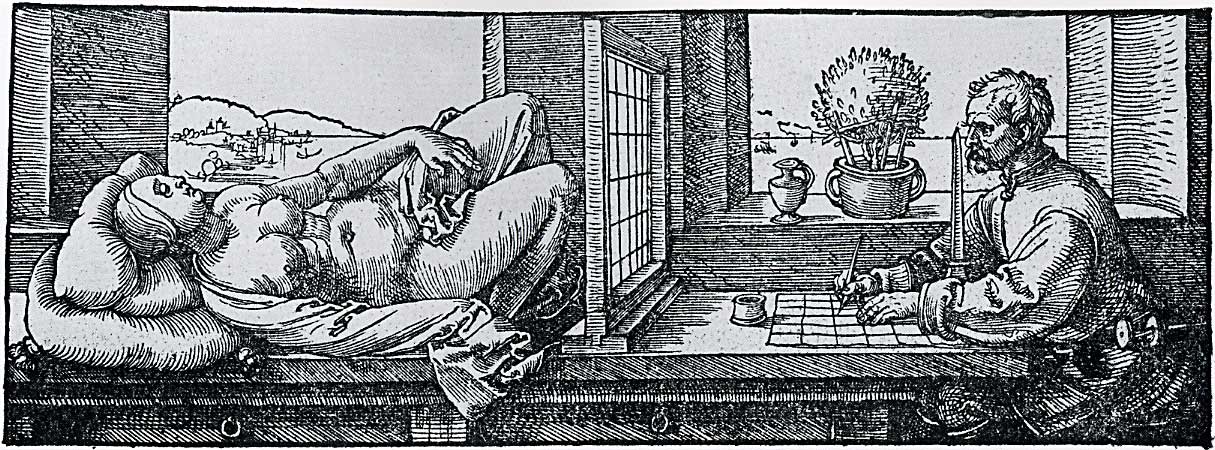
    The laws of perspective allowed the world to be visually reduced, literally, to a point.  Each point became a point in space from which the world looked a certain way, and the way it looked from one point always differed from the way it looked from any other point.  It is interesting to note that the laws of perspective, designed as a basis from which visual scenes could be rendered on canvas in a way that accurately captured the “real” experience of our visual sense, required a reduction of the very visual experience it was meant to uphold.  What I am referring to is the fact that perspective works from a single point, but the human being experiences the world through TWO such points.  The laws of perspective required the literal and figurative shutting out of fully half of our visual experience.

    durer_perspnudeThus, in both art and in science, the central feature became one of representation.  The art of the day was meant to represent in as exact detail as possible what could be viewed by a one-eyed person standing at a singular and exact location at a singular and exact moment in time.  Similarly, the science of the day strove for theories that reduced human experience to its most basic forms, thus allowing for a further abstraction into mathematical language.  Locke distinguished between “primary” and “secondary” qualities, and it was only the primary qualities that really mattered for science, because these could be objectified.  This objectification was the equivalent of restricting vision to one eye at one point; each phenomenon could be interpreted “correctly” only from a singular point of view that was completely restricted and delineated in both space and time.  The universe became a clock, and the human beings within it machines within the clock.  “Truth” became something external to the human being, something to be discovered through the fulfillment of the promises made by the new scientific methodology.

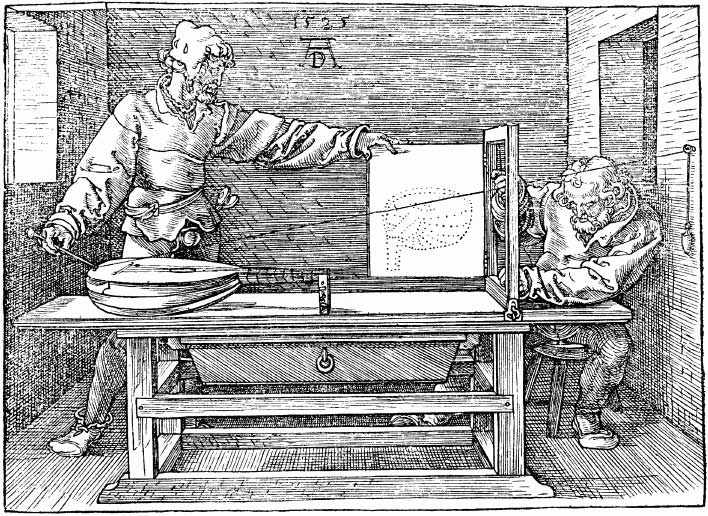
    duerer-perspective

    Truth thus became as one-pointed as perspective drawing, subject to the perfect and known limitations of a small set of rules; all deviations were to be ‘explained away’ by recourse to the completely non-personal operation of blind forces.  In art, ANYONE could presumably have the exact same visual experience as the next person if they stood in just the right spot at the right time; it took no special training or knowledge to interpret what was seen, because what was seen was reduced to its primal base: form and color in strict, law-abiding combinations.  Ironically, the point, a completely abstract dimensionless non-entity, set the tone for our experience of all the dimensions of available to our experience.

    Ultimately, however, this perspectival program was destined to destroy itself through its search for perfection.  In art, the quest to represent visual experience led beyond form and color to the wider and fuller experience of vision as a whole.  Many figures, from Goethe to Picasso, took part in a constructive dismantling of the dominant paradigm.  In science, this occurred through the discovery of relativity and quantum mechanics, and later chaos theory, which banished forever the naïve reliance upon the point-like structure of previous generations.