I’d like to offer something from the realm of projective geometry, with respect to infinity, that is (believe it or not) very practical. I have found that projective geometry offers something that is frankly unparalleled: a way to think towards infinity which is, at every step, clear and exact, brooks no nonsense, and is communicable and hygienic to boot. If you follow the exercise, I guarantee you will learn something about infinity. You will learn something of its signature, to use an esoteric term, and be able to recognize it when it shows up in other forms and within other processes. Also you can blow your friend’s minds at your next get-together if you lead them through this process, and spark some fascinating discussion that will leave everyone better than they were before.
In order to think towards infinity we have to change the habitual patterns of thinking that are called forth and repeatedly solidified through the way we usually make sense of our daily interactions with the world. We can, however, be led through a transparent process that requires no faith, no gaps or hidden elements, to push our mental conceptions to their limit, even to invert them. It is a process that requires participation and fails when we feel like we “have it” or have reached an answer. The change of perception only happens in the way the exercise functionally changes our ability to, if I may put it poetically, m/a/e/ssage our consciousness across the infinite boundary. It only works while we are doing it: once we only remember what we have experienced afterwards as a (fallen) fact, we have lost the essential nature stirred momentarily to life in our awakened thinking.
That’s just a little preparation. There are many ways to do this with projective geometry, but the simplest requires only three elements: two lines and a point.
Let us imagine: line (a) stretching, as it were, horizontally on the ground in front of you, spanning left and right into the distance.
Now remove everything but the line and enter the Platonic space of the form itself, with no other entities in this universe. Let this universe be uncurved across all scales (we could curve it later if we wish).
Now imagine point P not on line (a).
Draw a line (z) through P such that it intersects line (a) perpendicularly.
Note lines (a) and (z) now intersect in a new point, X.
This is the setup.
Now, rotate line (z) in a counterclockwise fashion around point P– not too fast, slowly at first, and note the change of position of X relative to P.
Continue the counterclockwise rotation of (z) around P, pinning the origin of your focus to P while following exactly what is happening to X.
Soon you will start to lose your sense of the exact position of X; you won’t be able to encompass it’s relative position to P in the same way that you could earlier, when it was “closer.” This is the beginning point of transforming your relationship with infinity in reality.
Continue the exercise, filling in with a more exact imagination the relationship of the geometric elements wherever your attention loses focus. Meditate it.
Now, rotate (z) until you reach the point of parallelality.
Notice. Notice your noticing and what has changed in it, when you reach this moment.
What has happened to X?
If you were to point to it, how exactly would you do so?
Please, do your best to not make any jumps; no leaps or gaps — if you find yourself making such shifts, do your best to fill in the process with clear, exact thinking. If you find your lines starting to make strange bends, whip them back into their perfectly unwavering straightness and try again.
Now let us reverse the process and rotate (z) clockwise around P until we feel we are back in a manageable situation that we can fully encompass with no loss of clarity at any point.
Rest in this more normal situation for a moment.
Now continue the clockwise rotation until we again approach “the problem” of parallelality.
Approach it with a fierce consciousness.
Euclid got here, but he failed to follow the inherent logic he himself had already set up. Perhaps his imagination was not sufficient to follow it through, completely, continuously, and coherently. Also, infinity is scary. In his frustration, Euclid had to add postulate #5 that forever haunted him: the parallel postulate, which he avoided for as long as he could, invoking it only when he had no other choice.
Notice newly: as (a) and (z) approach parallelality, X approaches infinity.
Can we do more than “approach”? Can we “arrive”? How?
Notice that as X gets farther and farther away from P we must slow down the rotation of (z) in order to continue following it with the same exactness we did when it was closer. As X goes on its infinite flight, every minor angle of rotation of (z) produces bigger and bigger effects, until …
Place your attention upon the situation where the angle between (a) and (z) is infinitesimally close to zero… the smallest possible further rotation will make them parallel.
What can you say about this situation?
Can you point to X?
Now let us allow ourselves a little leeway, and rotate (z) through the moment of parallelality so that now we are infinitesimally rotated past parallel, without requiring ourselves to account for the position of X exactly at every moment of this smallest–and yet biggest–of journeys.
Now point to X again.
Let us now hone in on the “problem” of parallelality by saturating our attention on the oscillation of (z) around the moment of parallelality with (a).
See X “jumping” from left to right and back again.
Really push for the smallest imaginable angle away from parallelality and oscillate your attention around it, making the change in angle between (a) and (z) shrink and shrink, all the while following X.
With this saturated consciousness, rest in the moment of parallelality.
Now point to X again.
In what direction are you required to point?
Let us say now that X is “at infinity.”
The finite position of X, made from the intersection of two non-parallel lines, is somehow now an infinite position, still made by the intersection of two lines: two parallel lines.
Lines (z) and (a) never stop meeting; they never cease having a relationship that forms a unique and singular point, even when parallel.
Two lines meet in a point; it’s as simple as that.
Notice now that point P can be anywhere.
Move point P away from line (a).
Does this change anything essential about the situation?
Where do you have to point to find X when (a) and (z) are parallel but farther apart?
What about if you move P infinitely far away from (a)? Does this change anything?
See that all lines that are parallel to each other share a single point at infinity.
Let this sink in.
And now let us speed up and go farther:
We could have placed our original line in any orientation. Let us place a new line (a’) orthogonally to (a) and repeat the experiment with parallel line (z’) meeting in X’.
See that when (a’) and (z’) are parallel, X’ is a different point at infinity than X. What is different is its direction.
Let us be clear: we are now speaking about the very nature of directionality; its source. Remember–no–see that the distance between (a) and (z) is irrelevant. Every line that is parallel to (a) meets at the single point X at infinity. We can “fill in” the plane entirely with lines parallel to (a): they all meet at X. We can even fill the volume of three dimensional space with more parallel lines, all of which still meet at a single point. The same continuation to higher flat dimensions holds (infinitely).
The point X, when it is at infinity, defines an infinite space of directionality. We can say that directionality is constituted solely and essentially by a single point at infinity that defines it–that direction.
But that direction, seen from “here,” from anywhere that is not at infinity, holds within itself a kind of strange duality. Normally when speaking of “a direction” we mean precisely the lack of every other direction. This only works when we ignore infinity. To include it requires that a single direction encompasses what is apparently its exact opposite: for any point X at infinity, it is simultaneously in two precisely opposing directions. Or perhaps it is better to say that every ‘single’ direction becomes its opposite through infinity. Another way to say this is that point X at infinity connects to itself through ‘finity’ via all possible lines parallel to and including (a). A given line “here” is nothing other than a unique token of the way directionality is made manifest from its single point at infinity. The single point at infinity X, unfolded into finity, is a line.
Place yourself now at point X at infinity. You’ll have to jump there, if you can.
Can you feel what it is like to inhabit this point?
Where, now, is the line for which you are the point at infinity?
Can you feel how there is an inversion that happens?
To ‘get’ to infinity we cannot simply move along the line… this would require infinite time to accomplish.
We have to flip over into infinity. Our consciousness cannot maintain coherence through this flip — it goes dark; there is a kind of threshold that prevents us from maintaining the same kind of wakefulness that lawfully got us to the moment of the flip. We have to abandon the very process that was the only reliable source of coherence in order to cross this threshold. But having trained ourselves via the process, we find that what meets us at the threshold is itself lawful, and that to pass through it our consciousness must perform a lawful act. This act is a kind of inversion; an insiding-out/outsiding-in, not just of consciousness but of space itself. It is making all the previous distinctions newly, but inversely. What was once approach is now recession. The center and the periphery have flipped into each other.
When looking “from here” we can count steps of a process, we can traverse more or we can traverse less, we have extension and duration and all that comes with relating those together with finite means.
When looking “from infinity” any step is a step “into” the non-infinite, an inversion into space and into process, into differentiable uniqueness. At infinity, uniqueness is, as it were, collapsed into itself; it is no longer expressed outwardly but only inwardly. All the potency spread out through space “here” is concretized inwardly at the infinite. From infinity the whole universe is found infinitely far within.
Pause for a moment.
Let us return and gain further contextualization.
And as we have seen, parallel lines (a’) and (z’) meet in a different point at infinity, X’, which then constitutes the way that all possible space is contextualized from that specific (dual) direction.
And see now that we must go further, and point out that X and X’ are two distinct points, which as we know, can be connected by a single line.
Where is this line (x), that connects the two points at infinity X and X’?
Can you point to another point on this line?
See that any direction in the plane shared by (a) and (a’) has its point at infinity that lies on this new line (x).
We must say that line (x) is a line at infinity, and that every point on this line is likewise at infinity.
Can you imagine walking along this line at infinity?
Can you feel something of the nature of this line at infinity, something of its character, its gesture?
Place yourself at point X at infinity, and now look at point X’ at infinity — what direction is it in?
If you wanted to reach it, how could you do so? What possible moves can you make and not fall back into non-infinite space?
There is only one possible move, and that is to move orthogonally to the direction of the line (a), whose point at infinity you are. But you will have to move infinitely far along the orthogonal direction.
See how infinity becomes contextualized by orthogonality in addition to directionality.
Like any line, between any two points lie an infinity of other points. Let us imagine one such point X” between X and X’. Notice that no matter how close you place this new point X” to X, the two points are infinitely far away from each other along line (x). Notice that from “here” we meet line (x) always orthogonally, no matter which direction in the plane we point.
Now we can see that just as the single point X at infinity concretizes itself across the infinite boundary as a line, so too the line (x) at infinity concretizes itself across the infinite boundary as a plane. A line at infinity is a plane “here.”
We see that there is a tendency to think of this line at infinity as a kind of circle. It is the only form that we can recognize as having similar properties. The line at infinity surrounds us; I can point in any direction in the plane and will meet the line at infinity orthogonally to my pointing. Despite this, the line is always and only ever straight. It does not curve, waver, or fold. It is exactly as much a line as any other, constituted precisely by the way all its points share directionality. But we see that this directionality at infinity is always orthogonal to all directions by which its points are reached from “here.” When we follow our pointing from “here” to X and then to X” we can measure some precise angle swept by our arms (for remember, we must point in two directions simultaneously). It would seem then that if we meet the line (x) at infinity along direction (a) orthogonally, then change the angle of our pointing, surely we must now meet (x) at some angle other than 90 degrees? Yet this is not the case; we always meet it, in every direction, orthogonally to our pointing, and the line never curves to accommodate our limited thinking. It remains straight, and infinitely so.
If you are on line (x) at infinity and wish to point in any direction other than along line (x), you must do so at 90 degrees to (x). All points not on line (x) are infinitely far away in the orthogonal direction, a direction shared across every point on line (x).
Yet your intuition that the line (x) at infinity is a circle is, in a way, quite correct. In fact, the line (x) at infinity is an infinite circle whose center is everywhere.
We cannot stop only at the line at infinity. Notice that there are infinitely many lines at infinity, each with their own unique directionality. Notice how any two lines that share a point define a plane. Notice how every line at infinity shares a single unique point with every other single line at infinity, and thus defines a single, unique plane at infinity? While it is possible “here” to have lines that are skew to each other and thus share no common point “here,” their respective points at infinity lie on a line at infinity, and this line is always a part of the same unique plane at infinity.
Let this sink in. Just as there exists a single line at infinity for a given plane, that in some sense surrounds the plane and enfolds it within itself, so too there exists a single plane at infinity for a given volume, which surrounds that volume and enfolds it within itself. The line at infinity is the boundary of the two-dimensional plane; the plane at infinity is the boundary of the volume of three-dimensional space.
From your position “here,” look in any direction. Follow this direction to infinity and you meet the unique, singular plane at infinity, and you meet it always and only orthogonally. Pascal gave no mere poetic turn of phrase when he said “Nature is an infinite sphere of which the center is everywhere and the circumference nowhere” — this is an exact imagination. Every place “here” is equidistant from the infinite plane at the periphery, and is thus equally the center as every other place “here.” The circumference of the infinite sphere is the plane at infinity, whose circumference is literally no-where; to be at infinity is to not have “a” place, to have no “here.” Infinity is an inversion of space, or perhaps its enfoldment within itself.
Euclid illuminated the basic logic of relations between point, line, and plane “here,” but he could not encompass infinity with the same logic. Yet it is by logic that we ourselves can go deeper than Euclid, to see precisely and exactly what is required of us if we are to penetrate to the inner nature of infinity. Along the way we find that we must speak of the reality of directionality, orthogonality, and inversion as essential inner aspects of infinity.
Follow the exact imaginative exercises presented here again and again until infinity saturates your consciousness; you will find that your phenomenological discoveries will forever recontextualize your relationship with what before was vague, confusing, and mysterious. The mystery, however, will only deepen.









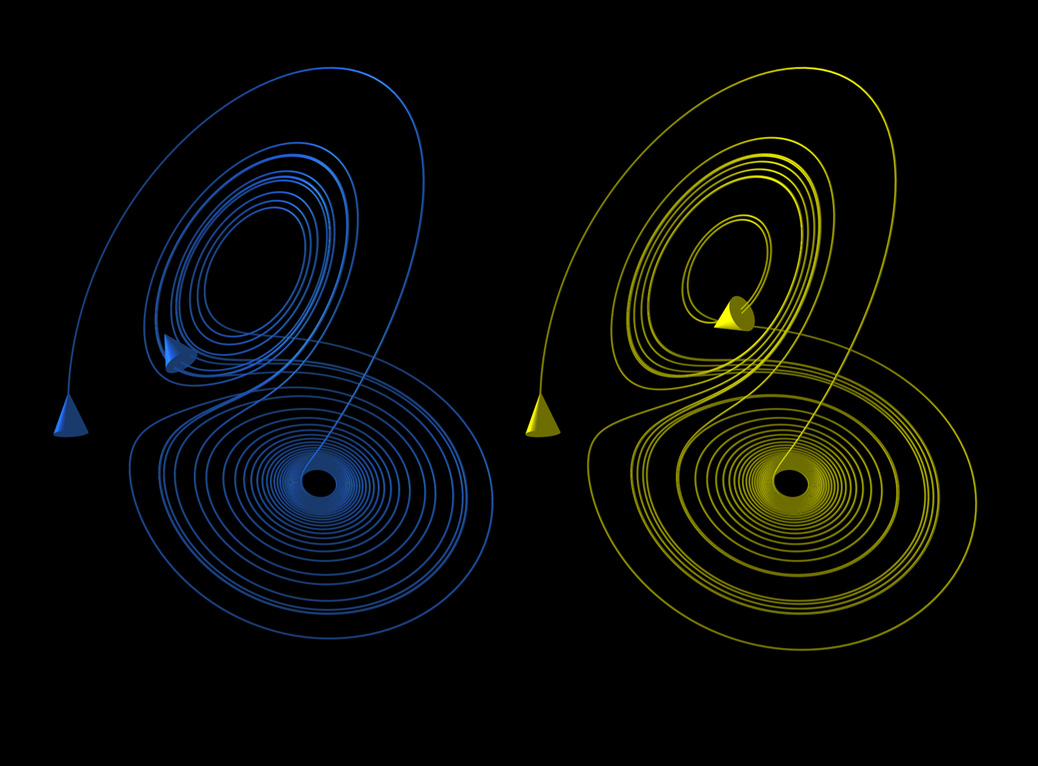
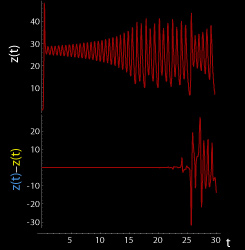
 So chaos THEORY is determinant in that the rules which it utilizes to describe evolving systems have the potential to be calculated EXACTLY from iteration to iteration. In other words, if we had a computer that could deal with an infinite number of digits we could theoretically pinpoint the next iteration describing the state of a system at the next moment with complete precision. BUT, there are serious caveats to this when applied to anything beyond the purely mathematical formulations themselves. REAL systems may be more or less calculable, more or less complex, and more or less willing to submit to the precision capable in theory. The determinacy of chaos theory is therefore more like a theoretical determinacy, having a dubious ontological status. I won’t get into the very crazy and amazing philosophical arguments that whirl around such things, to your immense relief. Suffice it to say that THE WORLD IS MYSTERIOUS, and we have to be careful when dealing with the connection between our thinking and our observing.