3. And so, there’s all this talk about ‘deterministic chaotic systems’… What exactly, is the stunning significance of this? I think I get that every shape in nature is ultimately created by patterns of itself within itself, but I’m confused as a biologist or physiologist or biochemist because things like continents are made of trillions of completely different molecules of matter. How does that relate to fractals?
The stunning significance of deterministic chaotic systems is that the Newtonian paradigm which equated determinism with complete predictability (ala Laplace) was shown to be WRONG. Chaos theory shows that we can have deterministic systems that are simply NOT PREDICATBLE. It is also stunning because the mathematics of fractals has helped us gain much deeper insights into some of the important vexing problems that stymied Newtonian-style thinkers (non-linear systems, fluid flow, etc.). It has fundamentally changed our view of the universe. It is often said that in the 20th century the most important epistemological advances were 1) Relativity 2) Quantum Mechanics, and 3) Chaos Theory, with 4) Goedel’s Theorem as another important, but less well-understood revolutionary idea.
Fractals are NOT only in the realm of geometrical structure; this is simply where we have the easiest access to their manifestation. Fractals can also describe the pattern of any iterated process. So you can have fractal family dynamics, in which large scale interactions are repeated on smaller scales, both in the sense of emotional scale and time scale and so forth.
Also, not EVERY shape in nature is fractal. There are plenty of non-fractal shapes, but it does appear that fractals are an intimate aspect of nature’s expression (and more accurately, evolution).
2. Does the fractal model also work for dynamic, fluid or changing shapes?
Yes, in fact this is it’s most ‘natural home’ I think. The reason is that fractals are about processes, not things, and processes are just that: descriptions of changes, not of things, and changes have a way of, well, being DIFFERENT the next time you look at them. So there are ‘orders’ or ‘levels’ of change, described by the number of levels of description required to get to the point where the pattern is invariant.
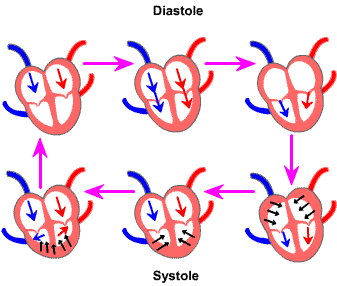
Your blood is constantly changing (systole, diastole), at this level of description there is no constant, because your blood pressure is constantly changing (lucky for us, or we’d be dead!). But at a higher level of description you get a pattern (high pressure, then lower pressure), that is invariant. You don’t get a systole and then another systole, or a succession of diastoles; they alternate. But this alternation is not constant either! The extent of the systole/diastole is ALSO constantly varying (also lucky for us, because this change, linked to what is known as ‘heart rate variability’, is strongly correlated with heart health), so it requires ANOTHER level of description to see how that is changing… and so on. At each level something ‘stays the same’ while other things ‘constantly change’. When we talk about change and constancy we have to be careful because we can never fully isolate one from the other; they are completely intertwined ‘all the way up and all the way down’.
The following four questions (one per post) were posed in a recent class. My edited responses follow.
1. So I understand that any shape in nature can be converted to a mathematical formula, right? Then you take that formula and plug in the variable related to that shape and feed the answer into the variable spot in the next equation, continuing that as many times as one wants (with potential infinite number of times). Here is where I get stuck. Does each answer produce a smaller version of the original shape or does the answer produce the snowflake-like shape of the whole, complex, product?
We do not know how to find mathematical functions for every shape in nature; indeed this is still an area of active research. Usually we can model (i.e. approximate) natural shapes with mathematical functions, but nature is a little more slippery and variable than the stark purity of mathematics proper, so we don’t get exact results. This isn’t usually a problem, however, because the whole point is that we can occasionally find mathematical functions that provide something of the… essence of the form.
For example your lungs are fractal in nature, branching and branching and branching… but they don’t do it in only one way. Rather, they have different ‘stages’ of branching, each with a different ‘fractal dimension’, depending on how many previous branches lie before it (I can explain what a fractal dimension is if you wish in another post). (Read a single page about this from the Cellular and Molecular Life Sciences journal – slightly technical but you can probably get the basic idea through a different lens, which is always useful: http://www.springerlink.com/content/q103206u70402617/)
But to answer the question directly re: “each answer…”, most fractals both occur and are described by the taking of a single set of relations (it may be a shape), and repeating that relation/shape on different scales, with rotations, translations (moving without rotating), etc. In other words, you start with a thing and then put it through some sort of process, then take the new whole that results and do the same process to it again, and so forth. What is interesting is that a pattern emerges out of the process… and the process is primary, NOT THE THING. In fact, you can take ANY shape, and subject it to a specific process over and over, and you will get the SAME fractal form, regardless of the original shape. So each iteration (“each answer”) is a further unfolding of the process, a more ‘detailed’ rendering of the pattern inherent in the unfolding of the process.
So it’s not just a question of “smaller versions” or of reproductions of the “whole”; the pattern that defines the particular fractal is really the expression of an infinite process (usually based on some pretty simple and limited rules, like “rotate 36 degrees counter-clockwise and scale by a factor of 1/2”), which can be “reversed” (rotate 36 degrees clockwise and scale by a factor of 2) – so size has nothing to do with it, and you can start anywhere in the process with whatever you have, because the thing isn’t ‘the thing’ if you know what I mean: ‘the thing’ is the process. This is very good for nature because nature can take whatever is there and do some pretty simple things and get some very complicated results. It doesn’t have to start with a ‘grand plan’ that requires everything to be exact and fit in just the right way in order for it to ‘work’, but can just take whatever is there and MESS AROUND. This isn’t the whole story but I’m just trying to relate this to fractals specifically.
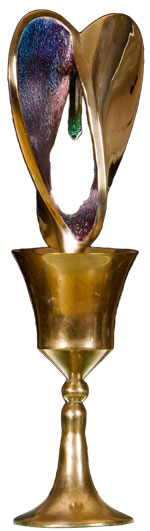
Frank Chester (find out about his initial work here, and read reviews of his work here) has just returned from a very well received presentation of his research on the Chestahedron at SunbridgeCollege in Spring Valley, New York. Many in the audience expressed disappointment afterwards that they had not notified their friends to attend these lectures because they did not realize that they would be witness to such an astonishing presentation.
Frank will be repeating these lectures this week in Fair Oaks at the Anthroposophia Conference as listed below. For those who wish to attend single lectures apart from the rest of the conference, the charge is $10 for students and $20 for adults
This is a good time to invite your friends and associates if they would like to hear about his discoveries, because Frank is planning on cutting back on his lecture schedule after this week so he can return to his research. You may download an attachment to this email, which provides some written information that may be helpful towards understanding what Frank’s work is about.
Frank will be presenting his work on the following dates:
Projective geometry offers a window into the human soul — not as a mere analogy, but directly: projective geometric processes are manifestations of the same archetypes that work through and within human experience.
Doing projective geometry is to move your soul in accordance with these archetypes, and in so doing you start to train your soul so that it can begin to perceive the movement of these archetypes both in your own soul and in the world-processes around you. In effect, projective geometry offers a path towards the development of organs of perception that operate not primarily in a physical way like your eyes or ears, but in a more subtle realm. The development of these soul-organs opens up new realms to your perception, just as if you were in a dark room and then someone turned on a light: now you can see depth, color, and form, where before these were literally non-existent for you.
In this spirit, I offer the following sequence of drawings that illustrate one process in projective geometry: that of Harmonic Points. I suggest, before looking further, that you examine and follow the constructions on your own in this post:
Once you have sufficient experience with the above, feel free to examine the following drawings. Note the context given in this post and the above linked post, and see if you can discern, as an exact soul-perception, the moving gesture that accompanies the sequence, paying special attention to the ‘unique’ moments of the transformation. Feel free to reply in comments to this post about your experience!
Note: the drawings have been placed on a separate page, so that they can be presented unencumbered by the limitations of the blog theme.
WARNING: PROJECTIVE GEOMETRY MAY PUT HOLES IN YOUR BRAIN. YOUR MIND MIGHT LEAK OUT – IF YOU WANT YOUR MIND IN YOUR BRAIN STOP READING NOW.
Okay, here is a geometric exercise that I find very interesting (for some context about WHY it is interesting, look here).
It is, however, more complicated than the previous one and will likely require you to actually take out a pencil (not a pen, please, and go for mechanical – 0.5mm lead… do it for me), a ruler, and unlined paper.
HARMONIC POINTS – Phase 1
The short setup first, then construction hints, then process, then comments:
I’d like to make a contribution with regards to circularity/linearity, from a geometrical standpoint. If you don’t like geometry, stop reading, or better yet, read with increased intensity.
The polarity between circle/line is one that is fundamental to many geometries – they are taken to be quite different logical entities. Primarily this arises because of (in a move parallel to Russel’s need to introduce the Theory of Types to avoid paradox) a limited way of dealing with infinity. Cybernetics shows us, by providing a wider view (attention to relations, recursions, and thus relations of relations, etc.) that the Theory of Types is unnecessary and points towards a more flexible and mysterious understanding of paradox. In the same way, projective geometry provides a way of dealing with infinity that encompasses, expands, and re-frames the conventional geometric view. (more…)