Month: August 2011

  • An Esoteric Guide to Spencer Brown’s Laws of Form #4

    An Esoteric Guide to Spencer Brown’s Laws of Form #4

    (New readers will want to start with the first installment.)

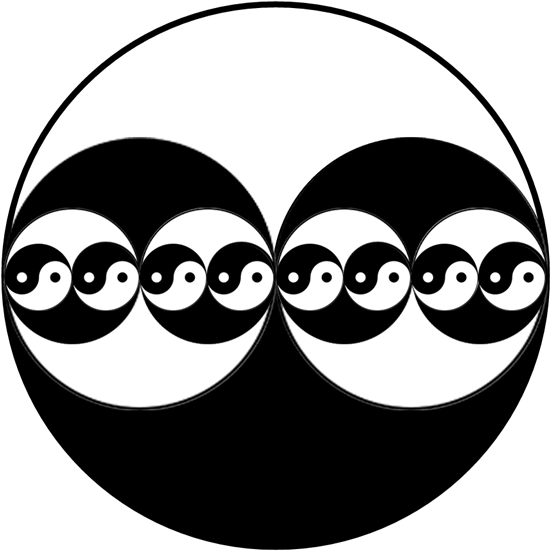
    We ended the last installment having come to realize something of the esoteric significance of the taijitu, or yin-yang, form, in something of an extended tangent. We return now to the text.

    GSB himself seemed to understand the importance of the Laws of Form, even if there were some of these more subtle specifics which were not apparent to him (or at least which he did not explicitly recognize).  Having reached this point (literally we are still on page 1 of LoF), the vast majority of the rest of the work in LoF is seen to be secondary.  Yet there are many valuable indications which deserve connection to esoteric principles, and the point of this exploration is to show that such connections are not arbitrary. So, to return to the actual content of LoF now, after this long but foundational detour, we can note that he says:

    LoF p. 5

    • Let any token [of the mark] be intended as an instruction to cross the boundary of the first distinction.

    That is, every mark is an invitation to cross it; every distinction is a call to make that distinction, not to simply point it out, but also to DO it, to MAKE the distinction.  In other words, the whole thing is ACTIVE, not passive, it is not descriptive but PRESCRIPTIVE.  Of course, the esoteric significance of this should be obvious, because precisely what distinguishes esoteric work from, say, philosophy or other disciplines, is (more…)
  • Identity

    Identity

    Identity

    Metaphor:

    The unknown attempts to know itself.

    It marks itself.

    Space arises in no space.

    Identity marks itself in time.

    Time transforms identity.

    Identity dissolves in time.

    Space yields no space.

    The mark unmarks itself.

    The known is newly unknown.

    Time for a new metaphor.

    [cincopa AsEAgnu2BUyh]
  • An Esoteric Guide to Spencer Brown’s Laws of Form #3

    An Esoteric Guide to Spencer Brown’s Laws of Form #3

    (New readers will want to start with the first installment.)

    We ended the last installment noting that the first distinction must be of distinction, but this must be considered as a complex, recursive creation and simultaneous crossing of a boundary that is just precisely the boundary between that very activity of its creation and the fact of it as created.

    To get at this another way, we can point out that the Glanville has actually hit on elements in this direction already, but (it seems) hasn’t quite put it together in the same way.  Remember that the whole time we have been talking about the first distinction we are also talking about “the observer”, which we could call a “self”.  It may even be worth revisiting some of the above text with that implicit translation in mind.  I remind you of this because, Glanville, in his essay The Self and the Other: The Purpose of Distinction, is exploring solutions to the problem of infinite regression that arise when the mark doesn’t distinguish itself from its value, and he uses “self” and “other” to hold the logic of “mark” and “value”, which is perfectly fine.

    Glanville notes that we have a set of relations that are implicit in each other: that between self and other: “the fundamental distinction between self and other [read: between the mark and its value] cannot be more fundamental than the distinction of the self, nor can it be less so: another circularity, another reduction of hierarchy” (p. 3).

    Except that this isn’t a reduction of hierarchy. It is actually (more…)

  • An Esoteric Guide to Spencer Brown’s Laws of Form #2

    An Esoteric Guide to Spencer Brown’s Laws of Form #2

    (New readers will want to start with the first installment.)

    Let us continue our beginning:

    LoF p. 1

    • We take as given the idea of distinction and the idea of indication, and that we cannot make an indication without drawing a distinction. We take, therefore, the form of distinction for the form.

    If this doesn’t strike you as having a “mystical” flavor, then you are drinking the wrong concoction.  I’m not going to try to explain this, but rather I’m going to try to re-frame it; you could say, in GSB-approved language, that I’m going to re-mark it.  The important thing to note about this, the very first “official” sentence of the LoF, is that it is recursive.  Let’s be clear: the Laws of Form (not the book, the LAWS) are only possible because of a recursion, a throwing back on itself of itself.  But a throwing back of what onto itself?

    Well, “nothing”, of course; but nothing understood as what everything would be if it were.

    But of course nothing doesn’t remain nothing (well, it does, but it doesn’t), because here we are.  The question GSB is really attempting to get at is the question: (more…)

  • An Esoteric Guide to Spencer Brown’s Laws of Form #1

    An Esoteric Guide to Spencer Brown’s Laws of Form #1

    (A full PDF of this article can be had here.)

    George Spencer Brown (in his spirit, I would like to say: “Let George Spencer Brown = GSB”), a logician, engineer, and teacher, wrote a curious little book called Laws of Form, that inspired countless interesting people of widely varying backgrounds.  The book is not a book of mathematics, nor is it a book of logic, although if you were to read it this is likely what you’d say.  It is, rather, an attempt to enact something prior to both.  Indeed, GSB feels that his work actually forms (meaning both “is” and “shapes”) “the basic forms [same double-meaning] underlying linguistic, mathematical, physical, and biological science” (p. v of the 1972 edition).

    If you haven’t read Laws of Form (LoF), I quite recommend it, and it is actually quite short.  Even if you don’t want to follow along with the meaty theorems and proofs, the prose and context is definitely worth chewing on.  What is fascinating to me is that the work can also be read with an esoteric eye, which is to say, with a sensitivity to the form and nature of spiritual experiences.  This is not at all a departure from what GSB intended: in his other works he quite openly discusses this connection (see Only Two Can Play This Game published under his pen name, James Keys).  Even in LoF he prefaces the preface with this quote from Blake:

    “Tho’ obscur’d, this is the form of the Angelic land.”

    So what I would like to do is to show that within the LoF are a number of coherent relations to principles that are rightly considered esoteric: they are (more…)