Month: February 2009

  • Social Networking and Consciousness

    I would like to say that the quite frankly astonishing rise of social-networking tools clearly points to an unmet need in the ‘wired’ populace at large.  We increasingly live in a fragmented society, where our friends and family are scattered across the globe.  Many of use no longer, for economic, personal, or many other reasons, choose to live in the same place for our entire lives, where we could build up a local network of family and friends.  And even if we do so, the demands of modern life and our cultural habits tend to erode (it seems) many opportunities for face-to-face gatherings over a long time period; such things now require real effort and are not a de facto part of everyday life.

    So it seems that a way of assuaging the erosion of the human need for contact, and just as importantly, a context within which such contact can be meaningful, can be found through the social networking tools.  These tools are not designed, and cannot really take the place of repeated face-to-face interactions, but what they DO provide is a way to ‘keep the door open’ to people who you might otherwise lose track of or only communicate with very rarely.  By having, for example, a Facebook page, you put yourself in a position of taking moments out of your day to have a conscious connection with people who would otherwise likely not enter your thoughts that day.  The immediacy and digital ‘nearness’ provided by the technologies allows for and creates a different kind of interaction than has heretofore been possible on the planet.  On the one hand, these technologies constrict certain kinds of communication; but it opens up others at the same time, and allows a thread of connection that can later be followed up by a more present, face-to-face, or otherwise soul-ful type of communication.

    This is something of the positive side of these tools, but they can also be used for pure ego-stroking, for bullying, for economic reductionism, etc.  Such is the way of any tool.  For me it’s always a question of how the tool is used, and I am convinced that humans have the power to make tools like this (and other technologies) work in a positive way for the benefit of themselves and the planet.

    It’s true: there is no substitute for real face-time.  I would simply point out that Facebook and such tools are NOT actually substituting for face-time.  In fact, the reverse might be true: the immediacy and ubiquity of social networking tools may actually increase the potential for two or more people to get together IRL (in real life)–there must be a study on this somewhere… if not, any takers?

    My feeling is that the use of such tools lessens both perceived and actual gaps between individuals, while also allowing individuals to discover more potential relationships that might otherwise be missed.  Increasingly human beings are going to have to learn how to deal with the instant availability of essentially infinite data.  In the pre-wired-era, the available data was restricted to your immediate sensory neighborhood, and you had no choice about this, notwithstanding the influence of books and letters.  Now, we have a choice, and can access a whole variety of types and fields of information literally out of thin air.  It opens up a whole different set of possibilities for human creativity and interaction….

    But obviously I’m not yet giving a well-rounded picture.  I should also point out that the way that these technologies lead human consciousness around may be problematic in a number of ways, and the identification and harmonizing of these regressive or sclerotic tendencies should be addressed up front.  But to speak of these would require an even longer discussion — one including talk about the inner life of the soul.

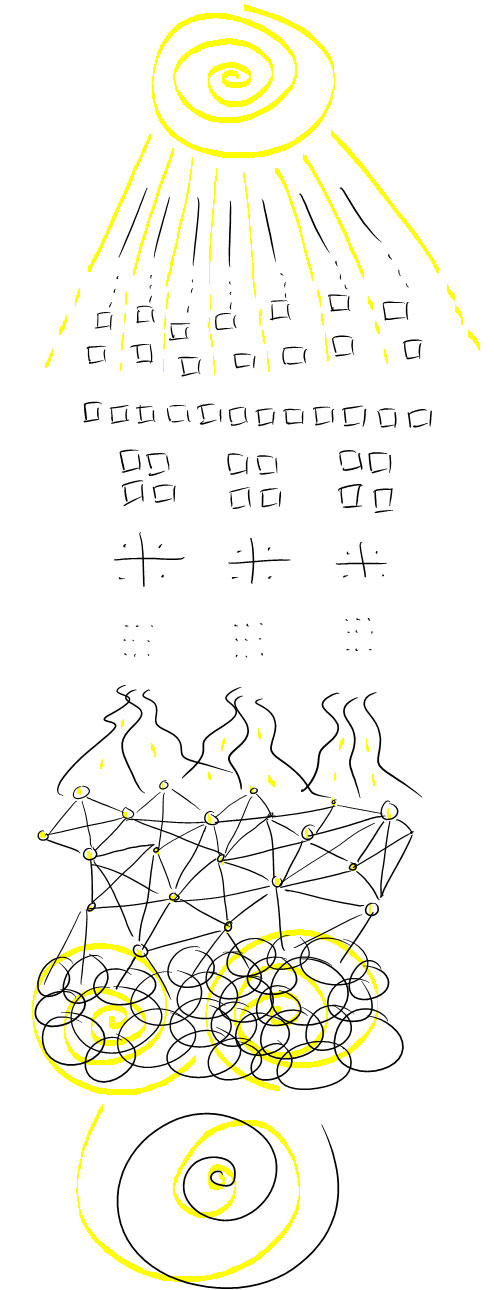
    Below:  a diagram depicting connections between a single user’s Facebook friends.

    my facebook friends

  • On one root of the name Seth

    It seems that Set was at one time regarded as the “chief god”, carrying the epithet, “His Majesty”, shared otherwise only with Ra.  He was a son of the earth (Geb) and sky (Nut), husband to the fertile land around the Nile (Nebt-het/Nephthys), and brother to death (Usir/Osiris), and (Aset/Isis, the wife of Osiris) and father of Anubis. Set was regarded as a fierce warrior. It was he who protected Ra on the solar barque, slaying the chaos serpent, Apep each day to allow the sun to rise.

    Apep was the chief opponent of Light and Truth (Ra), an embodiment of Darkness and Chaos, known as the greatest enemy of Ra.  So on the one hand Set was the being who was able to rhythmically defend the Light/Truth from the Darkness/Chaos of the underworld…

    …but then later (in conflict with Horus) Set actually became conflated with Apep himself, becoming the embodiment of the very evil he once defended against!  Apep was a huge serpent that lurked beneath the horizon, waiting to eat the Sun… and as the ‘World-encircler’ finds symbolic similarity in the Ouroboros…

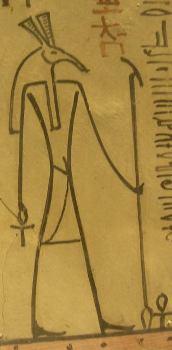
    egyptmythologysetHe is depicted as “a mysterious and unknown creature, referred to by Egyptologists as the Set animal or Typhonic beast, with a curved snout, square ears, forked tail, and canine body, or sometimes as a human with only the head of the Set animal. It has no complete resemblance to any known creature.”

    His upward-pointing square ears are like antennae, receiving the wisdom of the upper world, while his snout points downwards, to the mysteries of the underworld. (This may also find resonance through his role in the drama between Upper and Lower Egypt and their eventual uniting.)  Set stands between the worlds.  He sailed through the underworld at the prow of Ra’s boat, with Thoth on one side and Ma’at on the other – one male, the other female, both representing the Logos.

    Perhaps Set, then, truly is a proper manifestation of Chaos, thought about now in the modern sense as that which arises at the boundary between order and disorder.  Perhaps this makes Set one of the oldest alchemists, traveling the space between the most supreme heights as the chief god to the lowest depths, and the lowest depths as the destructive and evil force of the underworld.  Even more interestingly, once Set’s vilification had occurred, his images on various temples were replaced with that of Thoth – thought by hermeticists to be the first true alchemist, giver of the Corpus Hermeticum (via his syncretic link to Hermes Tresmegistus – ‘Thrice-Great-Hermes’).

    Wow!

  • seeing upside down (with bonus experiment!)

    Did you know that your eye is related to the pinhole camera?

    Light enters through the pupil of the eye, and a tiny image of the outside world fans out across the back of the eye, on the retina.  If you have an extremely dark room that has a window to the outside world, try this:

    Get some pieces of thick card-stock paper, or even a piece of cardboard, that covers your window entirely.  Make sure that your room is as dark as possible and that no light enters (this is much more difficult to achieve than you may think, but perfection is not required).  Poke a small hole, about 3 millimeters in diameter, in the paper, so that light from outside your room can enter through the hole (this works best during bright daylight conditions outside).  Now get a white towel or sheet, or even a white piece of paper, and hold it right on the hole. Now slowly move the piece of paper/sheet/whatever back from the hole… and be AMAZED!  No really, you will be amazed, trust me!

    For the truly inquisitive (that should be all of you reading this), try different sized holes, as well as holes of different shape, and see what effects this has on the resulting experience.  Also pay close attention to what happens as you move your ‘screen’ closer or farther away from the hole.  Now, for even MORE ridiculous fun, have someone go outside and move around in front of the window as you watch the screen on the inside…

    But this was all just a little experimental tangent to my real topic, which is that, just as in the above pin-hole camera exercise, the image which falls upon your retina is inverted.  Why, then do we experience the world ‘right side up’?


    A ridiculously simplified picture of the inversion of images on the retina.
    A ridiculously simplified picture of the inversion of images on the retina.

    Our brains – and this is a mysterious process – re-inverts the image so that our experience of the retinal impulses fits with information we get from other senses.  Equally fascinating, the process which the brain accomplishes is not restricted to any particular given orientation of the incoming retinal stimulus.  What I mean is that the image of the world can be presented onto the retina with any arbitrary rotation, and given sufficient time, the brain will compensate in such a way as to perfectly cancel out the rotation so that we again experience the world ‘right side up’.

    Even more interestingly (I know, can you stand it?) it isn’t just with orientation that this occurs.  Check out this quote from a 1967 paper by J.J. Gibson:

    “The altered ‘form’ of the sample-field produced by spectacles can be of many sorts: Stratton’s inversion, or Erisman’s reversal, or Kohler’s reversal, or tilt, or displacement (with wedge-prisms), and curvature, and compression, or ordinary telescopic magnification or minification, or single-meridian magnification or minification (Ogle), or for that manner, a non-geometrical bias of the sample-field such as the chromatic aberrations or color. The ‘invariance theory’ should still apply. We ordinarily don’t notice the forms of the visual field anyway, except in pictures: what we detect are invariants.”

    Such phenomena are well known in the realm of optics (the first such experiments being performed by Stratton in 1896, and later by Ivo Kohler in the 1950’s) where research subjects (probably volunteer grad students) wore a prism that inverted the retinal image all day long for a period of at a few weeks.  For many subjects, it took approximately a week or so for the image to switch.

    Once they adapted the research subjects then experienced the world ‘normally’ with no strangeness – their brain simply found it more economical to re-integrate the incoming stimulus in a way that allowed it to mesh with other sensory stimuli; the system tended towards a relatively stable attractor.

    Of course, when the subjects took the glasses off, the world re-inverted, and they experienced the world upside down, just like they did when the glasses first were put on, but the re-adaptation took much less time, and subjects could even become ‘practiced’ at switching between wearing the prism glasses and having them off.

    Do you not find such a phenomenon both compelling and mysterious?  Do you not sit in awe at the complex workings going on behind your eyes all the time?

    Our sense of touch and proprioception play a large role here, but also hearing and other senses which include directionality in relation to our 3D physical space.  Even more important, however, is the ability for the subject to actively move through space with the altered perception.  If the subject is restricted from moving (some subjects were literally strapped into a wheelchair), no visual adaptation occurs, and the world continues to be experienced in an inverted fashion.

    A lesson to be learned from this is that we are complex beings, WHOLE beings, in whom stream diverse sensory flows, which, like rivers in confluence, turbulently spin off vortices in a chaotic and ordered dance of becoming.  Our senses, rather than objectively reporting pure sensory ‘data’ to a central computer, are continually involved in, reshaped by, and reciprocally influenced by the dynamic, pulsing whole that lies beheath and within conscious experience.  This includes our emotions, our thoughts, our desires, as well as our other senses, our metabolism, our memory, and our will, to name just a few.

    No sense is isolated from any other.  Channels overlap.  Information bleeds.  The source is also the receiver.  The created is also the creator.

    Mmmmmmmm. chewy!


  • how do you know what knowledge is?

    It’s quite a dilemma – not being able to directly check much of what we are exposed to and presented as ‘knowledge’.  Unless we begin to discover our own ways of knowing (a very difficult proposition, but I think possible), then we likely remain wanderers in the fog of our own (and other’s) unconsciousness.  

    Of course, at least in any near future, it doesn’t seem like subconscious situational effects can be avoided – nor do I think they should be.  Much of what we enjoy as part of our everyday capacities for thinking, feeling, and willing are rooted deeply and complexly in unconscious processes.  Indeed, what is normally conscious for us is perhaps one of the tiniest slices out of what can be potentially conscious, and perhaps the potentially conscious is just the tiniest slice out of the full depth and breadth of the universe as a whole – or not (because, in accord with what I just said, this is an impossible determination, requiring consciousness to take place).  

    In any case, pretty much EVERY modern study that follows the basic scientific practices is a study in obfuscation, requiring for its potential success a decided ignorance of as many ‘attenuating’, ‘circumstantial’, ‘probabilistic’, or ‘random’ factors as possible.  The more willfully ignorant a study becomes, the more exact are its pronouncements, and the more its knowledge is sequestered from the whole.  This is why all studies require additional work to be re-connected to the complex actualities of the world, necessitating interpretation, reframing, and recontextualization.   

    This suggests a different way of performing ‘studies’, discovered long ago by Goethe and others, in which the situatedness, the contingency, the circumstantial, are all necessarily included aspects of any attempt to work with and understand a phenomenon. 

    plants-11


  • distinguishing between the ego and “I”


    Our experience of ourselves is in many ways completely mediated by aspects which are located beyond the normal boundary of the “I”.  I’d like to offer one possible way of looking at the issue.  

    I approach this question concerning the boudaries of the “I” by taking into account the transformations of the “I” as it works through and within the physical body and the soul body on its path from death to life to death to life.  To do so requires distinction between the ideas we have about our “I” and our unmediated, direct experience of our “I”, and more importantly between our “I” and what we can call our ego, on the basis of the usage of this term in the Western traditions (particularly psychology, which deals almost exclusively with the ego).  

    When incarnating, the human “I” experiences a period of darkness, which only gradually lifts throughout life, until (perhaps around the age of 21 or so) the first glimmerings of what I am referring to as the “I” become available to the experience of the ego, which is a structure that is present much earlier on, and is built up through a variety of relations between the burgeoning activities of the physical/soul bodies and the ‘outer’ worlds.  

    The incarnation of the “I” takes place not at birth, but much later, and sometimes not at all; this despite the fact that we each have the constructed ego that is constantly built up as a semi-permanent dialog between the inner activities of the body/soul and the various bodily and ensouled elements of our environment.  This ego includes the remnants of the activity which is rightfully regarded as the spiritual activity of the “I” – thinking.  Thus the ego becomes filled with thoughts but lacks the awareness of whence these thoughts originate.  In the meantime (in accord with all the social, cultural, historical, familial, etc. ‘forces’ at work around all the activities of the aspects of the human being which are not the “I”) the ego maintains the false impression that it is the one doing the thinking.  

    This then leads us to the question about how we draw the boundary around what we consider to be our “I”, which turns out more often than not to be a question to the ego about the ego.  There are no boundaries to the “I” in the normal sense, the “I” is a spiritual activity, a process.  It is a wonderful aspect of the spiritual world that “I’s” are capable of penetrating and moving with each other; their activities can merge, coincide, and diverge.  The idea of boundaries of the “I” only arises when we take our experience of the rules at work in the realm of physical bodies and our sense life and apply them to an arena in which no physical bodies or physical sense organs exist.  In other words, it is like asking about the flavor of a trapezoid.  

    We can have ideas, thoughts about the boundaries of our ego, but the activity upon which such ideas are based rests only in the “I”.  We can have the thought “My physical body only works because it includes trillions of bacteria and other organisms which I do not directly experience, but which science tells me are required for my process of digestion; if these microorganisms did not permeate my gut, I would be incapable of digesting my food.”  This leads us to the thought that perhaps I’d better take a look at what I consider to be my ‘self’ – shouldn’t it include all the aspects necessary to maintain the activities of my physical body, which support then my capacity to think and experience?  

    We can thus, in our thought-life (not our thinking-life) come to the idea that the normal drawing of the boundary between ‘self’ and ‘other’ is in some ways quite spurious.  There is then an attempt to fill the gap thus created (in thought) with other thoughts, which try to reorganize the connections made in thinking.  So we say things, perhaps, like “Well, yes, ‘I’ really must include the bacteria in my gut” and so forth.  

    But all the while we are missing the very activity that is the source of all of these reconfigurations of our thought-life; our thinking.  It is when we turn our attention to the thinking process itself that we start to come directly into contact with the “I” itself.  This experience, the recognition of the “I” by the “I”, is not a thought, but is what can occur when thinking takes itself as its own object.  In such a case, a completely different set of experiences become possible with respect to the question of the ‘boundaries’ of the self. 


    Moreover, what our ego keeps hidden from consciousness directly affects our perceptions and assumptions.  It seems that the ego, in a sense, precisely constitutes its boundaries by this very omission.  What I feel coming from my ego changes dramatically from situation to situation, not on the basis of what is included so much as on the basis of what is left out, and what’s more, on how it is left out.  

    The ‘mood’ around the process of the ego’s self-entrainment says more about my deeper nature than its explicit self-identifications ever could. 


    Cannon Beach Jan 2008-12

  • Quantum Sheep

    Concerning how quantum mechanics is being explored artistically:  (Quantum of Culture at Physics World)

    Consider Quantum Sheep, the brainchild of Valerie Laws, a writer who lives in the north of England. In 2002 she spray-painted words onto the fleeces of sheep from a nearby farm. As the flock milled about, the words rearranged and a new “poem” was created every time the sheep came to rest. A spokesperson for Northern Arts, which provided £2000 of funding for the project, said that the result was “an exciting fusion of poetry and quantum physics”. Here is one of the resulting “Haik-Ewes”:

    Clouds graze the sky
    Below, sheep drift gentle
    Over fields, soft mirrors
    Warm white snow

    Talking to the BBC at the time, Laws explained why she felt the project was worth pursuing. “Randomness and uncertainty is at the centre of how the universe is put together, and is quite difficult for us as humans who rely on order,” she said. “So I decided to explore randomness and some of the principles of quantum mechanics, through poetry, using the medium of sheep.”


    Random Poetry
    Random Poetry