Month: February 2009

  • Alchemy and narcissistic, reproductive, and creative learning

    Alfonso Montuori, one of my professors at CIIS, has identified three styles, or modes, of learning, which he calls the narcissistic, the reproductive, and the creative.

    From his article, The Quest for a New Education, From Oppositional Identities to Creative Inquiry, narcissistic learning is “an approach to education that sees the source of knowledge as inside the knower.  It focuses on the expression of the knower’s experience and interiority and his or her personal growth and transformation.” (Montuori, Quest: p5)

    Reproductive learning, by contrast, is “an approach to education that sees the source of knowledge as almost exclusively outside the knower, and focuses on the accurate reproduction of that knowledge by the knower.” (Montuori, Quest: p5)

    Creative learning is a middle path, “an approach that views inquiry as a creative process.” (Montuori, Quest: p5)

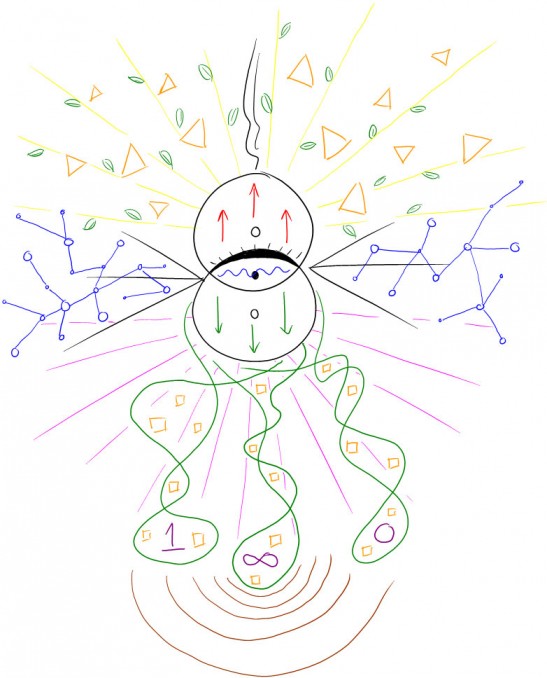
    I see a correspondence with Montuori’s categories and those of the alchemical tradition and the anthroposophical tradition.  Alchemically, what Montuori describes as reproductive, creative, and narcissistic learnings are embodied in the principles of Salt, Mercury, and Sulfur.  The Salt principle is one which is observable when you have a solution out of which a precipitate falls.  The process is ruled by Gravity and tends to result in innumerable discrete bits with a greater density than the original solution.  The precipitate literally ‘falls out’ of the continuously interconnected fluid mass to become something distinct, something identifiable and separate.  Alchemically, the Salt process produces forms which have Earth characteristics.  This describes the process of reproductive learning as an exact analogue: more of the same.  Specific bits of information carry the value in reproductive learning, to the detriment of the interconnectedness of the facts when they were ‘in solution’.  It is a strange irony that reproductive learning has most strongly co-opted the very metaphor that exemplifies the state of being inextricably contextually connected and turned it into its rally cry: “Solve!”  The word ‘solve’ actually means to loosen, but the Salt process of reproductive learning inverts the dynamic into one that requires a singular, discrete, and correct answer to the undifferentiated mass of the original ‘solution’ out of which a ‘solution’ is derived!  The Salt process densifies, separates, and agglomerates into ‘false’ wholes by virtue of external pressures while lacking inner coherence or connectivity.

    Taken to the other extreme, we end up in narcissistic learning, exemplified by the process known alchemically as Sulfur.  Here, learning ignites itself from within, taking its own substance as fuel.  Sulfur is ruled by the higher-order process of Levity, and is precisely what counteracts (in a polar-opposite way) the Gravity of the Salt process.  The Sulfur process tends towards the periphery, taking the facts in only inasmuch as they can be added fuel to the fire; i.e. Sulfur as a process is completely self-involved.  The particularity, the individuality, the singularity of the specific facts are burnt away exactly to the extent that they carry within them what relates to the particular mode of manifestation of the Sulfur process.  Everything else gets left behind as a char, an ash, devoid of (apparent) life (in fact, you may notice, the Salt and Sulfur processes always occur together in reciprocity, complementarity, or opposition).  Sulfur, like narcissistic learning, takes only itself as its object and contextualizes everything else around its own process.

    Creative inquiry embodies the Mercuric process.  Mercury is the process that links the Salt and Sulfur – it is the process that performs the alchemical ‘marriage’ between the Salt and the Sulfur.  The goal “to make the academic transformative and to ground the transformative in the academic” (Montuori, Quest: p5) is a way of saying that the transformative (Sulfuric) needs to ‘marry’ the academic (Salt) in order for a healthy learning to occur.  Montuori recognizes explicitly that the path of creative inquiry is one that exemplifies “a middle way, a spectrum of possibilities between extremes” (Montuori, Quest: p5).  The Mercuric process is the go-between, the walker of boundaries, the oscillator, the Messenger, the one who takes on the characteristics of the other while leading the other beyond itself.  It embodies aspects of both the Salt and Sulfur processes, by integrating them into a new form – a creative act – that is impossible without either the Salt or Sulfur.  Mercury’s/Herme’s caduceus, with its two entwined snakes, can be considered the alchemical Mercuric ideal of continuous interplay and harmonizing between the Salt and Sulfur processes, acted out in the being himself and carried as his most prominent symbol.

    Anthroposophically speaking, the Salt process is linked to a being known as Ahriman (a name taken from ancient Persia) while the Sulfur process is linked to a being known as Lucifer (whom I imagine you are all familiar with in some form).  The Mercury process – the middle way – is linked to the Christ being.  However, I won’t go into the details as this post has probably already put some people to sleep (another dual Salt/Sulfur process: part of you becomes a precipitate – your physical and life bodies – while another part of you expands to the periphery – your astral body and “I”; and in your dreams you embody Mercury…)

    Tulip-5


  • on why you will have trouble predicting what I say in this post

    One of the things about complexity/chaos theory is that prediction submits to very specific limits, in the sense that with anything but a VERY simple system, we must give up the potential for long-term predictive certainty.  This is because very small differences can lead towards extremely large differences later down the line, and we simply can’t account for the effects of these very small differences.

    The problem is that one never knows whether a small difference will actually make a difference or not.  And in any case, with any non-trivial system, the small differences are all complexly interrelated to larger scale changes, with much cross-feedback. 

    So SOME kinds of predictions are possible — it’s the RANGE that’s a problem.  For example, we can predict with high certainty that certain climatic patterns will continue far into the future — but we can’t predict with any accuracy on any given future date whether it will be cloudy and raining or sunny, because those detailed specifics are precisely what are affected the most by the tiny shifts in today’s weather.

    Then there is a completely separate but equally problematic blow to our predictive abilities.  If the only problem was the butterfly effect, we might be able to make a computer powerful enough to predict far-future events with accuracy, because it could take everything into account — after all, the universe follows its own laws, right?  We just tell the computer what those laws are, the initial conditions, and give it enough time to calculate and we should have an accurate and complete answer, right?

    Nope.  The problem is two-fold.  On the one hand, we simply don’t know how to account for (measure) all the very small initial states that would be required for such a computer to have sufficient information to do its job.  It’s simply too huge of a task in a practical sense.  You would, for example, need to know (in the case of weather, a good chaotic system) the pressure and temperature of the air… but for WHAT air?  Can you generalize and only look at average values for large volumes of air, say, those the size of a city?  Or do you need accuracy to within a cubic meter of air, so you can have distinct values for every cubic meter of air on the planet?  You see the practical problems associated with this.  Other complex systems, such as the body, behave in the same way — measuring hormone levels in the blood, the distance between dendrites and axons, the thickness of their myelination, etc. etc. — there is no practical way to get the information needed.

    BUT WAIT, IT GETS WORSE!
    Unfortunately for our predictive abilities, it isn’t even just a question of the practical difficulties in obtaining such information, but rather that such information is IN PRINCIPLE, not gettable.  This is because, as the quantum mechanics shows, we cannot help but disturb a system when we measure it, and that disturbance always introduces an uncertainty with respect to some other aspect of the system that we can never – IN PRINCIPLE – simultaneously account for so as to know the COMPLETE state of the system at any given instant.  We have to do all our predictive work on the basis of PROBABILITIES, not certainties – at least when we are talking about the quantum level.

    But here’s the rub: NOBODY knows when it might be okay to ignore quantum effects and stick with much more manageable ‘classical’ (and predictable) rules.  It’s a real philosophical and practical problem, because we see more and more that the quantum world and the world of macro-scale qualities are not separate.  Of course, it would be quite bizarre if quantum-scale effects simply occurred over a very well-defined set of limits, beyond which different rules took over that needed no reference to the quantum rules.   Of course, this is precisely how most scientists actually do their work — they either work in particle physics or other fields that look at very small scales, in which case they use the rules that describe the quantum realm, or they work in engineering or biology and only worry about quantum effects when they have to, otherwise they use classical rules as much as possible.

    Chaos theory itself is fractal – it’s laws span all scales.  We cannot ignore the potential and actual effects that cross over from one scale to another, decreasing our certainty at each level.  The change on one level of a phenomenon may very well cause a change on a completely different level — but in predicting that change to arbitrary accuracy we run into practical as well as principled issues which we cannot overcome.  Thus, the built-in indeterminacy at the quantum level can, through the scalar linking effects described by chaos theory,  can link single, quantum-scale processes to shifts at the macro scale.

    We can always make predictions, and for many situations and circumstances, the above problems are ignorable.  But for other situations–those near criticality, for example–the full effects of both quantum indeterminacy and chaos theory may make all the difference.

    pıctosophızıng ƒar ƒrom the chaoıds . .

  • on destruction

    The role of destruction, and of the working out of polarities, is a subject that has been dealt with an the alchemical tradition for a very long time.  Alchemically, it is understood that the issue you are dealing with, in which you find yourself (the prima materia) MUST go through a process of putrefaction, of fermentation… the individual elements cannot by themselves produce a work of lasting value (a Great Work), but must be destroyed in order to be refined.  The refined elements then have the capacity to ‘marry’ the other elements to form a higher, more integrated, more complex and simple unity which ennobles and embodies the transformation of the worst parts of ‘the matter’.

    All diagnoses are misdiagnoses because they stay at the level of the overt fact, and do not take into account the necessary inclusion of relationship, reversal, and the whole.  The image of the fireweed and the pinecone are examples in nature of the aspect of the Fire element in which destruction is required for new life.  In this sense, the destruction is viewed not as a negative process but as a transformative one, in which the potentials of the lower state are realizable only through their passing away, and indeed, it is their very passing away which creates the space (Air element) into which the potential new state can flow, because room is made for it.

    The same pattern occurs in the human being all the time – we do not transform without the heat of the Fire, also known as the Will – but not a will directed towards a specific absolute (an Earth), but what is known as an ‘open will’, which is just the part which maintains itself by transforming itself through its own death into a new state…

    20050601-img_3750

  • fly

    on the wing

    sometimes you stand on the borders of things
    waiting for that little nudge
    just the thing you needed
    for you to fly 

  • unknowing and the creative moment

    There are some things about creativity that have been on my mind.  I have been trying to hone in on the qualitative experience of the creative moment… what does it feel like to be creative?  What kinds of qualities distinguish the feeling of being creative from other types of feelings, like the feeling of ‘producing’, ‘innovating’, and so forth?  What makes a creative moment creative?

    It seems to me that in the experience of the creative moment, there is always a place where knowing runs out… where consciousness finds itself in a state of openness, as if surrounded by space.  In particular this feeling seems to be accompanied by the sense that the normal boundaries of the ego are loosened, expanded/expended, but not yet replaced or filled with anything.  This is specifically true with respect to the actual genesis of the creative activity, while during the activity this sense can be replaced with a feeling which Mihály Csíkszentmihályi called ‘flow’.

    In every case that I can think of (for myself, that is), creative moments are states of being characterizable by a sense of potential, of a sort of future-coming-into-the-present — but notably always without knowledge or specific anticipation.  It is a very hard state to even think about because it seems that thinking itself — at least in the normal, ego-centered thinking of much of daily life — is suspended, as if in the air.  And even in thinking ‘about’ the creative moment, there is almost a lacuna of consciousness around the creative moment itself, as if consciousness met a border that it could not cross with its normal configuration… so I have the feeling that it is as if some part of consciousness travels ‘underground’ or perhaps ‘above’, into the ‘sense of awaiting’ that permeates the surrounding ‘space’.

    You can see that the normal tendencies of speech have a hard time when applied to a moment which seems to transcend encapsulation.  One usage of languge serves to delineate, define, demarcate, depict, circumscribe, form, or otherwise pinpoint (alchemically this would be representative of the Earth element).  My initial questions are, in a sense, Earth questions, with language leading towards and assuming this Earthy aspect.  Yet by its very nature the object of the inquiry is perhaps unable to be Earthed – so I find a contradiction even in the asking of the question.  Thus a paradox: if it were possible to actually describe in words the qualitative essence of a creative moment, the creative moment itself would necessarily remain undescribed, even de-described.

    Therefore some questions:

    Is language as evocative rather than descriptive enough of a tool to allow thinking about creativity to proceed?

    Do all creative moments share some specific qualities, perhaps at a meta or meta-meta-level?  Or is it impossible for creative moments to be bound at all by any possibile prescription?

    With respect to the individual experiencing a creative moment, what kinds of processes occur qua the experienced sense of self/other?  That is, what happens to the sense of self in such a moment?

    Related: Are creative moments ever something that can be ‘mine’ in the same way that I can speak about (a perhaps naive) experience of ‘my’ pain, ‘my’ thoughts, and so forth?

    Also related: To what extent do ‘others’ play a role in creative moments that ‘I’ experience?

    Lastly: If we were seers, able to perceive the activities of the spiritual worlds, how would we describe what is experienced by a single human being in a creative moment?

    Newton's Third Law

  • on “higher” and “lower”

    ‘Higher’ is not intrinsically special by itself. Absent movement, and continuous transformation between higher and lower and lower and higher, higher becomes an irrelevant abstraction. But when experience directs us along a particular path, opens new vistas while closing and modifying others, punctuates contexts with more effective inclusivity, and actuates/accentuates the development of new capacities, ‘higher’ becomes a very real and useful way of describing the associated quality of consciousness.

    In this sense, ‘lower’ can be experienced as ‘higher’ (eg. Jung –> Shadow). As a metaphor, ‘higher’ (which, we can never forget, always comes with ‘lower’) constellates the experience of our self-contextualization around a direction of potential movement. It creates a pattern that inclusively represents a series of alternative becomings and lends potential value to their realization.

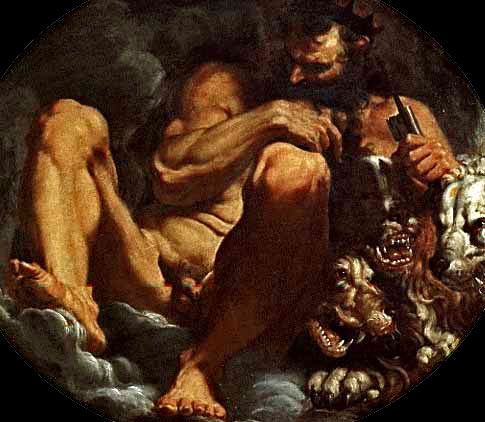
    Kept in motion, ‘higher’ and ‘lower’ are not necessarily problematic. This only happens when their constant r/evolving is artificially or arbitrarily stilled. Then ‘higher’ and ‘lower’ become weapons of Dis-tinction: the tincture made by Dis, another name for the god of the underworld, Pluto, whom only oaths and curses could reach. As the god of wealth (his name was originally Dis Pater, ‘Father of Riches’) he materializes the crystalline structures found within the Earth… not just as gold and gems, but as rigid habits of mind. His tincture keeps motion from arising through rigid constriction to form, and while this helps us to count (our money, our ideas), it obfuscates the healthy relationship (the transformation between) the ‘much’ and the ‘few’, the ‘higher’ and the ‘lower’, prejudicing one only.


    Pluto - Hades
    Pluto – Hades

    Agostino Carracci, 1592


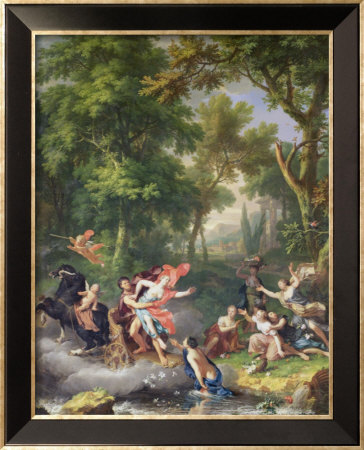
    The way out of this Dis-ease (but not ease for us) is well known: follow the trail left by Persephone, who’s name means ‘the emerging’. Persephone is a goddess (the feminine aspect is crucial) who embodies the alchemical qualities of Water: change/process (https://spiritalchemy.com/p6-metaphors.html). She was abducted by Dis Pater/Pluto (Roman)/Hades (Greek) from near her favorite haunt, a springing fountain, as she was gathering flowers (read ‘flowers’ as a verb). Her mother Ceres/Demeter, in looking over her whole domain (the Earth) found only her belt floating upon a little lake made from the tears of the Water Nymphs. Plato even said of her (in his Cratylus) that “she is wise and touches that which is in motion”.

    (The full context is interesting: “The first men who gave names [to the gods] were no ordinary persons, but high thinkers and great talkers . . . Pherephatta!–How many people fear this name, and also Apollon! I imagine it is because they do not know about correctness of names. You see they change the name to Phersephone and its aspect frightens them. But really the name indicates that the goddess is wise;for since things are in motion (pheromena), that which grasps (ephaptomenon) and touches (epaphôn) and is able to follow them is wisdom. Pherepapha, or something of that sort, would therefore be the correct name of the goddess, because she is wise and touches that which is in motion (epaphê tou pheromenou)–and this is the reason why Haides, who is wise, consorts with her, because she is wise–but people have altered her name, attaching more importance to euphony than to truth, and they call her Pherephatta.”)


    The Rape of Proserpine
    The Rape of Proserpine

    Jan van Huysum


    If we integrate the Plutonic (alchemically: Earth) with the Persephonic (Water) we prepare ourselves for Air, where what is above comes below, and what is below comes above; Persephone must spend half her time in the underworld and half above. It is in the oscillation between polarities that the ‘higher’ wisdom (in this case, represented by the seasons) can potentially manifest. Thus we see a difference between a ‘higher’ and a ‘higher-higher’: the meta-pattern remains.