Okay, I had to post this, as I found it to be … weirdly fascinating. Google has a tool that allows you to search for terms and see how they have trended over time based on global search volume. The service is called Google Trends, check it out.
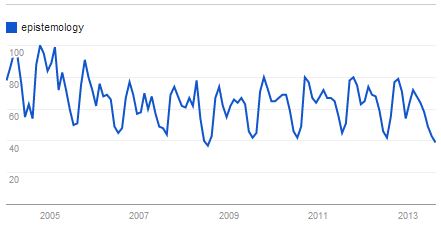
Here is the result for the term “epistemology”:
Apparently interest for the term “epistemology” follows a strong yearly cycle, with two maximum values in October and Feb/March and one strong minimum in July. Interestingly, the same basic pattern applies to the closely related term “ontology” (“close” if you are in philosophy, that is):
This is from Andre Michelle Laboratory, but I had to repost it here so I could have three simultaneous sets. Unfortunately I don’t know how to make them synchronize perfectly, because they load at different speeds… oh well. Also, if you have an iPad or iPhone, check out Soundprism too!
What Julian Assange COULD have said to 60 Minutes’ host Steve Kroft’s question: “Are you a subversive?”
Assange: Am I a subversive? Not at all; in fact, you can say that I’m a superversive. Do you know where the word “subversive” comes from? It’s from the Latin sub + vertio. Sub means “underneath” or “below”, and vertio means both “to turn around” and “to understand and upset”. Hence the meaning is usually given as “to overthrow” or “destroy”.
The key to subversion is that it is carried out underneath, in secret, below the radar. The real subversion is the act of keeping important truths hidden. By hiding important information concerning corrupt practices, corporations, governments, and individuals cannot be held accountable for their actions. In this sense, it is precisely the corrupt practices of such entities that can rightfully be called subversive, because they turn around, rout, and overthrow the public’s ability to respond to their behavior. Keeping corrupt practices secret subverts our consciousness by putting forth a façade that is not commensurate with the actual behavior. This is the tactic almost universally employed by corrupt organizations, governments, and individuals: to maintain (more…)
—————————————————- Hello!
I’m a huge fan of your lecture/insights re: the Matrix Trilogy. Can you PLEASE explain to me why after executing his feeling with the result that the sentinels must desist at the end of the second film, neo wakes up (at the start of the 3rd film) in that “parallel” universe with Sati, et al?
Kind regards,
Dave
—————————————————-
Dave,
Thanks for this good question. I don’t have any kind of definitive answer, just some thoughts. This was the moment of transformation from “The One” into “Neo” – you could call it an initiation process. All initiation processes (that are worth their salt) involve an expansion/reconfiguration of consciousness into areas that used to be unconscious. In other words, initiation is a way of integrating unconscious aspects into consciousness directly.
In the “old” days, initiation required a loosening of the life (etheric) body from the physcial body, which had the effect of letting consciousness awaken into the spiritual world. This was usually accomplished with the help of a guide/hierophant. The most expedient and direct way of making this transition involved, believe it or not, a conscious approach to death. This is meant in the literal sense: initiates would be buried alive, or would fast, or would be drowned (this is what baptism was originally!). The goal was to force the etheric body to release its hold on the physical, so that the astral body and Ego would no longer be overwhelmed with the physical body’s sensory inputs, in order to allow the more subtle effects from the spiritual world become apparent. This happens normally at death, but the technique of initiation used this relationship in a conscious and purposeful way to achieve spiritual sight.
In Matrix 2, “The One” had to go through a second initiation process in order to get to the stage of being able to work on his own etheric body with consciousness (in Matrix 1 his initiation process (again, involving a death) awakened him to his astral body). The One had no hierophant for this (more…)
This notebook was created as a personal record of the 1999-2000 Goethean Studies program at Rudolf Steiner College. This unique course, conceived of and taught primarily by Dennis Klocek, is still being offered — it is now called Consciousness Studies. When I took the course, which was seven months long and met for about three hours every weekday, I liked to call it “Being Human 101”, because it offered some basic perspectives about being human that spanned the spiritual, psychological, and physical worlds in a very deep and coherent way.
There are certainly errors contained herein: it was often simply not possible to record more than the merest fragments of the vast pictures that awakened in the little Emerson classroom and flowed like honey across our minds. This record is like a six year old’s crayon rendition of a Michelangelo: it may contain something recognizable, but is no substitute for the real thing, which I encourage everyone to experience.
It is likely that the only people who will see this document are those already familiar with the course in one of its various incarnations. For you I hope that it re-awakens a commitment and enthusiasm for the hard and necessary work of spiritual transformation by connecting you to the feeling you had sitting in the uncomfortably cold room on uncomfortable chairs, listening to another mind-blowing morning lecture by Dennis: the feeling that you were exactly where you needed to be and wouldn’t trade it for anything.
For those who have not been able to take the course, this gives a tiny taste of some of the content that was presented in its 1999-2000 incarnation, and will hopefully inspire you to research the current, more highly refined and potent version.
For those who have found this page but have no idea what I’m talking about even though you’ve read this far, just flip through it like it was you long-lost friend’s photo album and see what tickles your fancy as you skim on by.