 My first attempt at remixing/composing a song. The original vocal track is from Bisola Marignay. We partnered together to make a creation, and this is what happened:
Download Song of Transformation – TransD Mix
Enjoy!
My first attempt at remixing/composing a song. The original vocal track is from Bisola Marignay. We partnered together to make a creation, and this is what happened:
Download Song of Transformation – TransD Mix
Enjoy!
I would like to say that the quite frankly astonishing rise of social-networking tools clearly points to an unmet need in the ‘wired’ populace at large. We increasingly live in a fragmented society, where our friends and family are scattered across the globe. Many of use no longer, for economic, personal, or many other reasons, choose to live in the same place for our entire lives, where we could build up a local network of family and friends. And even if we do so, the demands of modern life and our cultural habits tend to erode (it seems) many opportunities for face-to-face gatherings over a long time period; such things now require real effort and are not a de facto part of everyday life.
So it seems that a way of assuaging the erosion of the human need for contact, and just as importantly, a context within which such contact can be meaningful, can be found through the social networking tools. These tools are not designed, and cannot really take the place of repeated face-to-face interactions, but what they DO provide is a way to ‘keep the door open’ to people who you might otherwise lose track of or only communicate with very rarely. By having, for example, a Facebook page, you put yourself in a position of taking moments out of your day to have a conscious connection with people who would otherwise likely not enter your thoughts that day. The immediacy and digital ‘nearness’ provided by the technologies allows for and creates a different kind of interaction than has heretofore been possible on the planet. On the one hand, these technologies constrict certain kinds of communication; but it opens up others at the same time, and allows a thread of connection that can later be followed up by a more present, face-to-face, or otherwise soul-ful type of communication.
This is something of the positive side of these tools, but they can also be used for pure ego-stroking, for bullying, for economic reductionism, etc. Such is the way of any tool. For me it’s always a question of how the tool is used, and I am convinced that humans have the power to make tools like this (and other technologies) work in a positive way for the benefit of themselves and the planet.
It’s true: there is no substitute for real face-time. I would simply point out that Facebook and such tools are NOT actually substituting for face-time. In fact, the reverse might be true: the immediacy and ubiquity of social networking tools may actually increase the potential for two or more people to get together IRL (in real life)–there must be a study on this somewhere… if not, any takers?
My feeling is that the use of such tools lessens both perceived and actual gaps between individuals, while also allowing individuals to discover more potential relationships that might otherwise be missed. Increasingly human beings are going to have to learn how to deal with the instant availability of essentially infinite data. In the pre-wired-era, the available data was restricted to your immediate sensory neighborhood, and you had no choice about this, notwithstanding the influence of books and letters. Now, we have a choice, and can access a whole variety of types and fields of information literally out of thin air. It opens up a whole different set of possibilities for human creativity and interaction….
But obviously I’m not yet giving a well-rounded picture. I should also point out that the way that these technologies lead human consciousness around may be problematic in a number of ways, and the identification and harmonizing of these regressive or sclerotic tendencies should be addressed up front. But to speak of these would require an even longer discussion — one including talk about the inner life of the soul.
Below: a diagram depicting connections between a single user’s Facebook friends.

It seems that Set was at one time regarded as the “chief god”, carrying the epithet, “His Majesty”, shared otherwise only with Ra. He was a son of the earth (Geb) and sky (Nut), husband to the fertile land around the Nile (Nebt-het/Nephthys), and brother to death (Usir/Osiris), and (Aset/Isis, the wife of Osiris) and father of Anubis. Set was regarded as a fierce warrior. It was he who protected Ra on the solar barque, slaying the chaos serpent, Apep each day to allow the sun to rise.
Apep was the chief opponent of Light and Truth (Ra), an embodiment of Darkness and Chaos, known as the greatest enemy of Ra. So on the one hand Set was the being who was able to rhythmically defend the Light/Truth from the Darkness/Chaos of the underworld…
…but then later (in conflict with Horus) Set actually became conflated with Apep himself, becoming the embodiment of the very evil he once defended against! Apep was a huge serpent that lurked beneath the horizon, waiting to eat the Sun… and as the ‘World-encircler’ finds symbolic similarity in the Ouroboros…
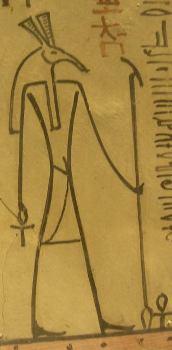 He is depicted as “a mysterious and unknown creature, referred to by Egyptologists as the Set animal or Typhonic beast, with a curved snout, square ears, forked tail, and canine body, or sometimes as a human with only the head of the Set animal. It has no complete resemblance to any known creature.”
His upward-pointing square ears are like antennae, receiving the wisdom of the upper world, while his snout points downwards, to the mysteries of the underworld. (This may also find resonance through his role in the drama between Upper and Lower Egypt and their eventual uniting.) Set stands between the worlds. He sailed through the underworld at the prow of Ra’s boat, with Thoth on one side and Ma’at on the other – one male, the other female, both representing the Logos.
Perhaps Set, then, truly is a proper manifestation of Chaos, thought about now in the modern sense as that which arises at the boundary between order and disorder. Perhaps this makes Set one of the oldest alchemists, traveling the space between the most supreme heights as the chief god to the lowest depths, and the lowest depths as the destructive and evil force of the underworld. Even more interestingly, once Set’s vilification had occurred, his images on various temples were replaced with that of Thoth – thought by hermeticists to be the first true alchemist, giver of the Corpus Hermeticum (via his syncretic link to Hermes Tresmegistus – ‘Thrice-Great-Hermes’).
Wow!
Concerning how quantum mechanics is being explored artistically: (Quantum of Culture at Physics World)
Consider Quantum Sheep, the brainchild of Valerie Laws, a writer who lives in the north of England. In 2002 she spray-painted words onto the fleeces of sheep from a nearby farm. As the flock milled about, the words rearranged and a new “poem” was created every time the sheep came to rest. A spokesperson for Northern Arts, which provided £2000 of funding for the project, said that the result was “an exciting fusion of poetry and quantum physics”. Here is one of the resulting “Haik-Ewes”:
Clouds graze the sky
Below, sheep drift gentle
Over fields, soft mirrors
Warm white snow
Talking to the BBC at the time, Laws explained why she felt the project was worth pursuing. “Randomness and uncertainty is at the centre of how the universe is put together, and is quite difficult for us as humans who rely on order,” she said. “So I decided to explore randomness and some of the principles of quantum mechanics, through poetry, using the medium of sheep.”

Trying to summarize:
The drawing of a distinction is a formative act. Drawing a distinction FORMS the space, constellates the infinitely possible unknown into spaces which are shaped by the particular WAY in which the distinction is drawn. The resulting spaces can not help but take the complementary shape of the distinction that defines them.
The drawing of a distinction is an INformative act. Drawing a distinction INFORMS the observer to distinguish the space like this. The resulting shape of any possible knowledge within the space cannot help but be informed (formed-in) by the particular way in which the distinction is drawn.
The distinction is an epistemological act that creates itself, and in so doing, is also the creation of the space in which the distinction occurs, as well as of the observer who makes the distinction.
There are levels of distinction; distinctions can be made about distinctions, and distinctions can be made about those distinctions…
Distinctions are atemporal and aspatial. They are the primitive act. The distinction between the distinction, the space, and the observer are all formally equivalent, just as the three interior angles of a triangle are all formally equivalent. In other words, they are interchangeable in any process that specifies ANGLE.
The only process that specifies distinction, space, and observer is DISTINCTION. The form (which is the same thing as the LAW of form) is an ouroboros.
Consciousness is the consciousness of distinction. That is to say, consciousness is distinction; it cannot be other than consciousness of distinction. Therefore consciousness is co-extensive with all distinction. What is distinguished is conscious of its distinction; this is why there is distinction; this is why there is consciousness.
Time is a higher order distinction that requires recursivity. It is a distinction about a distinction. Time is dependent upon the oscillation of distinction between two states made by that distinction. Time is the injunction to cross the boundary between the states, and once crossed, to cross again. The crossing is atemporal. Only the distinction of the crossing is temporal. The distinction of the crossing of the distinction is time.
<—————-distinction—————->
Now, I have no idea if any of the above is sensible or insensible <crossing boundary: its sensibility or insensibility is only possible on the basis of the distinction as such. In itself it is neither sensible nor insensible, but what it would be if it could> but it has raised some questions for me:
Is distinction ONLY binary? Is distinction always between this state and that state, that is, between one and another? Is it possible to distinguish not just between one:one, but between one:many, between one and another+another+another? In other words is this a binary reductionism? <crossing boundary: yes, if this binary distinction is made. now make another distinction.>
Okay, but what about the, um, distinction in quantum mechanics of the possible eigenstates of the wave function? There are an infinite number of possible eigenstates for any given system (even the simplest), and they must ALL be taken into account (their probabilities must be worked in to the equation). Then, out of the whole field of possibilities, ONE is observed. In the observation, all the other possible values have a probability of zero, while the observed value has a probability of one. This sounds an awful lot like the idea that the fundamental act of distinction creates the space and thus the values of any distinction in the space thus created. Does this have any validity, either as an analogue or at least a metaphor? <X: Do you distinguish it as such?>
…
Okay I have another question. What happens if we DON’T DISTINGUISH? I mean, we don’t un-distinguish and we don’t distinguish. Without distinction… what happens? Is this (GSB language) a marked empty mark?
Crap! And can making a distinction of a distinction actually be the same as not making a distinction in the first place?
Please, anyone, help?!
<X: >
A friend of mine said:
“… Concerning self-correction, can we say that the system corrects itself toward a state of homeostasis (feedback—-correction—-goal) OR toward maintaining the integrity of the closed system? Is it o.k. to look at this in terms of homeostasis?
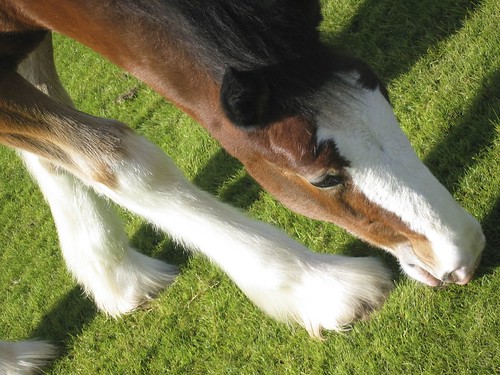
Reason why I’m asking is that I’ve been looking at the socialization behavior of horses in the herd, and how they “process” emotions. The processing looks very much like a feedback loop with a self-correcting mechanism – I see it as an infinity symbol. The interaction produces an action which takes the herd back to a state of “stability” or I call it homeostasis.
Anyway, this was a good experience for me because I read in that way – when I don’t get something I have a piece of paper and I draw to try to put the words into some visual.”
I said:
In the obvious case of the thermostat, there is a ‘goal’ – a temperature that is set by the second-order system (the human being). But now with horses you get something more obviously complexificated (i like coining ridiculous words). The horse is a system, the herd another, the environment another, and perhaps even another may be the system of “Horse” (i.e. ALL horses) thought about over a vast time period (that is, thinking about time from a second-order perspective – i think).
In this case, when we want to talk about homeostasis, what variables are tending towards sameness? If there are closed systems within closed systems within closed systems (as mitochondria are closed systems within each cell, which is another closed system…), then do we need to speak of a goal for each closed system? And is there only one goal per system (as in the thermostat), or can there be multiple goals which overlap from system to system? Or even multiple conflicting goals within a single system? Or is this not even possible from an cybernetic standpoint… or would it just be a double bind? Can you create a thermostat which simultaneously is tending towards TWO temperatures? How would it behave – oscillate in some frequency set by the speed of the feedback loops? Tend towards some intermediate value? Runaway?
Maybe symbiosis (which is an interesting concept to think about cybernetically) is the holding of multiple goals, one of which at least overlaps with another system? I’m just spitballing here.
Individual horse behavior —> herd qualities —> individual horse behavior (your infinity sign)
So if you can detect the processing of emotion in an individual horse, do you see also a higher-order processing of emotion that does NOT take place at the individual horse level but ONLY at the herd level? Is this a distinct process? Or is the herd’s processing so completely bound up with the individual horse’s processing that it is impossible to tell apart?
<insert context here – not me: YOU>
…but did we/they take off and burn the restraints of our minds? Did they/we realize that we cannot ‘heal’ the ‘patients’ when we don’t know that the patients are ourselves? That the demons aren’t simply ‘out there’ to be feared, nor are they ‘in here’ to be repressed or discarded, but that they are part and parcel of the space between the inner and outer – here to stay with us as we heal ourselves/others, so that they may be too?