Month: January 2012

  • Reality, Process, and Mathematics

    Reality, Process, and Mathematics

    All the qualities of the physical world exist through the interrelations of things to each other. What Moleschott says is correct for physical existence: ‘All existence is an existence through qualities. But there is no quality that does not exist through a relation.’ Just as everything of a soul nature contains something in itself by which it points to something outside itself, so conversely, a physical thing is so constituted that it is what it is through the relation to it of something outer.
    (Rudolf Steiner, Riddles of the Soul, Mercury Press, 1996, p. 69.)

    For such a philosophy, the relations that connect experiences must themselves be experienced relations, and any kind of relation experienced must be accounted as ‘real’ as anything else in the system.
    (William James, Essays in Radical Empiricism, Cosimo, Inc., 1912/2008, p. 20)

    In aesthetic epistemology, notions of “reality” are replaced by “patterns in process.”  “Things” are (ontologically) patterned processes.  We mistake the nature of the universe when we presume that “things,” to be, must “be” from the bottom up: on the basis of some “substance,” which THEN interacts in processes to yield what we experience (the first coherent expression of this began with the atoms in the void hypothesis of Leucippus and Democritus in Ancient Greece).  We assume that it is silly to speak of patterns of process without some kind of “thing” that we can point to as an indicator that the process is proceeding.  Because of the way our senses are involved in cognition, we tend to count as “real” only what can be made apparent to us through our senses (or their extensions via instruments). This is a huge presumption on our part.  What if we tried to conceive of “substance” as a secondary phenomenon?  What if process (thing-less process) is more primary?  In this view, things are precipitates (momentary nodes, relatively ‘still’ areas of patterned processes) of higher-order relations… not relations between THINGS but relations qua the activity of relating.  This may sound abstract, but this is because we are trained to think of reality in terms of substances (sub-stances: the “underneath-standings,” the bits from out of which a universe gets built).

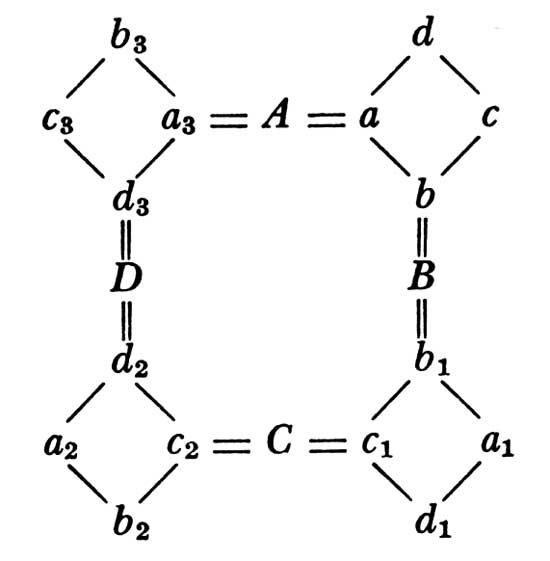
    The best example of one way that this can look is given in the field of mathematics.  Mathematics has no atoms, not even metaphorical atoms; it is entirely substanceless.  Rather, mathematics has, at its base, processes and their relations.  Even numbers aren’t the basis of mathematics,  (more…)
  • Patterns in Process: Transdisciplinarity as a Background for Working with the Elemental Cycle of Transformation

    Patterns in Process: Transdisciplinarity as a Background for Working with the Elemental Cycle of Transformation

    Elemental Cycle Abstract

    This essay outlines connections between the Elemental Cycle as an archetype of transformation, transdisciplinarity, and  cybernetics.  A number of questions are addressed: the nature and importance of connecting these fields, an examination of resources and the dominant disciplinary discourses for the associated fields, and a critical examination of my assumptions, beliefs, and position.

    Introduction

    How often do we find ourselves in a position of not being able to see something unless it is first pointed out to us?  This happens all the time with the visual and other physical senses, but of course also occurs in our thinking; certain concepts seem to hide in plain sight, and unless we are cued into where and how to look for (or to think about) them, they slide on by as a part of the undifferentiated background of conceptual life.  Usually we are introduced to these sorts of concepts just like we are to new people, through a third party who is already familiar with each of us: “Seth, I’d like you to meet Recursion; Recursion, this is Seth.”  Often with this sort of introduction comes an experience: “Oh hello Recursion!  You know, I feel like you must hang out at some of the same coffee-shops as I do, but we’ve never been formally introduced.”  And so a relationship begins with a concept, and just as with human beings, you can become more intimate and familiar, get into fights, seek new levels of understanding, and go on adventures. (more…)

  • Form and content – two levels of change

    Form and content – two levels of change

    Form and Content

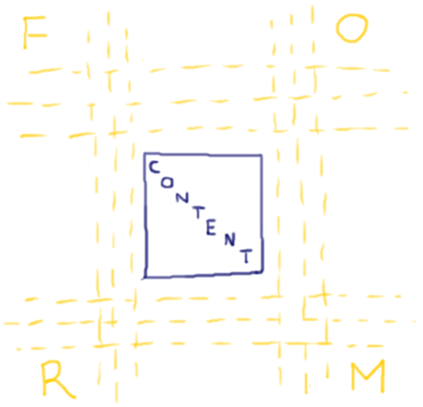
    Understanding change is a very difficult task. No aspect of our world, either experienced outwardly through our senses or inwardly through our feelings and thoughts, seems exempt from the paradoxical rule that the only constant is change. It is possible to examine the way change occurs at many levels. At the “lowest” level of examining change, we generally tend to focus on what can be called the “content.” The particular identified content (we’ll see in a minute why it is important to note that this content is “identified”) depends upon the arena in which the transformation is being studied. Generally, however, the content is the “thing” that is undergoing change, and is usually the overt focus of our attention. For example, in a chemical situation, the content would be the physical elements, such as hydrogen and oxygen in electrolysis. In a therapeutic setting, the “thing” might be one’s thoughts and feelings (in psychology), one’s bones (in chiropractics), or a family system (in family therapy).

    The content level is always present; it is always a part of the way that we encounter change. Yet in addition to looking at the content-level, we can also examine change in a different way: we can examine patterns of change. That is, we can place our attention on the way that changes in content unfold, and seek to identify similarities and differences in such patterns in order to get a deeper understanding of the “rules” that inform what happens at the content level. Paying attention to this level of change is paying attention to the process of change, rather than just its results.

    Form and Content

    This way of examining change takes place one level removed from the content level, and can thus be understood as a “higher” level. It is more abstract than the first, and because it provides the contextual rules that inform the unfolding of the processes as they appear at the content level, we can call this second level that of “Form”, or even better, “Forming”. This is spelled with a capital “F” to distinguish it from “form”, in the sense of a static outer shape or configuration. A given quadrilateral has a definite individual form, and there are an infinite number of quadrilaterals, such as the square and trapezoid. But every possible quadrilateral shares the same Form. This is the same relation between a set and an element in formal logic. The Form is a way of indicating (more…)

  • Quantum Mechanics – To Understand or Not Understand, that is the question

    Quantum Mechanics – To Understand or Not Understand, that is the question

    fractal flowerIntroduction

    About 100 years ago the birth of quantum theory changed forever how humans perceive the universe… sort of.  Certainly “quantum physics” is a phrase found far outside the boundaries of physics classrooms, and has even achieved a fairly wide popularity through movies such as What the Bleep and works like Fritjof Capra’s Tao of Physics.  Does this mean, for the average person who has at least been introduced to some basic ideas from quantum mechanics, that reality will never be the same?  Or do ideas from quantum mechanics (QM) remain something of a curiosity—fascinating and mind-boggling but so far removed from ‘normal’ everyday experience as to be essentially irrelevant?

    Take a moment and ponder this question for yourself.  Can you remember how you were affected when you first heard of electron tunneling, the EPR paradox, entanglement, the uncertainty principle, or more likely, Schrodinger’s cat?  Did your view of the world change?  A more relevant question might be: how do you know?  Perhaps the next time you looked at the shimmer of a butterfly’s wings or the more prosaic spectrum reflected off a thin layer of oil on pavement you gave an intellectual nod to the underlying quantum mechanical principles which give rise to these phenomena… and then went on about your day just like it was 1904 (the year before Einstein’s four seminal papers revolutionized the world of physics—many other worlds are still playing catch up).

    Now, quantum mechanics is, without a doubt, one of the best theories ever produced by human minds.  The effects of QM are likewise undeniable in their scope, and have reached every corner of the Earth, influencing the course of the 20th century immeasurably, mostly through the various technologies it has made possible (from computers and just about everything electronic—transistors, anyone?—to advances in medicine, communications, manufacturing, and more).  But the problem here is that (more…)