It's Elemental

Tag: transformation

  • A response to: “Anthroposophy and Waldorf Education: The Web as Will and Idea” – Can Digital Media be Redeemed?

    Web Internet SpiderThe following is my response to a recent article by Eugene Schwartz entitled “Anthroposophy and Waldorf Education: The Web as Will and Idea”, which is Eugene’s response to an article by the renowned anthroposophist Sergei Prokofieff, who wrote a remarkable article entitled “The Being of the Internet”, in which he argued that the digital media are carriers of such darkness that they are unredeemable.  The following will make the most sense if Eugene’s article (and ideally Prokofieff’s as well) is read first, but can still stand on its own as my opinion.

    Eugene has written a timely and well-considered article. As someone who has “grown up” (at the time of this writing I’m currently 33) watching and participating fully in the birth of the internet (I had an email address years before the world wide web existed), I am disheartened when anthroposophists shy away from what I consider to be an important task: the appropriate usage of these new kinds of technology.

    By appropriate, I mean utilizing the technology as a means of furthering a progressive human development. Of course what constitutes “progressive” or “development” can be hotly debated, but for me this involves not just empowering people through providing access to information of an esoteric nature that they might not otherwise have, but in providing the context for the shared creation of meaning in ways that are dynamically capable of leading towards real transformation.

    The ahrimanic nature of the internet lies primarily in the way that supports the decontextualization of meaning-making from the soul lives of its human participants. It allows us to abstract too easily, to decontextualize parts of ourselves in ways that challenge a healthy development. But at the same time the internet is the potential carrier of both luciferic impulses (getting willfully lost in online environments, expressions of rage, rampant self-satisfaction seeking opportunities, etc.) and Christ impulses as well.

    As always, the Christ-like impulses are a bit more subtle, a little less oriented towards appearing with a particular veneer, but no less powerful for all that. I am speaking of how the internet is used to help bring groups of people together in ways that fosters both community and action, and which promote love and change. This occurs not merely through sharing information, but in the literal creation of an in-between space which can be filled with the soul-activity and spirit-light of individual wills. This, I think, is what it looks like to “redeem” the internet. It happens when people are given tools to become active participants in the dynamic creation of meaning that fosters transformation and love.

    The challenge, as with the bringing into one’s heart of any Christ impulse, is that it occurs not by default, and not by control, but through a conscious surrendering of one’s will to a higher will, which is experienced both as a suffering and a redemption. Ahriman, I imagine, would like us to use the internet to manipulate and control so that we forget the much greater power available through this kind of conscious suffering, while Lucifer would be happy if we continued to use the internet to satisfy our desires and create infinite personalities for ourselves.

    The alchemists understood that nothing could go untransformed if the magnum opus is to be achieved. Their saying “As above, so below; as below, so above” was not an academic one about correlation; it meant that in order to reach the highest potential available to us, we had to transform our lowest aspects. This applied too to the outer world: nothing could ultimately go unredeemed, and if we ever decide to “write off” some aspect of reality as beyond hope, beyond action, and beyond transformation, then the forces of darkness will claim a victory.

    We must work together to build the world we wish to live in. It is a horrible mistake to try and divorce technology from morality, and to claim that “it’s all in how it is used.” Some technologies are more evil than others, but the internet is not an atomic bomb. The development of the internet, although beginning as a defense-oriented technology (not incidentally as a technology to help counter the potential effects of nuclear weapons), almost immediately was taken up and used for other means; primarily education. There are countless ways in which both the development and usage of the internet fosters healthy development of human beings–in ways not completely without strings, of course, but also not in ways that make its usage “unredeemable.”

    What we cannot do is let the regressive impulses have their way with the internet and co-opt the minds and souls of human beings for their own uses without a Michaelic challenge, a challenge for the creation of spirit-based groups of individuals (which are different than just ‘groups’), a challenge to permeate the spiritual spaces of the internet with transformed will, with conscious sacrifice, with love of transformation and a transformation of love.

  • Cybernetics of problems and solutions – an exercise in thinking complexly

    Cybernetics of problems and solutions – an exercise in thinking complexly

    First-order Solution:


    First Order Solution
    First Order Solution


    The problem and the solution share an epistemological context, each helping drive the other.

    Second ‘phase’ (to the right): In this context ‘more of the solution’ creates ‘more of the problem’ through a symmetrical relationship. The SAME problem is produced by the SAME solution. No real transformation is forthcoming from within the system, because it perpetuates itself from both sides.


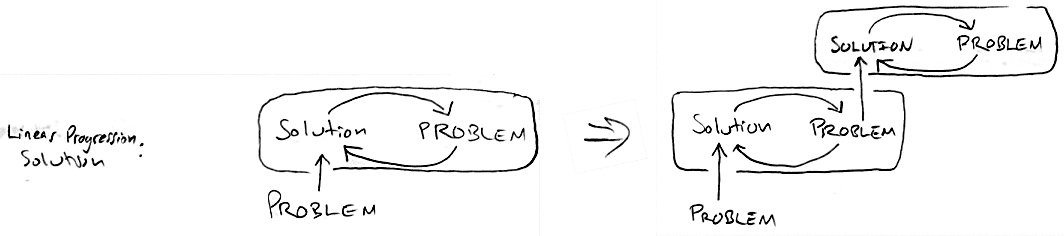
    Linear-Progressive Solution:


    Linear-Progressive Solution
    Linear-Progressive Solution


    A solution to a problem is found that does not perpetuate the original problem, but this creates a new problem (or problems) of its own, likely at the same level (with the same form) as the original, although with different content or within a different arena (problem ‘leaking’).

    Second ‘phase’ (to the right): This leads to a potential proliferation and regress of problems, because the epistemological context is never addressed at any level. DIFFERENT problems are produced by DIFFERENT solutions OF THE SAME ORDER. Transformation is possible but likely occurs with great difficulty and haphazardly, if at all.


    Second-order Solution:


    Second-Order Solution
    Second-Order Solution


    The epistemological context of the first order is seen as problematic, becoming the basis for a second-order solution that relies upon different epistemological distinctions. It is “second-order” because it explicitly recognizes the cyclic recapitulation of the first-order problem-solution system’s epistemological distinctions, and chooses not to participate by making different distinctions. Thus the problem-solution system becomes a new problem that is of a directly higher order.

    Second ‘phase’ (to the right): The solution to the original problem-solution system creates a new problem of a higher order (this would be the third-order problem), necessitating the uncovering of the epistemological limitations in the second-order problem-solution system (which now becomes the third-order problem). HIGHER-ORDER problems are created by HIGHER-ORDER solutions. Continuing in this way leads to higher-order levels of recursivity, but after only a few levels a practical limit is reached, and the system becomes to expansive and diffuse to affect transformation by itself.


    Simple Multivariant Ecology of Solutions:


    Multivariant Ecology of Solutions
    Multivariant Ecology of Solutions


    In an example of a more realistic (and complex) setting, a problem may be addressed with a “problematic solution” while at the same time efforts are made to seek a solution of a lineal type, which may create its own problem while being taken at the object of a second-order solution.

    Second ‘phase’ (to the right): The system of systems can evolve as a self-embedded ecology, where new opportunities for feedback become inevitable.  The network continues to evolve, involve, devolve, and revolve, all at once.

    Here’s a picture of them all together:


    Orders of Solutions
    Orders of Solutions


  • alchemical shirts…  because I can

    alchemical shirts… because I can

    There’s something amazing about alchemical imagery. Deep spiritual symbolism, specific practical advice about transformation, archetypal aspects, meditative visualizations, and esoteric mysteries can exist together all in ONE image. For how many other works of art can the same be said?

    In my opinion there is not enough alchemical imagery out in public on display, so to help remedy that situation I have made up some alchemical t-shirts and other products. Wear ’em and strike up a conversation about something unusual and profound.


  • Song of Transformation

    Song of Transformation

    Song of TransformationMy first attempt at remixing/composing a song.  The original vocal track is from Bisola Marignay.  We partnered together to make a creation, and this is what happened:

    Download Song of Transformation – TransD Mix

    Enjoy!

  • The Amazing Frank Chester – upcoming lecture!!!

    Trust me, YOU DON’T WANT TO MISS THIS!!!

    chaliceFrank Chester (find out about his initial work here, and read reviews of his work here) has just returned from a very well received presentation of his research on the Chestahedron at Sunbridge College in Spring Valley, New York. Many in the audience expressed disappointment afterwards that they had not notified their friends to attend these lectures because they did not realize that they would be witness to such an astonishing presentation.

    Frank will be repeating these lectures this week in Fair Oaks at the Anthroposophia Conference as listed below.  For those who wish to attend single lectures apart from the rest of the conference, the charge is $10 for students and $20 for adults

    This is a good time to invite your friends and associates if they would like to hear about his discoveries, because Frank is planning on cutting back on his lecture schedule after this week so he can return to his research.  You may download an attachment to this email, which provides some written information that may be helpful towards understanding what Frank’s work is about.

    Frank will be presenting his work on the following dates:

    April 23-26 Anthroposophia Conference (PDF Flyer)

    Rudolf Steiner College, Fair Oaks, CA

    Friday, April 24 7:15 pm – 9:15 pmImagineering of the Heart”

    Saturday, April 25 2:00 pm – 3:30 pm “Transformation”

    Sunday, April 26 11:00 am – 1:45 pm Question and Answers

  • Goethean Phenomenology, Soul Breathing, and Transformation

    Goethean phenomenology acts as a transformative bridge between the researcher and a topic of inquiry.  The method is unique not in that it attempts to work through the subject/object split, but rather in the WAY it attempts to do this.

    Doing Goethean phenomenological research requires that one be completely open to what presents itself, while at the same time recognizing that one’s perceiving is an active force with regards to the topic of inquiry; the topic changes researcher, and the researcher change the topic.

    The Goethean phenomenological method (GPM) asks that one address the topic in a complex way; it must be approached from many angles in order to gather as much potentially relevant data as possible.  The data are continually taken inward and addressed, particularly with attention to the sequencing, timing, and subtle morphological differences.  The goal is in part to be able to re-create, inwardly, an exact sensory imagination that moves with the same gesture as the phenomenon when observed ‘outwardly’.

    Normally, one takes as an ‘object’ of inquiry some outer phenomenon such as a plant species, a location, or a natural form or process.  This restriction is not required, however addressing the alternative does require the researcher to change somewhat the way in which the method has heretofore been conceptualized and practiced. It is possible to begin with a topic of inquiry that is not phenomenologically perceptible to the outer senses: love, for example, or relations between imaginary numbers.  All the same methods are used to work with the phenomenon, but different challenges arise when taking an ‘inward object’ as the focus of inquiry.

    The primary challenge arises due to the unequal stages of development of our outer and inner organs of perception.  My eyeball provides visual information in a way that is highly correlated with the way in which your eyeball provides you with visual information. Despite the variety of potential sensory differences, on the whole physical human sensory capacities share a high degree of correlation, especially when compared with more subtle (non-physical) senses.

    This is not as problematic as it may seem, because implicit in the GPM is a continual oscillation between the subject and the object, and likewise between conceptual and perceptual experience.  In fact, part of the goal of the GPM is to create the capacity (we could call it what it is: a soul-capacity) that allows our soul to move with the gesture of the unfolding phenomenon, as if from the inside-out… and then to come ‘back’ to oneself in order to become aware of that experience in a way that is not available when you are ‘in it’.  Dennis Klocek, a practitioner of this method, calls this process “soul-breathing.” which is a very accurate description of what is occurring. Indeed, the process of working phenomenologically in this way provides the very training necessary to develop one’s soul-capacities in a way that is commensurate with the phenomenon.  The practice of Goethean phenomenology is thus recursive; its practice changes how one can practice it. This recursivity forms a conceptual and perceptual loop which forms the basis for the development of the soul-organ of perception that is keyed to the particular phenomenon in question.

    Goethean phenomenology, as Goethe himself stated, is “delicate.” because the role of the inquirer is paramount in the endeavor; one cannot simply follow an established external protocol and expect results.  Rather, results arrive through a process of mutual interactivity between one’s own development and the simultaneous ‘unfolding’ of the phenomenon in question.

    This method, in many ways, embodies principles from participative inquiry, in that the method actually takes the ‘object’ as a ‘subject’, and treats it accordingly.  The researcher is not the ultimate authority on the phenomenon, but rather attempts to give the phenomenon voice.  We could actually say that the role of the researcher is to place him or herself in service to the unfolding nature of the phenomenon in all its complexity, so that it can live in an imagination that is exact with respect to the movement, transformation, and unfolding of the phenomenon (which is inseparable from the movement, transformation, and unfolding of the researcher); this allows the researcher to ultimately ‘speak for’ the phenomenon.  In a way, the researcher’s agenda is to give up the agenda in favor of the unfolding of the phenomenon.  This can only happen when the researcher becomes capable of perceiving in a way that is generally opposed to the dictates of normal human day-waking consciousness, which lives primarily in a constructed boundary called the “self” through which all experience is filtered.

    Goethean observation softens this boundary, makes it a semi-permeable membrane, and allows part of our soul to live through its inner movements into the unfolding of the other.  In this way, a real ‘dialogue’ begins to take place between the researcher and the phenomenon (rather than a purely self-relating inner dialogue where two aspects of oneself face each other, i.e. a monologue disguised as a dialogue).  It truly feels like one is dialoguing with the phenomenon, just as one would with another human being, but through an expanded language of gestures, tones, and subtle feeling-movements, rather than explicit words.  This allows for the creation of a shared ‘language’, consisting of inner soul movements that take the form of metamorphosing inner pictures (not simply visual, but tonal, gestural) which are exact analogues to the processes that the chosen ‘object’ of study move through.

    In this way, Goethean phenomenology requires and precipitates the transformation of the researcher. Indeed it is only through transformation that a researcher can learn to hear the continual whispering of what Goethe called nature’s ‘open secrets’.

  • Projective Geometry – Harmonic Points Sequence

    Projective geometry offers a window into the human soul — not as a mere analogy, but directly: projective geometric processes are manifestations of the same archetypes that work through and within human experience.

    Doing projective geometry is to move your soul in accordance with these archetypes, and in so doing you start to train your soul so that it can begin to perceive the movement of these archetypes both in your own soul and in the world-processes around you.  In effect, projective geometry offers a path towards the development of organs of perception that operate not primarily in a physical way like your eyes or ears, but in a more subtle realm.  The development of these soul-organs opens up new realms to your perception, just as if you were in a dark room and then someone turned on a light: now you can see depth, color, and form, where before these were literally non-existent for you.

    In this spirit, I offer the following sequence of drawings that illustrate one process in projective geometry: that of Harmonic Points.  I suggest, before looking further, that you examine and follow the constructions on your own in this post:

    Harmonic Points and Lines, a Projective Geometric Exercise

    Once you have sufficient experience with the above, feel free to examine the following drawings.  Note the context given in this post and the above linked post, and see if you can discern, as an exact soul-perception, the moving gesture that accompanies the sequence, paying special attention to the ‘unique’ moments of the transformation.  Feel free to reply in comments to this post about your experience!

    Note: the drawings have been placed on a separate page, so that they can be presented unencumbered by the limitations of the blog theme.