It's Elemental

Category: Anthroposophy

  • Toward an Aesthetic Epistemology – Slideshow Overview

    Toward an Aesthetic Epistemology – Slideshow Overview

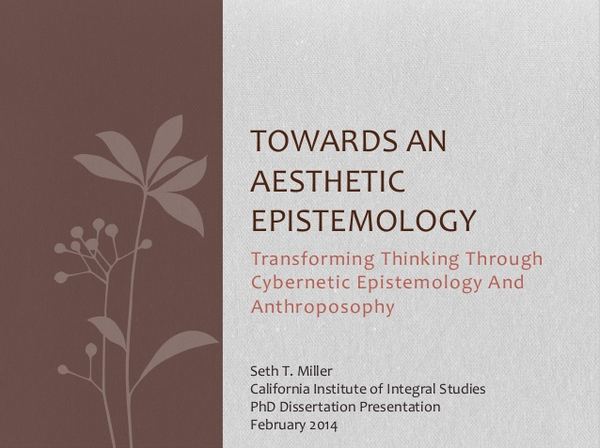
    In February 2014 I successfully defended my PhD dissertation, titled “Toward an Aesthetic Epistemology: Transforming Thinking through Cybernetic Epistemology and Anthroposophy.”

    The following is the abstract and a slideshow presentation that pulls out the crux of my arguments.

    Abstract

    The complexity, subtlety, interlinking, and scale of many problems faced individually and collectively in today’s rapidly changing world requires an epistemology—a way of thinking about our knowing—capable of facilitating new kinds of responses that avoid recapitulation of old ways of thinking and living. Epistemology, which implicitly provides the basis for engagement with the world via the fundamental act of distinction, must therefore be included as a central facet of any practical attempts at self/world transformation. We need to change how we think, not just what we think. The new epistemology needs to be of a higher order than the source of the problems we face.

    This theoretical, transdisciplinary dissertation argues that such a new epistemology needs to be recursive and process-oriented. This means that the thoughts about thinking that it produces must explicitly follow the patterns of thinking by which those thoughts are generated. The new epistemology is therefore also phenomenological, requiring the development of a reflexivity in thinking that recursively links across two levels of order—between content and process. The result is an epistemology that is of (and for) the whole human being. It is an enacted (will-imbued) and aesthetic (feeling-permeated) epistemology (thinking-penetrated) that is sensitive to and integrative of material, soul, and spiritual aspects of ourselves and our world. I call this kind of epistemology aesthetic, because its primary characteristic is found in the phenomenological, mutually fructifying and transformative marriage between the capacity for thinking and the capacity for feeling.

    Its foundations are brought forward through the confluence of multiple domains: cybernetic epistemology, the esoteric epistemology of anthroposophy (the spiritual science of Rudolf Steiner), and the philosophy of the implicit as developed by Eugene Gendlin.

    The practice of aesthetic epistemology opens new phenomenal domains of experience, shedding light on relations between ontology and epistemology, mind and body, logic and thinking, as well as on the formation (and transformation) of identity, the immanence of thinking in world-processes, the existence of different types of logic, and the nature of beings, of objects, and most importantly of thinking itself and its relationship to spirit.

    Keywords: anthroposophy, autopoiesis, cognition, cybernetic epistemology, distinction, epistemology, esotericism, logic, recursion, Rudolf Steiner, second-order cybernetics, spirituality, thinking

    Slideshow

    thetaPlease note that Slideshare translated the Greek letter Theta into the letter Q. This is unfortunate, because I used the Greek letter for its geometric shape, pictured correctly at left.

  • Embracing the paradox of Being: A relational view of epistemology, ontology, logic and difference.

    Embracing the paradox of Being: A relational view of epistemology, ontology, logic and difference.

    Let’s get right to it, shall we?

    With respect to ontology, let us say that there is no “it,” no independent reality that is exclusive of the observer.  This is a basic insight from second-order cybernetics: the observer must always be included in the observed.  Despite this, of course, we do have much talk and thinking about “it” that does not take the observer into account—we are very interested in the “what” of the universe, but have a fairly difficult time illuminating our own nature.  But this is okay, because ultimately the talk about “it,” the pointing to “it,” (not the thought of the “it” itself) is more fundamental to “it” than anything else, because it is the relations that are primary.  We can say that thingness is a subset of relatedness.  Following Eugene Gendlin’s (1997, p. 22) process-concept of “interaction-first,” we can conceive of relations not as forming between two already-existing “things,” but rather as being recursively self-generated between other relations.  In this sense, things are the precipitate of relations, a hardening out of a more fluid state.

    Elemental Cycle

    Going further than Gendlin, we can take a cue from the process-language of alchemy (Miller, 2008) to see how relations themselves are a precipitate of the tension between complementarily opposing potentials, made by a distinction out of the whole.  This corresponds to the recursive ontological alchemical sequencing of the elements from Fire (the whole) to Air (polarity) to Water (relation) to Earth (thing), to Fire (a new, transformed whole).  Relations are to opposing potentials of a distinction as things are to relations.  Opposing potentials are themselves a precipitate of the whole by virtue of distinction (of Fire by Fire), and work alongside each other within the whole simultaneously.  Each step from the whole is a kind of step-down transformation; ontologically we could say that beginning with level N, we move to level N-1.  Each level is pulled out of simultaneity by an act of distinction within the whole, of the whole, by the whole.  A cascading of levels of distinction thus yields the ontology of “things.” (more…)

  • The New Sacred Geometry of Frank Chester

    The New Sacred Geometry of Frank Chester

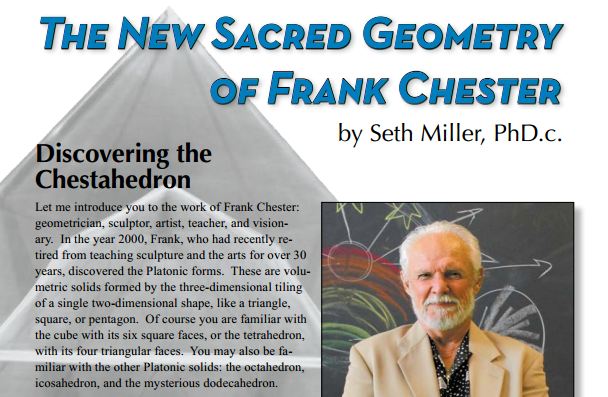
    This article was recently written for the Science to Sage International eMagazine. It introduces the work of Frank Chester, artist, sculptor, and geometrician, and explores how the special seven-sided volume with faces of equal area — the Chestahedron — relates to the traditional Platonic Solids.

    Download a high quality PDF here: The New Sacred Geometry of Frank Chester

    Or wait for the PDF to load below…

  • Video Games and Spiritual Development, a preliminary analysis

    Video Games and Spiritual Development, a preliminary analysis

    Introduction

    Video games are a huge global phenomenon, driving well over $70 billion dollars in sales in 2011—a number that is only rising year by year.  For comparison, global music sales in 2011 was about $16 billion, while global theater tickets was about $33 billion.  This has consequences—largely unexplored—for people that are interested in spiritual development.  It is thus important to look at the phenomenon of video games from a spiritual perspective, because almost no one growing up today can avoid them.  The time in which human beings could develop spiritually without the presence of modern technologies is essentially over, and video games are now deeply integrated into the fabric of modern society.  Their ubiquity means that human beings who wish to undertake spiritual development will often do so in contexts that are not devoid of video games.  We can thus ask the question, how might video games impact spiritual development? (more…)

  • Sleep, Dreams and Video Games

    Sleep, Dreams and Video Games

    How you use your attention in waking life has definite effects in your dreaming life.  The following is my distillation of some insights from anthroposophy in this regard, which I offer as one way of looking at this phenomenon, specifically around the issue of video games and dreaming.  This post should provide an appropriate background if necessary.

    If people are comfortable with the terms, we can talk about how the astral body (the subtle body that allows something outside to become something for us inwardly; i.e. the sense-body, which we share with animals) gains its content in large part by reflecting itself off of the etheric body (the less subtle body that keeps your body from becoming a corpse, which we share with the plant realm).

    When you spend hours of time focusing your senses on particular stimuli (i.e. a video game) your are patterning your etheric body through physiological repetitions: the movements of your eyes, hands, breathing, etc., and more importantly in the endocrine responses and other physiological changes that go along with the particular game experience.  Knowing why this is important needs a little background first.

    xbox-360-controller

    When you go to sleep, and you are no longer imposing your astral body on your etheric (i.e. choosing where to direct your attention and what sensations you will seek and avoid) your etheric body starts to (more…)

  • Patterns in Process: Transdisciplinarity as a Background for Working with the Elemental Cycle of Transformation

    Patterns in Process: Transdisciplinarity as a Background for Working with the Elemental Cycle of Transformation

    Elemental Cycle Abstract

    This essay outlines connections between the Elemental Cycle as an archetype of transformation, transdisciplinarity, and  cybernetics.  A number of questions are addressed: the nature and importance of connecting these fields, an examination of resources and the dominant disciplinary discourses for the associated fields, and a critical examination of my assumptions, beliefs, and position.

    Introduction

    How often do we find ourselves in a position of not being able to see something unless it is first pointed out to us?  This happens all the time with the visual and other physical senses, but of course also occurs in our thinking; certain concepts seem to hide in plain sight, and unless we are cued into where and how to look for (or to think about) them, they slide on by as a part of the undifferentiated background of conceptual life.  Usually we are introduced to these sorts of concepts just like we are to new people, through a third party who is already familiar with each of us: “Seth, I’d like you to meet Recursion; Recursion, this is Seth.”  Often with this sort of introduction comes an experience: “Oh hello Recursion!  You know, I feel like you must hang out at some of the same coffee-shops as I do, but we’ve never been formally introduced.”  And so a relationship begins with a concept, and just as with human beings, you can become more intimate and familiar, get into fights, seek new levels of understanding, and go on adventures. (more…)

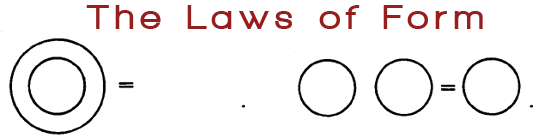
  • An Esoteric Guide to Spencer Brown’s Laws of Form #6

    An Esoteric Guide to Spencer Brown’s Laws of Form #6

    (New readers will want to start with the first installment.)

    We ended the last installment by discussing the esoteric nature of the injunction.  We continue this exploration, and bring this series to a close.

    LoF p. 81

    • In the command “let the crossing be to the state indicated by the token” we at once make the token doubly meaningful, first as an instruction to cross, secondly as an indicator (and thus a name) of where the crossing has taken us. It was an open question, before obeying this command, whether the token would carry an indication at all. But the command determines without ambiguity the state to which the crossing is made and thus, without ambiguity, the indication which the token will henceforth carry.

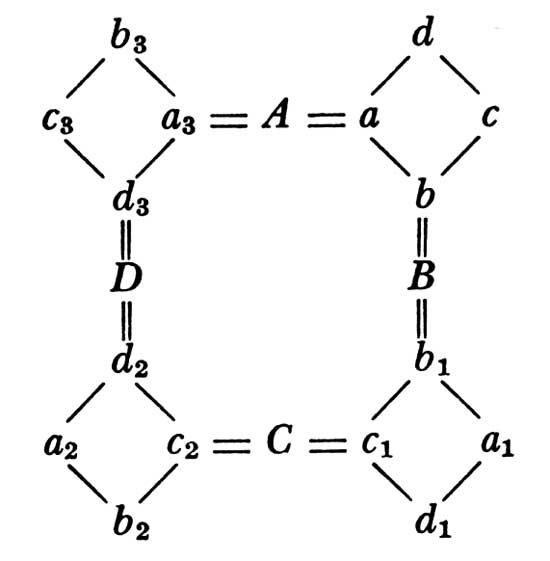
    This re-affirms that the mark has both a first and second-order character: it names the state of its content (its indication), and it is an instruction (its injunction) to mark that name, to make that distinction which yields that state. Thus every mark is both an indication and an injunction.  It is an indication of a content and an injunction on how to get there.

    LoF p. 82

    • We may consider how far, in ordinary life, we must observe the spirit rather than the letter of an injunction, and must develop the habitual capacity to interpret any injunction we receive by screening it against other indications of what we ought to do. In mathematics we have to unlearn this habit in favour of accepting an injunction literally and at once. This is why an author of mathematics must take such great pains to make his injunctions mutually permissive. Otherwise these pains, which rightly rest with the author, will fall with sickening import upon the reader, who, by virtue of his relationship with respect to the author, may be in no position to accept them.)

    All this actually relates to the task of the esoteric teacher, who (more…)