Every moment of transformation enacts an epistemology. Part of what it means to be human is to have the potential to awaken to this fact, and more: to recognize that the recognition of the inescapable relation between action and epistemology leads to the unfolding of a life-long quest and question: how do I know? Exploration of this question, always implicitly present but seldom asked, yields consequences for the entirety of human life, from the most mundane actions to the deepest soul struggles. Once one sees that it is impossible, as a living system, to escape epistemological concerns at even the most trivial level, such concerns form an ever-present background to the unfolding of one’s life. (more…)
Category: Anthroposophy
-

Blow your mind with epistemology and ontology!
To begin in the middle:
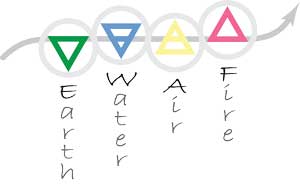
– There is no “it”, but there is talk about “it”. Ultimately the talk about “it”, the pointing to “it”, is more fundamental to “it” than anything else, because it is the RELATIONS that are primary: thingness is a subset of relatedness. Relations are not between two “things” but are recursively self-generated between other relations – things fall out of relations (things = Earth, relations = Water). Relations themselves are a precipitate of tension between complementarily opposing potentials (Air). Relations are to opposing potentials as things are to relations. Opposing potentials are themselves a precipitate of the whole, and work alongside each other within the whole simultaneously. Each step from the whole is a step-down transformation, we could say that beginning with level N, we move to level N-1. Each level is pulled out of simultaneity by an act of distinction within the whole, of the whole, by the whole. A cascading of levels of distinction yields the ontology of “things”, and simultaneously an epistemology of “knowing” activity, which together yield the whole of cosmology.
– This can be approached in another way. We can begin first with a problem of the modern condition, made apparent most strongly by both postmodernism and deconstructionism. The problem is that language is (more…)
-
The Spiritual Matrix – Transformation on Mobil Ave
—————————————————-
Hello!
I’m a huge fan of your lecture/insights re: the Matrix Trilogy. Can you PLEASE explain to me why after executing his feeling with the result that the sentinels must desist at the end of the second film, neo wakes up (at the start of the 3rd film) in that “parallel” universe with Sati, et al?
Kind regards,
Dave
—————————————————-Dave,
Thanks for this good question. I don’t have any kind of definitive answer, just some thoughts. This was the moment of transformation from “The One” into “Neo” – you could call it an initiation process. All initiation processes (that are worth their salt) involve an expansion/reconfiguration of consciousness into areas that used to be unconscious. In other words, initiation is a way of integrating unconscious aspects into consciousness directly.In the “old” days, initiation required a loosening of the life (etheric) body from the physcial body, which had the effect of letting consciousness awaken into the spiritual world. This was usually accomplished with the help of a guide/hierophant. The most expedient and direct way of making this transition involved, believe it or not, a conscious approach to death. This is meant in the literal sense: initiates would be buried alive, or would fast, or would be drowned (this is what baptism was originally!). The goal was to force the etheric body to release its hold on the physical, so that the astral body and Ego would no longer be overwhelmed with the physical body’s sensory inputs, in order to allow the more subtle effects from the spiritual world become apparent. This happens normally at death, but the technique of initiation used this relationship in a conscious and purposeful way to achieve spiritual sight.In Matrix 2, “The One” had to go through a second initiation process in order to get to the stage of being able to work on his own etheric body with consciousness (in Matrix 1 his initiation process (again, involving a death) awakened him to his astral body). The One had no hierophant for this (more…)
-
Goethean Studies Notebook
PDF: Goethean Studies Notebook (40mb)PDF: Higher quality, print version (180mb)
This notebook was created as a personal record of the 1999-2000 Goethean Studies program at Rudolf Steiner College. This unique course, conceived of and taught primarily by Dennis Klocek, is still being offered — it is now called Consciousness Studies. When I took the course, which was seven months long and met for about three hours every weekday, I liked to call it “Being Human 101”, because it offered some basic perspectives about being human that spanned the spiritual, psychological, and physical worlds in a very deep and coherent way.
There are certainly errors contained herein: it was often simply not possible to record more than the merest fragments of the vast pictures that awakened in the little Emerson classroom and flowed like honey across our minds. This record is like a six year old’s crayon rendition of a Michelangelo: it may contain something recognizable, but is no substitute for the real thing, which I encourage everyone to experience.
It is likely that the only people who will see this document are those already familiar with the course in one of its various incarnations. For you I hope that it re-awakens a commitment and enthusiasm for the hard and necessary work of spiritual transformation by connecting you to the feeling you had sitting in the uncomfortably cold room on uncomfortable chairs, listening to another mind-blowing morning lecture by Dennis: the feeling that you were exactly where you needed to be and wouldn’t trade it for anything.
For those who have not been able to take the course, this gives a tiny taste of some of the content that was presented in its 1999-2000 incarnation, and will hopefully inspire you to research the current, more highly refined and potent version.
For those who have found this page but have no idea what I’m talking about even though you’ve read this far, just flip through it like it was you long-lost friend’s photo album and see what tickles your fancy as you skim on by.
-
Levels of Dreaming and the Makeup of the Human Being: The Spiritual Ontology of Dreams
By Seth Miller
Everyone dreams, but few people find sufficient interest in their dreams to move beyond mere curiosity at their strange contents. Even many who work with dreams as a part of a transformative practice usually concentrate on their content, and only more rarely question their form, ontology, and origins. Exploring these aspects, however, can help provide a context that helps orient dreamers to some of the esoteric underpinnings of dream etiology (their meaningful origins), and can help enliven dream-based transformative practices. This article is an attempt to show how a spiritually-oriented understanding of the makeup of the human being gives a context for understanding different types of dreams, their origins, and some associated consequences for dreamwork.The language of spiritual science, also called anthroposophy (human wisdom) will be of help in this endeavor, because it maintains its cogency across multiple phenomenal realms (such as those of sleeping and waking), and because it has as its aim the ability to make clear and coherent processes which work within the physical realm but have their source beyond it, in the spiritual worlds. Fundamental anthroposophical terminology will not be explained in this article for reasons of space, and neither will the basic anthroposophical view of dreaming in general. For a brief introduction, I highly recommend that readers peruse this article: Sleep and Dreams in Anthroposophy, which provides the context (more…)
-
Workshop – Elemental Transformation: Changing How We Work with Change
Unfortunately, the workshop has been cancelled.
It will be rescheduled this Summer; keep an eye out here for the announcement!Form / Re-Form / In-Form / Trans-Form
Elemental Transformation: Changing How We Work with Change
A hands-on/minds-on workshop with Frank Chester and Seth Miller
Saturday, March 20th
9 am – 5 pm
Live Oak Charter School Petaluma, CAPre-registration is required.
All workshop materials provided. Cost: $100This all-day workshop will combine hands-on geometry with dynamic presentations and experiential exercises designed to help you deepen your relationship with transformation. You will leave this workshop with a physical form of your own creation and a more subtle and complex understanding of how transformation unfolds according to the archetypal patterning of the four elements: Earth, Water, Air, and Fire. Our goal is to inspire you and enliven your own everyday transformative work. This workshop is perfect for parents, teachers, therapists, social workers, and anyone interested in transformation. There will be a one hour period for lunch. You can bring your own lunch or drive off-site for lunch.
Frank Chester is an artist, sculptor, geometrician, and teacher based in San Francisco. He has been working with the four elements for over 10 years, having used them as an integral part of the research that led him to the discovery of a brand-new seven-sided form that has deep connections to the human heart. Frank travels widely, giving dynamic presentations connecting form, geometry, and spirit.Seth Miller has taught physics and many other subjects in Waldorf schools across the West. With a Master’s degree in consciousness studies, he is passionate about bringing forth tools for transformation; his specialty is the alchemy of the four elements. He is currently developing this work in a PhD dissertation, which weaves together alchemy, cybernetic epistemology, Goethean phenomenology, and anthroposophy. -
Ahriman and the Internet: Is there a third path?
Context:
The following post is prompted by discussion of a recent response I made concerning two essays: the first by Sergei Prokofieff, entitled “The Being of the Internet”, in which he argued that the digital media are carriers of such darkness that they are unredeemable, and the second, a reply to Prokofieff, in an article by Eugene Schwartz entitled “Anthroposophy and Waldorf Education: The Web as Will and Idea”, The reader will likely get more out of the following if both the original essays are read, as well as my original post.
In Sergei Prokofieff’s essay on “The Being of the Internet”, he states that:“If one looks behind the being of the computer on this basis, i.e. to the way information is processed and stored, then one discovers that everything is built on the duad which can endlessly and quantitatively be multiplied through repetition and differing compositions.”
also:
“In contrast the Internet or DVD puts everything on the level of purely abstract information that in addition comes in “bites [sic],” (this brings up the picture of Osiris cut into pieces by Typon) and thus is spread amongst mankind in a way towards which no ‘reverent feeling’ is possible.”
I wholeheartedly disagree with this statement. I think Prokofieff is confusing “how” with “what” in this case, and is using the term “abstract information” in a potentially (although likely unintentionally) misleading way. What makes information abstract is primarily the human being’s relationship to it, not the specific storage mechanism. For example, braille is a way of communicating written information that is entirely dependent upon a binary system of bumps and flat spaces. Does this make all information communicated through braille “abstract”; no, the notion is silly.
Simply placing information on a DVD or on the internet does not by itself change the nature of that information: what is required is an understanding of the whole system, which includes also the human (or other) beings doing the communicating, their intentions, their capacities, and so forth. Indeed, it is probably misleading to speak of “the nature of information” at all, because there is no such thing by itself. There is no “information” somehow “out there” independently of a system for which that information becomes useful. Information is always “information FOR” some system which can perceive and act or otherwise change because of this perception. As you can see, the whole concept of “information” is tricky, because the word has many meanings and is used in a variety of contexts.
I think Prokofieff is focusing too intently on the mechanism of storage (“how”). To declare that because information is communicated through digital means, it is therefore rendered into a state “which no ‘reverent feeling’ is possible” is not only a sweeping overgeneralization, but is simply not true; direct experiences of myself and countless others show this to be the case. I have been involved in many purely online interactions which have been transformative in a healthy sense, which have opened my heart to the other (and the other to me), which have broken barriers of abstraction, and which have connected me to another person, or even many people, in ways that I can confidently say further the Christ-impulse. In these moments I have a reverence for the other, for the space in between us, and for the unfolding of something new and completely NOT abstract: a living relationship. I have experienced love flowing through the internet–because human beings made the effort to do so.
“Already today one can find the most awful and defamatory attacks on Rudolf Steiner, Anthroposophy, Waldorf Schools and other institutions connected with Anthroposophy on the Internet. And this widespread effect is not comparable to that of print. There is no doubt that this will increase in future particularly with the publication of the collective works on the internet and DVD because then all alleged “vulnerable passages” in the collective works will be easily and quickly accessible.”
That attacks on Steiner and Anthroposophy and so forth are more common on the internet than in print is true, but I don’t think that this fact supports Prokofieff’s point that that internet is irredeemable. Something about the way Prokofieff states this rubs me the wrong way, as if his motivation is based on a fear of such criticism, and a desire to secretize what may invite such criticism, rather than meeting the criticism in a way that demonstrates in the action itself the worth of anthroposophical wisdom. Steiner is in no way infallible, and he said some things which were wrong, and other things which were ill-phrased or confusing. Thank God: he is human. Anthroposophists should be continually striving to develop and change, and to develop and change anthroposophy as well. Any living system that does not transform with its environment will die, and anthroposophy is no exception to this; it MUST change. Like any living system, some parts of it must decay and fall away, so that new growth can take hold and flower. I say this as a general response to the impulse to keep some information out of the stream of evolution and interaction simply because it is difficult to meet the task of transforming such information, of upholding what is appropriate and letting go what is not. This is not to say that ALL information should be available to all; simply that when the impulse to keep it secret is based on fear I become very suspect.
“If man wants to maintain his autonomy over the world of the computer then he has to differentiate between what objectively offers pure technical aid for his work and where he oversteps the mark behind which, at first unnoticeable, the ahrimanic seduction starts to take control.”
This is an excellent point, and is one that we cannot pay too much attention to. Here I see a glimmer of hope in Prokofieff’s words, because he at least indicates that there is a potential to use technology as a “technical aid”, and that this is different from being seduced by it into a kind of ahrimanic entrainment. But I would say that it is not enough simply to use technology as a “pure technical aid” for one’s work: we should use it as a means to further Michael’s mission, to manifest the impulse of Love, and to transform ourselves in progressive ways.
Now I would like to say that I primarily disagree only with Prokofieff’s conclusion that the internet is irredeemable and that it is solely the province of Ahriman. He paints only a partial picture–a valuable picture, but one that if taken by itself can be misleading. Prokofieff simply doesn’t speak to what human beings CAN do with these technologies, and to what the human being’s task is in relation to these creations. He only states that:
“What has been said does not mean, however, that one should therefore refrain from using a computer or the Internet. They belong to our civilisation and at the same time to the greatest ahrimanic provocations which mankind faces and will have to face increasingly in the future.”
I agree with this statement, in particular that it provides the greatest ahrimanic provocation which humankind has ever seen. The fact that we will have to face this more and more in the future, and he indicates, only makes his omission of any forward looking advice all the more confusing. That the internet (and its related technologies) offers a massive domain within which ahrimanic beings can do their work is something I won’t contest. But I’m not sure that I agree with Prokofieff’s indication that:
“Crucial is however, as with many similar problems, which we are faced with in today’s civilisation, whether man controls the computer and the internet or they man.”
Couching the issue as one of control, and offering only a binary opposition of outomes, seems to play right into the hands of the very beings he is ostensibly seeking to avoid. Attempts at increased control can be just as damaging as complete lack of control. As Prokofieff indicates, it is the introduction of a third option (or many “third options”) that is needed. Not control, and not abandonment. For me the third option is one that arises from the creative transformation of the will around the technologies in question. Steiner has offered us a fantastic bunch of advice on this very point. In my experience one of the most powerful ways of counteracting the ahrimanic tendencies is through the training of Goethean-style observation. This involves awakening a sensitivity to the movement of wholes, to their form, patterning, gesture, and meaning. This is not the space to give details on this way of walking a middle path, but at the very least I can indicate something of what I am referring to by linking to a recent essay on Goethe and a new aesthetic consciousness.
Prokofieff states that:
“Here the attempt is made in purely ahrimanic form to create a worldwide web that connects as many people as possible but in a way that mankind becomes increasingly separated from the cosmos and the hierarchies and thus is bound up with what was described above as an ahrimanic spider web.”
Earlier he quotes Steiner as saying that man will have to unite with the beings of the ahrimanic spider web. My sense is that if such a fate is in store for us (and it does certainly look as if we are going this way), then isn’t it important to build the capacities now that will help us in the future? Shouldn’t we learn how to keep ourselves connected with the impulses of the Michaelic school in the context of the first glimmerings of this spider web that takes the form of the internet today? Why shouldn’t we be active in doing what we can to make it possible to keep our spiritual evolution from future (and present!) stagnation? Should we leave the internet, its development, its adoption, and its various methods of capturing the will and intention of human beings up to those who have no esoteric understanding of what the consequences may be? Should we grant Ahriman his domain, bowing to get out of his way as he reaches his fingers further and further into our modes of perception and communication?