It's Elemental

Category: Anthroposophy

  • Universal developmental stages? – A continuation

    A friend continued:

    Does this mean there is no universal developmental stages that we each pass through simply due to the fact that we are all human? What are the underlying strata, the ground upon which both these explicate perspectives emerge? What is the implicate order regarding human development?

    Prompting the response:

    As for universal developmental stages… yes and no.  I guess I would point to the process of recapitulation.  You, as a physical being, go through stages in development which are a unique recapitulation of stages that have individually been achieved over vast timescales.  But, as modern beings, because what was achieved so long ago by (or rather ‘with’ and ‘through’) our ancestors (going ALL the way back, here) no longer requires the same kind of attention that it did when the developments were being worked out, we speed through these stages without any cognizance.  We also don’t have to experience the full drama of the development of those stages; we only get something like the form of an image of those stages, more like a hint or better a ‘gesture’ of those past stages.  The result is that instead of, say, having to develop anew the ability to breath air from scratch, we simply find ourselves with a capacity for breathing.

    The particular capacities we are thus ‘given’ are not “universal” in the absolute sense that ALL beings do this.  But it is close to universal when considering humans.  We are the ongoing unfolding of our past — all of our past.  And some capacities require more of us now than they will in the future, and others require less of us not than they did in the past.  Thus, we are no longer challenged so much by the development of breathing, but have a more difficult time with upright walking.  It is easier to have a mental picture than it is to dissolve a mental picture into nothing.  It is easy to feel rage, but much more attention is required to feel compassion.  These are tracings of past and future capacities, and we’re constantly in the flow of their development (and there is also a process of dissolution of capacities… but we’ll not go into that). 

    Physical Recapitulation
    Physical Recapitulation

    And there are always exceptions.  Some people who are born now are actually working out dramas that the bulk of humanity dealt with eons ago, and others are born who are dealing with developing capacities that the bulk of humanity will likely encounter only in the future.  So it’s not a simple question of everyone being equal.  Diversity is everpresent.

    Additionally, some of the capacities that have been given through our long history are only partially so.  Or rather, their development has only proceeded to a certain stage, beyond which any development or progression depends upon actions taken here and now.  The fulfillment of these capacities is not a given, but requires actual work on our part.  For example the capacity for free ethical action that comes from within the individual; this is not something that just everyone ‘has’ — it requires a certain amount of work.  So too the capacity to perceive accurately in the spiritual worlds requires individual work; it’s not yet capable of being given as an already-developed gift to the whole of humanity (like vision is) because the work required for that is still being done.

    The upshot of all this is that the situation is very complex and intertwined with multiple streams, working from the past and (sorry for sounding weird) from the future.  There is no ‘one-size-fits-all’ when it comes to these things, because we’re constantly dealing with a whole variety of interpenetrating levels and times.  Nevertheless, there are ‘global’ patterns at work, which can be perceived if one knows how to look.  David’s books very directly hint at this.  Also examine Richard Tarnas’ book The Passion of the Western Mind.  These are works in the popular domain which point to the sense of ongoing, non-random, directional development of consciousness and human beings.  (Of course, one could find a much more direct treatment of this aspect if one has the desire to look into more esoteric sources, such as Steiner.)  This is where you start to find a way into the question of the Implicate Order with respect to human development…

  • Evidence, science, and spiritual knowing: developing organs of spiritual perception

    Evidence can be gained through a variety of means.  Just as you would wish to use a sensitive detector of particular frequencies of light if you are doing x-ray crystallography, and not, say, an acoustic detector, so too we need to develop and use detectors that are appropriate to the realm in which we wish to gather evidence if we are to hope to gain any knowledge in that realm. 

    Thus, if we wish to develop knowledge of spiritual realms, we will need to develop organs of perception (for no material ‘device’ can do this for us) which are capable of perceiving in the realm of the spirit.  Not only that, but those organs, like any physical detector, need to be sensitized, tuned, and placed in the proper experimental setup for good evidence gathering to be likely.

    Of course, the basis for the spiritual organs of perception we are talking about here are rooted in our attention: it’s quality and rhythm.  For example, we lay people can only talk about all the fascinating stuff coming out of quantum mechanics in a second-(or third)-hand way, because we have ourselves not done the experiments in question, and our judgments and opinions on the matters are derivative of the interpretations of these experiments by those who have done them and their interpreters.  We would not expect an interested lay person to provide new information about quantum processes ex nihilo, but we can learn to conceptualize and come into closer relationship with those processes by virtue of our studies of what has been communicated about them by relative authorities.

    The exact same holds for spiritual considerations: those that have developed capacities to perceive spiritual realms can interpret and communicate these results to those of us that don’t, and we can study and learn about realms which we may not otherwise have access to as a consequence.  Moreover, just as we might, if we were really interested, take the necessary steps to learn the skills and concepts necessary to do research in quantum mechanics, so too we can take the steps necessary to learn the skills and concepts that allow one to do research in the spiritual worlds.

    Or does all this sound completely far-fetched?

    Unless we are scientific researchers in a particular field, we actually have very little direct evidence for our knowledge about quantum mechanical processes, chaos theory, and so forth; it’s almost completely anecdotal, yet we trust those that have done the research to provide us with a coherent and accurate picture of ‘what it is like’, and primarily on this basis we feel comfortable using the concepts and talking the talk.

    I’m only writing this because I wanted to point out that the scientific method in no way whatsoever excludes the non-physical, and that it is possible to have a clear understanding of how that is so; i.e. such a thing as spiritual science is possible.  Poor research is just as much of a problem in physical science as in spiritual science — and we must either rely upon ‘experts’ to let us know when this is the case or become an expert ourselves.

    Tree of the Wise
    Tree of the Wise
  • Organs of Perception

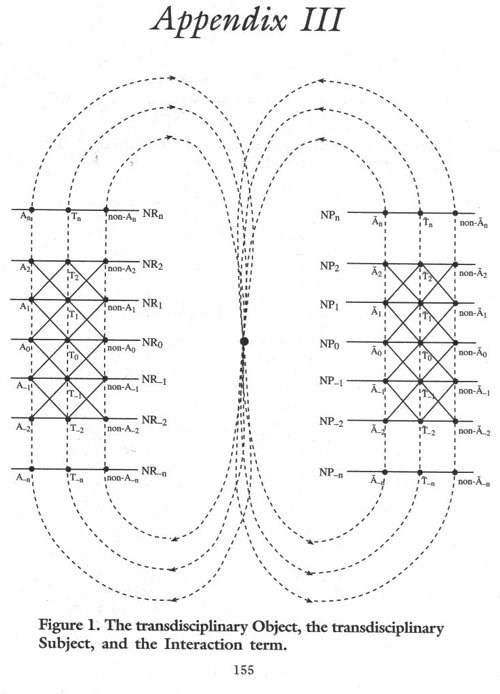
    Basarab Nicolescu is a physicist and proponent of transdisciplinarity.  In the book of the same name (which he edited), he speaks of multiple “levels of Reality”, which are accompanied by multiple “levels of perception”. These two complementary duals form, on the one hand, what he calls the “transdisciplinary object” and on the other the “transdisciplinary subject”.  These are united by a flow of “nonresistance to experience” he calls the sacred, which moves through all the levels.  See the picture from his book below:

    Transcendent Object/Subject and Sacred
    Transcendent Object/Subject and Sacred

    Although this view is a bit schematic, one of the things that Nicloescu includes which is often very lost in modern discussions about these sorts of things is the necessity for a corresponding “level of perception” when encountering various levels of reality.

    Specifically, this is something verifiable in my own experience: that it actually takes not just some kind of intellectual shift to see things from a new perspective, but rather the rhythmic development of new organs of perception in order to perceive new realities.  I’m speaking of ‘organs of perception’ because they are strictly analogous to real organs like our eyes and ears, but without physicality — they are, if you will, organs made ‘on the fly’ in the soul, which are capable of resolving details in a situation that otherwise would be lost.  Their constituency relies entirely upon the way in which they are themselves created — they form in the image of what they can thus perceive.  For example, a Waldorf teacher I know has developed in her contemplative work with children a soul-organ which can perceive movements of ‘warmth’ in ways that offer specific and practical information and actions regarding individuals — this is something experienced as eminently real and subtle, which would be lost on anyone who hadn’t done the same rhythmic work to create the relevant capacity for experience to hold that kind of perception.

    It seems we often expect that such perceptions should be contingent upon a primarily intellectual shift in understanding — and an understanding of outer phenomena in particular — as if it were only a question of having the right ideas about things that would allow us to perceive newly.  I think this is an error;  that kind of change is only preparation and accompaniment, but cannot fully constitute the necessary basis for actual perception of new realms.

  • Coros Meditative Retreat: The Teachings of Isis: From Anxiety to Insight

    Dennis Klocek is holding a Coros Institute meditative retreat on April 3rd – 5th (Palm Sunday Weekend) at Walker Creek Ranch in Petaluma, CA.

    Topics will include:

    · Death of the spirit in the material world as a source of unconscious anxiety.
    · Working on the essential steps of separating the soul forces in the process of self-development.
    · Re-uniting effectively the soul forces and forging new insights into dreams, destiny and karma.

    If you have never heard Dennis or worked with him before, you are in for a real treat.  He walks his talk, and offers a very unique approach and vision of personal transformation.  It’s not just theory, but well-honed advice that weaves together decades of personal meditative work, phenomenological study, and repeated application.  You don’t want to miss it!

    Attached is a PDF flier that you can print and mail in to register: do it before you come up with some lame excuse to stay home and keep your life static and unchanging!

    The Teachings of Isis: From Anxiety to Insight

    Check out Dennis’ Coros Institute for more information: http://www.corosinstitute.org


  • distinguishing between the ego and “I”


    Our experience of ourselves is in many ways completely mediated by aspects which are located beyond the normal boundary of the “I”.  I’d like to offer one possible way of looking at the issue.  

    I approach this question concerning the boudaries of the “I” by taking into account the transformations of the “I” as it works through and within the physical body and the soul body on its path from death to life to death to life.  To do so requires distinction between the ideas we have about our “I” and our unmediated, direct experience of our “I”, and more importantly between our “I” and what we can call our ego, on the basis of the usage of this term in the Western traditions (particularly psychology, which deals almost exclusively with the ego).  

    When incarnating, the human “I” experiences a period of darkness, which only gradually lifts throughout life, until (perhaps around the age of 21 or so) the first glimmerings of what I am referring to as the “I” become available to the experience of the ego, which is a structure that is present much earlier on, and is built up through a variety of relations between the burgeoning activities of the physical/soul bodies and the ‘outer’ worlds.  

    The incarnation of the “I” takes place not at birth, but much later, and sometimes not at all; this despite the fact that we each have the constructed ego that is constantly built up as a semi-permanent dialog between the inner activities of the body/soul and the various bodily and ensouled elements of our environment.  This ego includes the remnants of the activity which is rightfully regarded as the spiritual activity of the “I” – thinking.  Thus the ego becomes filled with thoughts but lacks the awareness of whence these thoughts originate.  In the meantime (in accord with all the social, cultural, historical, familial, etc. ‘forces’ at work around all the activities of the aspects of the human being which are not the “I”) the ego maintains the false impression that it is the one doing the thinking.  

    This then leads us to the question about how we draw the boundary around what we consider to be our “I”, which turns out more often than not to be a question to the ego about the ego.  There are no boundaries to the “I” in the normal sense, the “I” is a spiritual activity, a process.  It is a wonderful aspect of the spiritual world that “I’s” are capable of penetrating and moving with each other; their activities can merge, coincide, and diverge.  The idea of boundaries of the “I” only arises when we take our experience of the rules at work in the realm of physical bodies and our sense life and apply them to an arena in which no physical bodies or physical sense organs exist.  In other words, it is like asking about the flavor of a trapezoid.  

    We can have ideas, thoughts about the boundaries of our ego, but the activity upon which such ideas are based rests only in the “I”.  We can have the thought “My physical body only works because it includes trillions of bacteria and other organisms which I do not directly experience, but which science tells me are required for my process of digestion; if these microorganisms did not permeate my gut, I would be incapable of digesting my food.”  This leads us to the thought that perhaps I’d better take a look at what I consider to be my ‘self’ – shouldn’t it include all the aspects necessary to maintain the activities of my physical body, which support then my capacity to think and experience?  

    We can thus, in our thought-life (not our thinking-life) come to the idea that the normal drawing of the boundary between ‘self’ and ‘other’ is in some ways quite spurious.  There is then an attempt to fill the gap thus created (in thought) with other thoughts, which try to reorganize the connections made in thinking.  So we say things, perhaps, like “Well, yes, ‘I’ really must include the bacteria in my gut” and so forth.  

    But all the while we are missing the very activity that is the source of all of these reconfigurations of our thought-life; our thinking.  It is when we turn our attention to the thinking process itself that we start to come directly into contact with the “I” itself.  This experience, the recognition of the “I” by the “I”, is not a thought, but is what can occur when thinking takes itself as its own object.  In such a case, a completely different set of experiences become possible with respect to the question of the ‘boundaries’ of the self. 


    Moreover, what our ego keeps hidden from consciousness directly affects our perceptions and assumptions.  It seems that the ego, in a sense, precisely constitutes its boundaries by this very omission.  What I feel coming from my ego changes dramatically from situation to situation, not on the basis of what is included so much as on the basis of what is left out, and what’s more, on how it is left out.  

    The ‘mood’ around the process of the ego’s self-entrainment says more about my deeper nature than its explicit self-identifications ever could. 


    Cannon Beach Jan 2008-12

  • Alchemy and narcissistic, reproductive, and creative learning

    Alfonso Montuori, one of my professors at CIIS, has identified three styles, or modes, of learning, which he calls the narcissistic, the reproductive, and the creative.

    From his article, The Quest for a New Education, From Oppositional Identities to Creative Inquiry, narcissistic learning is “an approach to education that sees the source of knowledge as inside the knower.  It focuses on the expression of the knower’s experience and interiority and his or her personal growth and transformation.” (Montuori, Quest: p5)

    Reproductive learning, by contrast, is “an approach to education that sees the source of knowledge as almost exclusively outside the knower, and focuses on the accurate reproduction of that knowledge by the knower.” (Montuori, Quest: p5)

    Creative learning is a middle path, “an approach that views inquiry as a creative process.” (Montuori, Quest: p5)

    I see a correspondence with Montuori’s categories and those of the alchemical tradition and the anthroposophical tradition.  Alchemically, what Montuori describes as reproductive, creative, and narcissistic learnings are embodied in the principles of Salt, Mercury, and Sulfur.  The Salt principle is one which is observable when you have a solution out of which a precipitate falls.  The process is ruled by Gravity and tends to result in innumerable discrete bits with a greater density than the original solution.  The precipitate literally ‘falls out’ of the continuously interconnected fluid mass to become something distinct, something identifiable and separate.  Alchemically, the Salt process produces forms which have Earth characteristics.  This describes the process of reproductive learning as an exact analogue: more of the same.  Specific bits of information carry the value in reproductive learning, to the detriment of the interconnectedness of the facts when they were ‘in solution’.  It is a strange irony that reproductive learning has most strongly co-opted the very metaphor that exemplifies the state of being inextricably contextually connected and turned it into its rally cry: “Solve!”  The word ‘solve’ actually means to loosen, but the Salt process of reproductive learning inverts the dynamic into one that requires a singular, discrete, and correct answer to the undifferentiated mass of the original ‘solution’ out of which a ‘solution’ is derived!  The Salt process densifies, separates, and agglomerates into ‘false’ wholes by virtue of external pressures while lacking inner coherence or connectivity.

    Taken to the other extreme, we end up in narcissistic learning, exemplified by the process known alchemically as Sulfur.  Here, learning ignites itself from within, taking its own substance as fuel.  Sulfur is ruled by the higher-order process of Levity, and is precisely what counteracts (in a polar-opposite way) the Gravity of the Salt process.  The Sulfur process tends towards the periphery, taking the facts in only inasmuch as they can be added fuel to the fire; i.e. Sulfur as a process is completely self-involved.  The particularity, the individuality, the singularity of the specific facts are burnt away exactly to the extent that they carry within them what relates to the particular mode of manifestation of the Sulfur process.  Everything else gets left behind as a char, an ash, devoid of (apparent) life (in fact, you may notice, the Salt and Sulfur processes always occur together in reciprocity, complementarity, or opposition).  Sulfur, like narcissistic learning, takes only itself as its object and contextualizes everything else around its own process.

    Creative inquiry embodies the Mercuric process.  Mercury is the process that links the Salt and Sulfur – it is the process that performs the alchemical ‘marriage’ between the Salt and the Sulfur.  The goal “to make the academic transformative and to ground the transformative in the academic” (Montuori, Quest: p5) is a way of saying that the transformative (Sulfuric) needs to ‘marry’ the academic (Salt) in order for a healthy learning to occur.  Montuori recognizes explicitly that the path of creative inquiry is one that exemplifies “a middle way, a spectrum of possibilities between extremes” (Montuori, Quest: p5).  The Mercuric process is the go-between, the walker of boundaries, the oscillator, the Messenger, the one who takes on the characteristics of the other while leading the other beyond itself.  It embodies aspects of both the Salt and Sulfur processes, by integrating them into a new form – a creative act – that is impossible without either the Salt or Sulfur.  Mercury’s/Herme’s caduceus, with its two entwined snakes, can be considered the alchemical Mercuric ideal of continuous interplay and harmonizing between the Salt and Sulfur processes, acted out in the being himself and carried as his most prominent symbol.

    Anthroposophically speaking, the Salt process is linked to a being known as Ahriman (a name taken from ancient Persia) while the Sulfur process is linked to a being known as Lucifer (whom I imagine you are all familiar with in some form).  The Mercury process – the middle way – is linked to the Christ being.  However, I won’t go into the details as this post has probably already put some people to sleep (another dual Salt/Sulfur process: part of you becomes a precipitate – your physical and life bodies – while another part of you expands to the periphery – your astral body and “I”; and in your dreams you embody Mercury…)

    Tulip-5


  • concerning the evolution of consciousness

    Earth –> Day-waking (i.e. ‘normal’ adult) consciousness 
    Water –> Imaginative consciousness 
    Air —-> Inspirational consciousness 
    Fire —> Intuitive consciousness  

    Earth –> Thinking ‘about’ – object-oriented 
    Water –> Thinking ‘with’ – process oriented 
    Air —-> Thinking ‘between’ – polarity-oriented, (Brad exemplifies this very well) 
    Fire —-> Thinking ‘as’ – whole-oriented  

    Further, considering that all thinking is relational, and all relations are between beings:  

    Earth –> consciousness of other as if the other was an object (separation) 
    Water –> consciousness of other as if you were dreaming into the other’s experience, as if you were ‘seeing’ in an inner way the other’s perspective 
    Air —-> consciousness of other “as if” you were the other from the inside, as if you were ‘hearing’ in an inner way the tonality of the other’s experience 
    Fire —> consciousness of other AS the other, as if the other were living through and into you directly, with almost no distinction between who is who  

    The sequence is one which lays out the polarities between separation and coincidence of self and other.  Goethe made a strong case for the Water, or process, level of experiencing with his morphological studies of plants and his scientific work (particularly optics).


    Earth, Water, Air, and Fire
    Earth, Water, Air, and Fire