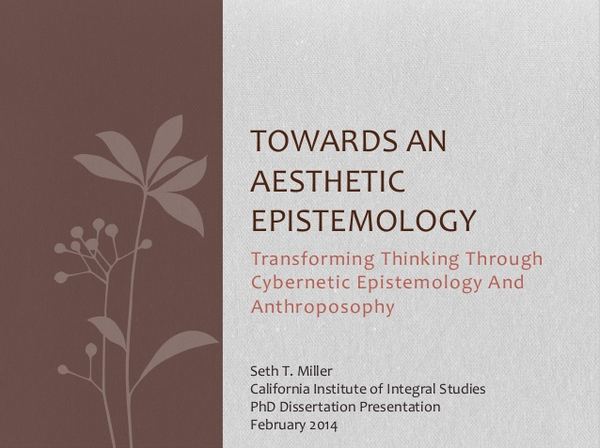
In February 2014 I successfully defended my PhD dissertation, titled “Toward an Aesthetic Epistemology: Transforming Thinking through Cybernetic Epistemology and Anthroposophy.”
The following is the abstract and a slideshow presentation that pulls out the crux of my arguments.
Abstract
The complexity, subtlety, interlinking, and scale of many problems faced individually and collectively in today’s rapidly changing world requires an epistemology—a way of thinking about our knowing—capable of facilitating new kinds of responses that avoid recapitulation of old ways of thinking and living. Epistemology, which implicitly provides the basis for engagement with the world via the fundamental act of distinction, must therefore be included as a central facet of any practical attempts at self/world transformation. We need to change how we think, not just what we think. The new epistemology needs to be of a higher order than the source of the problems we face.
This theoretical, transdisciplinary dissertation argues that such a new epistemology needs to be recursive and process-oriented. This means that the thoughts about thinking that it produces must explicitly follow the patterns of thinking by which those thoughts are generated. The new epistemology is therefore also phenomenological, requiring the development of a reflexivity in thinking that recursively links across two levels of order—between content and process. The result is an epistemology that is of (and for) the whole human being. It is an enacted (will-imbued) and aesthetic (feeling-permeated) epistemology (thinking-penetrated) that is sensitive to and integrative of material, soul, and spiritual aspects of ourselves and our world. I call this kind of epistemology aesthetic, because its primary characteristic is found in the phenomenological, mutually fructifying and transformative marriage between the capacity for thinking and the capacity for feeling.
Its foundations are brought forward through the confluence of multiple domains: cybernetic epistemology, the esoteric epistemology of anthroposophy (the spiritual science of Rudolf Steiner), and the philosophy of the implicit as developed by Eugene Gendlin.
The practice of aesthetic epistemology opens new phenomenal domains of experience, shedding light on relations between ontology and epistemology, mind and body, logic and thinking, as well as on the formation (and transformation) of identity, the immanence of thinking in world-processes, the existence of different types of logic, and the nature of beings, of objects, and most importantly of thinking itself and its relationship to spirit.
Please note that Slideshare translated the Greek letter Theta into the letter Q. This is unfortunate, because I used the Greek letter for its geometric shape, pictured correctly at left.
All the qualities of the physical world exist through the interrelations of things to each other. What Moleschott says is correct for physical existence: ‘All existence is an existence through qualities. But there is no quality that does not exist through a relation.’ Just as everything of a soul nature contains something in itself by which it points to something outside itself, so conversely, a physical thing is so constituted that it is what it is through the relation to it of something outer.
(Rudolf Steiner, Riddles of the Soul, Mercury Press, 1996, p. 69.)
For such a philosophy, the relations that connect experiences must themselves be experienced relations, and any kind of relation experienced must be accounted as ‘real’ as anything else in the system.
(William James, Essays in Radical Empiricism, Cosimo, Inc., 1912/2008, p. 20)
In aesthetic epistemology, notions of “reality” are replaced by “patterns in process.” “Things” are (ontologically) patterned processes. We mistake the nature of the universe when we presume that “things,” to be, must “be” from the bottom up: on the basis of some “substance,” which THEN interacts in processes to yield what we experience (the first coherent expression of this began with the atoms in the void hypothesis of Leucippus and Democritus in Ancient Greece). We assume that it is silly to speak of patterns of process without some kind of “thing” that we can point to as an indicator that the process is proceeding. Because of the way our senses are involved in cognition, we tend to count as “real” only what can be made apparent to us through our senses (or their extensions via instruments). This is a huge presumption on our part. What if we tried to conceive of “substance” as a secondary phenomenon? What if process (thing-less process) is more primary? In this view, things are precipitates (momentary nodes, relatively ‘still’ areas of patterned processes) of higher-order relations… not relations between THINGS but relations qua the activity of relating. This may sound abstract, but this is because we are trained to think of reality in terms of substances (sub-stances: the “underneath-standings,” the bits from out of which a universe gets built).
The best example of one way that this can look is given in the field of mathematics. Mathematics has no atoms, not even metaphorical atoms; it is entirely substanceless. Rather, mathematics has, at its base, processes and their relations. Even numbers aren’t the basis of mathematics, (more…)
About 100 years ago the birth of quantum theory changed forever how humans perceive the universe… sort of. Certainly “quantum physics” is a phrase found far outside the boundaries of physics classrooms, and has even achieved a fairly wide popularity through movies such as What the Bleep and works like Fritjof Capra’s Tao of Physics. Does this mean, for the average person who has at least been introduced to some basic ideas from quantum mechanics, that reality will never be the same? Or do ideas from quantum mechanics (QM) remain something of a curiosity—fascinating and mind-boggling but so far removed from ‘normal’ everyday experience as to be essentially irrelevant?
Take a moment and ponder this question for yourself. Can you remember how you were affected when you first heard of electron tunneling, the EPR paradox, entanglement, the uncertainty principle, or more likely, Schrodinger’s cat? Did your view of the world change? A more relevant question might be: how do you know? Perhaps the next time you looked at the shimmer of a butterfly’s wings or the more prosaic spectrum reflected off a thin layer of oil on pavement you gave an intellectual nod to the underlying quantum mechanical principles which give rise to these phenomena… and then went on about your day just like it was 1904 (the year before Einstein’s four seminal papers revolutionized the world of physics—many other worlds are still playing catch up).
Now, quantum mechanics is, without a doubt, one of the best theories ever produced by human minds. The effects of QM are likewise undeniable in their scope, and have reached every corner of the Earth, influencing the course of the 20th century immeasurably, mostly through the various technologies it has made possible (from computers and just about everything electronic—transistors, anyone?—to advances in medicine, communications, manufacturing, and more). But the problem here is that (more…)
This notebook was created as a personal record of the 1999-2000 Goethean Studies program at Rudolf Steiner College. This unique course, conceived of and taught primarily by Dennis Klocek, is still being offered — it is now called Consciousness Studies. When I took the course, which was seven months long and met for about three hours every weekday, I liked to call it “Being Human 101”, because it offered some basic perspectives about being human that spanned the spiritual, psychological, and physical worlds in a very deep and coherent way.
There are certainly errors contained herein: it was often simply not possible to record more than the merest fragments of the vast pictures that awakened in the little Emerson classroom and flowed like honey across our minds. This record is like a six year old’s crayon rendition of a Michelangelo: it may contain something recognizable, but is no substitute for the real thing, which I encourage everyone to experience.
It is likely that the only people who will see this document are those already familiar with the course in one of its various incarnations. For you I hope that it re-awakens a commitment and enthusiasm for the hard and necessary work of spiritual transformation by connecting you to the feeling you had sitting in the uncomfortably cold room on uncomfortable chairs, listening to another mind-blowing morning lecture by Dennis: the feeling that you were exactly where you needed to be and wouldn’t trade it for anything.
For those who have not been able to take the course, this gives a tiny taste of some of the content that was presented in its 1999-2000 incarnation, and will hopefully inspire you to research the current, more highly refined and potent version.
For those who have found this page but have no idea what I’m talking about even though you’ve read this far, just flip through it like it was you long-lost friend’s photo album and see what tickles your fancy as you skim on by.
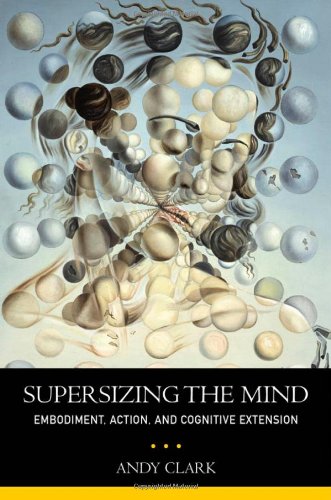
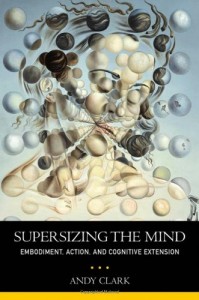
A Review of Andy Clark’s Book Supersizing the Mind: Embodiment, Action, and Cognitive Extension
by Seth Miller
Ask your neighbor: “If you had to locate your mind, where would you point?” In all likelihood, the overwhelming response will be a finger on the cranium. Ask Andy Clark, a professor of Philosophy in the School of Philosophy, Psychology, and Language Sciences at Edinburgh University in Scotland, and you might see him point to his mouth, his hands, and even occasionally to objects in the world such as pencils and notebooks. By way of explaining this seemingly odd behavior, Clark might shrug and hand you his newest book, Supersizing the Mind: Embodiment, Action, and Cognitive Extension (Clark, 2008).
In this work (StM), Clark attempts to flesh out (pardon the pun) the thesis that (more…)
Maybe you’ve had this experience: You are thinking about an acquaintance that you haven’t thought about in a long time and at that moment the phone rings. “What are the odds that it’s Jerry?” you think to yourself. And when it IS Jerry on the other line it seems somehow magical, amazing, beyond mere chance. Was this ‘just’ a coincidence, or is there something meaningful about this admittedly unusual event? Hopefully this is something you’ve wondered about before. The whole ‘coincidence’ thing is a fascinating realm to explore, and how we address it says much about our paradigm. What is interesting to me is the debate, such as it is(‘nt), between those who have a mathematical/statistical approach and those who have a spiritual approach (not that these are the only two camps, just that they represent a the major polarity).
For an excellent presentation of ideas about this very issue, listen to this RadioLab episode: Stochasticity. (If you have never met RadioLab before, you’re in for a treat!)
A mathematician will look at coincidence and point out how most people that find meaning in coincidence fail to understand the vastness of the potential field of events. In such a large set, not only is it not strange that coincidences occur, it is inevitable that they do; just a consequence of the numbers, nothing ‘special’.
But of course this completely misses the undeniable reality that such events ARE special by virtue of the fact that we actually experience them as such. What strikes me as unfortunately bizarre is that these two views, “just the numbers”/”full of meaning”, are CONTRASTED, when they are (obviously, it seems to me) complementary.
I would agree with the mathy people that such events are bound to occur, and that it is easily possible to overstate the importance of coincidences in a psychological sense. In other words, we should be careful with how we subjectively responds to coincidences; we should never let coincidence substitute for other means of addressing a phenomenon, such as rational thinking, heart-sense, discussion with friends, etc.; it should ADD to those other means.
I would also agree with the ‘meaning’ people that just because coincidences are inevitable (which is kind of funny, given the meaning of the terms), does NOT provide a sufficient basis for discarding any potential meaning that such events might have. Humans are meaning-making creatures. We can choose to make the meaning of a coincidence “this coincidence is meaningless” or we can make any other meaning from it. In fact, the very stochastic nature of coincidences is a solid reason why we SHOULD ‘use’ them to make meaning.
Take pendulum work, a popular modern divination technique. Here too we are looking at a stochastic system, which can vary within certain parameters… but the parameters are too delicate to be able to precisely control or predict, which is the point. Tiny hand tremors, gusts of wind, the rhythm of the pulse, and so forth, all can have effects on the non-linear motion of a pendulum. The fact that stochastic and physical processes underly and limit its potential motions (pendulums don’t usually point against gravity, for example) does not mean that the system is meaningless, because we–the human beings, meaning-makers–are always a part of the system. And this is the WHOLE POINT of divination, pendulums, and so forth: the taking of a stochastic process of sufficient simplicity and complexity that we can USE it to make meaning. Would any system of divination use a relatively non-variant process as its base? Not a chance. Systems in which differences can be maximized with little effort and within strict boundaries work best. With too few options the lack of variation doesn’t mesh well with the lived complexity of our experiences, (with the limiting case being a completely repetitive system that only gives one result, ex: “Will this rock fall upwards or downwards when released?”), while with too many options it becomes difficult to “find” meaning because we lose the basis for distinguishing between different states (too much ‘gray’ area, when the whole point of these kinds of techniques is to exit with some kind of new direction or idea that is clearly distinguishable from other options).
Does all this mean that the meaning made is “really” meaningless? NO. This is the point that the mathy people don’t quite get, because they discount the OTHER processes (which they generally know next to nothing about) which are involved in meaning making. Such processes, which are VERY difficult to get a hold of (in my view because these processes involve more than what can be accounted for by manipulation of the physical world), are sacrificed on the alter of what can be held in the Mind of Reason.
It makes complete sense for humans to use stochastic systems as the basis for meaning-making, because they have just the right features to allow the meaning-making parts of ourselves to activate. Imagination, the capacity to think “what if…?”, and a heightened sensitivity to difference all accompany the emotional and mental ‘opening up’ that is a central aspect of any transformation.
The issue about this kind of thing usually rests in the term “really”. Is coincidence “really” meaningless, or “really” meaningful? In other words, the question is usually taken ontologically, rather than epistemologically (it’s much simpler to think ontologically, hence psychological “projection”, while contrastingly the process of individuation has strong epistemic roots).
However, in regards to the ontological aspect of coincidence, it is simply not possible to “objectively” gather, using conventional means, an “answer”. The stochastic nature of the physical processes means that no individual coincidence can be actually predicted. Given a particular well-defined system, the fact that a certain individual coincidence willeventually occur with a specific probability can be known, but NOT when that coincidence will occur. The whole thing is very ‘quantum’ in this respect; there is always some inherent “fuzziness” beyond which we cannot penetrate directly, forcing us to rely upon stochastic (and other) techniques. This is precisely where the human being can enter the picture (“other techniques”), helping fill the gap that is left by the math, calling forth from us aspects of ourselves that prime us for change. As long as we don’t rely upon the techniques as substitutes for what otherwise requires harder thinking, they have a place. It is just as much a mistake to reify the meaning of such a system as it is its meaninglessness, ontologically speaking. If I throw some bones and then say “This is God’s Word for me”, and then psychologically close down all other options, I’m probably missing something, but if I use it to enhance the subtlety of my own meaning-making process, taking the ‘signs’ as spurs for my own development in the wider context of all the other meaning-making processes at work, then things probably won’t get out of hand.
Now, just because I am dodging the ontological question here doesn’t mean there is no ontological basis for “meaningful coincidence”. I’m just stating that (in my opinion) the vast majority of human beings don’t have access to the necessary capacities that would make this ontology available to consciousness; not that it can’t be. But my sense is that for those few individuals for whom such a capacity is awakened, it is precisely the divinatory techniques that are first abandoned, because much more direct (spiritual) routes to meaning-making are then available. In Steiner’s terminology this would be a transformation from Imagination to Inspiration and Intuition.
Coincidences can be BOTH stochastically necessary AND meaningful, in the full senses of both those terms.
A response to the question: “How is chaos theory non-determinant?”
This is an interesting question, because I think it might normally be asked in the opposite way: “How is chaos theory DETERMINANT?”, because chaos theory is, well, chaotic, so it seems more logical to connect chaos with non-determinancy than with determinancy.
So to explore the question that wasn’t really asked: The techniques which we have discovered that allow us to analyze systems that exhibit chaotic behavior are completely deterministic: they are mathematical in nature, having the feature of acting like an Ouroboros, where the output becomes the input in a recursive cycle. We can start with even very very simple systems, and show how chaotic behavior results when the system evolves, when that system’s evolution takes place in ways describable by this type of recursive mathematics (not all systems are so describable). Really the MATH isn’t the thing here, it’s rather the RECURSIVE PROCESS, RULE, or PROTOCOL that is important. The math is just a really nice and clean way of expressing the essence of what happens when a system evolves by following a recursive rule.
So chaos THEORY is determinant in that the rules which it utilizes to describe evolving systems have the potential to be calculated EXACTLY from iteration to iteration. In other words, if we had a computer that could deal with an infinite number of digits we could theoretically pinpoint the next iteration describing the state of a system at the next moment with complete precision. BUT, there are serious caveats to this when applied to anything beyond the purely mathematical formulations themselves. REAL systems may be more or less calculable, more or less complex, and more or less willing to submit to the precision capable in theory. The determinacy of chaos theory is therefore more like a theoretical determinacy, having a dubious ontological status. I won’t get into the very crazy and amazing philosophical arguments that whirl around such things, to your immense relief. Suffice it to say that THE WORLD IS MYSTERIOUS, and we have to be careful when dealing with the connection between our thinking and our observing.
The ‘problem’ with chaos theory is that we can’t observe closely enough to know where to START our calculations, so we ALWAYS know that they are ‘wrong’ when dealing with the actual observable world. This is that ‘sensitive dependence upon initial conditions’ thing again: there is no lower limit at which a difference does not potentially make a difference, even ALL the difference. In other words, even the smallest possible change cannot be ignored. The thing is that we can never know ahead of time when such a difference may be either influential or inconsequential – we have to let the system evolve in actuality in order to find out. We can’t calculate the future states of the system (which are theoretically determined!) with much success because (depending upon the system’s complexity and initial state) as soon as we get a few iterations under our belts our calculations tend to diverge from other initial states that were infinitesimally close to the one we are actually calculating. So our results tend to be so far off from what we will later actually observe that we start calling the whole thing a theory of CHAOS, even though every step in the process is ‘determined’; hence “deterministic chaos”. So even today a large bulk of weather predictions are based not off of complex theories of high pressure and low pressure zones, temperature gradients, moisture content, and such, but rather simply off of a comparison with past ACTUALITIES. Predictions START with a comparison of the averages for a particular place for that same day in previous years, because this is often a better predictor than if we were to try and start with vastly incomplete current data. The best predictions, of course, blend the two methods, but you’ll notice that nobody (okay, this isn’t true, but such people have completely different methods for prediction) is giving weather predictions much beyond a week or two at best. This isn’t just a fault of our weather theory, but is a consequence of the RECURSIVE NATURE OF NATURE.
So what is interesting is that our understandings from quantum physics put us in the strange position of having to admit that WE CAN NEVER HAVE PERFECT KNOWLEDGE of the state of any system – no matter how simple. So we can’t even hold on to some ‘theoretical’ exactness that would be possible if only we had better instruments, or more complete observations. THERE IS NO SUCH THING AS A COMPLETE OBSERVATION — at least in the sense of what had been the promise and holy grail of physics before the s**t hit the fan with relativity, quantum mechanics, Gödel, and chaos theory. It turns out we live in a dirty universe, which is much more crazy and mysterious than we had imagined or hoped.
But what is key here is that chaos is not a result of linear progressions, but is more or less inherent (in systems with almost any level of complexity) when the Ouroboros steps in and finds its tail: recursion yields chaos. I find this fascinating, because so many (all?) parts of the natural world utilize recursion as a technique — particularly in the living realm, but even in the purely mineral realm as well. Whenever nature comes up with a new process it tends to repeat itself if the conditions allow it. This repetition can easily become recursive, where some aspect of the process acts upon or is acted upon by some other aspect of the process. When this happens you usually either get a complete breakdown or cessation of the process (a sort of suicide process, sometimes through growth), or you get emergent complexity, homeodynamic systems, self-regulating organization, and the basis for higher-level recursions.
At the same time, every recursive process is — although perhaps potentially infinite — embedded in a contextual situation that provides limits and boundaries to the system’s evolution. Sometimes it happens via a law of physics, sometimes as a consequence of mathematical relations in the context of physical laws (as in the increase in volume with the cube and the surface area with the square), and sometimes it’s just the seemingly contingent facts of context (it doesn’t rain that year, the food runs out, the salinity changes slightly, and so forth). The point is that these contextual limitations are not usually a part of the chaotic models proper. Rather, the chaotic models become themselves modified by through a corresponding synthetic analysis of contextual facts. The Mandelbrot fractal is what it is because it does not have to evolve in the context of anything REAL; it is an ideal form through and through. This is why we only find approximate fractals in nature, forms which approach the self-similar repetition of mathematical models. But rather than say that nature’s forms approximate mathematical laws, maybe we should say that our mathematical laws approximate nature’s forms. Maybe the laws we use to think about these forms are one of the ways that nature involves itself in a sort of grand recursion; the mathematical laws are like a high-level iteration of a process which at a lower level is much more messy and dynamic, but now has the benefit of taking place completely within the consciousness of a human being, thus allowing it to reach a new level of emergent complexity, i.e. the laws of emergent complexity themselves.
 Please note that Slideshare translated the Greek letter Theta into the letter Q. This is unfortunate, because I used the Greek letter for its geometric shape, pictured correctly at left.






 So chaos THEORY is determinant in that the rules which it utilizes to describe evolving systems have the potential to be calculated EXACTLY from iteration to iteration. In other words, if we had a computer that could deal with an infinite number of digits we could theoretically pinpoint the next iteration describing the state of a system at the next moment with complete precision. BUT, there are serious caveats to this when applied to anything beyond the purely mathematical formulations themselves. REAL systems may be more or less calculable, more or less complex, and more or less willing to submit to the precision capable in theory. The determinacy of chaos theory is therefore more like a theoretical determinacy, having a dubious ontological status. I won’t get into the very crazy and amazing philosophical arguments that whirl around such things, to your immense relief. Suffice it to say that THE WORLD IS MYSTERIOUS, and we have to be careful when dealing with the connection between our thinking and our observing.