4. I don’t understand how the butterfly effect looks like the structures seen in the book…a butterfly looking pattern.
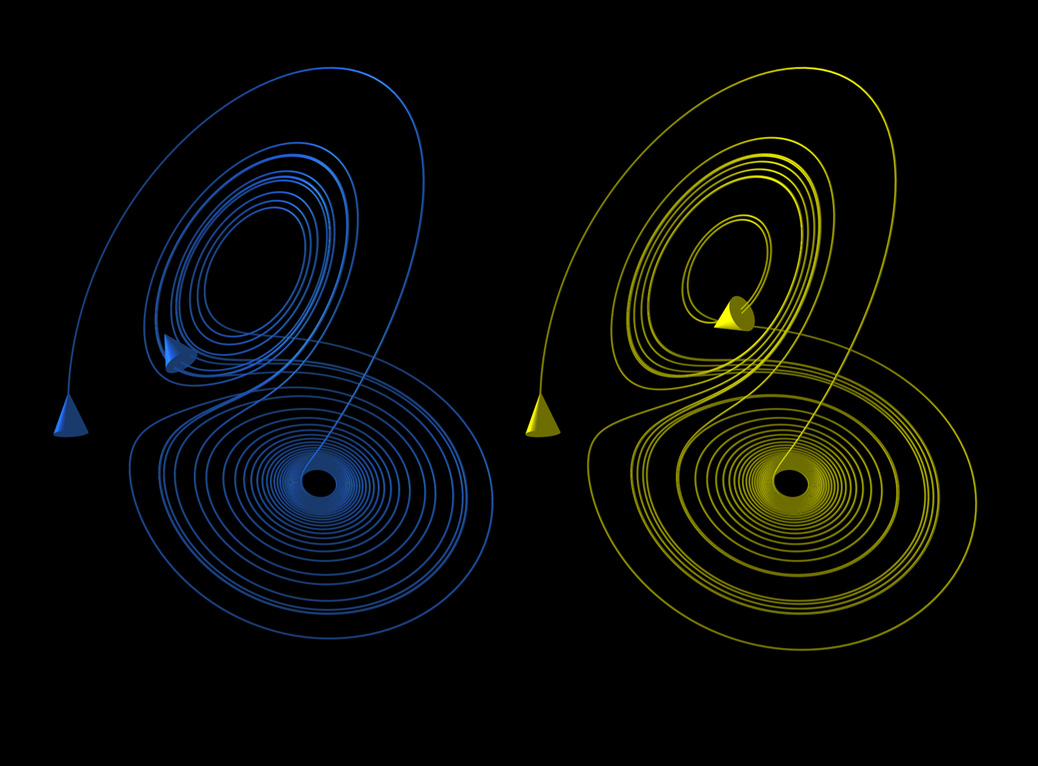
The butterfly effect is just the name, slightly arbitrary, of the idea that complex systems exhibit the characteristic by which tiny tiny tiny (infintesimally tiny) changes in one part of the system have the potential (not always actualized) to transform THE ENTIRE system, on all its scales. The Lorenz attractor kind of has the shape of a butterfly, and can be an image that is used to explain this sensitive dependence on initial conditions, but don’t worry about linking the Lorenz attractor specifically to ‘regular space’.
Drawings like that are actually drawings in what is known as “phase space”, which is simply an N-dimensional space where each dimension is represented by a change in ONE variable. The point of such diagrams is that they can incorporate simultaneous changes in many different variables at the same time (although visually there are limits on how to do this, because we are always projecting back into 2D space; holograms would help, but would only add 1 more spatial dimension in which to visualize, whereas there can be an INFINITE number of dimensions to map, depending on the phenomenon and how complex we get in our analysis).
A dimension here is just the abstract space in which any single variable can be tracked, such as distance (up/down, left/right, forward/backward, yielding 3 dimensions that can be mapped in phase space), time (adding a 4th dimension in phase space), or anything else that we want to track, like ‘population number’ or ‘frequency/color’ or ‘subjective happiness rating’ or ‘distance from Antares’ or ‘fractal dimension’ or WHATEVER.
If you wanted to plot two of those variables you could do it on a simple cartesian XY graph; this is a 2D phase space. If you want to track three variable simultaneously, you need to add an extra axis, giving a 3D phase space. But you can graph things in unique ways, for example by varying the color according to some rule that links the color with a variable, say temperature (you’ve all seen graphs and maps like this). You can use more tricks to get more data in a phase space plot, but when it gets beyond 3 or 4 dimensions most scientists (and mathematicians especially) drop the visualization completely and just stick with the math — you get tables of numbers, each ‘row’ representing, for example, the state of the thing you are tracking, including all of its possible variables at that moment. The next row would show the state at the next moment, and so forth. Then you can just choose two or three of the possible N-dimensions and graph them against each other, and then take a new set, and so forth, until you see patterns.
FROM WIKIPEDIA: BUTTERFLY EFFECT
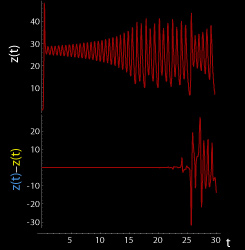
These figures show two segments of the three-dimensional evolution of two trajectories (one in blue, the other in yellow) for the same period of time in the Lorenz attractor starting at two initial points that differ only by 10−5 in the x-coordinate. Initially, the two trajectories seem coincident, as indicated by the small difference between the z coordinate of the blue and yellow trajectories, but for t > 23 the difference is as large as the value of the trajectory. The final position of the cones indicates that the two trajectories are no longer coincident at t=30.
3. And so, there’s all this talk about ‘deterministic chaotic systems’… What exactly, is the stunning significance of this? I think I get that every shape in nature is ultimately created by patterns of itself within itself, but I’m confused as a biologist or physiologist or biochemist because things like continents are made of trillions of completely different molecules of matter. How does that relate to fractals?
The stunning significance of deterministic chaotic systems is that the Newtonian paradigm which equated determinism with complete predictability (ala Laplace) was shown to be WRONG. Chaos theory shows that we can have deterministic systems that are simply NOT PREDICATBLE. It is also stunning because the mathematics of fractals has helped us gain much deeper insights into some of the important vexing problems that stymied Newtonian-style thinkers (non-linear systems, fluid flow, etc.). It has fundamentally changed our view of the universe. It is often said that in the 20th century the most important epistemological advances were 1) Relativity 2) Quantum Mechanics, and 3) Chaos Theory, with 4) Goedel’s Theorem as another important, but less well-understood revolutionary idea.
Fractals are NOT only in the realm of geometrical structure; this is simply where we have the easiest access to their manifestation. Fractals can also describe the pattern of any iterated process. So you can have fractal family dynamics, in which large scale interactions are repeated on smaller scales, both in the sense of emotional scale and time scale and so forth.
Also, not EVERY shape in nature is fractal. There are plenty of non-fractal shapes, but it does appear that fractals are an intimate aspect of nature’s expression (and more accurately, evolution).
2. Does the fractal model also work for dynamic, fluid or changing shapes?
Yes, in fact this is it’s most ‘natural home’ I think. The reason is that fractals are about processes, not things, and processes are just that: descriptions of changes, not of things, and changes have a way of, well, being DIFFERENT the next time you look at them. So there are ‘orders’ or ‘levels’ of change, described by the number of levels of description required to get to the point where the pattern is invariant.
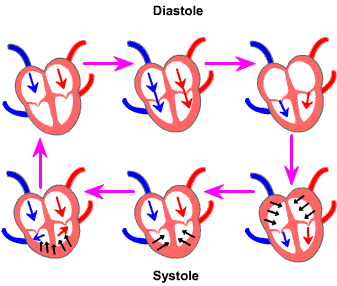
Your blood is constantly changing (systole, diastole), at this level of description there is no constant, because your blood pressure is constantly changing (lucky for us, or we’d be dead!). But at a higher level of description you get a pattern (high pressure, then lower pressure), that is invariant. You don’t get a systole and then another systole, or a succession of diastoles; they alternate. But this alternation is not constant either! The extent of the systole/diastole is ALSO constantly varying (also lucky for us, because this change, linked to what is known as ‘heart rate variability’, is strongly correlated with heart health), so it requires ANOTHER level of description to see how that is changing… and so on. At each level something ‘stays the same’ while other things ‘constantly change’. When we talk about change and constancy we have to be careful because we can never fully isolate one from the other; they are completely intertwined ‘all the way up and all the way down’.
The following four questions (one per post) were posed in a recent class. My edited responses follow.
1. So I understand that any shape in nature can be converted to a mathematical formula, right? Then you take that formula and plug in the variable related to that shape and feed the answer into the variable spot in the next equation, continuing that as many times as one wants (with potential infinite number of times). Here is where I get stuck. Does each answer produce a smaller version of the original shape or does the answer produce the snowflake-like shape of the whole, complex, product?
We do not know how to find mathematical functions for every shape in nature; indeed this is still an area of active research. Usually we can model (i.e. approximate) natural shapes with mathematical functions, but nature is a little more slippery and variable than the stark purity of mathematics proper, so we don’t get exact results. This isn’t usually a problem, however, because the whole point is that we can occasionally find mathematical functions that provide something of the… essence of the form.
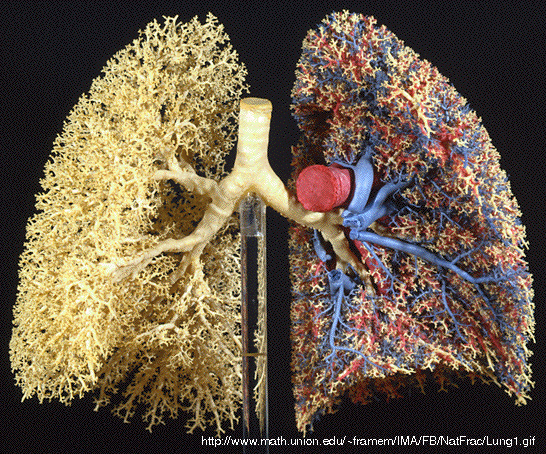
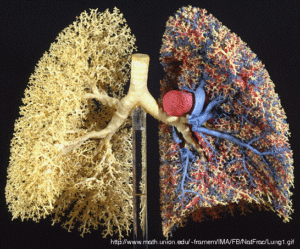
For example your lungs are fractal in nature, branching and branching and branching… but they don’t do it in only one way. Rather, they have different ‘stages’ of branching, each with a different ‘fractal dimension’, depending on how many previous branches lie before it (I can explain what a fractal dimension is if you wish in another post). (Read a single page about this from the Cellular and Molecular Life Sciences journal – slightly technical but you can probably get the basic idea through a different lens, which is always useful: http://www.springerlink.com/content/q103206u70402617/)
But to answer the question directly re: “each answer…”, most fractals both occur and are described by the taking of a single set of relations (it may be a shape), and repeating that relation/shape on different scales, with rotations, translations (moving without rotating), etc. In other words, you start with a thing and then put it through some sort of process, then take the new whole that results and do the same process to it again, and so forth. What is interesting is that a pattern emerges out of the process… and the process is primary, NOT THE THING. In fact, you can take ANY shape, and subject it to a specific process over and over, and you will get the SAME fractal form, regardless of the original shape. So each iteration (“each answer”) is a further unfolding of the process, a more ‘detailed’ rendering of the pattern inherent in the unfolding of the process.
So it’s not just a question of “smaller versions” or of reproductions of the “whole”; the pattern that defines the particular fractal is really the expression of an infinite process (usually based on some pretty simple and limited rules, like “rotate 36 degrees counter-clockwise and scale by a factor of 1/2”), which can be “reversed” (rotate 36 degrees clockwise and scale by a factor of 2) – so size has nothing to do with it, and you can start anywhere in the process with whatever you have, because the thing isn’t ‘the thing’ if you know what I mean: ‘the thing’ is the process. This is very good for nature because nature can take whatever is there and do some pretty simple things and get some very complicated results. It doesn’t have to start with a ‘grand plan’ that requires everything to be exact and fit in just the right way in order for it to ‘work’, but can just take whatever is there and MESS AROUND. This isn’t the whole story but I’m just trying to relate this to fractals specifically.
Much is owed to the ideas of Thomas Kuhn and his thoughts on science, which rightfully and helpfully recontextualize the practice of science in light of wider realities of human complexity. However, flowing out of postmodern trends, it is easy to then think of science as completely relative and just like any other knowledge domain. Similarly, those interested in alternative ways of knowing, such as mystical, shamanic, and spiritual, may make similar claims, pointing out that science is heavily dependent upon processes that are not as objective as we once assumed.
This is all well and good, a necessary stage on the path to a wider and deeper way of knowing that is not restricted to any singular method now present. I would therefore like to offer, on one side, something of a picture of science that is less characterizational and hopefully more subtle than might often be found in the debates surrounding this issue, in an attempt to keep us from overcategorizing and oversimplifying what are very complex and subtle realms.
It is true that there are limits to the practice of science: personal, cultural, psychological, economic, etc., and that these limits do have some relationship to the content of the science performed. However, the claims concerning the complete relativism of scientific knowledge are too strong. The arguments which support that view are selective and do not do justice to the features that make scientific knowledge different than other forms of sociologically constructed knowledge.
In the first place, we must be clear that the knowledge claims made by science are always and intrinsically (if not explicitly in their actual communication) tentative, at least to some extent. Science makes no claims to absolute knowledge beyond all possible modification; rather it offers conceptualizations that are continually taken through a highly refined process whereby those ideas that have the support of the greatest diversity and depth of experimental and logical lines of reasoning are held to be the most likely version of events.
Key to this process is the continual and purposeful reintroduction of the possibility for falsity through experiment. Kuhn is able to write his critique of science preciselybecause science is built to overturn itself. It is this very feature which allows it to continue its almost complete dominance in providing practical, testable, and predictiveknowledge claims concerning the physical world. Such dominance is not simply a measure of cultural values, although these play a part. Rather, its dominance is due %(primarily) to the fact that it provides a method for the generation of ideas which have direct, testable links to patterns in human experience. In other words, it works; it suggests solutions and provides a foundation upon which such solutions can be approached.
Science has a firm basis in empirical experience. It is true that were human beings constituted differently, with different sensory capacities, we would experience the world quite differently. However, to say that these differences would lead to a radically different set of ideas about the nature and operation of the world at a very fundamental level is not only not necessarily true, but likely simply wrong. Indeed, one of the reasons for the continued demonstrable power of the scientific process is precisely that it is capable of moving beyond human sensory capacities to a more general set of relationships between abstract properties (say, the property of quantum spin). We are capable of forming new ideas which, through their connection with other ideas, leads to propositions which have definite, falsifiable results in a public arena. Every time a new idea is tested experimentally and not found to contradict predictions, evidence for the validity of both the individual idea and the underlying connections the formed the basis for the new idea in the first place mounts. This does not mean that such an idea is taken to be absolute or objectively true; rather, it means that until we have a better idea, which has more explanatory and practical value, there is no sufficient reason to not use this idea as a foundation for the continued process of scientific exploration. Whether or not the idea is “true” in some ultimate sense is, frankly, beyond the scope of science. Unfortunately, it is the misunderstanding of this subtle point upon which much of the criticisms of science are based. Equally unfortunately, even plenty of scientists seem to live under the same misapprehension, at least unless pressed, so the error is widespread.
It bears pointing out that the process upon which science relies does not restrict science to exploring only physically testable propositions. The scientific process lends itself very well to a study of the material world, but is in no way limited to this domain; it is founded upon an epistemology of human experience, not an ontology. For this reason, the content of any idea is potentially amenable to scientific exploration, including ideas that arise from experiences that are considered spiritual in nature. The question is not whether the content of the ideas link directly to any material conception, but rather whether or not it is possible for the ideas to be falsifiable, repeatable, and capable of being linked coherently to the content of other ideas which enjoy the same benefits. It is one of the most powerful features of science that ideas which do not fit this description are not held up as representing scientific claims to knowledge. In other words, unlike many other disciplines, the criterion for selection of scientific ideas is very strict. This results in both a vast arena of ideas that are simply not capable of acting in a scientific capacity (“Betty Crocker has the best cookbook”), while at the same time requiring more robustness of the ideas that are admitted (“two masses attract each other in exact accordance with their relative masses, the square of their distance from each other, and a ratio which is constant in all situations”). Thus, scientific knowledge achieves a level of generic applicability that far outstrips knowledge claims made by (arguably) any other discipline that claims to produce knowledge.
Science concerns itself, in the broadest way, with questions concerning the nature of the universe, its parts, their behaviors and interrelationships, and the discovery of patterns that are thus manifested. The fact that we do discover — I emphasis discover even though arguments have been made to the effect that all discovery is invention — regular patterns in our directed experience of the world is remarkable. Even though the perception of these patterns requires some very particular sensory apparatus, the patterns thus revealed do not seem to rely solely on the particular approach made to them. Thus a more generalized concept is reached which links a variety of different avenues of evidence into a coherent whole which has consequences for each of the various domains which it touches. Most often this takes the form of mathematical relationships, but not always.
It should also be admitted that the scientific process is restricted to those parts of the universe which can submit themselves to conceptualization in the human mind. It is simply beyond the capacity of science to reach into non-conceptual domains, although these may very well be part of human experience in general. At the same time, it is not therefore the case that science cannot say anything about such experiences. This would only follow if it was the case that there were no links between such experiences and the parts of the universe which were amenable to conceptualization. Whether this is the case or not is a question for metaphysics, or perhaps for direct spiritual apprehension, but certainly not for science. But it is precisely on the basis of these non-scientific types of perception that the likeliest answer to this question is that such linkages do exist, and that the universe is vastly interconnected amongst all its levels. In this case, science can serve as a supplementary support to experiences which lie outside its normal domain, by offering up to such experience the relationships and patterns that are found to hold in its more restricted domain.
For this reason, science and spirituality indeed can — and even must — live together in mutual support. It is always possible to hold a different paradigm, with different knowledge claims and a different epistemology, and within such different systems the world appears differently. However, despite the relative and contextual nature of differing epistemologies, it is not therefore necessarily valid to say that all epistemologies are ‘essential equal’, which is the same thing as saying that they are all equally arbitrary. For some purposes, chosen by human agents, some epistemologies are vastly superior to others.
Just as science has real difficulty in dealing with experiences that do not have a strong or identifiable basis within the physical part of reality when compared to metaphysical or spiritual systems, so too metaphysical or spiritual systems have real difficulty in dealing with the very obstinate details of physical experiences. Each tends to shuffle the claims of the other into a sort of quarantine bin, where it is dealt with in a way that does not do justice to the depth and breadth of the other’s experience. It is very difficult to coherently cross this dissolute but entrenched lined: the bulk of our scientific knowledge does not come from meditative or transcendent experience, and the bulk of our spiritual knowledge does not come from scientific experience. Of course claims can be made that, in India in particular, something of a spiritual-science has been more or less continually developed for thousands of years, but the object of this type of science is quite far removed from the goals and achievements of modern science. The point is simply that as advanced as any system of spiritual science might be, none has yet produced knowledge claims that are as far reaching, inter- and intra-coherent, evidentially supported from multiple, diverse disciplines, and practically efficacious as that produced by modern science.
Frank Chester (find out about his initial work here, and read reviews of his work here) has just returned from a very well received presentation of his research on the Chestahedron at SunbridgeCollege in Spring Valley, New York. Many in the audience expressed disappointment afterwards that they had not notified their friends to attend these lectures because they did not realize that they would be witness to such an astonishing presentation.
Frank will be repeating these lectures this week in Fair Oaks at the Anthroposophia Conference as listed below. For those who wish to attend single lectures apart from the rest of the conference, the charge is $10 for students and $20 for adults
This is a good time to invite your friends and associates if they would like to hear about his discoveries, because Frank is planning on cutting back on his lecture schedule after this week so he can return to his research. You may download an attachment to this email, which provides some written information that may be helpful towards understanding what Frank’s work is about.
Frank will be presenting his work on the following dates:
Goethean phenomenology acts as a transformative bridge between the researcher and a topic of inquiry. The method is unique not in that it attempts to work through the subject/object split, but rather in the WAY it attempts to do this.
Doing Goethean phenomenological research requires that one be completely open to what presents itself, while at the same time recognizing that one’s perceiving is an active force with regards to the topic of inquiry; the topic changes researcher, and the researcher change the topic.
The Goethean phenomenological method (GPM) asks that one address the topic in a complex way; it must be approached from many angles in order to gather as much potentially relevant data as possible. The data are continually taken inward and addressed, particularly with attention to the sequencing, timing, and subtle morphological differences. The goal is in part to be able to re-create, inwardly, an exact sensory imagination that moves with the same gesture as the phenomenon when observed ‘outwardly’.
Normally, one takes as an ‘object’ of inquiry some outer phenomenon such as a plant species, a location, or a natural form or process. This restriction is not required, however addressing the alternative does require the researcher to change somewhat the way in which the method has heretofore been conceptualized and practiced. It is possible to begin with a topic of inquiry that is not phenomenologically perceptible to the outer senses: love, for example, or relations between imaginary numbers. All the same methods are used to work with the phenomenon, but different challenges arise when taking an ‘inward object’ as the focus of inquiry.
The primary challenge arises due to the unequal stages of development of our outer and inner organs of perception. My eyeball provides visual information in a way that is highly correlated with the way in which your eyeball provides you with visual information. Despite the variety of potential sensory differences, on the whole physical human sensory capacities share a high degree of correlation, especially when compared with more subtle (non-physical) senses.
This is not as problematic as it may seem, because implicit in the GPM is a continual oscillation between the subject and the object, and likewise between conceptual and perceptual experience. In fact, part of the goal of the GPM is to create the capacity (we could call it what it is: a soul-capacity) that allows our soul to move with the gesture of the unfolding phenomenon, as if from the inside-out… and then to come ‘back’ to oneself in order to become aware of that experience in a way that is not available when you are ‘in it’. Dennis Klocek, a practitioner of this method, calls this process “soul-breathing.” which is a very accurate description of what is occurring. Indeed, the process of working phenomenologically in this way provides the very training necessary to develop one’s soul-capacities in a way that is commensurate with the phenomenon. The practice of Goethean phenomenology is thus recursive; its practice changes how one can practice it. This recursivity forms a conceptual and perceptual loop which forms the basis for the development of the soul-organ of perception that is keyed to the particular phenomenon in question.
Goethean phenomenology, as Goethe himself stated, is “delicate.” because the role of the inquirer is paramount in the endeavor; one cannot simply follow an established external protocol and expect results. Rather, results arrive through a process of mutual interactivity between one’s own development and the simultaneous ‘unfolding’ of the phenomenon in question.
This method, in many ways, embodies principles from participative inquiry, in that the method actually takes the ‘object’ as a ‘subject’, and treats it accordingly. The researcher is not the ultimate authority on the phenomenon, but rather attempts to give the phenomenon voice. We could actually say that the role of the researcher is to place him or herself in service to the unfolding nature of the phenomenon in all its complexity, so that it can live in an imagination that is exact with respect to the movement, transformation, and unfolding of the phenomenon (which is inseparable from the movement, transformation, and unfolding of the researcher); this allows the researcher to ultimately ‘speak for’ the phenomenon. In a way, the researcher’s agenda is to give up the agenda in favor of the unfolding of the phenomenon. This can only happen when the researcher becomes capable of perceiving in a way that is generally opposed to the dictates of normal human day-waking consciousness, which lives primarily in a constructed boundary called the “self” through which all experience is filtered.
Goethean observation softens this boundary, makes it a semi-permeable membrane, and allows part of our soul to live through its inner movements into the unfolding of the other. In this way, a real ‘dialogue’ begins to take place between the researcher and the phenomenon (rather than a purely self-relating inner dialogue where two aspects of oneself face each other, i.e. a monologue disguised as a dialogue). It truly feels like one is dialoguing with the phenomenon, just as one would with another human being, but through an expanded language of gestures, tones, and subtle feeling-movements, rather than explicit words. This allows for the creation of a shared ‘language’, consisting of inner soul movements that take the form of metamorphosing inner pictures (not simply visual, but tonal, gestural) which are exact analogues to the processes that the chosen ‘object’ of study move through.
In this way, Goethean phenomenology requires and precipitates the transformation of the researcher. Indeed it is only through transformation that a researcher can learn to hear the continual whispering of what Goethe called nature’s ‘open secrets’.