There is a necessary recursion at the very heart of epistemology. Epistemology can never be founded upon a principle of linearity, where thinking traces its origin to something that lies before thinking, and somehow emerges or grows out of it, because the very existence of this “before”, whatever its nature, must always be assumed BY THINKING itself, as a distinction within thinking.
Therefore, the only proper starting point for an epistemology is the fundamental distinction OF distinction itself, by thinking FOR thinking, which constitutes the basis of all further distinction, and is implicit in it. The fundament of epistemology must be the recursive distinction of distinction. The nature of this self-distinction (distinction of distinction by distiction) is implicitly infinitely recursive, and identifies the very nature of thinking to be at its root one of distinction. Its implicit infinitude is a key aspect of thinking’s foundation, with definite consequences. It means that thinking is fundamentally (not secondarily) FREE: its potential to distinguish is unlimited. There is nothing that lies outside of thinking’s potential.
The consequences of this are more than epistemological, they are ontological. Thinking, infinite in its potential, is (more…)
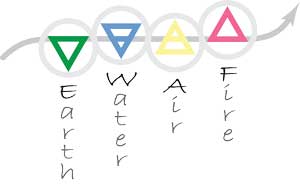
– There is no “it”, but there is talk about “it”. Ultimately the talk about “it”, the pointing to “it”, is more fundamental to “it” than anything else, because it is the RELATIONS that are primary: thingness is a subset of relatedness. Relations are not between two “things” but are recursively self-generated between other relations – things fall out of relations (things = Earth, relations = Water). Relations themselves are a precipitate of tension between complementarily opposing potentials (Air). Relations are to opposing potentials as things are to relations. Opposing potentials are themselves a precipitate of the whole, and work alongside each other within the whole simultaneously. Each step from the whole is a step-down transformation, we could say that beginning with level N, we move to level N-1. Each level is pulled out of simultaneity by an act of distinction within the whole, of the whole, by the whole. A cascading of levels of distinction yields the ontology of “things”, and simultaneously an epistemology of “knowing” activity, which together yield the whole of cosmology.
– This can be approached in another way. We can begin first with a problem of the modern condition, made apparent most strongly by both postmodernism and deconstructionism. The problem is that language is (more…)
“What is the connection between a transformative learning approach and the sense of one’s own spirituality? In what way does transformative learning nurture the spirit any more than any other learning style does?”
There are many styles of transformative learning. In general, however, one key aspect of transformative learning the explicit recognition that learning is not an activity that only takes place at a specified time and place built specifically for “learning”. Rather, learning is understood to be a life activity, and as such should be connected to all aspects of life in an integral way. The old, medieval style of education based on disciplinary structures that still dominates Western culture is fraying at the edges — thankfully.
Much of traditional academia is dominated by approaches where one learns “about” topics and ideas. In transformative learning, one learns “with” and “through” ideas by embodying them outside the classroom, in one’s daily life and work. The best transformative learning closes the loop by reciprocally inviting one’s outside activities into the classroom. This sets up a recursive relationship that helps unlock avenues for creative, integral inquiry that otherwise get stifled by a need to fit within an established epistemology, such as the kind implicit in most traditional educational offerings.
Transformative learning styles nurture the spirit because room is made both implicitly and explicitly for what we could call the appearance of the unknown. What you know limits your knowing, and making space for the arising of what is beyond one’s current understanding is central to any transformative process. You can’t fill a cup that is already full, and transformative learning styles take advantage of this wisdom directly by integrating opportunities for unknowing. What is spiritual in the human being is nurtured more by unknowing than by the addition of data to an already established way of being. Transformation occurs not when we change our ideas, but when we change how we know. Learning styles that are transformative in nature utilize this principle directly.
“Is there a place in the workforce for transformative learning? In what way might it be applied on the job?”
What we have to realize is that transformative learning is not just another system of facts and ideas that can be “applied on the job” without a recursive feedback effect on the business itself. It’s not like you can go to work and have an isolated “moment of transformative learning” to fulfill that week’s quota — transformative learning is more like an attitude than a specific system of ideas or practices, and as such it bleeds beyond borders. Most of the techniques and methods used in transformative learning approaches are designed to loosen us from our habitual ways of being in the world. They recognize, for example, that pretty much all the interesting stuff happens at the boundaries. This is where the juice is: where systems, ideas, events, and (most importantly) people meet and interact. Providing avenues for a greater diversity of interactions yields far more than a directed process where the outcome is dictated in advance. That’s good for building widgets, but not so good for the spirit. This has been known in some education circles (like Waldorf education) for about a century: play is not an activity for recess, but a core mode of learning that is, by its nature, transformative. A stick becomes a magic wand, a tent-pole, a sword, a sand-writing tool, and so forth in a dynamic flow. Only the adults, stuck with their more rigid, non-experimental epistemologies, see “just a stick”.
My father, who has been a business consulting psychologist for 25 years with the top management of major corporations like Best Buy, summed up his entire job to me recently by saying that his most important function has been to help his clients learn how to learn. This is an explicit recognition of the difference between the first-order concept of “learning” and the second-order concept of “learning how to learn”, which Gregory Bateson identified decades ago as a key to understanding complex goal-directed systems. In second-order learning, the snake bends back to bite its own tail and in so doing initiates a process of self-digestion. This self-digestion is a part of what is necessary to create the space for something new to arise, and is a stage on the way to an “adult” way of playing that is called “creative inquiry” and “transdisciplinarity” in academic circles.
Transformative learning invites higher-order transformation: not simply a change in what we think and do, but in how we think and how we carry out our actions. More businesses are starting to recognize the value of spaces (both physical and metaphorical spaces) that are not already locked into a pre-defined form, but which invite modification and multiplicity. This is a way of calling attention to and allowing human beings to bring forth the parts of themselves that get excited and passionate when they are simply given the space to be so. Some places, like Google, MIT, and other “big names” consciously utilize principles of transformative learning as a way to nurture diversity, openness, interaction, experimentation, and transformative involvement at various levels. The next level is when businesses begin to re-humanize their practices with the attitude that every “worker” or “employee” is first and foremost a whole human being. But to get there our whole understanding of business will have to transform as well…
The movie Inception is the best “question reality” movie since the Matrix (ultimately the Matrix is better, in my opinion), and it raises many fascinating questions having to do with the differences between the two primary states of consciousness available to humans today: waking and dreaming.
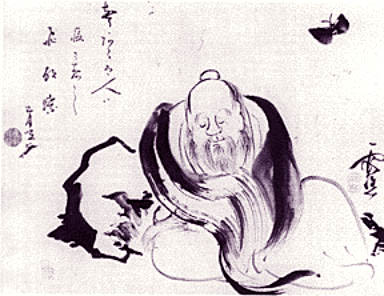
This issue has been around for about as long as recorded history, and has formed a central piece of some very detailed philosophical considerations. It shows up in the 4th Century B.C.E. in the famous Taoist Zuangzi’s “butterfly dream”:
“Once Zhuangzi dreamt he was a butterfly, a butterfly flitting and fluttering around, happy with himself and doing as he pleased. He didn’t know he was Zhuangzi. Suddenly he woke up and there he was, solid and unmistakable Zhuangzi. But he didn’t know if he was Zhuangzi who had dreamt he was a butterfly, or a butterfly dreaming he was Zhuangzi. Between Zhuangzi and a butterfly there must be some distinction! This is called the Transformation of Things.”
It also forms a central part of Indian philosophy, especially advaita vedanta, which explores cosmological questions through the exploration of (more…)
Unfortunately, the workshop has been cancelled.
It will be rescheduled this Summer; keep an eye out here for the announcement!
Form / Re-Form / In-Form / Trans-Form
Elemental Transformation: Changing How We Work with Change
A hands-on/minds-on workshop with Frank Chester and Seth Miller
Saturday, March 20th
9 am – 5 pm
Live Oak Charter School Petaluma, CA
Pre-registration is required.
All workshop materials provided. Cost: $100
This all-day workshop will combine hands-on geometry with dynamic presentations and experiential exercises designed to help you deepen your relationship with transformation. You will leave this workshop with a physical form of your own creation and a more subtle and complex understanding of how transformation unfolds according to the archetypal patterning of the four elements: Earth, Water, Air, and Fire. Our goal is to inspire you and enliven your own everyday transformative work. This workshop is perfect for parents, teachers, therapists, social workers, and anyone interested in transformation. There will be a one hour period for lunch. You can bring your own lunch or drive off-site for lunch.
Frank Chester is an artist, sculptor, geometrician, and teacher based in San Francisco. He has been working with the four elements for over 10 years, having used them as an integral part of the research that led him to the discovery of a brand-new seven-sided form that has deep connections to the human heart. Frank travels widely, giving dynamic presentations connecting form, geometry, and spirit.
Seth Miller has taught physics and many other subjects in Waldorf schools across the West. With a Master’s degree in consciousness studies, he is passionate about bringing forth tools for transformation; his specialty is the alchemy of the four elements. He is currently developing this work in a PhD dissertation, which weaves together alchemy, cybernetic epistemology, Goethean phenomenology, and anthroposophy.
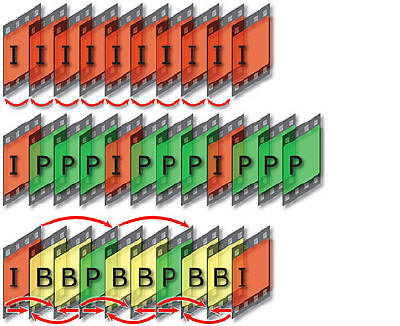
A fellow student pointed out recently to me that compression algorithms are an excellent way to see feedback at work, and used the example of mpeg2 video compression. Here we have a system that utilizes multiple levels of abstraction and feedback in order to efficiently compress video data.
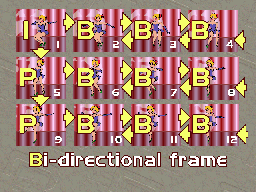
I will give you a picture or two and quote some relevant explanations on the process as a basis for the following discussion.
“The result of the MPEG-2 encoding process is a video stream. The basic unit of the stream is a “Group of Pictures” (GOP), made up of three picture types: I, B, and P. I-pictures (intra) are compressed using intra-frame techniques only, meaning that the information stored is complete enough to decode the frame without reference to any adjacent frames. For B (bi-directional) and P (predictive) pictures, however, only “difference information” (frame-to-frame changes) is stored, which generates much less data. These pictures can only be reconstructed by referring to the I-pictures around them, which is why the different picture types are grouped into GOPs.”
also:
“MPEG 2 provides for up to three types of frames called the I, P and B frames. The intra-frame, or ‘I’ frame, serves as a reference for predicting subsequent frames. ‘I’ frames, which occur on an average of one out of every ten to fifteen frames, only contains information presented within itself. ‘P’ Frames are predicted from information presented in the nearest preceding ‘I’ or ‘P’ frame. The bi-directional ‘B’ frames are coded using prediction data from the nearest preceding ‘I’ or ‘P’ frame AND the nearest following ‘I’ or ‘P’ frame.”
So you have completely self-contained frames, appropriately called I-frames. Then you have predictive-frames which contain information about DIFFERENCES ONLY, and which only have inputs from PAST I or P frames. But then you have bidirectional frames, which are constructed out of BOTH past and future frames (either I or P), and which also only encode differences.
This works because this type of compression operates on two levels simultaneously, the level of the FRAME CONTENT and the level of DIFFERENCES in frame content. The language of differences is a completely different language than that of the content, and constitutes (I think) a higher order of language from the type of language that can appropriately describe the content.
I’m only making this post because the content of the previous paragraph is generalizable to any system. Any system has a content-level which in some way encodes, describes, and utilizes a particular type of information (in this case, things like hue, lightness, and saturation). If the system never needed to interact with other systems (or itself in regards to this content), this would be enough. But as soon as any communication of or reflection on this information is needed, it becomes terribly inefficient to only keep to content-level languages. So in communicating or transferring that information from one epistemological system to another (a system for which the information can be of significance, i.e. produce a change), it is much more efficient to utilize a higher-order language whose primary function is to describe the content in a new way.
So this second-order language describes the description, or is information about the information. What can this second-order language contain? Essentially it contains information about DIFFERENCES in the content-level, which are not contained in the content-level itself. So I can’t describe the differences of hue, lightness, and saturation from one video frame to the next by using the language of hue, lightness, and saturation. The answer to the question: “What is the difference between a lightness value of 10 and 90?” is not itself a unit of lightness, it is a DESCRIPTION of lightness; you can’t use the answer directly and unmodified as information in the content-level system. You can’t tell your monitor to show a lightness value of “a difference of 80” DIRECTLY–you have to DECODE the difference back into the content-level language through a specific process.
What gets REALLY interesting, however, is when this kind of decoding has built in to it processes which modify the content-level data not just on the basis of the second-order language of differences (as in mpeg2 compression), but on the basis of a THIRD-order language of the difference of differences. This is like taking a description of the differences and feeding that information back into the system in a way that modifies the original information. So you have something like:
1) content-level (language of ‘raw’ data)
2) process-level (language of differences in ‘raw’ data)
3) meta-process level (language of differences of differences)
How far can this go? I have no idea; theoretically one can have an infinite number of levels, but practically I don’t think this is the case, and it has to do with the fact that there is a certain sort of separation between levels that has so far been assumed that is simply not the case. In other words, these different levels are complexly intertwined, and not capable of being separated. Each level is responsible for producing changes in other levels in various ways. The process-level, by encoding differences in the content-level, can produce changes in the content-level through appropriate decoding procedures. The same relation holds between the meta-process-level and the process-level. This also means that the meta-process level can drastically change things at the content-level. But additionally the content-level, by virtue of the type of information it contains, helps restrict the possible differences that can occur, and thus the possible ways of distinguishing differences in the process-level (it doesn’t make sense for a process-level language to encode differences about mood, temperature, or conductivity if the content-level doesn’t contain such information in the first place). So each level is like a bidirectional-frame in our video compression example, in which changes come both from ‘above’ and ‘below’.
What should be pointed out, however, is that there are SECONDARY effects which become possible with the utilization of any higher-order language. Any higher order language IS higher order because it can apply to multiple differing types and systems of data. A language of differences can be more or less strongly ‘coupled’ to a particular type of content. The closer the coupling the less easily the language can be used for descriptions of different types of data systems. The weaker the coupling, the more widely applicable the higher-order language can be to different data systems, but only at the cost of some potential loss of fidelity through the filtering out of SOME differences in favor of others.
Now here is where it gets even more interesting. The selective filtering of differences is another way of saying that each higher-order system embodies a particular epistemology. Languages about data, about differences in data, and about the differences of differences are all specific embodiments of epistemological frames. EVERY system has an epistemological frame: squirrels, lakes, crystals, and of course humans. The epistemological frame is the meta-context which admits or denies differences of a given class (temperature, color, quantity, mood, awareness…) and includes specific relations between various classes. But the epistemological frame is embedded within, arises from, and also determines the data available to the system — there is no ultimate ability to distinguish between frames and data – they each mutually produce each other.
What I distinguish distinguishes what I can distinguish. Differences differentiate my differentiating.
Epistemology determines the data available to a system for distinctions. The data available to a system determines the possible epistemologies that can make distinctions about the data (yielding capta. What is given determines what can be taken; what is taken then determines what can be given (the Latin root of data is ‘to give’, and of capta is ‘to take’).
There is no escape: we live in and create a world of paradox, which is probably enough for now.
I’ve been thinking about the co-existence of multiple descriptions of reality lately. In particular, as someone who has taught high-school physics, I run up against a philosophical quandary when I’m presenting, say Newton’s laws of motion. Am I presenting a lie to the students, because quantum mechanics and general relativity replaced the Newtonian physics?
On the one hand, we can argue that classical physics is flat-out wrong in its basic foundations, and thus that all of the subsequent predictions of it’s theories are equally (and absolutely) wrong as well. For example, take the prediction of a cannonball’s trajectory. Classically this follows a simple parabolic curve… but there are a number of non-Newtonian complexifications to this story that are required for a ‘truer’ description of the event. First you have the non-linear, chaotic effects of friction, then you have general relativistic corrections (changes in space-time curvature vary with distance to the mass of the Earth, thus changes in momentum, and even the mass of the cannonball, plus time dilation and other flying pink elephants), and then quantum corrections (virtual particle interactions, uncertainty limits, kryptonite fragments).
But, as evidenced by the crumbling city walls, the cannonball hits them anyway, whether or not we take these things into account (well, friction is really pretty important, but that’s why things in physics-world are always frictionless to begin with). In other words, even though, in an abstract and theoretical sense, classical physics is complexly wrong, it is also simply correct. It will get you to the moon just fine, thank you, no relativistic corrections needed.
The issue may require some consideration of the shifting between an epistemological stance and an ontological stance (that confounded relationship again!).
Ontologically we must say that Newton’s physics provides only an approximation of more fundamental principles. We can thus think of the classical principles as “wrong” because if we are to look at the phenomenon in its more complete ontological situation, other principles are required. However, when we don’t look in this way, the classical principles are arguably just as “right” as the more fundamental principles that need to be introduced when you look at the situation more completely. In other words, questions about ontology can be taken in-situ, and not, as most philosophers would have it, absolutely. This is a big faux-pas, as it undermines the common meaning of ‘ontology’, which refers to the essence or real being of a phenomena.
But if we our queues from Whitehead, we realize that the idea of being may no longer require some kind of Parmenidean, unalterable and unchangeable essence that is just itself for all eternity. Essence-being-may rather have existence only as a process, as an ongoing creation, subject always to the bursting through of novelty.
Somewhat ironically, if we took this, rather than the Newtonian assumptions as a starting point, then it would not be problematic to see that Newton’s physics can indeed have an equivalent ontological status in certain circumstances as the relativistic and quantum laws do in other circumstances. There may be no ontological need to posit relativistic effects unless such effects create differences that impinge upon classically-based predictions.
Of course, the fact that just this does occur in some situations is exactly why people had to come up with relativity and quantum mechanics! But the establishment of new ‘laws’ may not obviate the ontological status of earlier laws when we don’t arbitrarily discount the importance of the evolving context within which any ontological consideration arises in the first place.
The situation becomes more apparent when we are no longer considering simple physical systems, but try to account for more complex phenomena: life, emotion, healing, consciousness, social effects, etc. In these cases, the ‘laws’ of physics are simply completely and utterly inadequate to the phenomena; they explain only a tiny fraction of each phenomenon. New ‘laws’, and other principles are required to make sense of these different realms. These laws may or may not be ultimately reducible to known physical laws, but that may not even matter!
What ‘exists’ for a given way of approaching a complex, embedded, extended, and recursive system may change on the basis of how that system is approached, i.e. by the ‘question’ that is asked of it. Which of course leads us to the insight, offered by Bohr, that just this is how the universe works: it answers questions (is something for us) by virtue of the questions asked of it, which is another way to say “How you pay attention changes what comes to your attention.”
Classical physics will never ‘go away’, unless human experience changes so radically as to no longer require its principles for explanation (this is highly unlikely). We should be careful of the classical assumptions about ontology, and of projecting an absoluteness onto ‘being’ that is not sensitive to the human act of in-situ knowing. To declare, because the fundamental principles of chemistry can be reduced to physical principles, that “chemistry is not needed” would be a folly; chemical principles, when unreduced, still operate in an ontologically satisfying way – for the chemist. The fact that those behaviors can be thought of in ‘more fundamental’ terms does not automatically privilege the more fundamental understanding in an ontological sense.
This does not lead to ‘state-specific sciences’ (ala Charles Tart), which are radically separate, in which every question may have its own unique ontology and epistemology. It appears that the universe doesn’t quite work this way, because principles from one realm don’t stay put; they leak out into other, seemingly unrelated disciplines, where they may find fruitful soil, even taking over the previous assumptions at times. The universe doesn’t seem to split itself up quite the way we do. In other words, we cannot hold onto an ontology that abstracts itself indefinitely, but we cannot also completely de-reify ontological considerations (the mistake of much of post-modernism) in favor of purely ‘constructed’ ontologies.
We are thus lead to consider an epistemology – an embedded, flexible, transformable epistemology – may be go hand-in-hand with a companion ontology – a process-oriented, non-reductive, complex ontology. The ontology is thus capable of shifting on the basis of epistemological concerns, but is not reducible to them. The epistemology is likewise capable of transforming on the basis of ontological considerations, but cannot be completely enslaved to them. Rather, the epistemology and the ontology co-exist in a creative dance of becoming, mutually reinforcing each other and destroying each other in a complex cybernetic loop.



 On the one hand, we can argue that classical physics is flat-out wrong in its basic foundations, and thus that all of the subsequent predictions of it’s theories are equally (and absolutely) wrong as well. For example, take the prediction of a cannonball’s trajectory. Classically this follows a simple parabolic curve… but there are a number of non-Newtonian complexifications to this story that are required for a ‘truer’ description of the event. First you have the non-linear, chaotic effects of friction, then you have general relativistic corrections (changes in space-time curvature vary with distance to the mass of the Earth, thus changes in momentum, and even the mass of the cannonball, plus time dilation and other flying pink elephants), and then quantum corrections (virtual particle interactions, uncertainty limits, kryptonite fragments).
 The situation becomes more apparent when we are no longer considering simple physical systems, but try to account for more complex phenomena: life, emotion, healing, consciousness, social effects, etc. In these cases, the ‘laws’ of physics are simply completely and utterly inadequate to the phenomena; they explain only a tiny fraction of each phenomenon. New ‘laws’, and other principles are required to make sense of these different realms. These laws may or may not be ultimately reducible to known physical laws, but that may not even matter!
 We are thus lead to consider an epistemology – an embedded, flexible, transformable epistemology – may be go hand-in-hand with a companion ontology – a process-oriented, non-reductive, complex ontology. The ontology is thus capable of shifting on the basis of epistemological concerns, but is not reducible to them. The epistemology is likewise capable of transforming on the basis of ontological considerations, but cannot be completely enslaved to them. Rather, the epistemology and the ontology co-exist in a creative dance of becoming, mutually reinforcing each other and destroying each other in a complex cybernetic loop.