It's Elemental

Category: Consciousness

  • An Esoteric Guide to Spencer Brown’s Laws of Form #2

    An Esoteric Guide to Spencer Brown’s Laws of Form #2

    (New readers will want to start with the first installment.)

    Let us continue our beginning:

    LoF p. 1

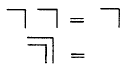
    • We take as given the idea of distinction and the idea of indication, and that we cannot make an indication without drawing a distinction. We take, therefore, the form of distinction for the form.

    If this doesn’t strike you as having a “mystical” flavor, then you are drinking the wrong concoction.  I’m not going to try to explain this, but rather I’m going to try to re-frame it; you could say, in GSB-approved language, that I’m going to re-mark it.  The important thing to note about this, the very first “official” sentence of the LoF, is that it is recursive.  Let’s be clear: the Laws of Form (not the book, the LAWS) are only possible because of a recursion, a throwing back on itself of itself.  But a throwing back of what onto itself?

    Well, “nothing”, of course; but nothing understood as what everything would be if it were.

    But of course nothing doesn’t remain nothing (well, it does, but it doesn’t), because here we are.  The question GSB is really attempting to get at is the question: (more…)
  • An Esoteric Guide to Spencer Brown’s Laws of Form #1

    An Esoteric Guide to Spencer Brown’s Laws of Form #1

    (A full PDF of this article can be had here.)

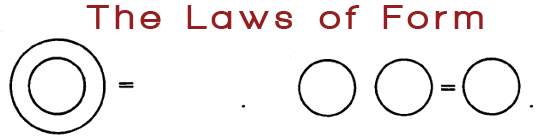
    George Spencer Brown (in his spirit, I would like to say: “Let George Spencer Brown = GSB”), a logician, engineer, and teacher, wrote a curious little book called Laws of Form, that inspired countless interesting people of widely varying backgrounds.  The book is not a book of mathematics, nor is it a book of logic, although if you were to read it this is likely what you’d say.  It is, rather, an attempt to enact something prior to both.  Indeed, GSB feels that his work actually forms (meaning both “is” and “shapes”) “the basic forms [same double-meaning] underlying linguistic, mathematical, physical, and biological science” (p. v of the 1972 edition).

    If you haven’t read Laws of Form (LoF), I quite recommend it, and it is actually quite short.  Even if you don’t want to follow along with the meaty theorems and proofs, the prose and context is definitely worth chewing on.  What is fascinating to me is that the work can also be read with an esoteric eye, which is to say, with a sensitivity to the form and nature of spiritual experiences.  This is not at all a departure from what GSB intended: in his other works he quite openly discusses this connection (see Only Two Can Play This Game published under his pen name, James Keys).  Even in LoF he prefaces the preface with this quote from Blake:

    “Tho’ obscur’d, this is the form of the Angelic land.”

    So what I would like to do is to show that within the LoF are a number of coherent relations to principles that are rightly considered esoteric: they are (more…)

  • Notes on the roots of epistemology in recursion

    Notes on the roots of epistemology in recursion

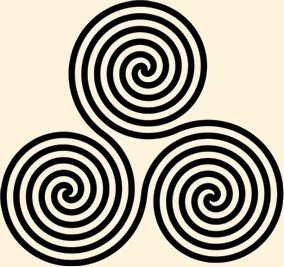
    threefold recursive spiral of knowing
    Unity in distinction, distinction in unity.

    There is a necessary recursion at the very heart of epistemology. Epistemology can never be founded upon a principle of linearity, where thinking traces its origin to something that lies before thinking, and somehow emerges or grows out of it, because the very existence of this “before”, whatever its nature, must always be assumed BY THINKING itself, as a distinction within thinking.

    Therefore, the only proper starting point for an epistemology is the fundamental distinction OF distinction itself, by thinking FOR thinking, which constitutes the basis of all further distinction, and is implicit in it. The fundament of epistemology must be the recursive distinction of distinction. The nature of this self-distinction (distinction of distinction by distiction) is implicitly infinitely recursive, and identifies the very nature of thinking to be at its root one of distinction. Its implicit infinitude is a key aspect of thinking’s foundation, with definite consequences. It means that thinking is fundamentally (not secondarily) FREE: its potential to distinguish is unlimited. There is nothing that lies outside of thinking’s potential.

    The consequences of this are more than epistemological, they are ontological. Thinking, infinite in its potential, is (more…)

  • A Theoretical Beginning

    A Theoretical Beginning

    Every moment of transformation enacts an epistemology.  Part of what it means to be human is to have the potential to awaken to this fact, and more: to recognize that the recognition of the inescapable relation between action and epistemology leads to the unfolding of a life-long quest and question: how do I know? Exploration of this question, always implicitly present but seldom asked, yields consequences for the entirety of human life, from the most mundane actions to the deepest soul struggles.  Once one sees that it is impossible, as a living system, to escape epistemological concerns at even the most trivial level, such concerns form an ever-present background to the unfolding of one’s life. (more…)

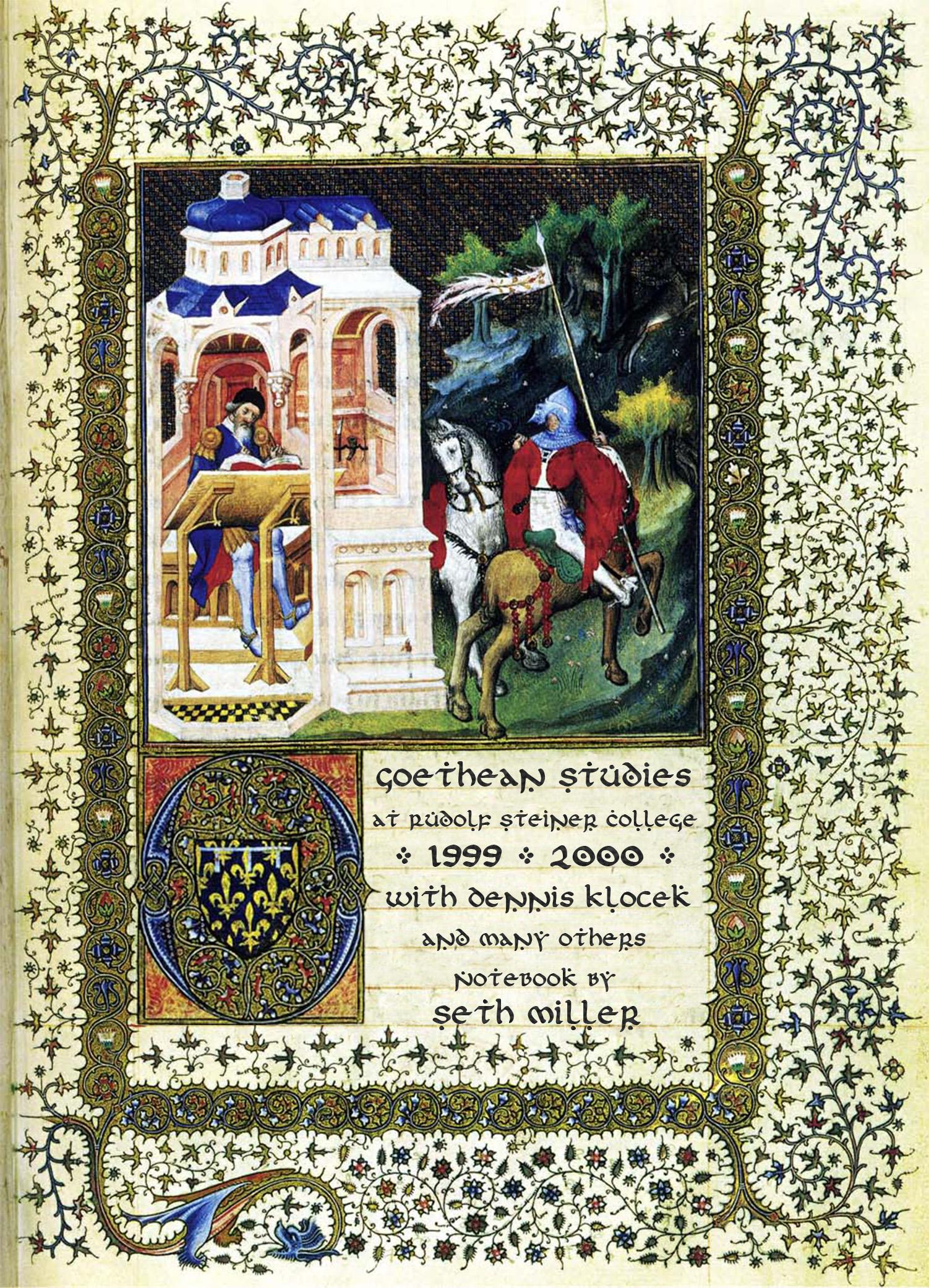
  • Goethean Studies Notebook

    Goethean Studies Notebook

    Goethean-Studies-1999-2000-Notes-by-Seth-MillerPDF: Goethean Studies Notebook (40mb)

    PDF: Higher quality, print version (180mb)

    This notebook was created as a personal record of the 1999-2000 Goethean Studies program at Rudolf Steiner College. This unique course, conceived of and taught primarily by Dennis Klocek, is still being offered — it is now called Consciousness Studies. When I took the course, which was seven months long and met for about three hours every weekday, I liked to call it “Being Human 101”, because it offered some basic perspectives about being human that spanned the spiritual, psychological, and physical worlds in a very deep and coherent way.

    There are certainly errors contained herein: it was often simply not possible to record more than the merest fragments of the vast pictures that awakened in the little Emerson classroom and flowed like honey across our minds. This record is like a six year old’s crayon rendition of a Michelangelo: it may contain something recognizable, but is no substitute for the real thing, which I encourage everyone to experience.

    It is likely that the only people who will see this document are those already familiar with the course in one of its various incarnations. For you I hope that it re-awakens a commitment and enthusiasm for the hard and necessary work of spiritual transformation by connecting you to the feeling you had sitting in the uncomfortably cold room on uncomfortable chairs, listening to another mind-blowing morning lecture by Dennis: the feeling that you were exactly where you needed to be and wouldn’t trade it for anything.

    For those who have not been able to take the course, this gives a tiny taste of some of the content that was presented in its 1999-2000 incarnation, and will hopefully inspire you to research the current, more highly refined and potent version.

    For those who have found this page but have no idea what I’m talking about even though you’ve read this far, just flip through it like it was you long-lost friend’s photo album and see what tickles your fancy as you skim on by.

  • Levels of Dreaming and the Makeup of the Human Being: The Spiritual Ontology of Dreams

    Levels of Dreaming and the Makeup of the Human Being: The Spiritual Ontology of Dreams

    By Seth Miller

    Full PDF

    DreamerEveryone dreams, but few people find sufficient interest in their dreams to move beyond mere curiosity at their strange contents.  Even many who work with dreams as a part of a transformative practice usually concentrate on their content, and only more rarely question their form, ontology, and origins. Exploring these aspects, however, can help provide a context that helps orient dreamers to some of the esoteric underpinnings of dream etiology (their meaningful origins), and can help enliven dream-based transformative practices. This article is an attempt to show how a spiritually-oriented understanding of the makeup of the human being gives a context for understanding different types of dreams, their origins, and some associated consequences for dreamwork.

    The language of spiritual science, also called anthroposophy (human wisdom) will be of help in this endeavor, because it maintains its cogency across multiple phenomenal realms (such as those of sleeping and waking), and because it has as its aim the ability to make clear and coherent processes which work within the physical realm but have their source beyond it, in the spiritual worlds.  Fundamental anthroposophical terminology will not be explained in this article for reasons of space, and neither will the basic anthroposophical view of dreaming in general.  For a brief introduction, I highly recommend that readers peruse this article: Sleep and Dreams in Anthroposophy, which provides the context (more…)

  • Book Review: Supersizing the Mind by Andy Clark

    Book Review: Supersizing the Mind by Andy Clark

    When Minds Won’t Stay Put:

    A Review of Andy Clark’s Book Supersizing the Mind: Embodiment, Action, and Cognitive Extension

    by Seth Miller

    supersizing-the-mind

    Ask your neighbor: “If you had to locate your mind, where would you point?”  In all likelihood, the overwhelming response will be a finger on the cranium.  Ask Andy Clark, a professor of Philosophy in the School of Philosophy, Psychology, and Language Sciences at Edinburgh University in Scotland, and you might see him point to his mouth, his hands, and even occasionally to objects in the world such as pencils and notebooks.  By way of explaining this seemingly odd behavior, Clark might shrug and hand you his newest book, Supersizing the Mind: Embodiment, Action, and Cognitive Extension (Clark, 2008).

    In this work (StM), Clark attempts to flesh out (pardon the pun) the thesis that (more…)