Understanding change is a very difficult task. No aspect of our world, either experienced outwardly through our senses or inwardly through our feelings and thoughts, seems exempt from the paradoxical rule that the only constant is change. It is possible to examine the way change occurs at many levels. At the “lowest” level of examining change, we generally tend to focus on what can be called the “content.” The particular identified content (we’ll see in a minute why it is important to note that this content is “identified”) depends upon the arena in which the transformation is being studied. Generally, however, the content is the “thing” that is undergoing change, and is usually the overt focus of our attention. For example, in a chemical situation, the content would be the physical elements, such as hydrogen and oxygen in electrolysis. In a therapeutic setting, the “thing” might be one’s thoughts and feelings (in psychology), one’s bones (in chiropractics), or a family system (in family therapy).
The content level is always present; it is always a part of the way that we encounter change. Yet in addition to looking at the content-level, we can also examine change in a different way: we can examine patterns of change. That is, we can place our attention on the way that changes in content unfold, and seek to identify similarities and differences in such patterns in order to get a deeper understanding of the “rules” that inform what happens at the content level. Paying attention to this level of change is paying attention to the process of change, rather than just its results.
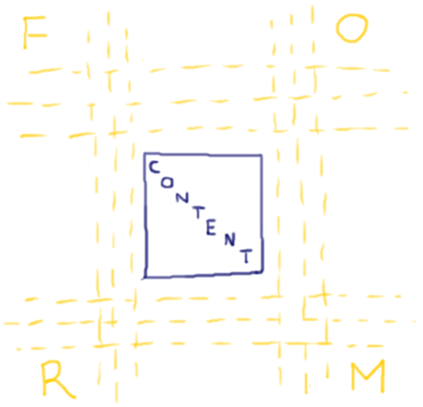
This way of examining change takes place one level removed from the content level, and can thus be understood as a “higher” level. It is more abstract than the first, and because it provides the contextual rules that inform the unfolding of the processes as they appear at the content level, we can call this second level that of “Form”, or even better, “Forming”. This is spelled with a capital “F” to distinguish it from “form”, in the sense of a static outer shape or configuration. A given quadrilateral has a definite individual form, and there are an infinite number of quadrilaterals, such as the square and trapezoid. But every possible quadrilateral shares the same Form. This is the same relation between a set and an element in formal logic. The Form is a way of indicating (more…)
About 100 years ago the birth of quantum theory changed forever how humans perceive the universe… sort of. Certainly “quantum physics” is a phrase found far outside the boundaries of physics classrooms, and has even achieved a fairly wide popularity through movies such as What the Bleep and works like Fritjof Capra’s Tao of Physics. Does this mean, for the average person who has at least been introduced to some basic ideas from quantum mechanics, that reality will never be the same? Or do ideas from quantum mechanics (QM) remain something of a curiosity—fascinating and mind-boggling but so far removed from ‘normal’ everyday experience as to be essentially irrelevant?
Take a moment and ponder this question for yourself. Can you remember how you were affected when you first heard of electron tunneling, the EPR paradox, entanglement, the uncertainty principle, or more likely, Schrodinger’s cat? Did your view of the world change? A more relevant question might be: how do you know? Perhaps the next time you looked at the shimmer of a butterfly’s wings or the more prosaic spectrum reflected off a thin layer of oil on pavement you gave an intellectual nod to the underlying quantum mechanical principles which give rise to these phenomena… and then went on about your day just like it was 1904 (the year before Einstein’s four seminal papers revolutionized the world of physics—many other worlds are still playing catch up).
Now, quantum mechanics is, without a doubt, one of the best theories ever produced by human minds. The effects of QM are likewise undeniable in their scope, and have reached every corner of the Earth, influencing the course of the 20th century immeasurably, mostly through the various technologies it has made possible (from computers and just about everything electronic—transistors, anyone?—to advances in medicine, communications, manufacturing, and more). But the problem here is that (more…)
This question is a touchstone for the modern human dilemma, and it’s all about consciousness.
I’ve recently been in some discussions around transitioning to being vegetarian/mostly vegan. Part of the discussions revolve around the available evidence for the state of affairs with respect to our food production. Two heavy-hitting potential sources for perspective can be found readily on the YouTube: the movie Earthlings (http://www.youtube.com/watch?v=UeSA2j4oiDA), and a video lecture presentation by Gary Yourofsky (http://www.youtube.com/watch?v=es6U00LMmC4).
Watching these sorts of things is not fun, and people know it. We intuitively know that when we expand our awareness and broaden our perspective, we cannot remain the same. HOW we don’t remain the same is up to us, there is no script given to us by the universe telling us unequivocally how to act. The apprehension around this feeling of inevitable change (which is completely understandable), can deter us from seeking new knowledge and perspectives that are different than whatever perspectives we currently entertain, and which are already integrated into our daily lifestyles, choices and self-image.
In the face of this apprehension, when presented with an opportunity to entertain an alternative perspective, the following kind of thought might occur:
“Ok, so I will think about it…watching it that is. And how do you know that there is not an intended bias put in that distorts the situation? There are horrible examples of almost everything (parenting, professors, sanitation…) but that doesn’t mean it is ALL like that.”
This is quite true: a few bad apples don’t spoil the whole bunch, and everyone is biased. There is quite overtly an intended bias in the lecture/films. This is, indeed, the point: they are biased towards treating animals decently, towards environmentally sound choices, and towards developing the “humane” part of the human being. In other words, being biased towards knowledge (vs. ignorance), towards compassion, and towards care for the world is something very different than a bias towards maximizing corporate profit, for reduction of knowledge (systemic practices of hiding the nature of the processes by which our food is created), and for reduction of ethical considerations around food choices.
This difference should be pretty clear. There is always distortion; that is the nature of being a human. But because that is a given, we have the ability to take a second-order view: we can’t eliminate distortion (doing so would itself be a distortion), but we can become active curators of the processes by which our views get distorted. By entering into these admittedly subtle processes, rather than ignoring them, we can gain some measure of freedom. This is essentially saying that the question is–quite centrally–an epistemological one.
This is one of the most basic psychological principles: what you DON’T know about yourself influences you more deeply and directly than what you DO know about yourself. Just like individual therapy was created to help humans take an active stake in self-knowing, so that we can have more freedom in the way we conceive of ourselves, and just as family therapy (systems-oriented therapy) took that to the next level and showed how it is not enough to have self-knowledge (because the family system is always more than individuals and individual dynamics), so too there is a burgeoning field of ecotherapy, in which the next logical step is taken, towards recognition that individuals and family systems are embedded in, and co-evolve with, even larger contexts (and spiritual psychology takes that beyond the Earth to even higher realms).
Each expansion is accompanied by greater awareness of the systemic connections between levels, so that what at first seemed totally individual (“what I want for lunch”) becomes inextricably connected to all the other systems, and not in a vague, wishy-washy way, but by virtue of various streams of evidential data and shared experiences. So, the very true fact that “it is not ALL like that” simply means that if we don’t want to be supporters of the places where it IS like that, we need to become aware of the myriad elements of the particular systems in which we partake, so that they are no longer part of an unconscious or semi-conscious “given” context for our actions, but become available consciously as one of a possible number of other contexts in which we can act (and create!).
The entire world is already paying the increasing price for the lack of this work (global climate change being a major example). The weird key is that it is the individual human being (always in larger contexts, but still individual) who represents the capacity for the world to wake up to itself, to see itself as a whole, and to begin to evolve in less systemically destructive ways. So human beings have a particular responsibility to develop just this capacity to see–as individuals–beyond their individuality, to hold in consciousness the various polarities necessitated by life, to recognize the connections between all the various living and non-living systems, and how this all calls for the creation of new ethical distinctions that, when acted upon, help create a better world for the whole, rather than just some few parts.
The time for ignorance is quickly coming to an end; human systems are too globally interconnected, too vast and dehumanized in their processes, to let them continue without better guidance. Knowingly choosing an answer to the question “what’s for lunch?” is exactly what this guidance looks like on an everyday basis. If humans don’t begin to collectively (as individuals!) ask that question in some form, then the fate of the world will be given over by default to exactly the same kinds of unconscious or semi-conscious processes that are behind the vast majority of the world’s problems. The world itself is in need of a kind of therapy, but it is human beings who are the only ones capable of both being the therapists and the clients in this situation. We have to create the therapy and administer it to ourselves, on behalf of the world. We can’t sit the ducks, polar bears, bees and amoeba down in the chair and explain to them what they need to do to change so that the world can evolve together in a more peaceful and healthy manner. We can only do this to ourselves–not ourselves as individuals only, but also as representatives of the rest of the entire world that can’t speak for itself without our help. This calls on human beings to undertake a path towards wakeful compassion that extends our individuality beyond the walls of our skin, beyond the walls of our limited mental representations of self, so that we become facilitators of ways of being that are systemically, integrally wise.
We ended the last installment by discussing the esoteric nature of the injunction. We continue this exploration, and bring this series to a close.
LoF p. 81
In the command “let the crossing be to the state indicated by the token” we at once make the token doubly meaningful, first as an instruction to cross, secondly as an indicator (and thus a name) of where the crossing has taken us. It was an open question, before obeying this command, whether the token would carry an indication at all. But the command determines without ambiguity the state to which the crossing is made and thus, without ambiguity, the indication which the token will henceforth carry.
This re-affirms that the mark has both a first and second-order character: it names the state of its content (its indication), and it is an instruction (its injunction) to mark that name, to make that distinction which yields that state. Thus every mark is both an indication and an injunction. It is an indication of a content and an injunction on how to get there.
LoF p. 82
We may consider how far, in ordinary life, we must observe the spirit rather than the letter of an injunction, and must develop the habitual capacity to interpret any injunction we receive by screening it against other indications of what we ought to do. In mathematics we have to unlearn this habit in favour of accepting an injunction literally and at once. This is why an author of mathematics must take such great pains to make his injunctions mutually permissive. Otherwise these pains, which rightly rest with the author, will fall with sickening import upon the reader, who, by virtue of his relationship with respect to the author, may be in no position to accept them.)
All this actually relates to the task of the esoteric teacher, who (more…)
We ended the last installment with a recognition that the Laws of Form naturally led GSB to an understanding of both the necessity and importance of the realm of imaginary numbers. We will continue this elaboration.
You are likely familiar with the paradoxical sentence: “This sentence is false.” Is it false or true? The answer is yes, and it depends on when you ask me. It was this kind of paradox that drove Russell and Whitehead into creating their Theory of Logical Types, which was designed specifically to prevent this kind of thing from simply ever coming up in the first place. GSB is not so limited, and understands the importance of formally including paradox in his calculus. So how does he deal with this?
He points out that we are driven to a higher order of logic, one that includes re-entry. In the first Esalen lecture, GSB states that (more…)
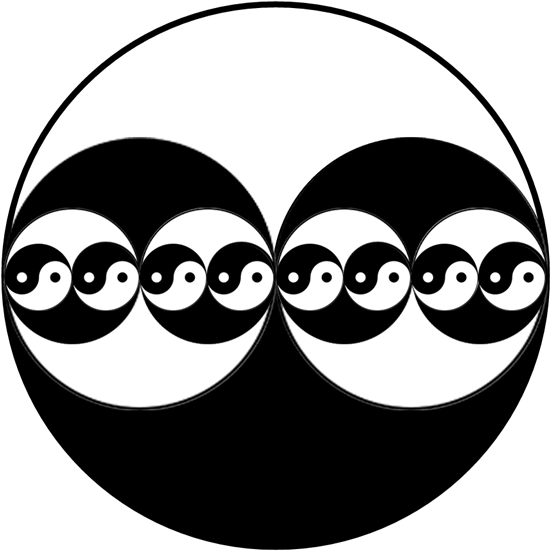
We ended the last installment having come to realize something of the esoteric significance of the taijitu, or yin-yang, form, in something of an extended tangent. We return now to the text.
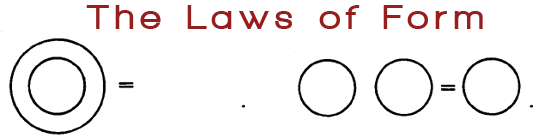
GSB himself seemed to understand the importance of the Laws of Form, even if there were some of these more subtle specifics which were not apparent to him (or at least which he did not explicitly recognize). Having reached this point (literally we are still on page 1 of LoF), the vast majority of the rest of the work in LoF is seen to be secondary. Yet there are many valuable indications which deserve connection to esoteric principles, and the point of this exploration is to show that such connections are not arbitrary. So, to return to the actual content of LoF now, after this long but foundational detour, we can note that he says:
LoF p. 5
Let any token [of the mark] be intended as an instruction to cross the boundary of the first distinction.
That is, every mark is an invitation to cross it; every distinction is a call to make that distinction, not to simply point it out, but also to DO it, to MAKE the distinction. In other words, the whole thing is ACTIVE, not passive, it is not descriptive but PRESCRIPTIVE. Of course, the esoteric significance of this should be obvious, because precisely what distinguishes esoteric work from, say, philosophy or other disciplines, is (more…)
We ended the last installment noting that the first distinction must be of distinction, but this must be considered as a complex, recursive creation and simultaneous crossing of a boundary that is just precisely the boundary between that very activity of its creation and the fact of it as created.
To get at this another way, we can point out that the Glanville has actually hit on elements in this direction already, but (it seems) hasn’t quite put it together in the same way. Remember that the whole time we have been talking about the first distinction we are also talking about “the observer”, which we could call a “self”. It may even be worth revisiting some of the above text with that implicit translation in mind. I remind you of this because, Glanville, in his essay The Self and the Other: The Purpose of Distinction, is exploring solutions to the problem of infinite regression that arise when the mark doesn’t distinguish itself from its value, and he uses “self” and “other” to hold the logic of “mark” and “value”, which is perfectly fine.
Glanville notes that we have a set of relations that are implicit in each other: that between self and other: “the fundamental distinction between self and other [read: between the mark and its value] cannot be more fundamental than the distinction of the self, nor can it be less so: another circularity, another reduction of hierarchy” (p. 3).
Except that this isn’t a reduction of hierarchy. It is actually (more…)