It's Elemental

Tag: Rudolf Steiner

  • Toward an Aesthetic Epistemology – Slideshow Overview

    Toward an Aesthetic Epistemology – Slideshow Overview

    In February 2014 I successfully defended my PhD dissertation, titled “Toward an Aesthetic Epistemology: Transforming Thinking through Cybernetic Epistemology and Anthroposophy.”

    The following is the abstract and a slideshow presentation that pulls out the crux of my arguments.

    Abstract

    The complexity, subtlety, interlinking, and scale of many problems faced individually and collectively in today’s rapidly changing world requires an epistemology—a way of thinking about our knowing—capable of facilitating new kinds of responses that avoid recapitulation of old ways of thinking and living. Epistemology, which implicitly provides the basis for engagement with the world via the fundamental act of distinction, must therefore be included as a central facet of any practical attempts at self/world transformation. We need to change how we think, not just what we think. The new epistemology needs to be of a higher order than the source of the problems we face.

    This theoretical, transdisciplinary dissertation argues that such a new epistemology needs to be recursive and process-oriented. This means that the thoughts about thinking that it produces must explicitly follow the patterns of thinking by which those thoughts are generated. The new epistemology is therefore also phenomenological, requiring the development of a reflexivity in thinking that recursively links across two levels of order—between content and process. The result is an epistemology that is of (and for) the whole human being. It is an enacted (will-imbued) and aesthetic (feeling-permeated) epistemology (thinking-penetrated) that is sensitive to and integrative of material, soul, and spiritual aspects of ourselves and our world. I call this kind of epistemology aesthetic, because its primary characteristic is found in the phenomenological, mutually fructifying and transformative marriage between the capacity for thinking and the capacity for feeling.

    Its foundations are brought forward through the confluence of multiple domains: cybernetic epistemology, the esoteric epistemology of anthroposophy (the spiritual science of Rudolf Steiner), and the philosophy of the implicit as developed by Eugene Gendlin.

    The practice of aesthetic epistemology opens new phenomenal domains of experience, shedding light on relations between ontology and epistemology, mind and body, logic and thinking, as well as on the formation (and transformation) of identity, the immanence of thinking in world-processes, the existence of different types of logic, and the nature of beings, of objects, and most importantly of thinking itself and its relationship to spirit.

    Keywords: anthroposophy, autopoiesis, cognition, cybernetic epistemology, distinction, epistemology, esotericism, logic, recursion, Rudolf Steiner, second-order cybernetics, spirituality, thinking

    Slideshow

    thetaPlease note that Slideshare translated the Greek letter Theta into the letter Q. This is unfortunate, because I used the Greek letter for its geometric shape, pictured correctly at left.

  • Embracing the paradox of Being: A relational view of epistemology, ontology, logic and difference.

    Embracing the paradox of Being: A relational view of epistemology, ontology, logic and difference.

    Let’s get right to it, shall we?

    With respect to ontology, let us say that there is no “it,” no independent reality that is exclusive of the observer.  This is a basic insight from second-order cybernetics: the observer must always be included in the observed.  Despite this, of course, we do have much talk and thinking about “it” that does not take the observer into account—we are very interested in the “what” of the universe, but have a fairly difficult time illuminating our own nature.  But this is okay, because ultimately the talk about “it,” the pointing to “it,” (not the thought of the “it” itself) is more fundamental to “it” than anything else, because it is the relations that are primary.  We can say that thingness is a subset of relatedness.  Following Eugene Gendlin’s (1997, p. 22) process-concept of “interaction-first,” we can conceive of relations not as forming between two already-existing “things,” but rather as being recursively self-generated between other relations.  In this sense, things are the precipitate of relations, a hardening out of a more fluid state.

    Elemental Cycle

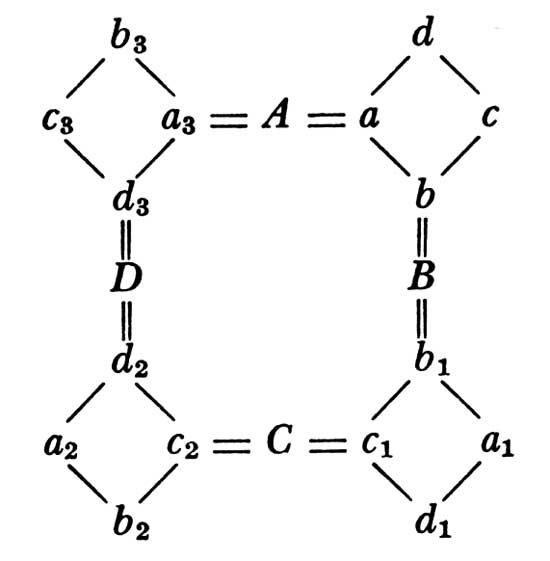
    Going further than Gendlin, we can take a cue from the process-language of alchemy (Miller, 2008) to see how relations themselves are a precipitate of the tension between complementarily opposing potentials, made by a distinction out of the whole.  This corresponds to the recursive ontological alchemical sequencing of the elements from Fire (the whole) to Air (polarity) to Water (relation) to Earth (thing), to Fire (a new, transformed whole).  Relations are to opposing potentials of a distinction as things are to relations.  Opposing potentials are themselves a precipitate of the whole by virtue of distinction (of Fire by Fire), and work alongside each other within the whole simultaneously.  Each step from the whole is a kind of step-down transformation; ontologically we could say that beginning with level N, we move to level N-1.  Each level is pulled out of simultaneity by an act of distinction within the whole, of the whole, by the whole.  A cascading of levels of distinction thus yields the ontology of “things.” (more…)

  • Video Games and Spiritual Development, a preliminary analysis

    Video Games and Spiritual Development, a preliminary analysis

    Introduction

    Video games are a huge global phenomenon, driving well over $70 billion dollars in sales in 2011—a number that is only rising year by year.  For comparison, global music sales in 2011 was about $16 billion, while global theater tickets was about $33 billion.  This has consequences—largely unexplored—for people that are interested in spiritual development.  It is thus important to look at the phenomenon of video games from a spiritual perspective, because almost no one growing up today can avoid them.  The time in which human beings could develop spiritually without the presence of modern technologies is essentially over, and video games are now deeply integrated into the fabric of modern society.  Their ubiquity means that human beings who wish to undertake spiritual development will often do so in contexts that are not devoid of video games.  We can thus ask the question, how might video games impact spiritual development? (more…)

  • Patterns in Process: Transdisciplinarity as a Background for Working with the Elemental Cycle of Transformation

    Patterns in Process: Transdisciplinarity as a Background for Working with the Elemental Cycle of Transformation

    Elemental Cycle Abstract

    This essay outlines connections between the Elemental Cycle as an archetype of transformation, transdisciplinarity, and  cybernetics.  A number of questions are addressed: the nature and importance of connecting these fields, an examination of resources and the dominant disciplinary discourses for the associated fields, and a critical examination of my assumptions, beliefs, and position.

    Introduction

    How often do we find ourselves in a position of not being able to see something unless it is first pointed out to us?  This happens all the time with the visual and other physical senses, but of course also occurs in our thinking; certain concepts seem to hide in plain sight, and unless we are cued into where and how to look for (or to think about) them, they slide on by as a part of the undifferentiated background of conceptual life.  Usually we are introduced to these sorts of concepts just like we are to new people, through a third party who is already familiar with each of us: “Seth, I’d like you to meet Recursion; Recursion, this is Seth.”  Often with this sort of introduction comes an experience: “Oh hello Recursion!  You know, I feel like you must hang out at some of the same coffee-shops as I do, but we’ve never been formally introduced.”  And so a relationship begins with a concept, and just as with human beings, you can become more intimate and familiar, get into fights, seek new levels of understanding, and go on adventures. (more…)

  • Goethean Studies Notebook

    Goethean Studies Notebook

    Goethean-Studies-1999-2000-Notes-by-Seth-MillerPDF: Goethean Studies Notebook (40mb)

    PDF: Higher quality, print version (180mb)

    This notebook was created as a personal record of the 1999-2000 Goethean Studies program at Rudolf Steiner College. This unique course, conceived of and taught primarily by Dennis Klocek, is still being offered — it is now called Consciousness Studies. When I took the course, which was seven months long and met for about three hours every weekday, I liked to call it “Being Human 101”, because it offered some basic perspectives about being human that spanned the spiritual, psychological, and physical worlds in a very deep and coherent way.

    There are certainly errors contained herein: it was often simply not possible to record more than the merest fragments of the vast pictures that awakened in the little Emerson classroom and flowed like honey across our minds. This record is like a six year old’s crayon rendition of a Michelangelo: it may contain something recognizable, but is no substitute for the real thing, which I encourage everyone to experience.

    It is likely that the only people who will see this document are those already familiar with the course in one of its various incarnations. For you I hope that it re-awakens a commitment and enthusiasm for the hard and necessary work of spiritual transformation by connecting you to the feeling you had sitting in the uncomfortably cold room on uncomfortable chairs, listening to another mind-blowing morning lecture by Dennis: the feeling that you were exactly where you needed to be and wouldn’t trade it for anything.

    For those who have not been able to take the course, this gives a tiny taste of some of the content that was presented in its 1999-2000 incarnation, and will hopefully inspire you to research the current, more highly refined and potent version.

    For those who have found this page but have no idea what I’m talking about even though you’ve read this far, just flip through it like it was you long-lost friend’s photo album and see what tickles your fancy as you skim on by.

  • The Art of Nature: Alchemy, Goethe, and a New Aesthetic Consciousness

    The Art of Nature: Alchemy, Goethe, and a New Aesthetic Consciousness

    Are you fascinated by the beauty of forms in the natural world?  Do you sense something amazing at work out there, like an intelligence that lies just beneath the surfaces of things?  Then I invite you to read a new essay that explores the building of a new aesthetic consciousness that seeks to connect us with natural processes in a way that is truly transformative.  I follow threads from alchemy into the genius of Goethe, and end with intimations brought forth by Rudolf Steiner, and even include some home-made animations as a part of a practical exercise for you to work with.  You are invited to come and participate in opening a new set of eyes…

    The Art of Nature: Alchemy, Goethe, and a New Aesthetic Consciousness

  • Waldorf Educators: A Light on the Path

    The world has problems; LOTS of them.  But as long as there are people like my friend Nancy, who devote their lives and love to one of the most important and practical callings on the planet, education of our young, I have hope for the future.

    Let me give you a picture, in her own words, of what I mean, as an example of how Waldorf education tries to meet the challenging tasks of our time.  This is but a tiny picture of what is possible–today– for education:

    My class went to our auditorium today and entered in the dark.  The room was covered in pine boughs in the shape of a spiral path.  In the center of the path was one large glowing candle that sat upon a tree trunk covered by a blue cloth with gold stars on it.  It smelled like a pine forest.  The students entered in silence and proceeded to a semi-circular row of chairs to sit down.  Two women, playing penny whistle, violin, and cello began playing various musical selections.

    The first child approached me.  I was standing by a table filled with red apples, each holding a slim candle in a hole carved into it.  Then, one by one, each child took the spiral walk into the center where the light glowed.  Lighting their own small candle from that big central light, they each turned and began walking back out from the center.  At some place of their own choosing along the path, they each picked a spot to place their little light.

    When the last child had gone, I took my candle filled apple and walked the path among the little lights, to the center.  After lighting my own candle, I found a place along the way to place my own light among the others.  It was an extraordinary experience for us all.  The metaphors were flooding my mind as I watched each of these students proceed on this path.  When they were little, their kindergarten teacher or parent held their hand on the way.  Now, they seemed to have grown so tall, only third graders, yet I marveled at how they had gotten so big.

    As I looked at them, a veil was drawn back for me and I could see much more than I could usually see.  Everything was revealed to me in a moment.  It seemed to me, as they walked, that I could sense them as younger children, as who they were now, and even who they were going to one day become.  In the darkness, I really felt I could see their future before my physical eyes.

    When my turn came, I realized that in the last two years of first and second grade, I always had walked the advent spiral first – before they did – so that they could see how to do it again.  This time, they walked confidently alone without my example.  This time, I followed their example.  As I passed by each one of the lights on my way into the middle, I felt as if I were floating along in the starry heavens, each star one of these students of mine that I hold so dear.  Each star lighting my way into the center.  I was so humbled to place my small light, no bigger or smaller than the others, down on the path to join in lighting the room.  I could also feel how profound it was for the students to see their teacher walk this inward path.

    With each eye intently and silently upon me, I felt the connection, the gravity, the grace, the sacredness of the responsibility I carry on their behalf, but also I felt, “I am the so-called teacher this time, but I am really only one of you.  You, who have been my teachers, who will be my teachers in the future.”  What a privilege to live in such light.  Blessings on us all.