It's Elemental

Author: Seth

  • Projective Geometry – Harmonic Points Sequence

    Projective geometry offers a window into the human soul — not as a mere analogy, but directly: projective geometric processes are manifestations of the same archetypes that work through and within human experience.

    Doing projective geometry is to move your soul in accordance with these archetypes, and in so doing you start to train your soul so that it can begin to perceive the movement of these archetypes both in your own soul and in the world-processes around you.  In effect, projective geometry offers a path towards the development of organs of perception that operate not primarily in a physical way like your eyes or ears, but in a more subtle realm.  The development of these soul-organs opens up new realms to your perception, just as if you were in a dark room and then someone turned on a light: now you can see depth, color, and form, where before these were literally non-existent for you.

    In this spirit, I offer the following sequence of drawings that illustrate one process in projective geometry: that of Harmonic Points.  I suggest, before looking further, that you examine and follow the constructions on your own in this post:

    Harmonic Points and Lines, a Projective Geometric Exercise

    Once you have sufficient experience with the above, feel free to examine the following drawings.  Note the context given in this post and the above linked post, and see if you can discern, as an exact soul-perception, the moving gesture that accompanies the sequence, paying special attention to the ‘unique’ moments of the transformation.  Feel free to reply in comments to this post about your experience!

    Note: the drawings have been placed on a separate page, so that they can be presented unencumbered by the limitations of the blog theme.

  • Organs of Perception

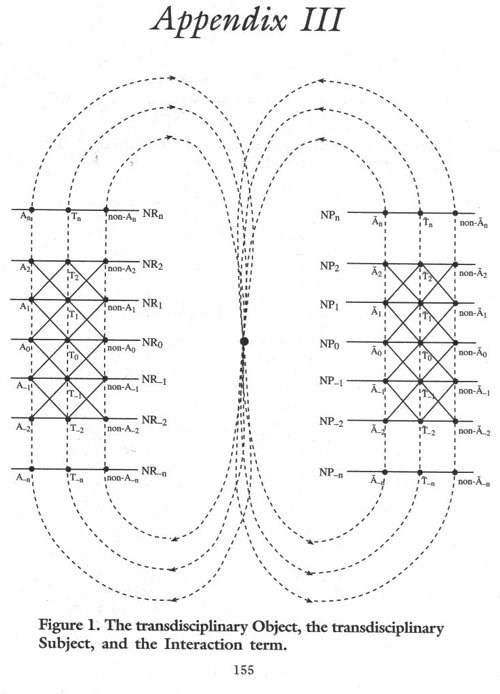
    Basarab Nicolescu is a physicist and proponent of transdisciplinarity.  In the book of the same name (which he edited), he speaks of multiple “levels of Reality”, which are accompanied by multiple “levels of perception”. These two complementary duals form, on the one hand, what he calls the “transdisciplinary object” and on the other the “transdisciplinary subject”.  These are united by a flow of “nonresistance to experience” he calls the sacred, which moves through all the levels.  See the picture from his book below:

    Transcendent Object/Subject and Sacred
    Transcendent Object/Subject and Sacred

    Although this view is a bit schematic, one of the things that Nicloescu includes which is often very lost in modern discussions about these sorts of things is the necessity for a corresponding “level of perception” when encountering various levels of reality.

    Specifically, this is something verifiable in my own experience: that it actually takes not just some kind of intellectual shift to see things from a new perspective, but rather the rhythmic development of new organs of perception in order to perceive new realities.  I’m speaking of ‘organs of perception’ because they are strictly analogous to real organs like our eyes and ears, but without physicality — they are, if you will, organs made ‘on the fly’ in the soul, which are capable of resolving details in a situation that otherwise would be lost.  Their constituency relies entirely upon the way in which they are themselves created — they form in the image of what they can thus perceive.  For example, a Waldorf teacher I know has developed in her contemplative work with children a soul-organ which can perceive movements of ‘warmth’ in ways that offer specific and practical information and actions regarding individuals — this is something experienced as eminently real and subtle, which would be lost on anyone who hadn’t done the same rhythmic work to create the relevant capacity for experience to hold that kind of perception.

    It seems we often expect that such perceptions should be contingent upon a primarily intellectual shift in understanding — and an understanding of outer phenomena in particular — as if it were only a question of having the right ideas about things that would allow us to perceive newly.  I think this is an error;  that kind of change is only preparation and accompaniment, but cannot fully constitute the necessary basis for actual perception of new realms.

  • is reliance upon dualism hardwired?

    I wonder about the extent to which dichotomous thinking is either hard-wired or at least dependent on completely non-social forces.  It seems almost to be a thermodynamic question, that is, a question of trying to optimize the amount of energy spent in thinking for a given situation.  Thinking is a very expensive activity, physiologically speaking – it is essentially a catabolic process which relies upon the breakdown of molecules for their energy.   

    Evolution isn’t usually needlessly extravagant – in fact it’s kind of lazy, if you don’t mind the anthropomorphism.  It seems that in a broad sense, there is a sort of law of diminishing returns for the energy investment required for thinking.  In other words, if you encounter a situation in which some kind of action or distinction is called for, you get the most bang for your buck by quickly assessing things according to an either/or model.  Identify one aspect, which automatically calls up some kind of opposite, and make a determination on the basis of this division.  It’s quick, dirty, and effective for generating actions, feelings, and new thoughts.  If the feelings, actions, etc. that result from this distinction are ‘good enough’ then there is little reason/pressure to continue the act of thinking about it in a way that calls into question the basic assumptions of the underlying duality.  In other words, it’s easy to make and maintain the most basic of distinctions, those of duality.  

    So it seems to me that it is largely social factors that mitigate this tendency.  Trying to think through the layers and layers and layers of connection that inevitably describe EVERY situation is simply not practical energy-wise, and thus requires very significant counter-pressure for its activation.  We must run into situations in which our original duality is experientially shown to be inadequate for there to be a commitment to another round, or three or ten, of thinking over and through a given situation.  At some point things seem to just get too complex and we give up, and the point at which we abandon the process relates to the level of depth and complexity we are able to experience.   

    This is why I really like Kwame Anthony Appiah’s appeal to respectful experience with people not like us, i.e. through conversation: “Conversation doesn’t have to lead to consensus about anything, especially not values; it’s enough that it helps people get used to one another” (Appiah, 2006, p.85).  At a very basic level, time spent with others presents us with countless variations on the experience of discovering that our implicit or explicit distinctions are not always shared.  This presents (often, but maybe not often enough?) a kind of social pressure to go through a second round of thinking about our primary distinctions, the effect of which at least sets up a greater likelihood that we can ‘get used to’ differences which before were causes for anxiety.  

    In any case, it seems that there is a certain amount of ‘going against the biological grain’ required to produce people like Morin, Bernstein, or Appiah.  Luckily it’s not all biology!  Of course, applying this little analysis to itself, I should be wary of relying upon the duality of biology/sociality, because, following Morin, ‘it isn’t quite that simple’.  Round 1 over.

    20080507-IMG_6045


  • Coros Meditative Retreat: The Teachings of Isis: From Anxiety to Insight

    Dennis Klocek is holding a Coros Institute meditative retreat on April 3rd – 5th (Palm Sunday Weekend) at Walker Creek Ranch in Petaluma, CA.

    Topics will include:

    · Death of the spirit in the material world as a source of unconscious anxiety.
    · Working on the essential steps of separating the soul forces in the process of self-development.
    · Re-uniting effectively the soul forces and forging new insights into dreams, destiny and karma.

    If you have never heard Dennis or worked with him before, you are in for a real treat.  He walks his talk, and offers a very unique approach and vision of personal transformation.  It’s not just theory, but well-honed advice that weaves together decades of personal meditative work, phenomenological study, and repeated application.  You don’t want to miss it!

    Attached is a PDF flier that you can print and mail in to register: do it before you come up with some lame excuse to stay home and keep your life static and unchanging!

    The Teachings of Isis: From Anxiety to Insight

    Check out Dennis’ Coros Institute for more information: http://www.corosinstitute.org


  • On “The Moral Collapse of the University” by Bruce Wilshire

    As a philosopher and an educator, I enjoyed Wilshire’s book. Quite a number of his experiences parallel my own with regards to teaching and the self-reflective processing and mulling over the ‘educational act’. I felt very at home with a number of his statements, like “we arrive at the capital feature of the educating act: self-awareness, or self-reflexivity” (Wilshire, 1990, p.27), or my favorite, “The ultimate educating force is who I am” (Wilshire, 1990, p.31 – italics mine).


    These two statements are old-hat for Waldorf teachers (of which I am one), and I found most of what Wilshire brought in regards to his educational analysis familiar territory — but this is a good thing, as the educational philosophy behind Waldorf education is to educate the whole child. Much modern education lacks an awareness of the importance of consciously developing not only an open face-to-face relationship with one’s students, but also — going much further than Wilshire — developing an open spiritual relationship as well, through contemplative practices. And of course we should also play with the above statements by Wilshire in a cybernetic context: the educating act calls forth self-reflexivity through its realization, while self-reflexivity opens vast arenas of potential educability. Likewise, the force of education helps make us who we are, and who we are as educators.


    I am grateful that Wilshire so adroitly points out the various cultural forces that worked to create the over-professionalization we have today — recognizing these causes is both enlightening and freeing. I especially appreciate his remark that “the organizing center of the university ought to be the organizing center of the developing human person” (Wilshire, 1990, p.85). In other words, I see Wilshire calling for the re-humanization of education, the recognition that education is not about knowledge, but about the development of human beings (Wilshire speaks of the returning the university to the “human scale” (Wilshire, 1990, p. 226)).


    In this way, Wilshire parallels Rudolf Steiner’s view (as the originator of Waldorf education) that education is for the soul what medicine is for the body: a bringing to harmonic wholeness of diverse aspects. We are presently suffering from an overdevelopment — using the body metaphor that Wilshire favors — of the head. Specifically, we have brought education out of the realm of the heart and the hands, which have become atrophied, almost useless remnants when forced to squeeze themselves through the tight gates of academia. Education, to be a source of life, of passion, of deep inquiry and engagement, must explicitly and integrally include what in the body manifest as the rhythmic and metabolic realms. The techniques of much of modern education (I’m thinking here of grades, testing, quantitative reductionism, departmentalization, and so forth), from an alchemical perspective, are too heavy on the salt and too light on the sulfur, with almost NO mercury to be found. I won’t go on about these metaphors, although they are what we could call exact analogues.


    Wilshire, in his language, points out the continual presence of ‘archaic’ forces, while showing how the university lacks awareness of the process of ‘mimetic engulfment’ and its concomitant effects on the thoughts and actions of both the professors and the students. And of course he continually relates both these aspects to the willfully obfuscated sense of the self as a ‘body-self’, with all the unrecognized or semi-recognized purification rituals which subersively accompany the imbalance:


    “The failure to grasp the concept of body-self means the failure to grasp the utter inability of seventeenth-century psycho/physical dualism to grasp the nature of knowledge and the knower, the reality of the human situation” (Wilshire, 1990, p. 183).


    We could just as easily point out the same drama via the polarity of Apollo/Dionysus (Wilshire mentions this in passing on p. 225 and p.230), nervous/metabolic, salt/sulfur, male/female, contraction/expansion, centric/peripheral. In every case what is missing is the third aspect: Eros, rhythm, mercury, the universal human, and the dynamic, responsive and evolving membrane; Wilshire speaks of the ‘reciprocating field’ (Wilshire, 1990, p. 224), a physicist might talk about entanglement, and Western esotericist the Cosmic Christ.


    That “education is basically a moral relationship between persons devoted to truth” (Wilshire, 1990, p.229) is a much more sane approach than what presently passes for education is without much doubt for those of us who have experienced both sides of the screen, as it were. His call to reclaim, following Wordsworth, the “feeling intellect” (Wilshire, 1990, p.231) is a call put forth much more directly and strongly in regards to education by Steiner almost a hundred years ago. He recognized that education must fit the reality of the developing human being, not vice-versa, and partly for this reason included practical arts as well as aesthetic arts in addition to more intellectual topics — all of which were presented in time to work with whatever stages of body, soul, and spirit growth the child was experiencing. Steiner also embodied and presented the model of the educator as model, in which the presence of the educator is more educating for life than any specific verbalization of concepts, even if those concepts are about life.


    Wilshire’s last chapter on Reclaiming the Vision of Education: Redefining Definition, Identity, Gender was the most juicy for me. I appreciate his delving into the need to reframe the discussion in a way that includes the feminine aspects of the situation. His suggestion (following Dinnerstein) that male and female parents take a nearly equal hand in raising children (Wilshire, 1990, p.271) is probably a bit oversimplistic, although I’d love to see it happen!!! A crucial aspect, as he points out, is that we desperately need “examples of meaningful human lives, [which] must be provided first and foremost in person” (Wilshire, 1990, p.230). By human, I presume, he means human qua human universalis, or perhaps human archetypus, for the central mystery of the archetype is that it is both universal and particular, both dynamically evolving and homeostatic… just like us.
  • Social Networking and Consciousness

    I would like to say that the quite frankly astonishing rise of social-networking tools clearly points to an unmet need in the ‘wired’ populace at large.  We increasingly live in a fragmented society, where our friends and family are scattered across the globe.  Many of use no longer, for economic, personal, or many other reasons, choose to live in the same place for our entire lives, where we could build up a local network of family and friends.  And even if we do so, the demands of modern life and our cultural habits tend to erode (it seems) many opportunities for face-to-face gatherings over a long time period; such things now require real effort and are not a de facto part of everyday life.

    So it seems that a way of assuaging the erosion of the human need for contact, and just as importantly, a context within which such contact can be meaningful, can be found through the social networking tools.  These tools are not designed, and cannot really take the place of repeated face-to-face interactions, but what they DO provide is a way to ‘keep the door open’ to people who you might otherwise lose track of or only communicate with very rarely.  By having, for example, a Facebook page, you put yourself in a position of taking moments out of your day to have a conscious connection with people who would otherwise likely not enter your thoughts that day.  The immediacy and digital ‘nearness’ provided by the technologies allows for and creates a different kind of interaction than has heretofore been possible on the planet.  On the one hand, these technologies constrict certain kinds of communication; but it opens up others at the same time, and allows a thread of connection that can later be followed up by a more present, face-to-face, or otherwise soul-ful type of communication.

    This is something of the positive side of these tools, but they can also be used for pure ego-stroking, for bullying, for economic reductionism, etc.  Such is the way of any tool.  For me it’s always a question of how the tool is used, and I am convinced that humans have the power to make tools like this (and other technologies) work in a positive way for the benefit of themselves and the planet.

    It’s true: there is no substitute for real face-time.  I would simply point out that Facebook and such tools are NOT actually substituting for face-time.  In fact, the reverse might be true: the immediacy and ubiquity of social networking tools may actually increase the potential for two or more people to get together IRL (in real life)–there must be a study on this somewhere… if not, any takers?

    My feeling is that the use of such tools lessens both perceived and actual gaps between individuals, while also allowing individuals to discover more potential relationships that might otherwise be missed.  Increasingly human beings are going to have to learn how to deal with the instant availability of essentially infinite data.  In the pre-wired-era, the available data was restricted to your immediate sensory neighborhood, and you had no choice about this, notwithstanding the influence of books and letters.  Now, we have a choice, and can access a whole variety of types and fields of information literally out of thin air.  It opens up a whole different set of possibilities for human creativity and interaction….

    But obviously I’m not yet giving a well-rounded picture.  I should also point out that the way that these technologies lead human consciousness around may be problematic in a number of ways, and the identification and harmonizing of these regressive or sclerotic tendencies should be addressed up front.  But to speak of these would require an even longer discussion — one including talk about the inner life of the soul.

    Below:  a diagram depicting connections between a single user’s Facebook friends.

    my facebook friends