This notebook was created as a personal record of the 1999-2000 Goethean Studies program at Rudolf Steiner College. This unique course, conceived of and taught primarily by Dennis Klocek, is still being offered — it is now called Consciousness Studies. When I took the course, which was seven months long and met for about three hours every weekday, I liked to call it “Being Human 101”, because it offered some basic perspectives about being human that spanned the spiritual, psychological, and physical worlds in a very deep and coherent way.
There are certainly errors contained herein: it was often simply not possible to record more than the merest fragments of the vast pictures that awakened in the little Emerson classroom and flowed like honey across our minds. This record is like a six year old’s crayon rendition of a Michelangelo: it may contain something recognizable, but is no substitute for the real thing, which I encourage everyone to experience.
It is likely that the only people who will see this document are those already familiar with the course in one of its various incarnations. For you I hope that it re-awakens a commitment and enthusiasm for the hard and necessary work of spiritual transformation by connecting you to the feeling you had sitting in the uncomfortably cold room on uncomfortable chairs, listening to another mind-blowing morning lecture by Dennis: the feeling that you were exactly where you needed to be and wouldn’t trade it for anything.
For those who have not been able to take the course, this gives a tiny taste of some of the content that was presented in its 1999-2000 incarnation, and will hopefully inspire you to research the current, more highly refined and potent version.
For those who have found this page but have no idea what I’m talking about even though you’ve read this far, just flip through it like it was you long-lost friend’s photo album and see what tickles your fancy as you skim on by.
Our experience of ourselves is in many ways completely mediated by aspects which are located beyond the normal boundary of the “I”. I’d like to offer one possible way of looking at the issue.
I approach this question concerning the boudaries of the “I” by taking into account the transformations of the “I” as it works through and within the physical body and the soul body on its path from death to life to death to life. To do so requires distinction between the ideas we have about our “I” and our unmediated, direct experience of our “I”, and more importantly between our “I” and what we can call our ego, on the basis of the usage of this term in the Western traditions (particularly psychology, which deals almost exclusively with the ego).
When incarnating, the human “I” experiences a period of darkness, which only gradually lifts throughout life, until (perhaps around the age of 21 or so) the first glimmerings of what I am referring to as the “I” become available to the experience of the ego, which is a structure that is present much earlier on, and is built up through a variety of relations between the burgeoning activities of the physical/soul bodies and the ‘outer’ worlds.
The incarnation of the “I” takes place not at birth, but much later, and sometimes not at all; this despite the fact that we each have the constructed ego that is constantly built up as a semi-permanent dialog between the inner activities of the body/soul and the various bodily and ensouled elements of our environment. This ego includes the remnants of the activity which is rightfully regarded as the spiritual activity of the “I” – thinking. Thus the ego becomes filled with thoughts but lacks the awareness of whence these thoughts originate. In the meantime (in accord with all the social, cultural, historical, familial, etc. ‘forces’ at work around all the activities of the aspects of the human being which are not the “I”) the ego maintains the false impression that it is the one doing the thinking.
This then leads us to the question about how we draw the boundary around what we consider to be our “I”, which turns out more often than not to be a question to the ego about the ego. There are no boundaries to the “I” in the normal sense, the “I” is a spiritual activity, a process. It is a wonderful aspect of the spiritual world that “I’s” are capable of penetrating and moving with each other; their activities can merge, coincide, and diverge. The idea of boundaries of the “I” only arises when we take our experience of the rules at work in the realm of physical bodies and our sense life and apply them to an arena in which no physical bodies or physical sense organs exist. In other words, it is like asking about the flavor of a trapezoid.
We can have ideas, thoughts about the boundaries of our ego, but the activity upon which such ideas are based rests only in the “I”. We can have the thought “My physical body only works because it includes trillions of bacteria and other organisms which I do not directly experience, but which science tells me are required for my process of digestion; if these microorganisms did not permeate my gut, I would be incapable of digesting my food.” This leads us to the thought that perhaps I’d better take a look at what I consider to be my ‘self’ – shouldn’t it include all the aspects necessary to maintain the activities of my physical body, which support then my capacity to think and experience?
We can thus, in our thought-life (not our thinking-life) come to the idea that the normal drawing of the boundary between ‘self’ and ‘other’ is in some ways quite spurious. There is then an attempt to fill the gap thus created (in thought) with other thoughts, which try to reorganize the connections made in thinking. So we say things, perhaps, like “Well, yes, ‘I’ really must include the bacteria in my gut” and so forth.
But all the while we are missing the very activity that is the source of all of these reconfigurations of our thought-life; our thinking. It is when we turn our attention to the thinking process itself that we start to come directly into contact with the “I” itself. This experience, the recognition of the “I” by the “I”, is not a thought, but is what can occur when thinking takes itself as its own object. In such a case, a completely different set of experiences become possible with respect to the question of the ‘boundaries’ of the self.
Moreover, what our ego keeps hidden from consciousness directly affects our perceptions and assumptions. It seems that the ego, in a sense, precisely constitutes its boundaries by this very omission. What I feel coming from my ego changes dramatically from situation to situation, not on the basis of what is included so much as on the basis of what is left out, and what’s more, on how it is left out.
The ‘mood’ around the process of the ego’s self-entrainment says more about my deeper nature than its explicit self-identifications ever could.
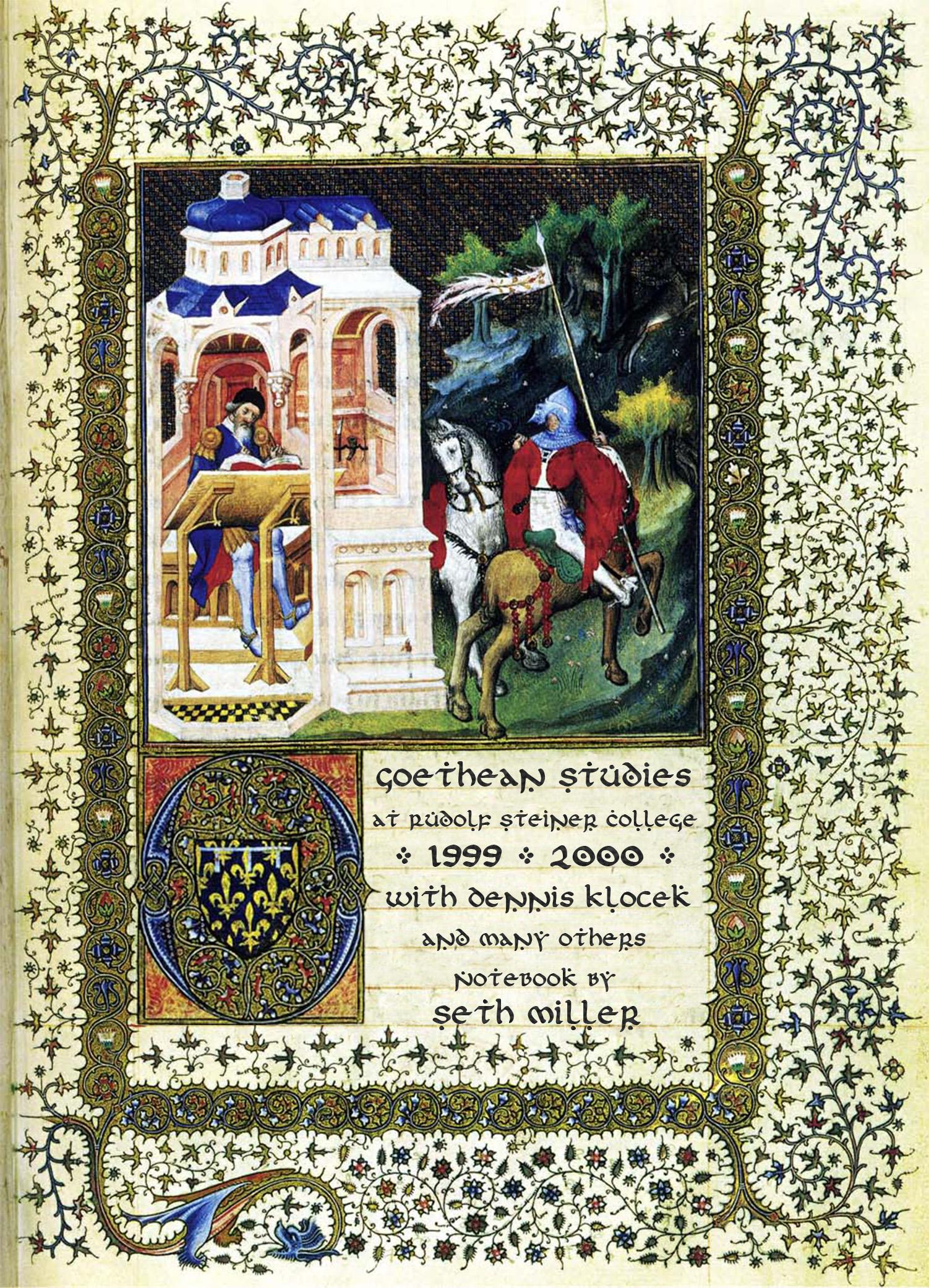
 PDF: Goethean Studies Notebook (40mb)