It's Elemental

Tag: Anthroposophy

  • Toward an Aesthetic Epistemology – Slideshow Overview

    Toward an Aesthetic Epistemology – Slideshow Overview

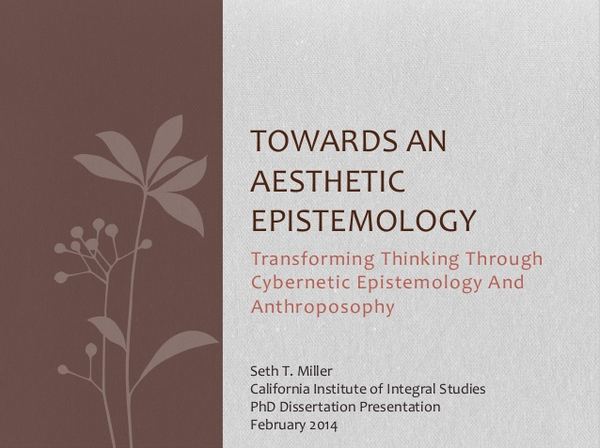
    In February 2014 I successfully defended my PhD dissertation, titled “Toward an Aesthetic Epistemology: Transforming Thinking through Cybernetic Epistemology and Anthroposophy.”

    The following is the abstract and a slideshow presentation that pulls out the crux of my arguments.

    Abstract

    The complexity, subtlety, interlinking, and scale of many problems faced individually and collectively in today’s rapidly changing world requires an epistemology—a way of thinking about our knowing—capable of facilitating new kinds of responses that avoid recapitulation of old ways of thinking and living. Epistemology, which implicitly provides the basis for engagement with the world via the fundamental act of distinction, must therefore be included as a central facet of any practical attempts at self/world transformation. We need to change how we think, not just what we think. The new epistemology needs to be of a higher order than the source of the problems we face.

    This theoretical, transdisciplinary dissertation argues that such a new epistemology needs to be recursive and process-oriented. This means that the thoughts about thinking that it produces must explicitly follow the patterns of thinking by which those thoughts are generated. The new epistemology is therefore also phenomenological, requiring the development of a reflexivity in thinking that recursively links across two levels of order—between content and process. The result is an epistemology that is of (and for) the whole human being. It is an enacted (will-imbued) and aesthetic (feeling-permeated) epistemology (thinking-penetrated) that is sensitive to and integrative of material, soul, and spiritual aspects of ourselves and our world. I call this kind of epistemology aesthetic, because its primary characteristic is found in the phenomenological, mutually fructifying and transformative marriage between the capacity for thinking and the capacity for feeling.

    Its foundations are brought forward through the confluence of multiple domains: cybernetic epistemology, the esoteric epistemology of anthroposophy (the spiritual science of Rudolf Steiner), and the philosophy of the implicit as developed by Eugene Gendlin.

    The practice of aesthetic epistemology opens new phenomenal domains of experience, shedding light on relations between ontology and epistemology, mind and body, logic and thinking, as well as on the formation (and transformation) of identity, the immanence of thinking in world-processes, the existence of different types of logic, and the nature of beings, of objects, and most importantly of thinking itself and its relationship to spirit.

    Keywords: anthroposophy, autopoiesis, cognition, cybernetic epistemology, distinction, epistemology, esotericism, logic, recursion, Rudolf Steiner, second-order cybernetics, spirituality, thinking

    Slideshow

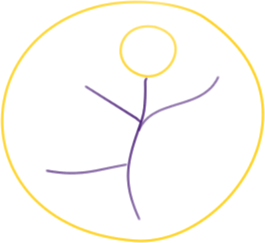
    thetaPlease note that Slideshare translated the Greek letter Theta into the letter Q. This is unfortunate, because I used the Greek letter for its geometric shape, pictured correctly at left.

  • First and Second-Order Epistemologies

    First and Second-Order Epistemologies

    Gregory Bateson (1991) famously said that we “cannot claim to have no epistemology. Those who so claim have nothing but a bad epistemology” (p. 178).  Bateson is calling for self-reflection in our epistemology.  He wants it to be recursive, so that in our production of knowledge we do not delude ourselves into thinking that the means of production is independent of what is produced.  Bradford Keeney, cybernetic epistemologist, family therapist, modern day New Orleans-style shaman, and student of Gregory Bateson, notes that recursive epistemology has roots in second-order cybernetics and the recognition (1983) that “any distinction drawn is drawn by an observer. … An observer observes by drawing distinctions. … The starting point of epistemology is therefore an observer drawing distinctions in order to observe” (p. 24). This leads us to a fundamental recursion or non-linearity at the very start of any epistemological endeavor. While non-recursive epistemologies try to mitigate this kind of loopiness, cybernetic epistemology embraces it as the very heart of knowing, using it as a creative generator of change and transformation. Working with a non-lineal epistemology leads to a different kind of knowing, one which “emphasizes ecology, relationship, and whole systems. In contrast to lineal epistemology, it is attuned to interrelation, complexity, and context” (Keeney, 1983, p. 107).

    The consequences of lacking a self-reflexive epistemology are dire, leading to real practical and ethical dilemmas.  The structure of the sequence often goes something like this:

    • Knowledge is produced on the basis of a non-reflexive epistemology (Bateson’s “bad” epistemology). Ex: You performed an act found to be illegal.
    • The knowledge produced is thus assumed to be “objective” and “true” (i.e. independent of the means of its production; ignorant of its genesis). Ex: It doesn’t really matter why you did what you did, you are beholden to the law as written.
    • This tends to have a psychologically limiting effect with respect to alternative knowledge and especially alternative modes of knowledge production.  One’s viewpoint becomes ossified. Ex: The judicial system limits its treatment of you as a whole human being only to what is allowable within the strictures that the law defines. You become identified with your act.
    • The unreflective assumption of the “truth” of the knowledge becomes justification for its projection, often forcefully, onto other people and processes in the environments surrounding the knower.  A sense of conviction that the world is “like this” leads to inflexible protocols in our institutions and in our modes of interaction with others.  In other words, outer processes are also ossified; they become sclerotic. Ex: Now, instead of being a whole human being who with a completely full and complex life that included the illegal act, your identity shifts to that of a criminal. Your identity shifts, and you are now identified with the label “criminal,” and the judicial system creates places called prisons designed largely to maintain this distinction of your new identity.

    The unintended effects of this kind of lineal process knowledge production could fill multiple volumes, from the most subtle aspects of daily life to world-historical events. But recursive epistemology is not in opposition to lineal epistemology; it is rather meant to be a way of maintaining complexity and subtlety (and ideally, wisdom) by calibrating the linearity of standard epistemological practices through higher-order recursion.

    Calibration and Self-Calibration.

    But what does it mean to have a self-reflexive epistemology?  The difference between the two types of epistemologies, non-self-relfexive and self-reflexive, can be described by the first and second order difference.  A non-self-reflexive epistemology is a first-order epistemology, a process of creating knowledge that operates in a linear fashion.  The knowledge it generates is not explicitly connected to the process of its generation, and thus does not act as a potential corrective to its mode of production.  Epistemology is a tool for knowing; but with a non-self-reflexive epistemology, the tool’s operation does not change the tool, so that no matter what job it is called to do, it re-instances any new creations in the manner and style of its past processes—regardless of what might be new in the situation it encounters.  The kind of newness that comes from a linear epistemology is (more…)

  • Video Games and Spiritual Development, a preliminary analysis

    Video Games and Spiritual Development, a preliminary analysis

    Introduction

    Video games are a huge global phenomenon, driving well over $70 billion dollars in sales in 2011—a number that is only rising year by year.  For comparison, global music sales in 2011 was about $16 billion, while global theater tickets was about $33 billion.  This has consequences—largely unexplored—for people that are interested in spiritual development.  It is thus important to look at the phenomenon of video games from a spiritual perspective, because almost no one growing up today can avoid them.  The time in which human beings could develop spiritually without the presence of modern technologies is essentially over, and video games are now deeply integrated into the fabric of modern society.  Their ubiquity means that human beings who wish to undertake spiritual development will often do so in contexts that are not devoid of video games.  We can thus ask the question, how might video games impact spiritual development? (more…)

  • Sleep, Dreams and Video Games

    Sleep, Dreams and Video Games

    How you use your attention in waking life has definite effects in your dreaming life.  The following is my distillation of some insights from anthroposophy in this regard, which I offer as one way of looking at this phenomenon, specifically around the issue of video games and dreaming.  This post should provide an appropriate background if necessary.

    If people are comfortable with the terms, we can talk about how the astral body (the subtle body that allows something outside to become something for us inwardly; i.e. the sense-body, which we share with animals) gains its content in large part by reflecting itself off of the etheric body (the less subtle body that keeps your body from becoming a corpse, which we share with the plant realm).

    When you spend hours of time focusing your senses on particular stimuli (i.e. a video game) your are patterning your etheric body through physiological repetitions: the movements of your eyes, hands, breathing, etc., and more importantly in the endocrine responses and other physiological changes that go along with the particular game experience.  Knowing why this is important needs a little background first.

    xbox-360-controller

    When you go to sleep, and you are no longer imposing your astral body on your etheric (i.e. choosing where to direct your attention and what sensations you will seek and avoid) your etheric body starts to (more…)

  • Goethean Studies Notebook

    Goethean Studies Notebook

    Goethean-Studies-1999-2000-Notes-by-Seth-MillerPDF: Goethean Studies Notebook (40mb)

    PDF: Higher quality, print version (180mb)

    This notebook was created as a personal record of the 1999-2000 Goethean Studies program at Rudolf Steiner College. This unique course, conceived of and taught primarily by Dennis Klocek, is still being offered — it is now called Consciousness Studies. When I took the course, which was seven months long and met for about three hours every weekday, I liked to call it “Being Human 101”, because it offered some basic perspectives about being human that spanned the spiritual, psychological, and physical worlds in a very deep and coherent way.

    There are certainly errors contained herein: it was often simply not possible to record more than the merest fragments of the vast pictures that awakened in the little Emerson classroom and flowed like honey across our minds. This record is like a six year old’s crayon rendition of a Michelangelo: it may contain something recognizable, but is no substitute for the real thing, which I encourage everyone to experience.

    It is likely that the only people who will see this document are those already familiar with the course in one of its various incarnations. For you I hope that it re-awakens a commitment and enthusiasm for the hard and necessary work of spiritual transformation by connecting you to the feeling you had sitting in the uncomfortably cold room on uncomfortable chairs, listening to another mind-blowing morning lecture by Dennis: the feeling that you were exactly where you needed to be and wouldn’t trade it for anything.

    For those who have not been able to take the course, this gives a tiny taste of some of the content that was presented in its 1999-2000 incarnation, and will hopefully inspire you to research the current, more highly refined and potent version.

    For those who have found this page but have no idea what I’m talking about even though you’ve read this far, just flip through it like it was you long-lost friend’s photo album and see what tickles your fancy as you skim on by.

  • Levels of Dreaming and the Makeup of the Human Being: The Spiritual Ontology of Dreams

    Levels of Dreaming and the Makeup of the Human Being: The Spiritual Ontology of Dreams

    By Seth Miller

    Full PDF

    DreamerEveryone dreams, but few people find sufficient interest in their dreams to move beyond mere curiosity at their strange contents.  Even many who work with dreams as a part of a transformative practice usually concentrate on their content, and only more rarely question their form, ontology, and origins. Exploring these aspects, however, can help provide a context that helps orient dreamers to some of the esoteric underpinnings of dream etiology (their meaningful origins), and can help enliven dream-based transformative practices. This article is an attempt to show how a spiritually-oriented understanding of the makeup of the human being gives a context for understanding different types of dreams, their origins, and some associated consequences for dreamwork.

    The language of spiritual science, also called anthroposophy (human wisdom) will be of help in this endeavor, because it maintains its cogency across multiple phenomenal realms (such as those of sleeping and waking), and because it has as its aim the ability to make clear and coherent processes which work within the physical realm but have their source beyond it, in the spiritual worlds.  Fundamental anthroposophical terminology will not be explained in this article for reasons of space, and neither will the basic anthroposophical view of dreaming in general.  For a brief introduction, I highly recommend that readers peruse this article: Sleep and Dreams in Anthroposophy, which provides the context (more…)

  • Workshop – Elemental Transformation: Changing How We Work with Change

    Workshop – Elemental Transformation: Changing How We Work with Change

    Unfortunately, the workshop has been cancelled.
    It will be rescheduled this Summer; keep an eye out here for the announcement!

    Form / Re-Form / In-Form / Trans-Form

    Elemental Transformation: Changing How We Work with Change

    A hands-on/minds-on workshop with Frank Chester and Seth Miller

    Saturday, March 20th
    9 am – 5 pm
    Live Oak Charter School Petaluma, CA

    Pre-registration is required.
    All workshop materials provided. Cost: $100

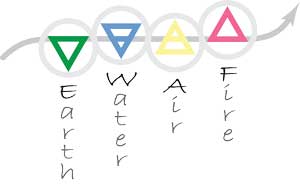
    This all-day workshop will combine hands-on geometry with dynamic presentations and experiential exercises designed to help you deepen your relationship with transformation.  You will leave this workshop with a physical form of your own creation and a more subtle and complex understanding of how transformation unfolds according to the archetypal patterning of the four elements: Earth, Water, Air, and Fire. Our goal is to inspire you and enliven your own everyday transformative work.  This workshop is perfect for parents, teachers, therapists, social workers, and anyone interested in transformation. There will be a one hour period for lunch. You can bring your own lunch or drive off-site for lunch.

    Frank Chester is an artist, sculptor, geometrician, and teacher based in San Francisco.  He has been working with the four elements for over 10 years, having used them as an integral part of the research that led him to the discovery of a brand-new seven-sided form that has deep connections to the human heart. Frank travels widely, giving dynamic presentations connecting form, geometry, and spirit.

    Seth Miller has taught physics and many other subjects in Waldorf schools across the West.  With a Master’s degree in consciousness studies, he is passionate about bringing forth tools for transformation; his specialty is the alchemy of the four elements. He is currently developing this work in a PhD dissertation, which weaves together alchemy, cybernetic epistemology, Goethean phenomenology, and anthroposophy.