It's Elemental

Category: Philosophy

  • on “higher” and “lower”

    ‘Higher’ is not intrinsically special by itself. Absent movement, and continuous transformation between higher and lower and lower and higher, higher becomes an irrelevant abstraction. But when experience directs us along a particular path, opens new vistas while closing and modifying others, punctuates contexts with more effective inclusivity, and actuates/accentuates the development of new capacities, ‘higher’ becomes a very real and useful way of describing the associated quality of consciousness.

    In this sense, ‘lower’ can be experienced as ‘higher’ (eg. Jung –> Shadow). As a metaphor, ‘higher’ (which, we can never forget, always comes with ‘lower’) constellates the experience of our self-contextualization around a direction of potential movement. It creates a pattern that inclusively represents a series of alternative becomings and lends potential value to their realization.

    Kept in motion, ‘higher’ and ‘lower’ are not necessarily problematic. This only happens when their constant r/evolving is artificially or arbitrarily stilled. Then ‘higher’ and ‘lower’ become weapons of Dis-tinction: the tincture made by Dis, another name for the god of the underworld, Pluto, whom only oaths and curses could reach. As the god of wealth (his name was originally Dis Pater, ‘Father of Riches’) he materializes the crystalline structures found within the Earth… not just as gold and gems, but as rigid habits of mind. His tincture keeps motion from arising through rigid constriction to form, and while this helps us to count (our money, our ideas), it obfuscates the healthy relationship (the transformation between) the ‘much’ and the ‘few’, the ‘higher’ and the ‘lower’, prejudicing one only.
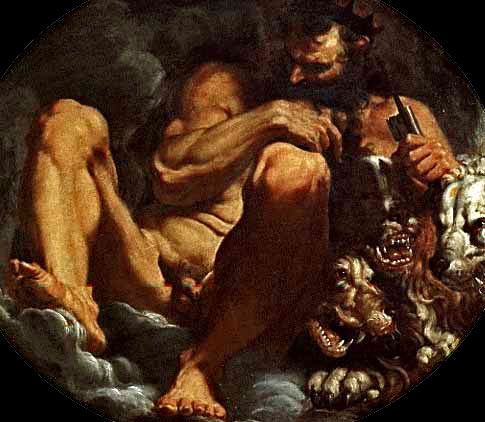

    Pluto - Hades
    Pluto – Hades

    Agostino Carracci, 1592


    The way out of this Dis-ease (but not ease for us) is well known: follow the trail left by Persephone, who’s name means ‘the emerging’. Persephone is a goddess (the feminine aspect is crucial) who embodies the alchemical qualities of Water: change/process (https://spiritalchemy.com/p6-metaphors.html). She was abducted by Dis Pater/Pluto (Roman)/Hades (Greek) from near her favorite haunt, a springing fountain, as she was gathering flowers (read ‘flowers’ as a verb). Her mother Ceres/Demeter, in looking over her whole domain (the Earth) found only her belt floating upon a little lake made from the tears of the Water Nymphs. Plato even said of her (in his Cratylus) that “she is wise and touches that which is in motion”.

    (The full context is interesting: “The first men who gave names [to the gods] were no ordinary persons, but high thinkers and great talkers . . . Pherephatta!–How many people fear this name, and also Apollon! I imagine it is because they do not know about correctness of names. You see they change the name to Phersephone and its aspect frightens them. But really the name indicates that the goddess is wise;for since things are in motion (pheromena), that which grasps (ephaptomenon) and touches (epaphôn) and is able to follow them is wisdom. Pherepapha, or something of that sort, would therefore be the correct name of the goddess, because she is wise and touches that which is in motion (epaphê tou pheromenou)–and this is the reason why Haides, who is wise, consorts with her, because she is wise–but people have altered her name, attaching more importance to euphony than to truth, and they call her Pherephatta.”)
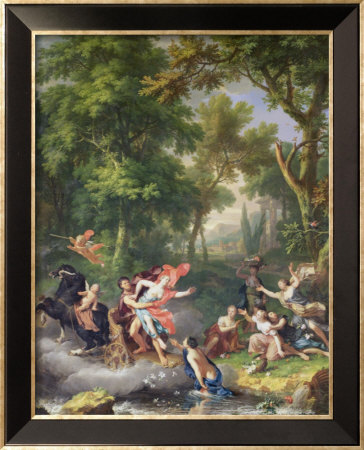

    The Rape of Proserpine
    The Rape of Proserpine

    Jan van Huysum


    If we integrate the Plutonic (alchemically: Earth) with the Persephonic (Water) we prepare ourselves for Air, where what is above comes below, and what is below comes above; Persephone must spend half her time in the underworld and half above. It is in the oscillation between polarities that the ‘higher’ wisdom (in this case, represented by the seasons) can potentially manifest. Thus we see a difference between a ‘higher’ and a ‘higher-higher’: the meta-pattern remains.
  • tension

    We must be capable BOTH of forming models AND of dissolving them. We shouldn’t either become model-less, nor bound by any model, including the one you are proposing.

    Tensions must be maintained. Tensions must collapse. Tensions must be created.
    Tensions are maintained. Tensions collapse. Tensions create.
    Maintain tension. Collapse tension. Create tension.

    20050403-136_3627_r1

  • on distinction

    Trying to summarize:

    The drawing of a distinction is a formative act.  Drawing a distinction FORMS the space, constellates the infinitely possible unknown into spaces which are shaped by the particular WAY in which the distinction is drawn.  The resulting spaces can not help but take the complementary shape of the distinction that defines them.


    The drawing of a distinction is an INformative act.  Drawing a distinction INFORMS the observer to distinguish the space like this.  The resulting shape of any possible knowledge within the space cannot help but be informed (formed-in) by the particular way in which the distinction is drawn.


    The distinction is an epistemological act that creates itself, and in so doing, is also the creation of the space in which the distinction occurs, as well as of the observer who makes the distinction.


    There are levels of distinction; distinctions can be made about distinctions, and distinctions can be made about those distinctions…


    Distinctions are atemporal and aspatial.  They are the primitive act.  The distinction between the distinction, the space, and the observer are all formally equivalent, just as the three interior angles of a triangle are all formally equivalent.  In other words, they are interchangeable in any process that specifies ANGLE. 


    The only process that specifies distinction, space, and observer is DISTINCTION.  The form (which is the same thing as the LAW of form) is an ouroboros.


    Consciousness is the consciousness of distinction.  That is to say, consciousness is distinction; it cannot be other than consciousness of distinction. Therefore consciousness is co-extensive with all distinction.  What is distinguished is conscious of its distinction; this is why there is distinction; this is why there is consciousness.


    Time is a higher order distinction that requires recursivity.  It is a distinction about a distinction.  Time is dependent upon the oscillation of distinction between two states made by that distinction.  Time is the injunction to cross the boundary between the states, and once crossed, to cross again.  The crossing is atemporal.  Only the distinction of the crossing is temporal.  The distinction of the crossing of the distinction is time.


    <—————-distinction—————->

    Now, I have no idea if any of the above is sensible or insensible <crossing boundary: its sensibility or insensibility is only possible on the basis of the distinction as such.  In itself it is neither sensible nor insensible, but what it would be if it could> but it has raised some questions for me:


    Is distinction ONLY binary?  Is distinction always between this state and that state, that is, between one and another?  Is it possible to distinguish not just between one:one, but between one:many, between one and another+another+another?  In other words is this a binary reductionism? <crossing boundary: yes, if this binary distinction is made.  now make another distinction.>


    Okay, but what about the, um, distinction in quantum mechanics of the possible eigenstates of the wave function?  There are an infinite number of possible eigenstates for any given system (even the simplest), and they must ALL be taken into account (their probabilities must be worked in to the equation). Then, out of the whole field of possibilities, ONE is observed.  In the observation, all the other possible values have a probability of zero, while the observed value has a probability of one.   This sounds an awful lot like the idea that the fundamental act of distinction creates the space and thus the values of any distinction in the space thus created.  Does this have any validity, either as an analogue or at least a metaphor? <X: Do you distinguish it as such?>


    Okay I have another question.  What happens if we DON’T DISTINGUISH?  I mean, we don’t un-distinguish and we don’t distinguish.  Without distinction… what happens?  Is this (GSB language) a marked empty mark? 


    Crap!  And can making a distinction of a distinction actually be the same as not making a distinction in the first place?


    Please, anyone, help?!

    <X:                 >

    20080507-IMG_6032

  • observing the observer

    So then to begin in the middle I have many questions: 
      
    What constitutes an observer? How do we think about what an observer is/does? Is it as simply complex as the recursive: “An observer creates distinctions; distinctions create observers.”? 
      
    What is a distinction? In order for it to occur, does it require only an observer, or is there also an ‘observed’? If so, what constitutes the observed if we are speaking of it before the act of observation? Or is there no such thing as an ‘observed’ before its being observed? Is it possible for the specific distinction within the observed to be meaningless before observation while still maintaining on a higher order level that there is a realm of the ‘unobserved-observed’? 
      
    I mean to think about this issue as much as possible without the benefit of assumptions, knowing this is impossible. 
      
    Does the concept of the complementarity of field/wave in quantum physics help conceptualize this problem? Physicists can speak of descriptions of … using words that evoke particulate metaphors or wave-like metaphors. The … is always …, although some like to speak of wavicles to try and express the idea that beneath (?) the individual descriptions of what happens in particle physics experiments as either particle-like or wave-like, some more encompassing ‘reality’ is manifesting in an either/or fashion while remaining singular in itself. 
      
    The epistemological issue of the observer/observed qua cybernetics thus seems analogically exact to the epistemological dilemmas raised in our attempts to understand the quantum mechanics. Both point to some aspect of recursion as a central feature of any potential ordering of knowledge.

    There's a Light Inside

  • concerning the evolution of consciousness

    Earth –> Day-waking (i.e. ‘normal’ adult) consciousness 
    Water –> Imaginative consciousness 
    Air —-> Inspirational consciousness 
    Fire —> Intuitive consciousness  

    Earth –> Thinking ‘about’ – object-oriented 
    Water –> Thinking ‘with’ – process oriented 
    Air —-> Thinking ‘between’ – polarity-oriented, (Brad exemplifies this very well) 
    Fire —-> Thinking ‘as’ – whole-oriented  

    Further, considering that all thinking is relational, and all relations are between beings:  

    Earth –> consciousness of other as if the other was an object (separation) 
    Water –> consciousness of other as if you were dreaming into the other’s experience, as if you were ‘seeing’ in an inner way the other’s perspective 
    Air —-> consciousness of other “as if” you were the other from the inside, as if you were ‘hearing’ in an inner way the tonality of the other’s experience 
    Fire —> consciousness of other AS the other, as if the other were living through and into you directly, with almost no distinction between who is who  

    The sequence is one which lays out the polarities between separation and coincidence of self and other.  Goethe made a strong case for the Water, or process, level of experiencing with his morphological studies of plants and his scientific work (particularly optics).


    Earth, Water, Air, and Fire
    Earth, Water, Air, and Fire


  • horse –> herd –> cybernetics


    A friend of mine said:

    “… Concerning self-correction, can we say that the system corrects itself toward a state of homeostasis (feedback—-correction—-goal) OR toward maintaining the integrity of the closed system? Is it o.k. to look at this in terms of homeostasis?  

    Reason why I’m asking is that I’ve been looking at the socialization behavior of horses in the herd, and how they “process” emotions. The processing looks very much like a feedback loop with a self-correcting mechanism – I see it as an infinity symbol.  The interaction produces an action which takes the herd back to a state of “stability” or I call it homeostasis.  

    Anyway, this was a good experience for me because I read in that way – when I don’t get something I have a piece of paper and I draw to try to put the words into some visual.”

    I said:

    In the obvious case of the thermostat, there is a ‘goal’ – a temperature that is set by the second-order system (the human being).  But now with horses you get something more obviously complexificated (i like coining ridiculous words).  The horse is a system, the herd another, the environment another, and perhaps even another may be the system of “Horse” (i.e. ALL horses) thought about over a vast time period (that is, thinking about time from a second-order perspective – i think).

    In this case, when we want to talk about homeostasis, what variables are tending towards sameness?  If there are closed systems within closed systems within closed systems (as mitochondria are closed systems within each cell, which is another closed system…), then do we need to speak of a goal for each closed system?  And is there only one goal per system (as in the thermostat), or can there be multiple goals which overlap from system to system?  Or even multiple conflicting goals within a single system?  Or is this not even possible from an cybernetic standpoint… or would it just be a double bind?  Can you create a thermostat which simultaneously is tending towards TWO temperatures?  How would it behave – oscillate in some frequency set by the speed of the feedback loops? Tend towards some intermediate value? Runaway?

    Maybe symbiosis (which is an interesting concept to think about cybernetically) is the holding of multiple goals, one of which at least overlaps with another system?  I’m just spitballing here.

    Individual horse behavior —> herd qualities —> individual horse behavior (your infinity sign)

    So if you can detect the processing of emotion in an individual horse, do you see also a higher-order processing of emotion that does NOT take place at the individual horse level but ONLY at the herd level?  Is this a distinct process?  Or is the herd’s processing so completely bound up with the individual horse’s processing that it is impossible to tell apart?  

    20060107-120_2015

  • on demons

    <insert context here – not me: YOU>

    …but did we/they take off and burn the restraints of our minds?  Did they/we realize that we cannot ‘heal’ the ‘patients’ when we don’t know that the patients are ourselves?  That the demons aren’t simply ‘out there’ to be feared, nor are they ‘in here’ to be repressed or discarded, but that they are part and parcel of the space between the inner and outer – here to stay with us as we heal ourselves/others, so that they may be too?

    20030528-124_2424