There is a necessary recursion at the very heart of epistemology. Epistemology can never be founded upon a principle of linearity, where thinking traces its origin to something that lies before thinking, and somehow emerges or grows out of it, because the very existence of this “before”, whatever its nature, must always be assumed BY THINKING itself, as a distinction within thinking.
Therefore, the only proper starting point for an epistemology is the fundamental distinction OF distinction itself, by thinking FOR thinking, which constitutes the basis of all further distinction, and is implicit in it. The fundament of epistemology must be the recursive distinction of distinction. The nature of this self-distinction (distinction of distinction by distiction) is implicitly infinitely recursive, and identifies the very nature of thinking to be at its root one of distinction. Its implicit infinitude is a key aspect of thinking’s foundation, with definite consequences. It means that thinking is fundamentally (not secondarily) FREE: its potential to distinguish is unlimited. There is nothing that lies outside of thinking’s potential.
The consequences of this are more than epistemological, they are ontological. Thinking, infinite in its potential, is (more…)
Every moment of transformation enacts an epistemology. Part of what it means to be human is to have the potential to awaken to this fact, and more: to recognize that the recognition of the inescapable relation between action and epistemology leads to the unfolding of a life-long quest and question: how do I know? Exploration of this question, always implicitly present but seldom asked, yields consequences for the entirety of human life, from the most mundane actions to the deepest soul struggles. Once one sees that it is impossible, as a living system, to escape epistemological concerns at even the most trivial level, such concerns form an ever-present background to the unfolding of one’s life. (more…)
– There is no “it”, but there is talk about “it”. Ultimately the talk about “it”, the pointing to “it”, is more fundamental to “it” than anything else, because it is the RELATIONS that are primary: thingness is a subset of relatedness. Relations are not between two “things” but are recursively self-generated between other relations – things fall out of relations (things = Earth, relations = Water). Relations themselves are a precipitate of tension between complementarily opposing potentials (Air). Relations are to opposing potentials as things are to relations. Opposing potentials are themselves a precipitate of the whole, and work alongside each other within the whole simultaneously. Each step from the whole is a step-down transformation, we could say that beginning with level N, we move to level N-1. Each level is pulled out of simultaneity by an act of distinction within the whole, of the whole, by the whole. A cascading of levels of distinction yields the ontology of “things”, and simultaneously an epistemology of “knowing” activity, which together yield the whole of cosmology.
– This can be approached in another way. We can begin first with a problem of the modern condition, made apparent most strongly by both postmodernism and deconstructionism. The problem is that language is (more…)
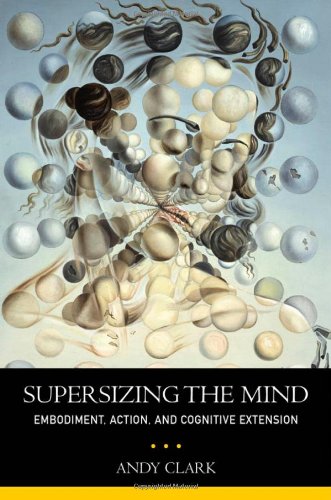
A Review of Andy Clark’s Book Supersizing the Mind: Embodiment, Action, and Cognitive Extension
by Seth Miller
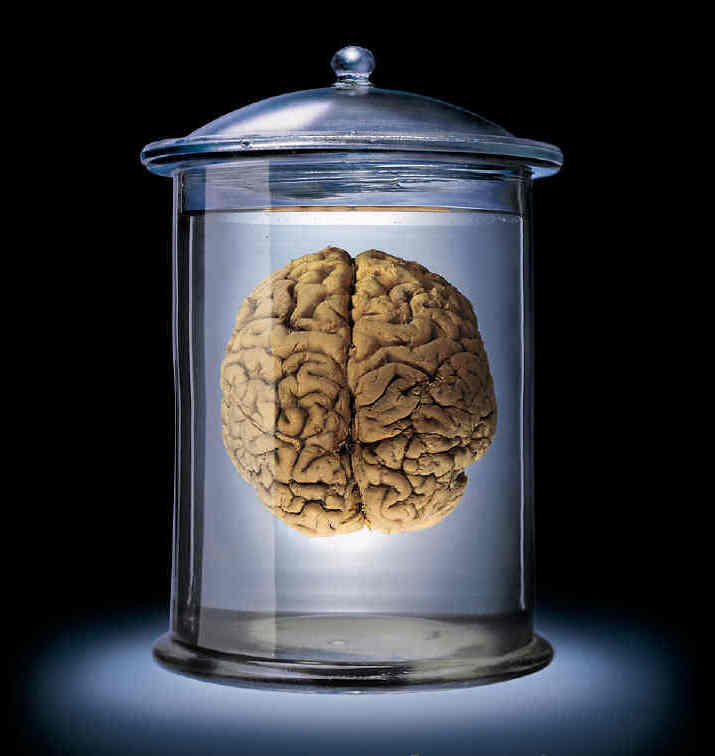
Ask your neighbor: “If you had to locate your mind, where would you point?” In all likelihood, the overwhelming response will be a finger on the cranium. Ask Andy Clark, a professor of Philosophy in the School of Philosophy, Psychology, and Language Sciences at Edinburgh University in Scotland, and you might see him point to his mouth, his hands, and even occasionally to objects in the world such as pencils and notebooks. By way of explaining this seemingly odd behavior, Clark might shrug and hand you his newest book, Supersizing the Mind: Embodiment, Action, and Cognitive Extension (Clark, 2008).
In this work (StM), Clark attempts to flesh out (pardon the pun) the thesis that (more…)
Bifurcations are “splits” in the way a system develops from one state to the next. Think of them as two roads diverging in a yellow wood; one leads to some unknown mystery. The other leads to MILKSHAKES (stay tuned).
My understanding is that bifurcations are always relative (did that paradox slip by you?); depending upon how you look at the system you my find quite ‘steady’ states, or at least steady states within limits (which are generally set by the way you look at the system). Take a different look from a different perspective and you might find bifurcations going on at a different level while some OTHER level maintains its steadiness. This is the whole “order is maintained through change” and “change is maintained by order” song and dance. (Not familiar? Welcome to CYBERNETICS.)
Usually bifurcations occur when energy from ‘outside’ is introduced into the system. Bifurcations don’t occur just because “time passes”, but that as time passes you typically get changes in the amount of energy available for a system. The usual channels by which order is maintained through lower-level change can no longer handle the energy in the same old way… leading to a bifurcation where multiple new possible states result (but quite notably, NOT the ‘old state’–at least as far as I’m aware… Input anyone? Anyone? Beuller?). But those new states are usually less stable and more sensitive to changes in energy or initial conditions; drive the energy up even a little more and you get bifurcations of the bifurcations… and so on. But then, WHAM! More and more and more chaos produces… not more chaos, but suddenly ORDER… a very FEW possible states that sort of ‘collapse’ all the previous activity into a limited set of possibilities. WEIRD. The upshot? Add energy/action/motivation/enthusiasm/motion to a system and things can get a lot more interesting… and FAST. You know this because you have some friend who always takes things one step too far at parties.
by Garrick Besterwitch
Now this does not describe all chaotic systems, at least as far as I am aware, but does give a good picture of how chaotic systems can evolve in general. Now a friend of mine was wondering (he’s not a normal guy; he’s WAY cooler, you can tell because his name is SNAKE) whether humanity as a whole is wasting a lot of time thinking about transforming when we should just take a cue from the caterpillar, who sets up a chrysalis and can just hang out, because transformation is just going to HAPPEN, without having to do anything to produce it. Despite the fact that this is something of a bastardization of his point, it serves my purpose here.
Now it would be nice if we could just sit back and watch humanity transform like a caterpillar into a beautiful soaring butterfly… but more likely if we sat back to watch the show we’d end up with some kind of oozing slime-mold, or “Twilight“. Ummm, I could be wrong about the slime-mold thing, they are actually pretty awesome. The POINT is that a caterpillar changing into a butterfly takes a LOT of energy; it’s not a ‘quiet, relaxing period’… but one where the caterpillar more or less EATS ITSELF (“Ouroboros, table for two, I mean one?”). Have you ever tried to digest yourself? Well you do every day. Eat a big lunch and get the afternoon sleepies because your liver just got slammed with an order to break down a milkshake so it doesn’t end up in your blood, clogging your arteries. “Too much to do here!” says your liver to your consciousness. “You need to get outta here cause you are holding up my work.” Zzzzzzzzzzzzzz.
From your perspective you didn’t have to “do” anything to digest your lunch. But on a systemic level we are talking serious amounts of activity… it’s just that the activity is occurring on the basis of processes that are not readily available to your consciousness (even if you remained awake). The system as a whole is changing its state — bifurcating, if you will — because 720 calories of ice cream is a LOT of energy, which drives the system from its previous ‘steady’ state.
Now we can eat milkshakes for lunch (for the record, I have… okay DEFINITELY done this before) and have the systemic relationships activate which result in our loss of ability to influence the system effectively, or to even be aware of where it is headed… Or we can maybe snack on some almonds (or at least eat a reasonable meal–from your liver’s perspective; THINK OF YOUR LIVER!!!) and help steer the context towards one that can more robustly handle the higher-level situations (boss yelling at you, papers to write, world peace and such), which you can’t do very well when your consciousness gets kicked out by your much more powerful digestive processes.
There is some sort of dynamic harmony (not really BALANCE, which is too static) here; you need enough energy to keep the system from stagnation and ossification, but not too much energy that you drive it too fast, yielding bifurcations too quickly (cancer), which pushes the system into a new steady state by virtue of undesirable transformation (death).
As the Rosicrucians were fully aware, you can’t avoid death, BUT YOU CAN DIE BEFORE YOU DIE. By consciously approaching these processes (rather than them approaching you–too late!), they discovered that we could have ‘little deaths’ that allow us to experience the world in a more engaged and subtle and effectively wise way. This was a form of conscious suffering.
And these sorts of processes DID have some order. There were various stages, and it was VITALLY important not do to things out of order; this could ruin the whole work. Alchemists discovered quite a few different processes (every “stage” is really a process), but to boil it all down and oversimplify it you have something like this:
1) Undifferentiated unity (prima materia) 2) Differentiation into parts 3) Purification of parts 4) Integration of parts into a new unity (what I call a “differentiated unity”)
And all of THAT can be summed up in one nice Greek word (perhaps coined by Paracelsus): Spagyrics, from spao, to tear open, + ageiro, to collect.
So in terms of alchemical processes, the WHOLE THING can be understood as a big cycle of taking apart and putting together, with the purification of the parts implied by the fact that they can be put back together again. Thus, at the very least, this is the most important and significant ‘order’ to any alchemical process. All the other sub-processes are, shall we say, bifurcations of this large gesture into smaller and smaller sub-cycles.
Now if you want to get real alchemical about it, it might be worth pointing out that there were three basic ‘gestures’, which was another way to understand this process. They were called Salt, Sulfur, and Mercury.
The Salt corresponds to the taking apart, the Mercury to the purification, and the Sulfur to the re-integration. You’ll find these three processes ALL OVER alchemy, precisely because they represent the WHOLE WORK. These three physical substances exhibited properties–really qualitative transformations, which we usually call ‘processes’ because we like to think we are scientific–which embodied in the material realm the qualities that were found to describe essentially ANY transformation, and came to stand for the higher-level ‘gesture’ of a three-fold transformation of unity into unity.
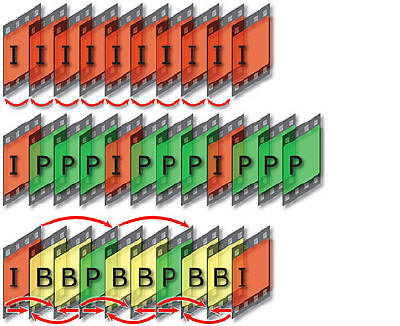
A fellow student pointed out recently to me that compression algorithms are an excellent way to see feedback at work, and used the example of mpeg2 video compression. Here we have a system that utilizes multiple levels of abstraction and feedback in order to efficiently compress video data.
I will give you a picture or two and quote some relevant explanations on the process as a basis for the following discussion.
“The result of the MPEG-2 encoding process is a video stream. The basic unit of the stream is a “Group of Pictures” (GOP), made up of three picture types: I, B, and P. I-pictures (intra) are compressed using intra-frame techniques only, meaning that the information stored is complete enough to decode the frame without reference to any adjacent frames. For B (bi-directional) and P (predictive) pictures, however, only “difference information” (frame-to-frame changes) is stored, which generates much less data. These pictures can only be reconstructed by referring to the I-pictures around them, which is why the different picture types are grouped into GOPs.”
also:
“MPEG 2 provides for up to three types of frames called the I, P and B frames. The intra-frame, or ‘I’ frame, serves as a reference for predicting subsequent frames. ‘I’ frames, which occur on an average of one out of every ten to fifteen frames, only contains information presented within itself. ‘P’ Frames are predicted from information presented in the nearest preceding ‘I’ or ‘P’ frame. The bi-directional ‘B’ frames are coded using prediction data from the nearest preceding ‘I’ or ‘P’ frame AND the nearest following ‘I’ or ‘P’ frame.”
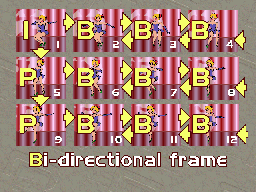
So you have completely self-contained frames, appropriately called I-frames. Then you have predictive-frames which contain information about DIFFERENCES ONLY, and which only have inputs from PAST I or P frames. But then you have bidirectional frames, which are constructed out of BOTH past and future frames (either I or P), and which also only encode differences.
This works because this type of compression operates on two levels simultaneously, the level of the FRAME CONTENT and the level of DIFFERENCES in frame content. The language of differences is a completely different language than that of the content, and constitutes (I think) a higher order of language from the type of language that can appropriately describe the content.
I’m only making this post because the content of the previous paragraph is generalizable to any system. Any system has a content-level which in some way encodes, describes, and utilizes a particular type of information (in this case, things like hue, lightness, and saturation). If the system never needed to interact with other systems (or itself in regards to this content), this would be enough. But as soon as any communication of or reflection on this information is needed, it becomes terribly inefficient to only keep to content-level languages. So in communicating or transferring that information from one epistemological system to another (a system for which the information can be of significance, i.e. produce a change), it is much more efficient to utilize a higher-order language whose primary function is to describe the content in a new way.
So this second-order language describes the description, or is information about the information. What can this second-order language contain? Essentially it contains information about DIFFERENCES in the content-level, which are not contained in the content-level itself. So I can’t describe the differences of hue, lightness, and saturation from one video frame to the next by using the language of hue, lightness, and saturation. The answer to the question: “What is the difference between a lightness value of 10 and 90?” is not itself a unit of lightness, it is a DESCRIPTION of lightness; you can’t use the answer directly and unmodified as information in the content-level system. You can’t tell your monitor to show a lightness value of “a difference of 80” DIRECTLY–you have to DECODE the difference back into the content-level language through a specific process.
What gets REALLY interesting, however, is when this kind of decoding has built in to it processes which modify the content-level data not just on the basis of the second-order language of differences (as in mpeg2 compression), but on the basis of a THIRD-order language of the difference of differences. This is like taking a description of the differences and feeding that information back into the system in a way that modifies the original information. So you have something like:
1) content-level (language of ‘raw’ data)
2) process-level (language of differences in ‘raw’ data)
3) meta-process level (language of differences of differences)
How far can this go? I have no idea; theoretically one can have an infinite number of levels, but practically I don’t think this is the case, and it has to do with the fact that there is a certain sort of separation between levels that has so far been assumed that is simply not the case. In other words, these different levels are complexly intertwined, and not capable of being separated. Each level is responsible for producing changes in other levels in various ways. The process-level, by encoding differences in the content-level, can produce changes in the content-level through appropriate decoding procedures. The same relation holds between the meta-process-level and the process-level. This also means that the meta-process level can drastically change things at the content-level. But additionally the content-level, by virtue of the type of information it contains, helps restrict the possible differences that can occur, and thus the possible ways of distinguishing differences in the process-level (it doesn’t make sense for a process-level language to encode differences about mood, temperature, or conductivity if the content-level doesn’t contain such information in the first place). So each level is like a bidirectional-frame in our video compression example, in which changes come both from ‘above’ and ‘below’.
What should be pointed out, however, is that there are SECONDARY effects which become possible with the utilization of any higher-order language. Any higher order language IS higher order because it can apply to multiple differing types and systems of data. A language of differences can be more or less strongly ‘coupled’ to a particular type of content. The closer the coupling the less easily the language can be used for descriptions of different types of data systems. The weaker the coupling, the more widely applicable the higher-order language can be to different data systems, but only at the cost of some potential loss of fidelity through the filtering out of SOME differences in favor of others.
Now here is where it gets even more interesting. The selective filtering of differences is another way of saying that each higher-order system embodies a particular epistemology. Languages about data, about differences in data, and about the differences of differences are all specific embodiments of epistemological frames. EVERY system has an epistemological frame: squirrels, lakes, crystals, and of course humans. The epistemological frame is the meta-context which admits or denies differences of a given class (temperature, color, quantity, mood, awareness…) and includes specific relations between various classes. But the epistemological frame is embedded within, arises from, and also determines the data available to the system — there is no ultimate ability to distinguish between frames and data – they each mutually produce each other.
What I distinguish distinguishes what I can distinguish. Differences differentiate my differentiating.
Epistemology determines the data available to a system for distinctions. The data available to a system determines the possible epistemologies that can make distinctions about the data (yielding capta. What is given determines what can be taken; what is taken then determines what can be given (the Latin root of data is ‘to give’, and of capta is ‘to take’).
There is no escape: we live in and create a world of paradox, which is probably enough for now.