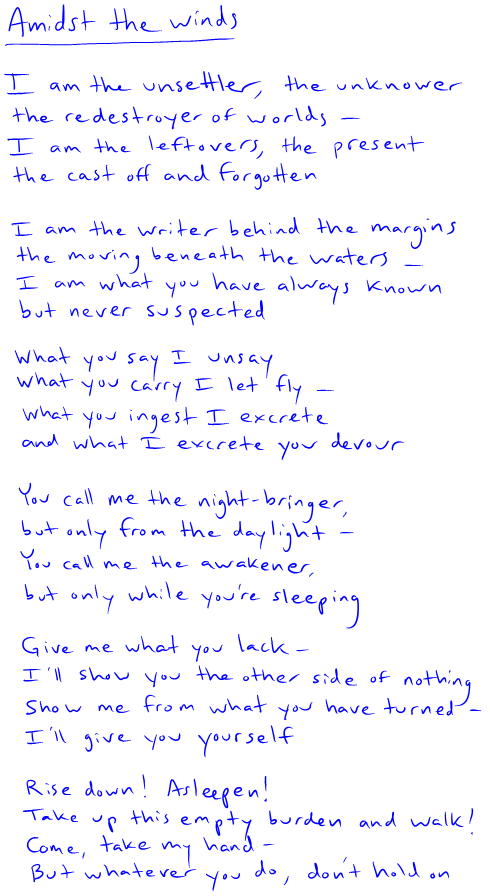

So then to begin in the middle I have many questions:
What constitutes an observer? How do we think about what an observer is/does? Is it as simply complex as the recursive: “An observer creates distinctions; distinctions create observers.”?
What is a distinction? In order for it to occur, does it require only an observer, or is there also an ‘observed’? If so, what constitutes the observed if we are speaking of it before the act of observation? Or is there no such thing as an ‘observed’ before its being observed? Is it possible for the specific distinction within the observed to be meaningless before observation while still maintaining on a higher order level that there is a realm of the ‘unobserved-observed’?
I mean to think about this issue as much as possible without the benefit of assumptions, knowing this is impossible.
Does the concept of the complementarity of field/wave in quantum physics help conceptualize this problem? Physicists can speak of descriptions of … using words that evoke particulate metaphors or wave-like metaphors. The … is always …, although some like to speak of wavicles to try and express the idea that beneath (?) the individual descriptions of what happens in particle physics experiments as either particle-like or wave-like, some more encompassing ‘reality’ is manifesting in an either/or fashion while remaining singular in itself.
The epistemological issue of the observer/observed qua cybernetics thus seems analogically exact to the epistemological dilemmas raised in our attempts to understand the quantum mechanics. Both point to some aspect of recursion as a central feature of any potential ordering of knowledge.
Earth –> Day-waking (i.e. ‘normal’ adult) consciousness
Water –> Imaginative consciousness
Air —-> Inspirational consciousness
Fire —> Intuitive consciousness
Earth –> Thinking ‘about’ – object-oriented
Water –> Thinking ‘with’ – process oriented
Air —-> Thinking ‘between’ – polarity-oriented, (Brad exemplifies this very well)
Fire —-> Thinking ‘as’ – whole-oriented
Further, considering that all thinking is relational, and all relations are between beings:
Earth –> consciousness of other as if the other was an object (separation)
Water –> consciousness of other as if you were dreaming into the other’s experience, as if you were ‘seeing’ in an inner way the other’s perspective
Air —-> consciousness of other “as if” you were the other from the inside, as if you were ‘hearing’ in an inner way the tonality of the other’s experience
Fire —> consciousness of other AS the other, as if the other were living through and into you directly, with almost no distinction between who is who
The sequence is one which lays out the polarities between separation and coincidence of self and other. Goethe made a strong case for the Water, or process, level of experiencing with his morphological studies of plants and his scientific work (particularly optics).

Ross Ashby says:
No system adapts to the changing: it can adapt only to what is constant.
(http://www.rossashby.info/aphorisms.html)
Ross Ashby says:
That homo has a brain no more entitles him to assume he knows how he thinks than possession of a liver entitles him to assume that he knows how he metabolises.