Are you fascinated by the beauty of forms in the natural world? Do you sense something amazing at work out there, like an intelligence that lies just beneath the surfaces of things? Then I invite you to read a new essay that explores the building of a new aesthetic consciousness that seeks to connect us with natural processes in a way that is truly transformative. I follow threads from alchemy into the genius of Goethe, and end with intimations brought forth by Rudolf Steiner, and even include some home-made animations as a part of a practical exercise for you to work with. You are invited to come and participate in opening a new set of eyes…
Bifurcations are “splits” in the way a system develops from one state to the next. Think of them as two roads diverging in a yellow wood; one leads to some unknown mystery. The other leads to MILKSHAKES (stay tuned).
My understanding is that bifurcations are always relative (did that paradox slip by you?); depending upon how you look at the system you my find quite ‘steady’ states, or at least steady states within limits (which are generally set by the way you look at the system). Take a different look from a different perspective and you might find bifurcations going on at a different level while some OTHER level maintains its steadiness. This is the whole “order is maintained through change” and “change is maintained by order” song and dance. (Not familiar? Welcome to CYBERNETICS.)
Usually bifurcations occur when energy from ‘outside’ is introduced into the system. Bifurcations don’t occur just because “time passes”, but that as time passes you typically get changes in the amount of energy available for a system. The usual channels by which order is maintained through lower-level change can no longer handle the energy in the same old way… leading to a bifurcation where multiple new possible states result (but quite notably, NOT the ‘old state’–at least as far as I’m aware… Input anyone? Anyone? Beuller?). But those new states are usually less stable and more sensitive to changes in energy or initial conditions; drive the energy up even a little more and you get bifurcations of the bifurcations… and so on. But then, WHAM! More and more and more chaos produces… not more chaos, but suddenly ORDER… a very FEW possible states that sort of ‘collapse’ all the previous activity into a limited set of possibilities. WEIRD. The upshot? Add energy/action/motivation/enthusiasm/motion to a system and things can get a lot more interesting… and FAST. You know this because you have some friend who always takes things one step too far at parties.
by Garrick Besterwitch
Now this does not describe all chaotic systems, at least as far as I am aware, but does give a good picture of how chaotic systems can evolve in general. Now a friend of mine was wondering (he’s not a normal guy; he’s WAY cooler, you can tell because his name is SNAKE) whether humanity as a whole is wasting a lot of time thinking about transforming when we should just take a cue from the caterpillar, who sets up a chrysalis and can just hang out, because transformation is just going to HAPPEN, without having to do anything to produce it. Despite the fact that this is something of a bastardization of his point, it serves my purpose here.
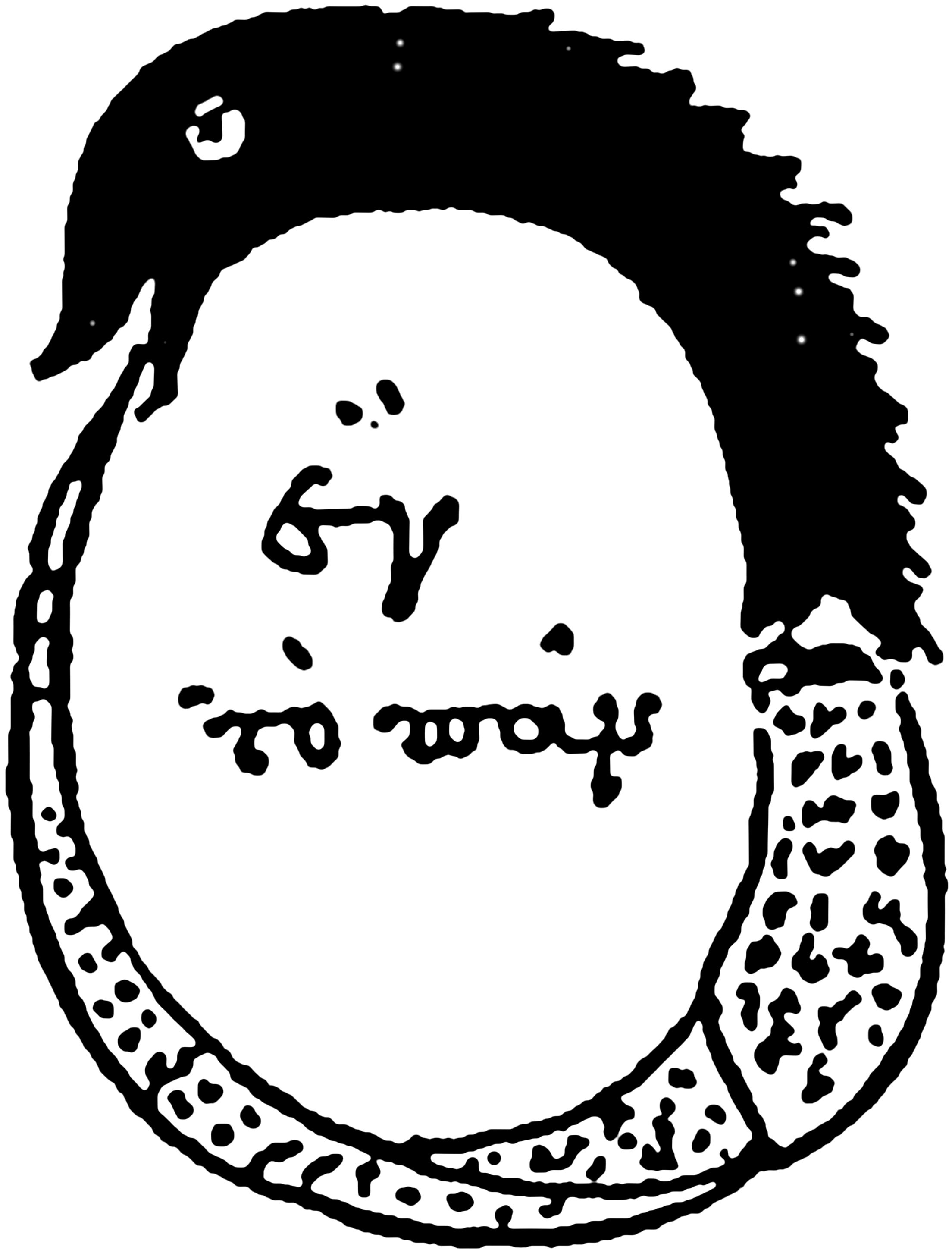
Now it would be nice if we could just sit back and watch humanity transform like a caterpillar into a beautiful soaring butterfly… but more likely if we sat back to watch the show we’d end up with some kind of oozing slime-mold, or “Twilight“. Ummm, I could be wrong about the slime-mold thing, they are actually pretty awesome. The POINT is that a caterpillar changing into a butterfly takes a LOT of energy; it’s not a ‘quiet, relaxing period’… but one where the caterpillar more or less EATS ITSELF (“Ouroboros, table for two, I mean one?”). Have you ever tried to digest yourself? Well you do every day. Eat a big lunch and get the afternoon sleepies because your liver just got slammed with an order to break down a milkshake so it doesn’t end up in your blood, clogging your arteries. “Too much to do here!” says your liver to your consciousness. “You need to get outta here cause you are holding up my work.” Zzzzzzzzzzzzzz.
From your perspective you didn’t have to “do” anything to digest your lunch. But on a systemic level we are talking serious amounts of activity… it’s just that the activity is occurring on the basis of processes that are not readily available to your consciousness (even if you remained awake). The system as a whole is changing its state — bifurcating, if you will — because 720 calories of ice cream is a LOT of energy, which drives the system from its previous ‘steady’ state.
Now we can eat milkshakes for lunch (for the record, I have… okay DEFINITELY done this before) and have the systemic relationships activate which result in our loss of ability to influence the system effectively, or to even be aware of where it is headed… Or we can maybe snack on some almonds (or at least eat a reasonable meal–from your liver’s perspective; THINK OF YOUR LIVER!!!) and help steer the context towards one that can more robustly handle the higher-level situations (boss yelling at you, papers to write, world peace and such), which you can’t do very well when your consciousness gets kicked out by your much more powerful digestive processes.
There is some sort of dynamic harmony (not really BALANCE, which is too static) here; you need enough energy to keep the system from stagnation and ossification, but not too much energy that you drive it too fast, yielding bifurcations too quickly (cancer), which pushes the system into a new steady state by virtue of undesirable transformation (death).
As the Rosicrucians were fully aware, you can’t avoid death, BUT YOU CAN DIE BEFORE YOU DIE. By consciously approaching these processes (rather than them approaching you–too late!), they discovered that we could have ‘little deaths’ that allow us to experience the world in a more engaged and subtle and effectively wise way. This was a form of conscious suffering.
And these sorts of processes DID have some order. There were various stages, and it was VITALLY important not do to things out of order; this could ruin the whole work. Alchemists discovered quite a few different processes (every “stage” is really a process), but to boil it all down and oversimplify it you have something like this:
1) Undifferentiated unity (prima materia) 2) Differentiation into parts 3) Purification of parts 4) Integration of parts into a new unity (what I call a “differentiated unity”)
And all of THAT can be summed up in one nice Greek word (perhaps coined by Paracelsus): Spagyrics, from spao, to tear open, + ageiro, to collect.
So in terms of alchemical processes, the WHOLE THING can be understood as a big cycle of taking apart and putting together, with the purification of the parts implied by the fact that they can be put back together again. Thus, at the very least, this is the most important and significant ‘order’ to any alchemical process. All the other sub-processes are, shall we say, bifurcations of this large gesture into smaller and smaller sub-cycles.
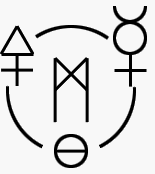
Now if you want to get real alchemical about it, it might be worth pointing out that there were three basic ‘gestures’, which was another way to understand this process. They were called Salt, Sulfur, and Mercury.
The Salt corresponds to the taking apart, the Mercury to the purification, and the Sulfur to the re-integration. You’ll find these three processes ALL OVER alchemy, precisely because they represent the WHOLE WORK. These three physical substances exhibited properties–really qualitative transformations, which we usually call ‘processes’ because we like to think we are scientific–which embodied in the material realm the qualities that were found to describe essentially ANY transformation, and came to stand for the higher-level ‘gesture’ of a three-fold transformation of unity into unity.
One thing that struck me as interesting was that feedback, as a concept, seems to assume two things (and probably more): 1) step-wise time (and thus some kind of “state” in which a system can be identified, and thus 2) some kind of ‘levels’ within and between systems, in part based on their “state”.
So feedback, at least in the way that I’ve been thinking about it up to now, is this idea that state A of a system precipitates state B in some way, but that state B has non-trivial links ‘back’ to processes that help create state A. But of course because we are talking about the evolution of systems, this idea of ‘back’ may be better understood inversely, as ‘forward’, in the sense that there is a real distinction between state A, state B(sub-A), which is the state of system B-as-influenced-by-A, and then state A(sub-B,sub-A) the state of A-influenced-by-B-which-is-already-influenced-by-A…. And this goes on, so we have something more like a system-of-relations (S) at various points, which are distinguished by virtue of the feedback relations between its states A and B.
Here’s an attempt at a table explicating the pattern of what we mean by “feedback”:
S1 A
S2 B(A)
S3 A(B(A))
S4 B(A(B(A)))
S5 A(B(A(B(A))))
You can see the pattern unfolding infinitely — the thing is that when we think about it in this way, the pattern that is unfolding is one that does so on the basis of these ‘moments’ (S1, S2, …). But these moments are always arbitrary; there doesn’t seem to be any ontological significance to them outside of the context of their actual identification by someone thinking about cybernetics. Our knowledge of the system becomes apropos when we question it, when a need for knowledge arises… and not otherwise.
If this is true, it’s kind of misleading to have the idea of “a system” that exists “in a state” and that this state influences some other system’s state, and so forth. It’s too reductive… and it seems to fall prey to Whitehead’s fallacy of misplaced concreteness. (Others familiar with quantum physics, and specifically the Einstein-Bohr debates may see some parallels with this line of thinking.)
When thinking about TIME and evolving systems, we run into some serious complexities, because different information flows through a given portion of a system at different rates depending upon the nature of that part of the system and the nature of the information being carried. Heat flows at one speed through a specific material, at another speed through another material. Information carried by light moves still differently, as does linguistic meaning, different types of sensation, etc. etc. etc.. Just about every ‘channel’ of information has its own unique set of variables in this regard, so there is no way to divvy up a given system into “state A” or “state B” with complete certainty, because at any arbitrary snapshot point, an important bit of information from one part of the system might be ‘on its way’ but not yet resulting in any modification elsewhere in the system in a significant way — in other words feedback has an analog character. We can create digital systems in which feedback appears to operate step-wise, but this is always an oversimplification… (perhaps not if we get to the quantum level, but even then I have a suspicion that something, perhaps not either analog or digital, has a role to play in what is now left out of the loop entirely, i.e. is attributed to ‘randomness’). In any case any macroscopic digital process always (?) includes analog processes (on higher and lower levels). The point is that it is misleading to speak of “states” at all.
So what? Well, our very ability to speak about feedback seems to presuppose a conceptual reliance upon “states”. Hmmmmm. What if we got rid of “states” and started to look more at the processes? What if we slipped out of the subtle reification of “statehood” and into the flowing of flows? The processes of processes? It seems then impossible to consider anything but the whole; everything is a whole, evolves-as-whole, is-always-whole-ing, and never ‘just is’.
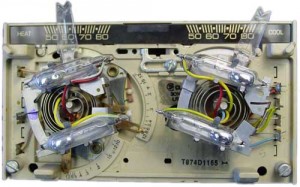
For example in an old-style mercury thermostat, the state changes from “on” to “off” to “on” again. The way it does this is through a process of feedback between the temperature of the room and the curvature of a bi-metallic strip. When the temperature is too cold (given a specific calibration point to begin with), the bimetallic strip curves in on itself, causing mercury (a conductive liquid)to fall to one side of its containing vial, where it closes an electrical circuit, making the heater go on. When the temperature is warm enough, the bi-metallic strip expands and causes the vial to tilt the other way, so that the mercury ends up in the other side of the vial, breaking the circuit and causing the heater to go off. Wash, rinse, repeat, over and over.
This is the ‘classic’ case of a feedback system. The system of the room+thermostat includes a feedback “mechanism” by which information ABOUT the “state” of the system is influential in determining the BEHAVIOR of the system. But there is something arbitrary about thinking of the system as composed of a room and a thermostat. We could divide things up into any number of different configurations, which would give slightly different perspectives on the whole. For example we can distinguish the temperature of different volumes of air, the internal components of the thermostat, the volume of air in the heating ducts and their placement, etc. “The thermostat” and “the room” are just cognitive shortcuts for more complex interrelations that, on the one hand, can be usefully summed up by such shortcuts, but which on the other hand deflects awareness from the process by which the making of the distinctions occurs, and its interactive, contingent, on-going nature. This is a general issue that crops up around epistemology.
Exploring a bit further, it would then seem that if we take such an idea to heart, it becomes much more difficult to speak of “levels” that are clear and distinct (to borrow a pithy and dangerous phrase from Descartes)–for the basis for any such distinction is some clarity about difference, and the basis for clarity is the distinction of difference. Alchemically, this is like the operation of precipitation, where a flowing, dissolving, ever-changing substance becomes punctuated by moments of particularly which separate themselves off from the activity of being-in-process with the rest of the solution. Identity becomes not only possible but fitting: here we have the formation of a crystal. It is here, it is this size, it is moving like this, it is not any of these other equally separate and identifiable crystals. (In terms of the alchemical language of process, this is the Earth element at work.)
In other words, the concept of feedback works well by virtue of its implicit reliance upon the tendency to make distinctions in complex wholes: this “part” of a system and that “part” of a system, this “state” at one time and some other “state” at another. Such distinctions may represent an a-ontological punctuation of difference within a field of activity that admits–without the activity of the distinguisher–of no such intrinsic difference. That is to say, distinctions have a certain amount of… freedom to them. Our distinguishing of one state or part of a system may not be rooted in some kind of ontologically independent “reality” which can, on its own hold up the validity of that distinction. Such validity always requires the situated contextuality of the distinguisher. (In terms of the alchemical language of process, this is the element of Water at work).
One can think of the thermostat/room system as a homeostatic one, which brings the room temperature towards some specific target through negative feedback. But this ‘stasis’ is somewhat illusory; it is accomplished by continual change. No matter how the system is constructed, it is change that creates the stasis. So it’s more accurate to think of the thermostat/room system as evolving around a cyclic attractor, where the temperature regularly fluctuates above and below a certain average (the ‘target’ temperature). It is also the stasis that creates change; the curling and uncurling of the bimetallic strip can only occur if the ambient temperature has some aspect that is constant (in this case, that the temperature STAYS above or below the target value–you’ll notice that this is a case of higher-order constancy, a constancy that is possible on the basis of change that maintains a difference).
So we sometimes make a distinction about levels: on a ‘higher’ level the system is essentially constant, while on a ‘lower’ level it is continually in flux. But again these are cognitive shortcuts for interweaving processes which do not admit of such self-distinction. The ‘levels’ are identified BY us FOR us. Just as the identification of ‘states’ is contextually contingent and not necessarily ontological, so it is with the identification of ‘levels’.
This is not to say that our distinctions are completely unguided or arbitrary–because we can’t overlook the fact that we ourselves are involved in any system by virtue of our interaction with it. Even if we are ‘just looking’ at a system, we cannot but help look with eyes that see only particularities that evolve with our ability to distinguish them. Even our seeing is cybernetic, involved in recursive looping between the ‘out there’ and the ‘in here’. The seeing is not either ‘objective’ or ‘subjective’, but partakes of both aspects, being guided by outer processes and inner processes simultaneously, and which affects the ‘seeing system’ in multiple ways, some of which may be inconsequential, and some of which may make all the difference in the world.
There’s something amazing about alchemical imagery. Deep spiritual symbolism, specific practical advice about transformation, archetypal aspects, meditative visualizations, and esoteric mysteries can exist together all in ONE image. For how many other works of art can the same be said?
In my opinion there is not enough alchemical imagery out in public on display, so to help remedy that situation I have made up some alchemical t-shirts and other products. Wear ’em and strike up a conversation about something unusual and profound.
I had the good fortune to attend a Coros Institute meditative retreat: The Great Passage with Dennis Klocek on Whidbey Island a few years ago with my mother. It was an amazing event, full of profound wisdom, practical exercises, and excellent company. I would highly recommend it, not just for those who are thinking about the Great Passage for themselves or a loved one, but as a complement to any who are interested in the spiritual connections between the living and the dead.
Dennis, as usual, offers living pictures that are not like the kind of popular new-age stuff on the bookshelves at your local bookstore. He has a way of speaking and interacting that makes it very clear that his wisdom is a developed wisdom, brought forth on the basis of years and years of contemplative, artistic, and scientific work. The best part is that because he knows HOW he developed his own experience, he can be of explicit help to others who wish to deepen their own spirituality.
If you can make this retreat, DO IT! You won’t be disappointed.
Frank Chester (find out about his initial work here, and read reviews of his work here) has just returned from a very well received presentation of his research on the Chestahedron at SunbridgeCollege in Spring Valley, New York. Many in the audience expressed disappointment afterwards that they had not notified their friends to attend these lectures because they did not realize that they would be witness to such an astonishing presentation.
Frank will be repeating these lectures this week in Fair Oaks at the Anthroposophia Conference as listed below. For those who wish to attend single lectures apart from the rest of the conference, the charge is $10 for students and $20 for adults
This is a good time to invite your friends and associates if they would like to hear about his discoveries, because Frank is planning on cutting back on his lecture schedule after this week so he can return to his research. You may download an attachment to this email, which provides some written information that may be helpful towards understanding what Frank’s work is about.
Frank will be presenting his work on the following dates:
 Are you fascinated by the beauty of forms in the natural world? Do you sense something amazing at work out there, like an intelligence that lies just beneath the surfaces of things? Then I invite you to read a new essay that explores the building of a new aesthetic consciousness that seeks to connect us with natural processes in a way that is truly transformative. I follow threads from alchemy into the genius of Goethe, and end with intimations brought forth by Rudolf Steiner, and even include some home-made animations as a part of a practical exercise for you to work with. You are invited to come and participate in opening a new set of eyes…