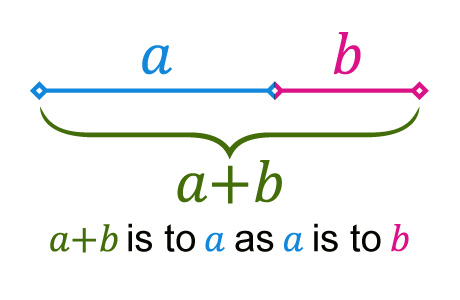
A golden section is a geometric form constructed in a particular ratio of 1:1.618… (it’s an irrational number that goes on forever without repeating… I like the idea that the golden ratio is irrational). Technically, the golden section is defined as the relation between two sections (a short and a long) on a line which divide the line in a homonic relation. The relation between the short and long section is the same as the relation between the long section and the whole line:
The simplest construction is a rectangle. You are familiar with golden-ratio rectangles in the form of your credit cards:
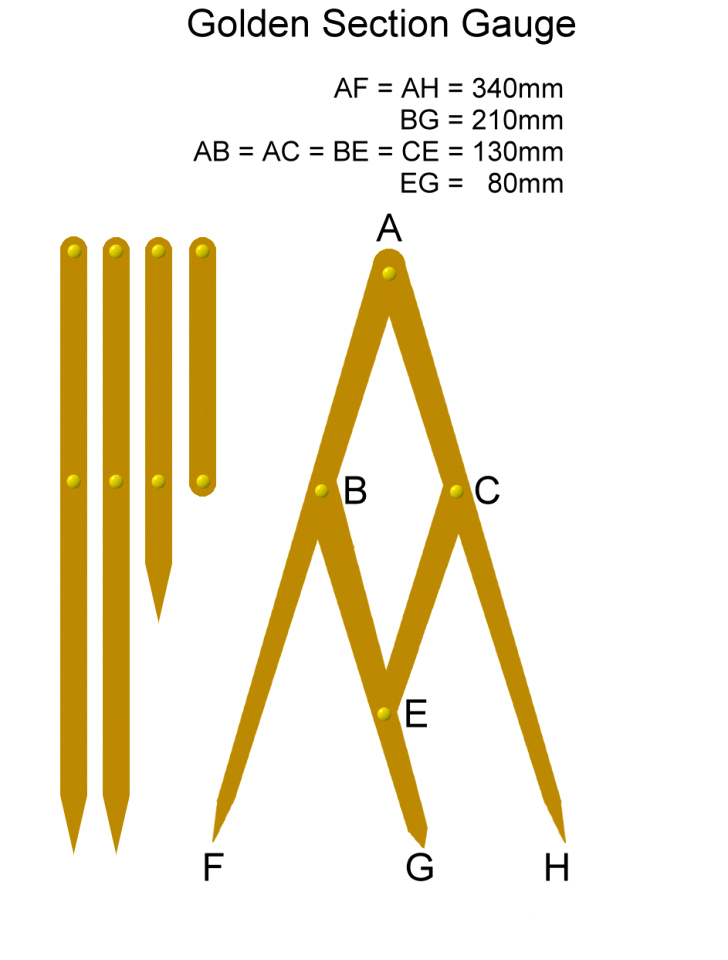
Incidentally you can make your own golden section ratio device to discover how saturated the world is with these ratios or to follow along by using it with the images in this post. It’s easy! Just follow these instructions:
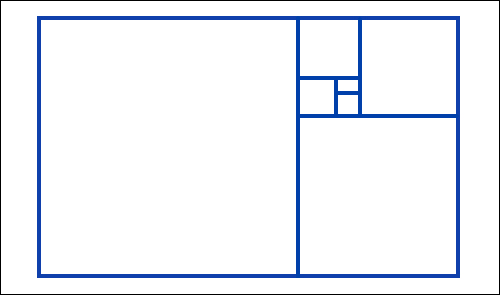
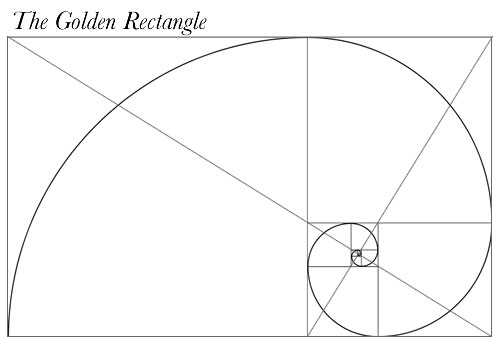
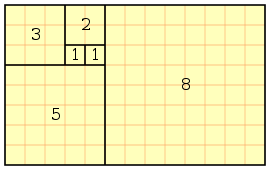
Golden rectangles nest perfectly because of the ratio:
You also have a golden spiral which is embedded in the nesting rectangles:
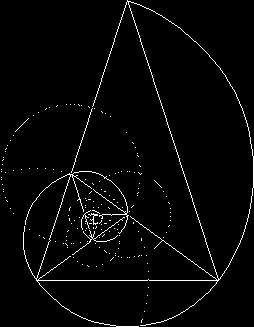
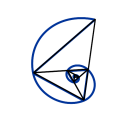
This same spiral can be found with golden triangles too:
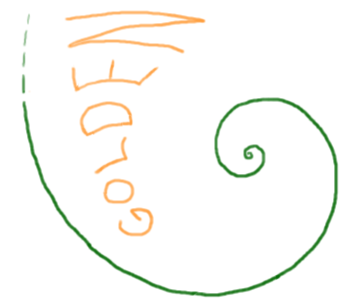
It’s known as a logarithmic spiral:
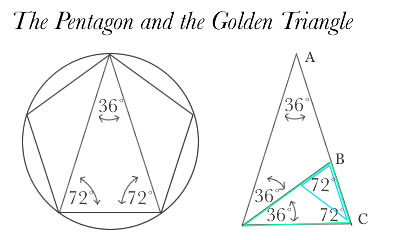
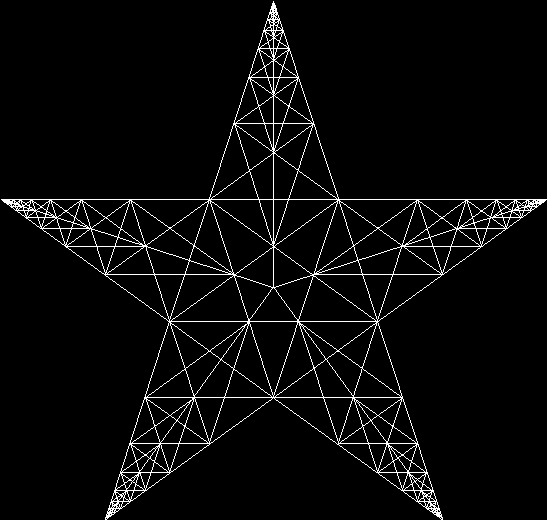
And it relates to the pentagon/pentagram:
The pentagram is built entirely of golden sections:
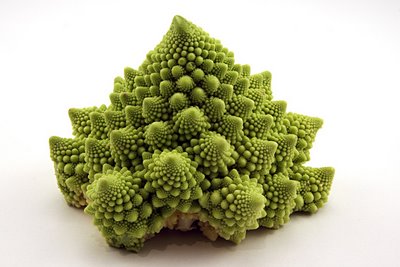
The logarithmic spiral is an extremely efficient shape for biological growth, and is thus found all over the natural world, specifically in biology:
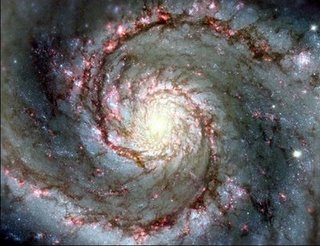
But is also found in non-living things, like galaxies:
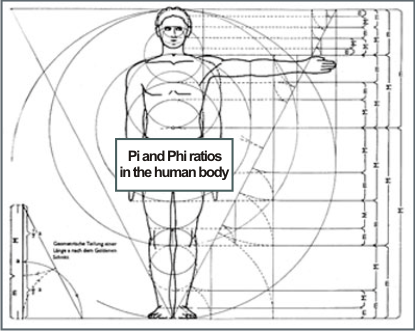
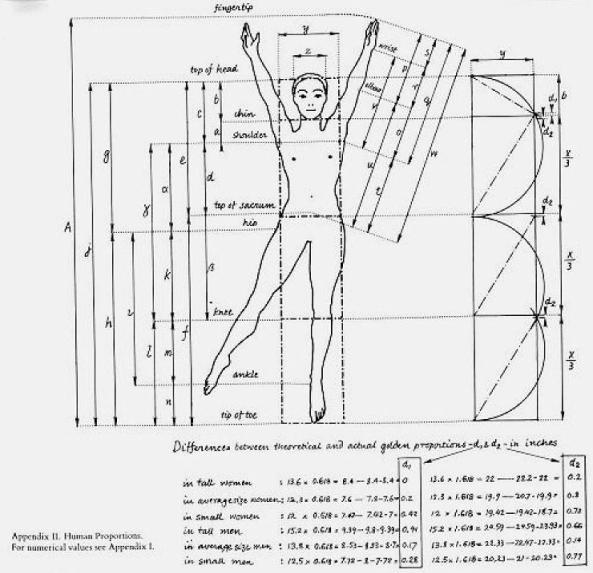
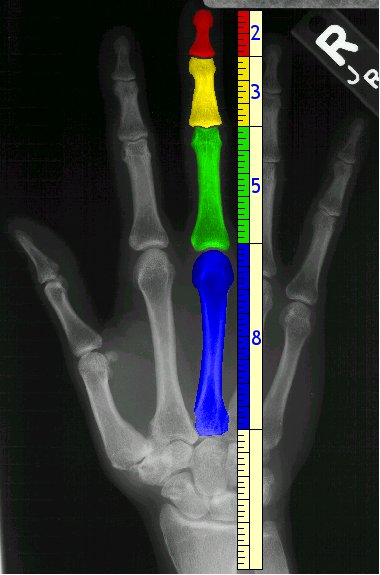
Closest to home, however, it is found over and over in the human body. In fact, as far as I am aware, the human body has more golden ratios than any other biological organism:
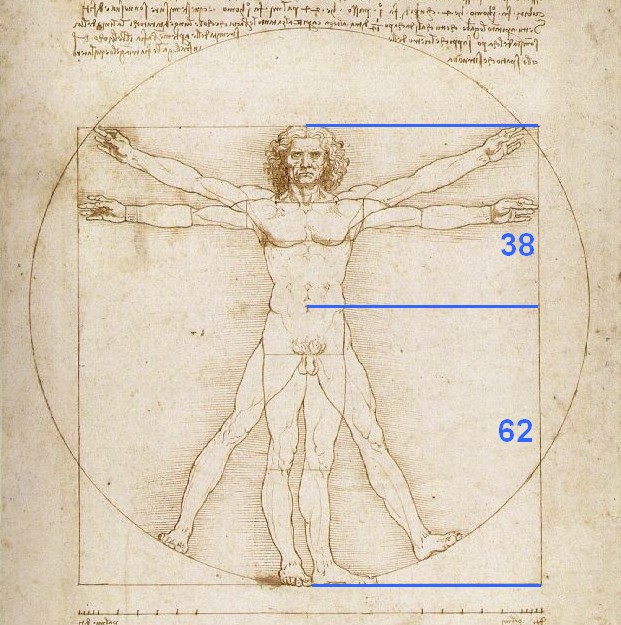
Our good friend Leonardo concurs:
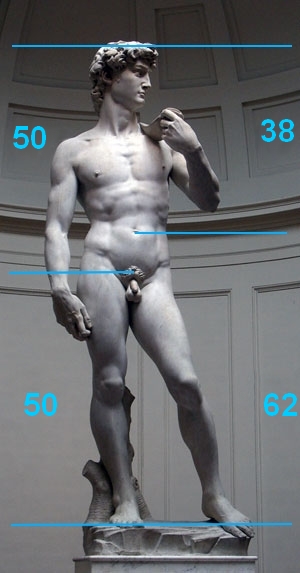
So does his pal Michelangelo:
But here’s something more to chew on:
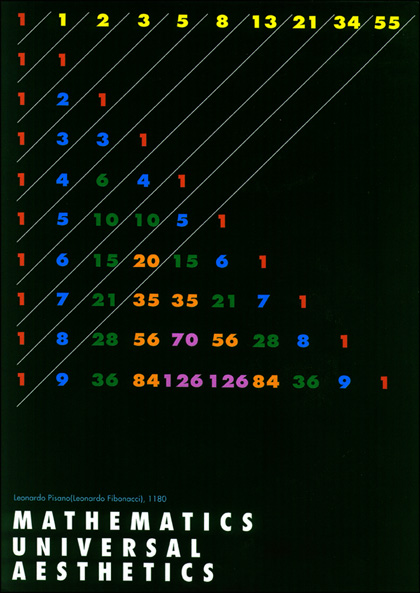
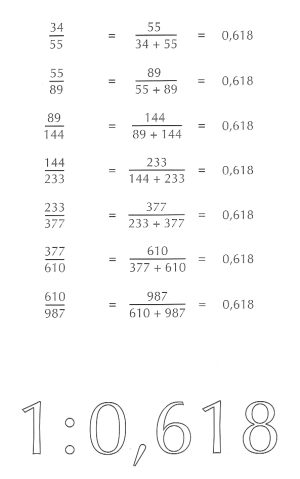
If you start to MEASURE these ratios, you find that they have an interesting pattern:
The next number in the sequence that leads to the golden ratio ends up being equal to the sum of the previous two numbers:
This is called the Fibonacci sequence, after, um…
Yeah, that guy.
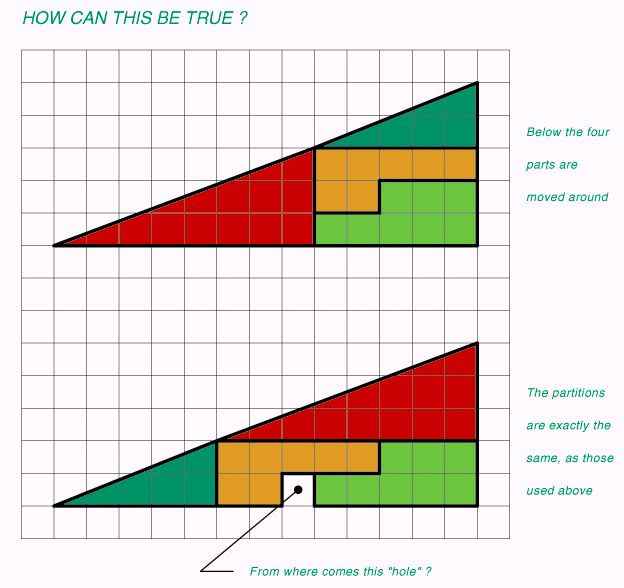
BONUS: I bet he would have been able to figure out the following conundrum:
The following is my response to a recent article by Eugene Schwartz entitled “Anthroposophy and Waldorf Education: The Web as Will and Idea”, which is Eugene’s response to an article by the renowned anthroposophist Sergei Prokofieff, who wrote a remarkable article entitled “The Being of the Internet”, in which he argued that the digital media are carriers of such darkness that they are unredeemable. The following will make the most sense if Eugene’s article (and ideally Prokofieff’s as well) is read first, but can still stand on its own as my opinion.
Eugene has written a timely and well-considered article. As someone who has “grown up” (at the time of this writing I’m currently 33) watching and participating fully in the birth of the internet (I had an email address years before the world wide web existed), I am disheartened when anthroposophists shy away from what I consider to be an important task: the appropriate usage of these new kinds of technology.
By appropriate, I mean utilizing the technology as a means of furthering a progressive human development. Of course what constitutes “progressive” or “development” can be hotly debated, but for me this involves not just empowering people through providing access to information of an esoteric nature that they might not otherwise have, but in providing the context for the shared creation of meaning in ways that are dynamically capable of leading towards real transformation.
The ahrimanic nature of the internet lies primarily in the way that supports the decontextualization of meaning-making from the soul lives of its human participants. It allows us to abstract too easily, to decontextualize parts of ourselves in ways that challenge a healthy development. But at the same time the internet is the potential carrier of both luciferic impulses (getting willfully lost in online environments, expressions of rage, rampant self-satisfaction seeking opportunities, etc.) and Christ impulses as well.
As always, the Christ-like impulses are a bit more subtle, a little less oriented towards appearing with a particular veneer, but no less powerful for all that. I am speaking of how the internet is used to help bring groups of people together in ways that fosters both community and action, and which promote love and change. This occurs not merely through sharing information, but in the literal creation of an in-between space which can be filled with the soul-activity and spirit-light of individual wills. This, I think, is what it looks like to “redeem” the internet. It happens when people are given tools to become active participants in the dynamic creation of meaning that fosters transformation and love.
The challenge, as with the bringing into one’s heart of any Christ impulse, is that it occurs not by default, and not by control, but through a conscious surrendering of one’s will to a higher will, which is experienced both as a suffering and a redemption. Ahriman, I imagine, would like us to use the internet to manipulate and control so that we forget the much greater power available through this kind of conscious suffering, while Lucifer would be happy if we continued to use the internet to satisfy our desires and create infinite personalities for ourselves.
The alchemists understood that nothing could go untransformed if the magnum opus is to be achieved. Their saying “As above, so below; as below, so above” was not an academic one about correlation; it meant that in order to reach the highest potential available to us, we had to transform our lowest aspects. This applied too to the outer world: nothing could ultimately go unredeemed, and if we ever decide to “write off” some aspect of reality as beyond hope, beyond action, and beyond transformation, then the forces of darkness will claim a victory.
We must work together to build the world we wish to live in. It is a horrible mistake to try and divorce technology from morality, and to claim that “it’s all in how it is used.” Some technologies are more evil than others, but the internet is not an atomic bomb. The development of the internet, although beginning as a defense-oriented technology (not incidentally as a technology to help counter the potential effects of nuclear weapons), almost immediately was taken up and used for other means; primarily education. There are countless ways in which both the development and usage of the internet fosters healthy development of human beings–in ways not completely without strings, of course, but also not in ways that make its usage “unredeemable.”
What we cannot do is let the regressive impulses have their way with the internet and co-opt the minds and souls of human beings for their own uses without a Michaelic challenge, a challenge for the creation of spirit-based groups of individuals (which are different than just ‘groups’), a challenge to permeate the spiritual spaces of the internet with transformed will, with conscious sacrifice, with love of transformation and a transformation of love.
Are you fascinated by the beauty of forms in the natural world? Do you sense something amazing at work out there, like an intelligence that lies just beneath the surfaces of things? Then I invite you to read a new essay that explores the building of a new aesthetic consciousness that seeks to connect us with natural processes in a way that is truly transformative. I follow threads from alchemy into the genius of Goethe, and end with intimations brought forth by Rudolf Steiner, and even include some home-made animations as a part of a practical exercise for you to work with. You are invited to come and participate in opening a new set of eyes…
The world has problems; LOTS of them. But as long as there are people like my friend Nancy, who devote their lives and love to one of the most important and practical callings on the planet, education of our young, I have hope for the future.
Let me give you a picture, in her own words, of what I mean, as an example of how Waldorf education tries to meet the challenging tasks of our time. This is but a tiny picture of what is possible–today– for education:
My class went to our auditorium today and entered in the dark. The room was covered in pine boughs in the shape of a spiral path. In the center of the path was one large glowing candle that sat upon a tree trunk covered by a blue cloth with gold stars on it. It smelled like a pine forest. The students entered in silence and proceeded to a semi-circular row of chairs to sit down. Two women, playing penny whistle, violin, and cello began playing various musical selections.
The first child approached me. I was standing by a table filled with red apples, each holding a slim candle in a hole carved into it. Then, one by one, each child took the spiral walk into the center where the light glowed. Lighting their own small candle from that big central light, they each turned and began walking back out from the center. At some place of their own choosing along the path, they each picked a spot to place their little light.
When the last child had gone, I took my candle filled apple and walked the path among the little lights, to the center. After lighting my own candle, I found a place along the way to place my own light among the others. It was an extraordinary experience for us all. The metaphors were flooding my mind as I watched each of these students proceed on this path. When they were little, their kindergarten teacher or parent held their hand on the way. Now, they seemed to have grown so tall, only third graders, yet I marveled at how they had gotten so big.
As I looked at them, a veil was drawn back for me and I could see much more than I could usually see. Everything was revealed to me in a moment. It seemed to me, as they walked, that I could sense them as younger children, as who they were now, and even who they were going to one day become. In the darkness, I really felt I could see their future before my physical eyes.
When my turn came, I realized that in the last two years of first and second grade, I always had walked the advent spiral first – before they did – so that they could see how to do it again. This time, they walked confidently alone without my example. This time, I followed their example. As I passed by each one of the lights on my way into the middle, I felt as if I were floating along in the starry heavens, each star one of these students of mine that I hold so dear. Each star lighting my way into the center. I was so humbled to place my small light, no bigger or smaller than the others, down on the path to join in lighting the room. I could also feel how profound it was for the students to see their teacher walk this inward path.
With each eye intently and silently upon me, I felt the connection, the gravity, the grace, the sacredness of the responsibility I carry on their behalf, but also I felt, “I am the so-called teacher this time, but I am really only one of you. You, who have been my teachers, who will be my teachers in the future.” What a privilege to live in such light. Blessings on us all.
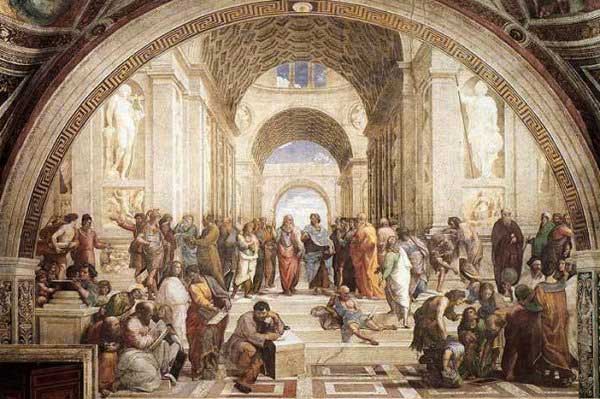
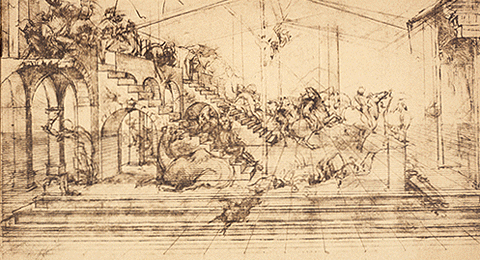
The “discovery” of perspective was a radical point (pardon the pun) in the development of art, and was intimately tied in with a whole shifting of consciousness during the time of the Renaissance and forward, having correlative expressions in the increasing reliance upon an “objective” perspective from which to view the world. Science in its modern form arose during this period as a methodological way of systematically removing subjectivity from observations, allowing data to be gathered which was amenable to enumeration and mathematical manipulation. The abstraction of the observer from the observed and the dissociation of both this abstracted observer and the observed phenomenon from the ever-changing background contexts that held both provided a powerful basis for a new way of being in the world.
Leonardo da Vinci: study for adoration of the magi
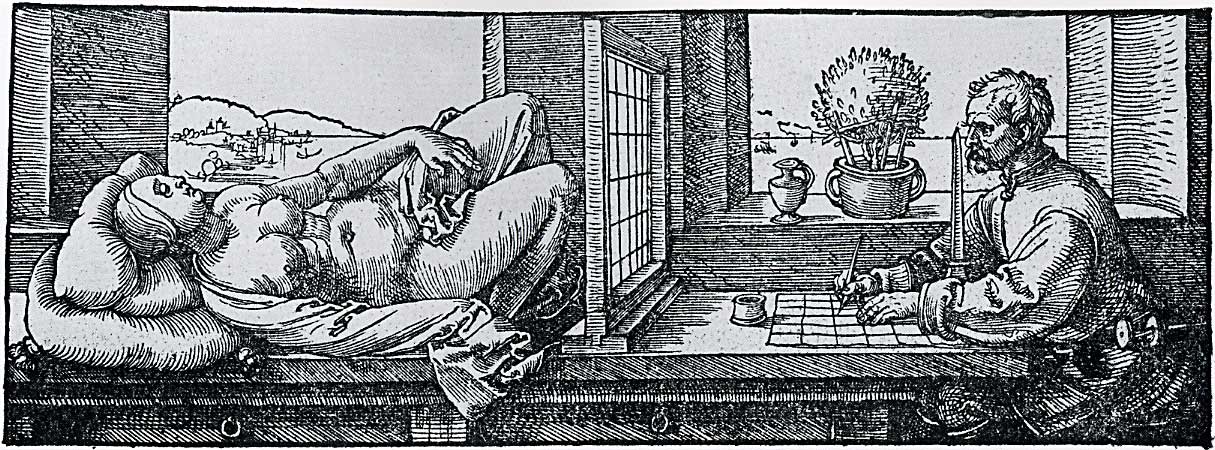
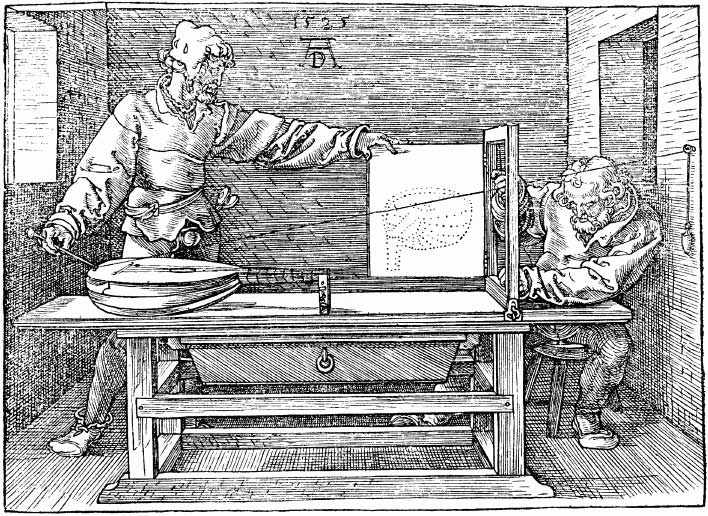
The laws of perspective allowed the world to be visually reduced, literally, to a point. Each point became a point in space from which the world looked a certain way, and the way it looked from one point always differed from the way it looked from any other point. It is interesting to note that the laws of perspective, designed as a basis from which visual scenes could be rendered on canvas in a way that accurately captured the “real” experience of our visual sense, required a reduction of the very visual experience it was meant to uphold. What I am referring to is the fact that perspective works from a single point, but the human being experiences the world through TWO such points. The laws of perspective required the literal and figurative shutting out of fully half of our visual experience.
Thus, in both art and in science, the central feature became one of representation. The art of the day was meant to represent in as exact detail as possible what could be viewed by a one-eyed person standing at a singular and exact location at a singular and exact moment in time. Similarly, the science of the day strove for theories that reduced human experience to its most basic forms, thus allowing for a further abstraction into mathematical language. Locke distinguished between “primary” and “secondary” qualities, and it was only the primary qualities that really mattered for science, because these could be objectified. This objectification was the equivalent of restricting vision to one eye at one point; each phenomenon could be interpreted “correctly” only from a singular point of view that was completely restricted and delineated in both space and time. The universe became a clock, and the human beings within it machines within the clock. “Truth” became something external to the human being, something to be discovered through the fulfillment of the promises made by the new scientific methodology.
Truth thus became as one-pointed as perspective drawing, subject to the perfect and known limitations of a small set of rules; all deviations were to be ‘explained away’ by recourse to the completely non-personal operation of blind forces. In art, ANYONE could presumably have the exact same visual experience as the next person if they stood in just the right spot at the right time; it took no special training or knowledge to interpret what was seen, because what was seen was reduced to its primal base: form and color in strict, law-abiding combinations. Ironically, the point, a completely abstract dimensionless non-entity, set the tone for our experience of all the dimensions of available to our experience.
Ultimately, however, this perspectival program was destined to destroy itself through its search for perfection. In art, the quest to represent visual experience led beyond form and color to the wider and fuller experience of vision as a whole. Many figures, from Goethe to Picasso, took part in a constructive dismantling of the dominant paradigm. In science, this occurred through the discovery of relativity and quantum mechanics, and later chaos theory, which banished forever the naïve reliance upon the point-like structure of previous generations.
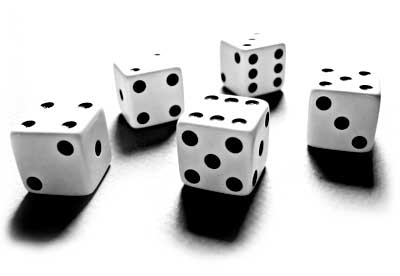
Maybe you’ve had this experience: You are thinking about an acquaintance that you haven’t thought about in a long time and at that moment the phone rings. “What are the odds that it’s Jerry?” you think to yourself. And when it IS Jerry on the other line it seems somehow magical, amazing, beyond mere chance. Was this ‘just’ a coincidence, or is there something meaningful about this admittedly unusual event? Hopefully this is something you’ve wondered about before. The whole ‘coincidence’ thing is a fascinating realm to explore, and how we address it says much about our paradigm. What is interesting to me is the debate, such as it is(‘nt), between those who have a mathematical/statistical approach and those who have a spiritual approach (not that these are the only two camps, just that they represent a the major polarity).
For an excellent presentation of ideas about this very issue, listen to this RadioLab episode: Stochasticity. (If you have never met RadioLab before, you’re in for a treat!)
A mathematician will look at coincidence and point out how most people that find meaning in coincidence fail to understand the vastness of the potential field of events. In such a large set, not only is it not strange that coincidences occur, it is inevitable that they do; just a consequence of the numbers, nothing ‘special’.
But of course this completely misses the undeniable reality that such events ARE special by virtue of the fact that we actually experience them as such. What strikes me as unfortunately bizarre is that these two views, “just the numbers”/”full of meaning”, are CONTRASTED, when they are (obviously, it seems to me) complementary.
I would agree with the mathy people that such events are bound to occur, and that it is easily possible to overstate the importance of coincidences in a psychological sense. In other words, we should be careful with how we subjectively responds to coincidences; we should never let coincidence substitute for other means of addressing a phenomenon, such as rational thinking, heart-sense, discussion with friends, etc.; it should ADD to those other means.
I would also agree with the ‘meaning’ people that just because coincidences are inevitable (which is kind of funny, given the meaning of the terms), does NOT provide a sufficient basis for discarding any potential meaning that such events might have. Humans are meaning-making creatures. We can choose to make the meaning of a coincidence “this coincidence is meaningless” or we can make any other meaning from it. In fact, the very stochastic nature of coincidences is a solid reason why we SHOULD ‘use’ them to make meaning.
Take pendulum work, a popular modern divination technique. Here too we are looking at a stochastic system, which can vary within certain parameters… but the parameters are too delicate to be able to precisely control or predict, which is the point. Tiny hand tremors, gusts of wind, the rhythm of the pulse, and so forth, all can have effects on the non-linear motion of a pendulum. The fact that stochastic and physical processes underly and limit its potential motions (pendulums don’t usually point against gravity, for example) does not mean that the system is meaningless, because we–the human beings, meaning-makers–are always a part of the system. And this is the WHOLE POINT of divination, pendulums, and so forth: the taking of a stochastic process of sufficient simplicity and complexity that we can USE it to make meaning. Would any system of divination use a relatively non-variant process as its base? Not a chance. Systems in which differences can be maximized with little effort and within strict boundaries work best. With too few options the lack of variation doesn’t mesh well with the lived complexity of our experiences, (with the limiting case being a completely repetitive system that only gives one result, ex: “Will this rock fall upwards or downwards when released?”), while with too many options it becomes difficult to “find” meaning because we lose the basis for distinguishing between different states (too much ‘gray’ area, when the whole point of these kinds of techniques is to exit with some kind of new direction or idea that is clearly distinguishable from other options).
Does all this mean that the meaning made is “really” meaningless? NO. This is the point that the mathy people don’t quite get, because they discount the OTHER processes (which they generally know next to nothing about) which are involved in meaning making. Such processes, which are VERY difficult to get a hold of (in my view because these processes involve more than what can be accounted for by manipulation of the physical world), are sacrificed on the alter of what can be held in the Mind of Reason.
It makes complete sense for humans to use stochastic systems as the basis for meaning-making, because they have just the right features to allow the meaning-making parts of ourselves to activate. Imagination, the capacity to think “what if…?”, and a heightened sensitivity to difference all accompany the emotional and mental ‘opening up’ that is a central aspect of any transformation.
The issue about this kind of thing usually rests in the term “really”. Is coincidence “really” meaningless, or “really” meaningful? In other words, the question is usually taken ontologically, rather than epistemologically (it’s much simpler to think ontologically, hence psychological “projection”, while contrastingly the process of individuation has strong epistemic roots).
However, in regards to the ontological aspect of coincidence, it is simply not possible to “objectively” gather, using conventional means, an “answer”. The stochastic nature of the physical processes means that no individual coincidence can be actually predicted. Given a particular well-defined system, the fact that a certain individual coincidence willeventually occur with a specific probability can be known, but NOT when that coincidence will occur. The whole thing is very ‘quantum’ in this respect; there is always some inherent “fuzziness” beyond which we cannot penetrate directly, forcing us to rely upon stochastic (and other) techniques. This is precisely where the human being can enter the picture (“other techniques”), helping fill the gap that is left by the math, calling forth from us aspects of ourselves that prime us for change. As long as we don’t rely upon the techniques as substitutes for what otherwise requires harder thinking, they have a place. It is just as much a mistake to reify the meaning of such a system as it is its meaninglessness, ontologically speaking. If I throw some bones and then say “This is God’s Word for me”, and then psychologically close down all other options, I’m probably missing something, but if I use it to enhance the subtlety of my own meaning-making process, taking the ‘signs’ as spurs for my own development in the wider context of all the other meaning-making processes at work, then things probably won’t get out of hand.
Now, just because I am dodging the ontological question here doesn’t mean there is no ontological basis for “meaningful coincidence”. I’m just stating that (in my opinion) the vast majority of human beings don’t have access to the necessary capacities that would make this ontology available to consciousness; not that it can’t be. But my sense is that for those few individuals for whom such a capacity is awakened, it is precisely the divinatory techniques that are first abandoned, because much more direct (spiritual) routes to meaning-making are then available. In Steiner’s terminology this would be a transformation from Imagination to Inspiration and Intuition.
Coincidences can be BOTH stochastically necessary AND meaningful, in the full senses of both those terms.
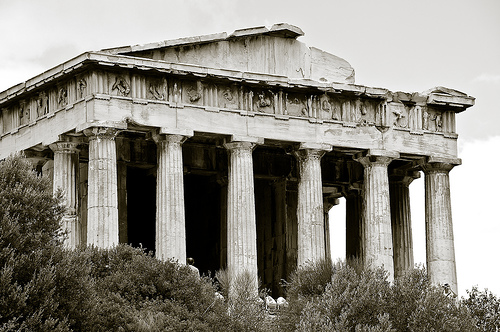
I’ve always been struck by the historical uniqueness of ancient Greece. The most amazing and radical transitions were experienced by the culture(s) present around the Aegean sea during only a few centuries. The most striking thing about the transformation was the rise of a thinking that started to take itself as its own object. We could call this thinking qua thinking, or thinking squared, exemplified overtly in Aristotle’s exploration of the stages of the self-reflection of thinking as the literal way to approach the divine.
It is astounding to me the diversity and amount of exploration of the realm of thought that occurred during ancient and particularly classical Greece; it was exemplified everywhere, from the organization of the polis to the architecture, sculpture, plays, games, economics, and of course within the philosophies that spanned enough of the potential field of human thinking that Alfred North Whitehead proclaimed the whole of European philosophy to consist of footnotes—not to the ancient Greeks as a whole—but even just to the single most outstanding Greek of them all: Plato.
Some complex confluence of events led to the possibility for human beings to take up a new, experimental and exploratory stance towards the human endeavor. The environment developed along with the changes in consciousness, which further changed the environment, until it became possible to support a veritable explosion of the intellect. Number, ratio, measure, clarity, precision… but above all the principle of form became paramount. The form of not only outer things like buildings and statues, but of inner things like the conduct of one’s life, morality, aesthetic sensibility, and the brotherly relations between citizens, were held up in the newly dawning type of consciousness that allowed these activities to be overtly reflected upon by the power of the intellect. Before, ideals had lived within people as a kind of semi-conscious drive, but in ancient Greece these ideals became the object of a newly freed capacity for thinking, which could then “hold” an ideal as an idea.
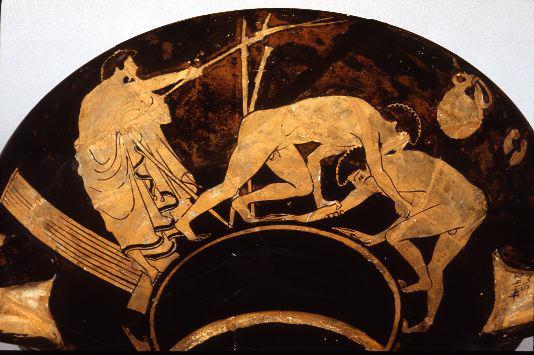
Unfortunately this kind of thinking had a certain kind of intrinsic… shall we say, gesture. It was not inclusive, but divisatory in nature. It excelled at distinction, dissection, difference, but was frankly pretty terrible at putting together, integrating, or seeing the whole. Indeed, one of the principle ‘measures’ of Greek life was the struggle, “agon”, from which we get our words “agony” and “antagonistic”. Excellence came about through the struggle, the contest, the pitting of one against another. The founding of the Olympics provided a typically outer form in which the demonstration of excellence could be had through direct competition. Elsewhere in Greek society, the repeated failures of Greek democracy were a testament to the problematic nature of this kind of thinking. The use of slaves and the subservient role of women (who were generally kept to a special upper room in the house) also demonstrate the consequences of the separatory gesture of thinking. Zeno’s brilliant but failed analysis of motion and time exemplify both this kind of thinking’s promise and simultaneous downfall.
The aftermath of the introduction of the Greek intellect is still being experienced today. The reduction of choice to binary options (yes/no, either/or) is a kind of habitual but false way of thinking that first showed its strength in ancient Greece, and which plagues humankind today. Multi-modal logics and the creation of quantum computers which utilize non-binary “qubits” demonstrate conclusively that binary logic is only one possible way of structuring thought. Cybernetics and the complexity sciences add an even more important layer of possibility by stressing the recursive nature of any complex system and the necessary inclusion of the observer in the observed. Let us hope that the lessons from these sometimes obscure realms are not lost on us!