
It's Elemental

Tag: Waldorf Education

  • Ahriman and the Internet: Is there a third path?

    Ahriman and the Internet: Is there a third path?

    Context:

    The following post is prompted by discussion of a recent response I made concerning two essays: the first by Sergei Prokofieff, entitled “The Being of the Internet”, in which he argued that the digital media are carriers of such darkness that they are unredeemable, and the second, a reply to Prokofieff, in an article by Eugene Schwartz entitled “Anthroposophy and Waldorf Education: The Web as Will and Idea”,  The reader will likely get more out of the following if both the original essays are read, as well as my original post.
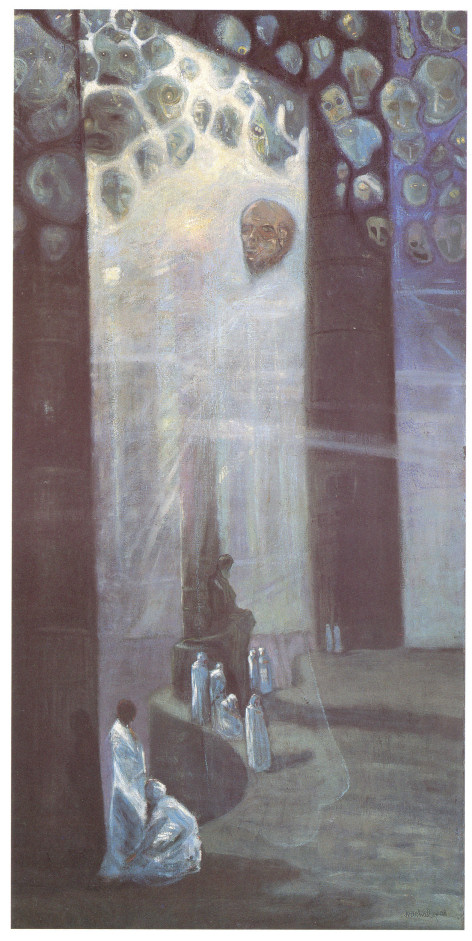
     

    The Cult of Ahriman - Josef VáchalIn Sergei Prokofieff’s essay on “The Being of the Internet”, he states that:

    “If one looks behind the being of the computer on this basis, i.e. to the way information is processed and stored, then one discovers that everything is built on the duad which can endlessly and quantitatively be multiplied through repetition and differing compositions.”

    also:

    “In contrast the Internet or DVD puts everything on the level of purely abstract information that in addition comes in “bites [sic],” (this brings up the picture of Osiris cut into pieces by Typon) and thus is spread amongst mankind in a way towards which no ‘reverent feeling’ is possible.”

    I wholeheartedly disagree with this statement.   I think Prokofieff is confusing “how” with “what” in this case, and is using the term “abstract information” in a potentially (although likely unintentionally) misleading way.  What makes information abstract is primarily the human being’s relationship to it, not the specific storage mechanism.  For example, braille is a way of communicating written information that is entirely dependent upon a binary system of bumps and flat spaces.  Does this make all information communicated through braille “abstract”; no, the notion is silly.

    Simply placing information on a DVD or on the internet does not by itself change the nature of that information: what is required is an understanding of the whole system, which includes also the human (or other) beings doing the communicating, their intentions, their capacities, and so forth.  Indeed, it is probably misleading to speak of “the nature of information” at all, because there is no such thing by itself.  There is no “information” somehow “out there” independently of a system for which that information becomes useful.  Information is always “information FOR” some system which can perceive and act or otherwise change because of this perception.  As you can see, the whole concept of “information” is tricky, because the word has many meanings and is used in a variety of contexts.

    I think Prokofieff is focusing too intently on the mechanism of storage (“how”).  To declare that because information is communicated through digital means, it is therefore rendered into a state “which no ‘reverent feeling’ is possible” is not only a sweeping overgeneralization, but is simply not true; direct experiences of myself and countless others show this to be the case.  I have been involved in many purely online interactions which have been transformative in a healthy sense, which have opened my heart to the other (and the other to me), which have broken barriers of abstraction, and which have connected me to another person, or even many people, in ways that I can confidently say further the Christ-impulse.  In these moments I have a reverence for the other, for the space in between us, and for the unfolding of something new and completely NOT abstract: a living relationship.  I have experienced love flowing through the internet–because human beings made the effort to do so.

    “Already today one can find the most awful and defamatory attacks on Rudolf Steiner, Anthroposophy, Waldorf Schools and other institutions connected with Anthroposophy on the Internet. And this widespread effect is not comparable to that of print. There is no doubt that this will increase in future particularly with the publication of the collective works on the internet and DVD because then all alleged “vulnerable passages” in the collective works will be easily and quickly accessible.”

    That attacks on Steiner and Anthroposophy and so forth are more common on the internet than in print is true, but I don’t think that this fact supports Prokofieff’s point that that internet is irredeemable.  Something about the way Prokofieff states this rubs me the wrong way, as if his motivation is based on a fear of such criticism, and a desire to secretize what may invite such criticism, rather than meeting the criticism in a way that demonstrates in the action itself the worth of anthroposophical wisdom.  Steiner is in no way infallible, and he said some things which were wrong, and other things which were ill-phrased or confusing.  Thank God: he is human.  Anthroposophists should be continually striving to develop and change, and to develop and change anthroposophy as well.  Any living system that does not transform with its environment will die, and anthroposophy is no exception to this; it MUST change.  Like any living system, some parts of it must decay and fall away, so that new growth can take hold and flower.  I say this as a general response to the impulse to keep some information out of the stream of evolution and interaction simply because it is difficult to meet the task of transforming such information, of upholding what is appropriate and letting go what is not.  This is not to say that ALL information should be available to all; simply that when the impulse to keep it secret is based on fear I become very suspect.

    “If man wants to maintain his autonomy over the world of the computer then he has to differentiate between what objectively offers pure technical aid for his work and where he oversteps the mark behind which, at first unnoticeable, the ahrimanic seduction starts to take control.”

    This is an excellent point, and is one that we cannot pay too much attention to.  Here I see a glimmer of hope in Prokofieff’s words, because he at least indicates that there is a potential to use technology as a “technical aid”, and that this is different from being seduced by it into a kind of ahrimanic entrainment.  But I would say that it is not enough simply to use technology as a “pure technical aid” for one’s work: we should use it as a means to further Michael’s mission, to manifest the impulse of Love, and to transform ourselves in progressive ways.

    Now I would like to say that I primarily disagree only with Prokofieff’s conclusion that the internet is irredeemable and that it is solely the province of Ahriman.  He paints only a partial picture–a valuable picture, but one that if taken by itself can be misleading.  Prokofieff simply doesn’t speak to what human beings CAN do with these technologies, and to what the human being’s task is in relation to these creations.  He only states that:

     “What has been said does not mean, however, that one should therefore refrain from using a computer or the Internet. They belong to our civilisation and at the same time to the greatest ahrimanic provocations which mankind faces and will have to face increasingly in the future.”

    I agree with this statement, in particular that it provides the greatest ahrimanic provocation which humankind has ever seen.  The fact that we will have to face this more and more in the future, and he indicates, only makes his omission of any forward looking advice all the more confusing.  That the internet (and its related technologies) offers a massive domain within which ahrimanic beings can do their work is something I won’t contest.  But I’m not sure that I agree with Prokofieff’s indication that:

    “Crucial is however, as with many similar problems, which we are faced with in today’s civilisation, whether man controls the computer and the internet or they man.”

    Couching the issue as one of control, and offering only a binary opposition of outomes, seems to play right into the hands of the very beings he is ostensibly seeking to avoid.  Attempts at increased control can be just as damaging as complete lack of control.  As Prokofieff indicates, it is the introduction of a third option (or many “third options”) that is needed.  Not control, and not abandonment.  For me the third option is one that arises from the creative transformation of the will around the technologies in question. Steiner has offered us a fantastic bunch of advice on this very point.  In my experience one of the most powerful ways of counteracting the ahrimanic tendencies is through the training of Goethean-style observation.  This involves awakening a sensitivity to the movement of wholes, to their form, patterning, gesture, and meaning.  This is not the space to give details on this way of walking a middle path, but at the very least I can indicate something of what I am referring to by linking to a recent essay on Goethe and a new aesthetic consciousness.

    Prokofieff states that:

    “Here the attempt is made in purely ahrimanic form to create a worldwide web that connects as many people as possible but in a way that mankind becomes increasingly separated from the cosmos and the hierarchies and thus is bound up with what was described above as an ahrimanic spider web.”

    Earlier he quotes Steiner as saying that man will have to unite with the beings of the ahrimanic spider web.  My sense is that if such a fate is in store for us (and it does certainly look as if we are going this way), then isn’t it important to build the capacities now that will help us in the future?  Shouldn’t we learn how to keep ourselves connected with the impulses of the Michaelic school in the context of the first glimmerings of this spider web that takes the form of the internet today?  Why shouldn’t we be active in doing what we can to make it possible to keep our spiritual evolution from future (and present!) stagnation?  Should we leave the internet, its development, its adoption, and its various methods of capturing the will and intention of human beings up to those who have no esoteric understanding of what the consequences may be?   Should we grant Ahriman his domain, bowing to get out of his way as he reaches his fingers further and further into our modes of perception and communication?
  • A response to: “Anthroposophy and Waldorf Education: The Web as Will and Idea” – Can Digital Media be Redeemed?

    Web Internet SpiderThe following is my response to a recent article by Eugene Schwartz entitled “Anthroposophy and Waldorf Education: The Web as Will and Idea”, which is Eugene’s response to an article by the renowned anthroposophist Sergei Prokofieff, who wrote a remarkable article entitled “The Being of the Internet”, in which he argued that the digital media are carriers of such darkness that they are unredeemable.  The following will make the most sense if Eugene’s article (and ideally Prokofieff’s as well) is read first, but can still stand on its own as my opinion.

    Eugene has written a timely and well-considered article. As someone who has “grown up” (at the time of this writing I’m currently 33) watching and participating fully in the birth of the internet (I had an email address years before the world wide web existed), I am disheartened when anthroposophists shy away from what I consider to be an important task: the appropriate usage of these new kinds of technology.

    By appropriate, I mean utilizing the technology as a means of furthering a progressive human development. Of course what constitutes “progressive” or “development” can be hotly debated, but for me this involves not just empowering people through providing access to information of an esoteric nature that they might not otherwise have, but in providing the context for the shared creation of meaning in ways that are dynamically capable of leading towards real transformation.

    The ahrimanic nature of the internet lies primarily in the way that supports the decontextualization of meaning-making from the soul lives of its human participants. It allows us to abstract too easily, to decontextualize parts of ourselves in ways that challenge a healthy development. But at the same time the internet is the potential carrier of both luciferic impulses (getting willfully lost in online environments, expressions of rage, rampant self-satisfaction seeking opportunities, etc.) and Christ impulses as well.

    As always, the Christ-like impulses are a bit more subtle, a little less oriented towards appearing with a particular veneer, but no less powerful for all that. I am speaking of how the internet is used to help bring groups of people together in ways that fosters both community and action, and which promote love and change. This occurs not merely through sharing information, but in the literal creation of an in-between space which can be filled with the soul-activity and spirit-light of individual wills. This, I think, is what it looks like to “redeem” the internet. It happens when people are given tools to become active participants in the dynamic creation of meaning that fosters transformation and love.

    The challenge, as with the bringing into one’s heart of any Christ impulse, is that it occurs not by default, and not by control, but through a conscious surrendering of one’s will to a higher will, which is experienced both as a suffering and a redemption. Ahriman, I imagine, would like us to use the internet to manipulate and control so that we forget the much greater power available through this kind of conscious suffering, while Lucifer would be happy if we continued to use the internet to satisfy our desires and create infinite personalities for ourselves.

    The alchemists understood that nothing could go untransformed if the magnum opus is to be achieved. Their saying “As above, so below; as below, so above” was not an academic one about correlation; it meant that in order to reach the highest potential available to us, we had to transform our lowest aspects. This applied too to the outer world: nothing could ultimately go unredeemed, and if we ever decide to “write off” some aspect of reality as beyond hope, beyond action, and beyond transformation, then the forces of darkness will claim a victory.

    We must work together to build the world we wish to live in. It is a horrible mistake to try and divorce technology from morality, and to claim that “it’s all in how it is used.” Some technologies are more evil than others, but the internet is not an atomic bomb. The development of the internet, although beginning as a defense-oriented technology (not incidentally as a technology to help counter the potential effects of nuclear weapons), almost immediately was taken up and used for other means; primarily education. There are countless ways in which both the development and usage of the internet fosters healthy development of human beings–in ways not completely without strings, of course, but also not in ways that make its usage “unredeemable.”

    What we cannot do is let the regressive impulses have their way with the internet and co-opt the minds and souls of human beings for their own uses without a Michaelic challenge, a challenge for the creation of spirit-based groups of individuals (which are different than just ‘groups’), a challenge to permeate the spiritual spaces of the internet with transformed will, with conscious sacrifice, with love of transformation and a transformation of love.

  • Waldorf Educators: A Light on the Path

    The world has problems; LOTS of them.  But as long as there are people like my friend Nancy, who devote their lives and love to one of the most important and practical callings on the planet, education of our young, I have hope for the future.

    Let me give you a picture, in her own words, of what I mean, as an example of how Waldorf education tries to meet the challenging tasks of our time.  This is but a tiny picture of what is possible–today– for education:

    My class went to our auditorium today and entered in the dark.  The room was covered in pine boughs in the shape of a spiral path.  In the center of the path was one large glowing candle that sat upon a tree trunk covered by a blue cloth with gold stars on it.  It smelled like a pine forest.  The students entered in silence and proceeded to a semi-circular row of chairs to sit down.  Two women, playing penny whistle, violin, and cello began playing various musical selections.

    The first child approached me.  I was standing by a table filled with red apples, each holding a slim candle in a hole carved into it.  Then, one by one, each child took the spiral walk into the center where the light glowed.  Lighting their own small candle from that big central light, they each turned and began walking back out from the center.  At some place of their own choosing along the path, they each picked a spot to place their little light.

    When the last child had gone, I took my candle filled apple and walked the path among the little lights, to the center.  After lighting my own candle, I found a place along the way to place my own light among the others.  It was an extraordinary experience for us all.  The metaphors were flooding my mind as I watched each of these students proceed on this path.  When they were little, their kindergarten teacher or parent held their hand on the way.  Now, they seemed to have grown so tall, only third graders, yet I marveled at how they had gotten so big.

    As I looked at them, a veil was drawn back for me and I could see much more than I could usually see.  Everything was revealed to me in a moment.  It seemed to me, as they walked, that I could sense them as younger children, as who they were now, and even who they were going to one day become.  In the darkness, I really felt I could see their future before my physical eyes.

    When my turn came, I realized that in the last two years of first and second grade, I always had walked the advent spiral first – before they did – so that they could see how to do it again.  This time, they walked confidently alone without my example.  This time, I followed their example.  As I passed by each one of the lights on my way into the middle, I felt as if I were floating along in the starry heavens, each star one of these students of mine that I hold so dear.  Each star lighting my way into the center.  I was so humbled to place my small light, no bigger or smaller than the others, down on the path to join in lighting the room.  I could also feel how profound it was for the students to see their teacher walk this inward path.

    With each eye intently and silently upon me, I felt the connection, the gravity, the grace, the sacredness of the responsibility I carry on their behalf, but also I felt, “I am the so-called teacher this time, but I am really only one of you.  You, who have been my teachers, who will be my teachers in the future.”  What a privilege to live in such light.  Blessings on us all.

  • The Matrix and Anthroposophy video

    The Matrix and Anthroposophy video

    This lecture presentation was given at the East Bay Waldorf School in 2007 (see flyer below).  It explores the Matrix trilogy of movies from the perspective of spiritual science. Close attention is paid to the actual events in the “text” of the movies, with an eye towards illuminating features concerning the major characters and plot elements in a coherent, symbolic, and mythological perspective. In particular the movies are shown to be uniquely understandable from the perspective of Steiner’s anthroposophical insights concerning human evolution.

    The video is based upon this essay, but (particularly because of some very astute questions from the audience) also contains a number of details that I was unable to put into the original paper.

    httpv://www.youtube.com/watch?v=MAobTuY08Vg

  • On “The Moral Collapse of the University” by Bruce Wilshire

    As a philosopher and an educator, I enjoyed Wilshire’s book. Quite a number of his experiences parallel my own with regards to teaching and the self-reflective processing and mulling over the ‘educational act’. I felt very at home with a number of his statements, like “we arrive at the capital feature of the educating act: self-awareness, or self-reflexivity” (Wilshire, 1990, p.27), or my favorite, “The ultimate educating force is who I am” (Wilshire, 1990, p.31 – italics mine).


    These two statements are old-hat for Waldorf teachers (of which I am one), and I found most of what Wilshire brought in regards to his educational analysis familiar territory — but this is a good thing, as the educational philosophy behind Waldorf education is to educate the whole child. Much modern education lacks an awareness of the importance of consciously developing not only an open face-to-face relationship with one’s students, but also — going much further than Wilshire — developing an open spiritual relationship as well, through contemplative practices. And of course we should also play with the above statements by Wilshire in a cybernetic context: the educating act calls forth self-reflexivity through its realization, while self-reflexivity opens vast arenas of potential educability. Likewise, the force of education helps make us who we are, and who we are as educators.


    I am grateful that Wilshire so adroitly points out the various cultural forces that worked to create the over-professionalization we have today — recognizing these causes is both enlightening and freeing. I especially appreciate his remark that “the organizing center of the university ought to be the organizing center of the developing human person” (Wilshire, 1990, p.85). In other words, I see Wilshire calling for the re-humanization of education, the recognition that education is not about knowledge, but about the development of human beings (Wilshire speaks of the returning the university to the “human scale” (Wilshire, 1990, p. 226)).


    In this way, Wilshire parallels Rudolf Steiner’s view (as the originator of Waldorf education) that education is for the soul what medicine is for the body: a bringing to harmonic wholeness of diverse aspects. We are presently suffering from an overdevelopment — using the body metaphor that Wilshire favors — of the head. Specifically, we have brought education out of the realm of the heart and the hands, which have become atrophied, almost useless remnants when forced to squeeze themselves through the tight gates of academia. Education, to be a source of life, of passion, of deep inquiry and engagement, must explicitly and integrally include what in the body manifest as the rhythmic and metabolic realms. The techniques of much of modern education (I’m thinking here of grades, testing, quantitative reductionism, departmentalization, and so forth), from an alchemical perspective, are too heavy on the salt and too light on the sulfur, with almost NO mercury to be found. I won’t go on about these metaphors, although they are what we could call exact analogues.


    Wilshire, in his language, points out the continual presence of ‘archaic’ forces, while showing how the university lacks awareness of the process of ‘mimetic engulfment’ and its concomitant effects on the thoughts and actions of both the professors and the students. And of course he continually relates both these aspects to the willfully obfuscated sense of the self as a ‘body-self’, with all the unrecognized or semi-recognized purification rituals which subersively accompany the imbalance:


    “The failure to grasp the concept of body-self means the failure to grasp the utter inability of seventeenth-century psycho/physical dualism to grasp the nature of knowledge and the knower, the reality of the human situation” (Wilshire, 1990, p. 183).


    We could just as easily point out the same drama via the polarity of Apollo/Dionysus (Wilshire mentions this in passing on p. 225 and p.230), nervous/metabolic, salt/sulfur, male/female, contraction/expansion, centric/peripheral. In every case what is missing is the third aspect: Eros, rhythm, mercury, the universal human, and the dynamic, responsive and evolving membrane; Wilshire speaks of the ‘reciprocating field’ (Wilshire, 1990, p. 224), a physicist might talk about entanglement, and Western esotericist the Cosmic Christ.


    That “education is basically a moral relationship between persons devoted to truth” (Wilshire, 1990, p.229) is a much more sane approach than what presently passes for education is without much doubt for those of us who have experienced both sides of the screen, as it were. His call to reclaim, following Wordsworth, the “feeling intellect” (Wilshire, 1990, p.231) is a call put forth much more directly and strongly in regards to education by Steiner almost a hundred years ago. He recognized that education must fit the reality of the developing human being, not vice-versa, and partly for this reason included practical arts as well as aesthetic arts in addition to more intellectual topics — all of which were presented in time to work with whatever stages of body, soul, and spirit growth the child was experiencing. Steiner also embodied and presented the model of the educator as model, in which the presence of the educator is more educating for life than any specific verbalization of concepts, even if those concepts are about life.


    Wilshire’s last chapter on Reclaiming the Vision of Education: Redefining Definition, Identity, Gender was the most juicy for me. I appreciate his delving into the need to reframe the discussion in a way that includes the feminine aspects of the situation. His suggestion (following Dinnerstein) that male and female parents take a nearly equal hand in raising children (Wilshire, 1990, p.271) is probably a bit oversimplistic, although I’d love to see it happen!!! A crucial aspect, as he points out, is that we desperately need “examples of meaningful human lives, [which] must be provided first and foremost in person” (Wilshire, 1990, p.230). By human, I presume, he means human qua human universalis, or perhaps human archetypus, for the central mystery of the archetype is that it is both universal and particular, both dynamically evolving and homeostatic… just like us.

  • Waldorf and Montessori – a tiny perspective

    There is often confusion about the differences between Waldorf and Montessori methods of education.  Having been a Waldorf teacher for six years certainly puts me in a biased position, but potentially one that can also offer some perspective on the matter.

    The Waldorf pedagogy recognizes that how one approaches the child is keyed closely to the developmental stages that naturally occur as the child grows, including a conscious awareness of not just the physical but also the life-body (etheric), desire/sense-body (astral), and ego realms.  It is a major tenet of the Waldorf method that these developmental stages are not either random or completely individualistic, but partake of physical and spiritual patterns that have to do with the wider picture of the evolution of the human being in general.  In other words, Waldorf pedagogy has a deeply spiritual background, and views education as a therapeutic, health-producing activity.  The health in this case is produced not simply in the physical realm (although of course education works here too), but addresses the underlying growth-forces, the emotional, the intellectual, and the moral realms as well.

    To give you an example of how Waldorf might differ from Montessori, a Waldorf educator (particularly regarding early childhood / kindergarten / first few grades) would see that the level to which Montessori educators allow ‘free reign’ of the children’s predelictions can potentially be harmful, because this brings in aspects of the child’s astral body (life of desire) too early, which can result in the hampering of the development of the child’s sense of interconnectedness, feelings of social responsibility, and sense of humility.  In contrast, the Waldorf educator provides a robust curricula that addresses a wide array of inner potentials that the child may not be conscious of, let alone would choose to exercise, but which need care and environmental response to come to fruition.

    The child cannot be asked to take on these aspects of self-development in a conscious, self-reflective way, because this requires the benefit of a well-formed and integrated ego which they can only enjoy once the education has taken effect!  In other words, the educators are the ones which must provide for an environment which is conducive to the all-around present and future health of the growing child.  Providing such environments is the art of educating, and it is important that what is presented to the child find deep resonance in the particular experiences that accompany the child’s inner life as they grow from year to year.

    The pegagogical background of Waldorf education is geared towards identifying how the various aspects that make up the growing human being (physical, etheric, astral, ego) uniquely manifest themselves at different stages of development, so that educators can craft potential experiences which meet their changing needs–many of which the child is not able to consciously recognize or express, but whose recognition by the educator is essential if they are to be met in a healthy and integrated way.

    You can think of it a bit like this: if you plant a seed in the soil, you wouldn’t want to do so at the wrong time of the year.  You also wouldn’t treat the seed in the same way as you would a grown plant, or a plant that is about to produce fruit.  Each stage of the plant’s growth requires (and is evolutionarily keyed to) specific environmental potentials, and it is the processual, rhythmically experienced flowing from stage to stage, environmental condition to environmental condition, that nurtures the overall health of the plant as a whole, over its entire life-cycle.

    Montessori education can (of course this depends on the specific conditions under consideration, including the particular child) serves to maximize particular potentials of the child, which can work against the overall development of the child if allowed to proceed too strongly or for too long.  It’s like giving too much fertilizer to a young plant, which cannot process the nutrient efficiently or quickly enough, resulting in stunted growth, overgrowth, or other imbalances.

    Of course, when speaking of children, we are talking about things like developing a sense of community, of fairness, of warmth of soul, of enjoyment of diversity, of respect for otherness, and so forth.  Montessori does an excellent job of promoting individuality, and the availability of the arts is fantastic and a terribly under-represented realm of human experience in education.  Long term Montessori students may be more likely to find themselves in a particular realm of experience–one that they have chosen, yes–but which may rigidify their soul forces so that they have a harder time appreciating other realms of human experience and effort.

    Creativity should not be too linked to personal desire, because the deepest source of creativity is–in the end–always found beyond the part of ourselves that initiates desire.  It is rather about balance, or better yet harmony between structure and freedom, contraction and expansion, the inner and the outer.  If we do not pay attention to the subtle shifts in the inner life of the developing child, we will miss the opportunities made possible by meeting the associated needs with the appropriate challenges and experiences, or we may alternately overdevelop and underdevelop specific patterns that take place in the child’s soul life.

    See also:

    http://www.steinerstorehouse.com/blog/archives/206 (an article written by someone who has been a teacher in both educational systems)

    http://www.jnorth.net/mindmaps/personal/parenting/parenting%20research/Waldorfvs.Montesorri.html

    http://www.mothering.com/discussions/showthread.php?t=199390

    Felted Alphabet