We ended the last installment by discussing the esoteric nature of the injunction. We continue this exploration, and bring this series to a close.
LoF p. 81
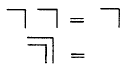
In the command “let the crossing be to the state indicated by the token” we at once make the token doubly meaningful, first as an instruction to cross, secondly as an indicator (and thus a name) of where the crossing has taken us. It was an open question, before obeying this command, whether the token would carry an indication at all. But the command determines without ambiguity the state to which the crossing is made and thus, without ambiguity, the indication which the token will henceforth carry.
This re-affirms that the mark has both a first and second-order character: it names the state of its content (its indication), and it is an instruction (its injunction) to mark that name, to make that distinction which yields that state. Thus every mark is both an indication and an injunction. It is an indication of a content and an injunction on how to get there.
LoF p. 82
We may consider how far, in ordinary life, we must observe the spirit rather than the letter of an injunction, and must develop the habitual capacity to interpret any injunction we receive by screening it against other indications of what we ought to do. In mathematics we have to unlearn this habit in favour of accepting an injunction literally and at once. This is why an author of mathematics must take such great pains to make his injunctions mutually permissive. Otherwise these pains, which rightly rest with the author, will fall with sickening import upon the reader, who, by virtue of his relationship with respect to the author, may be in no position to accept them.)
All this actually relates to the task of the esoteric teacher, who (more…)
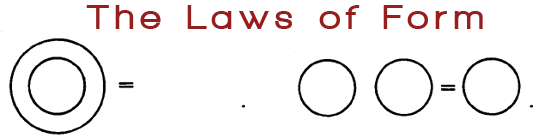
We take as given the idea of distinction and the idea of indication, and that we cannot make an indication without drawing a distinction. We take, therefore, the form of distinction for the form.
If this doesn’t strike you as having a “mystical” flavor, then you are drinking the wrong concoction. I’m not going to try to explain this, but rather I’m going to try to re-frame it; you could say, in GSB-approved language, that I’m going to re-mark it. The important thing to note about this, the very first “official” sentence of the LoF, is that it is recursive. Let’s be clear: the Laws of Form (not the book, the LAWS) are only possible because of a recursion, a throwing back on itself of itself. But a throwing back of what onto itself?
Well, “nothing”, of course; but nothing understood as what everything would be if it were.
But of course nothing doesn’t remain nothing (well, it does, but it doesn’t), because here we are. The question GSB is really attempting to get at is the question: (more…)
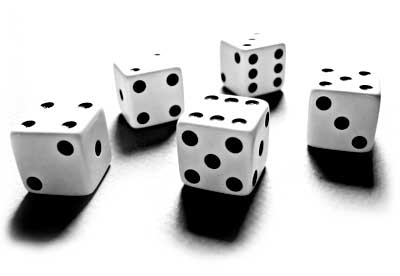
Maybe you’ve had this experience: You are thinking about an acquaintance that you haven’t thought about in a long time and at that moment the phone rings. “What are the odds that it’s Jerry?” you think to yourself. And when it IS Jerry on the other line it seems somehow magical, amazing, beyond mere chance. Was this ‘just’ a coincidence, or is there something meaningful about this admittedly unusual event? Hopefully this is something you’ve wondered about before. The whole ‘coincidence’ thing is a fascinating realm to explore, and how we address it says much about our paradigm. What is interesting to me is the debate, such as it is(‘nt), between those who have a mathematical/statistical approach and those who have a spiritual approach (not that these are the only two camps, just that they represent a the major polarity).
For an excellent presentation of ideas about this very issue, listen to this RadioLab episode: Stochasticity. (If you have never met RadioLab before, you’re in for a treat!)
A mathematician will look at coincidence and point out how most people that find meaning in coincidence fail to understand the vastness of the potential field of events. In such a large set, not only is it not strange that coincidences occur, it is inevitable that they do; just a consequence of the numbers, nothing ‘special’.
But of course this completely misses the undeniable reality that such events ARE special by virtue of the fact that we actually experience them as such. What strikes me as unfortunately bizarre is that these two views, “just the numbers”/”full of meaning”, are CONTRASTED, when they are (obviously, it seems to me) complementary.
I would agree with the mathy people that such events are bound to occur, and that it is easily possible to overstate the importance of coincidences in a psychological sense. In other words, we should be careful with how we subjectively responds to coincidences; we should never let coincidence substitute for other means of addressing a phenomenon, such as rational thinking, heart-sense, discussion with friends, etc.; it should ADD to those other means.
I would also agree with the ‘meaning’ people that just because coincidences are inevitable (which is kind of funny, given the meaning of the terms), does NOT provide a sufficient basis for discarding any potential meaning that such events might have. Humans are meaning-making creatures. We can choose to make the meaning of a coincidence “this coincidence is meaningless” or we can make any other meaning from it. In fact, the very stochastic nature of coincidences is a solid reason why we SHOULD ‘use’ them to make meaning.
Take pendulum work, a popular modern divination technique. Here too we are looking at a stochastic system, which can vary within certain parameters… but the parameters are too delicate to be able to precisely control or predict, which is the point. Tiny hand tremors, gusts of wind, the rhythm of the pulse, and so forth, all can have effects on the non-linear motion of a pendulum. The fact that stochastic and physical processes underly and limit its potential motions (pendulums don’t usually point against gravity, for example) does not mean that the system is meaningless, because we–the human beings, meaning-makers–are always a part of the system. And this is the WHOLE POINT of divination, pendulums, and so forth: the taking of a stochastic process of sufficient simplicity and complexity that we can USE it to make meaning. Would any system of divination use a relatively non-variant process as its base? Not a chance. Systems in which differences can be maximized with little effort and within strict boundaries work best. With too few options the lack of variation doesn’t mesh well with the lived complexity of our experiences, (with the limiting case being a completely repetitive system that only gives one result, ex: “Will this rock fall upwards or downwards when released?”), while with too many options it becomes difficult to “find” meaning because we lose the basis for distinguishing between different states (too much ‘gray’ area, when the whole point of these kinds of techniques is to exit with some kind of new direction or idea that is clearly distinguishable from other options).
Does all this mean that the meaning made is “really” meaningless? NO. This is the point that the mathy people don’t quite get, because they discount the OTHER processes (which they generally know next to nothing about) which are involved in meaning making. Such processes, which are VERY difficult to get a hold of (in my view because these processes involve more than what can be accounted for by manipulation of the physical world), are sacrificed on the alter of what can be held in the Mind of Reason.
It makes complete sense for humans to use stochastic systems as the basis for meaning-making, because they have just the right features to allow the meaning-making parts of ourselves to activate. Imagination, the capacity to think “what if…?”, and a heightened sensitivity to difference all accompany the emotional and mental ‘opening up’ that is a central aspect of any transformation.
The issue about this kind of thing usually rests in the term “really”. Is coincidence “really” meaningless, or “really” meaningful? In other words, the question is usually taken ontologically, rather than epistemologically (it’s much simpler to think ontologically, hence psychological “projection”, while contrastingly the process of individuation has strong epistemic roots).
However, in regards to the ontological aspect of coincidence, it is simply not possible to “objectively” gather, using conventional means, an “answer”. The stochastic nature of the physical processes means that no individual coincidence can be actually predicted. Given a particular well-defined system, the fact that a certain individual coincidence willeventually occur with a specific probability can be known, but NOT when that coincidence will occur. The whole thing is very ‘quantum’ in this respect; there is always some inherent “fuzziness” beyond which we cannot penetrate directly, forcing us to rely upon stochastic (and other) techniques. This is precisely where the human being can enter the picture (“other techniques”), helping fill the gap that is left by the math, calling forth from us aspects of ourselves that prime us for change. As long as we don’t rely upon the techniques as substitutes for what otherwise requires harder thinking, they have a place. It is just as much a mistake to reify the meaning of such a system as it is its meaninglessness, ontologically speaking. If I throw some bones and then say “This is God’s Word for me”, and then psychologically close down all other options, I’m probably missing something, but if I use it to enhance the subtlety of my own meaning-making process, taking the ‘signs’ as spurs for my own development in the wider context of all the other meaning-making processes at work, then things probably won’t get out of hand.
Now, just because I am dodging the ontological question here doesn’t mean there is no ontological basis for “meaningful coincidence”. I’m just stating that (in my opinion) the vast majority of human beings don’t have access to the necessary capacities that would make this ontology available to consciousness; not that it can’t be. But my sense is that for those few individuals for whom such a capacity is awakened, it is precisely the divinatory techniques that are first abandoned, because much more direct (spiritual) routes to meaning-making are then available. In Steiner’s terminology this would be a transformation from Imagination to Inspiration and Intuition.
Coincidences can be BOTH stochastically necessary AND meaningful, in the full senses of both those terms.
One thing that struck me as interesting was that feedback, as a concept, seems to assume two things (and probably more): 1) step-wise time (and thus some kind of “state” in which a system can be identified, and thus 2) some kind of ‘levels’ within and between systems, in part based on their “state”.
So feedback, at least in the way that I’ve been thinking about it up to now, is this idea that state A of a system precipitates state B in some way, but that state B has non-trivial links ‘back’ to processes that help create state A. But of course because we are talking about the evolution of systems, this idea of ‘back’ may be better understood inversely, as ‘forward’, in the sense that there is a real distinction between state A, state B(sub-A), which is the state of system B-as-influenced-by-A, and then state A(sub-B,sub-A) the state of A-influenced-by-B-which-is-already-influenced-by-A…. And this goes on, so we have something more like a system-of-relations (S) at various points, which are distinguished by virtue of the feedback relations between its states A and B.
Here’s an attempt at a table explicating the pattern of what we mean by “feedback”:
S1 A
S2 B(A)
S3 A(B(A))
S4 B(A(B(A)))
S5 A(B(A(B(A))))
You can see the pattern unfolding infinitely — the thing is that when we think about it in this way, the pattern that is unfolding is one that does so on the basis of these ‘moments’ (S1, S2, …). But these moments are always arbitrary; there doesn’t seem to be any ontological significance to them outside of the context of their actual identification by someone thinking about cybernetics. Our knowledge of the system becomes apropos when we question it, when a need for knowledge arises… and not otherwise.
If this is true, it’s kind of misleading to have the idea of “a system” that exists “in a state” and that this state influences some other system’s state, and so forth. It’s too reductive… and it seems to fall prey to Whitehead’s fallacy of misplaced concreteness. (Others familiar with quantum physics, and specifically the Einstein-Bohr debates may see some parallels with this line of thinking.)
When thinking about TIME and evolving systems, we run into some serious complexities, because different information flows through a given portion of a system at different rates depending upon the nature of that part of the system and the nature of the information being carried. Heat flows at one speed through a specific material, at another speed through another material. Information carried by light moves still differently, as does linguistic meaning, different types of sensation, etc. etc. etc.. Just about every ‘channel’ of information has its own unique set of variables in this regard, so there is no way to divvy up a given system into “state A” or “state B” with complete certainty, because at any arbitrary snapshot point, an important bit of information from one part of the system might be ‘on its way’ but not yet resulting in any modification elsewhere in the system in a significant way — in other words feedback has an analog character. We can create digital systems in which feedback appears to operate step-wise, but this is always an oversimplification… (perhaps not if we get to the quantum level, but even then I have a suspicion that something, perhaps not either analog or digital, has a role to play in what is now left out of the loop entirely, i.e. is attributed to ‘randomness’). In any case any macroscopic digital process always (?) includes analog processes (on higher and lower levels). The point is that it is misleading to speak of “states” at all.
So what? Well, our very ability to speak about feedback seems to presuppose a conceptual reliance upon “states”. Hmmmmm. What if we got rid of “states” and started to look more at the processes? What if we slipped out of the subtle reification of “statehood” and into the flowing of flows? The processes of processes? It seems then impossible to consider anything but the whole; everything is a whole, evolves-as-whole, is-always-whole-ing, and never ‘just is’.
For example in an old-style mercury thermostat, the state changes from “on” to “off” to “on” again. The way it does this is through a process of feedback between the temperature of the room and the curvature of a bi-metallic strip. When the temperature is too cold (given a specific calibration point to begin with), the bimetallic strip curves in on itself, causing mercury (a conductive liquid)to fall to one side of its containing vial, where it closes an electrical circuit, making the heater go on. When the temperature is warm enough, the bi-metallic strip expands and causes the vial to tilt the other way, so that the mercury ends up in the other side of the vial, breaking the circuit and causing the heater to go off. Wash, rinse, repeat, over and over.
This is the ‘classic’ case of a feedback system. The system of the room+thermostat includes a feedback “mechanism” by which information ABOUT the “state” of the system is influential in determining the BEHAVIOR of the system. But there is something arbitrary about thinking of the system as composed of a room and a thermostat. We could divide things up into any number of different configurations, which would give slightly different perspectives on the whole. For example we can distinguish the temperature of different volumes of air, the internal components of the thermostat, the volume of air in the heating ducts and their placement, etc. “The thermostat” and “the room” are just cognitive shortcuts for more complex interrelations that, on the one hand, can be usefully summed up by such shortcuts, but which on the other hand deflects awareness from the process by which the making of the distinctions occurs, and its interactive, contingent, on-going nature. This is a general issue that crops up around epistemology.
Exploring a bit further, it would then seem that if we take such an idea to heart, it becomes much more difficult to speak of “levels” that are clear and distinct (to borrow a pithy and dangerous phrase from Descartes)–for the basis for any such distinction is some clarity about difference, and the basis for clarity is the distinction of difference. Alchemically, this is like the operation of precipitation, where a flowing, dissolving, ever-changing substance becomes punctuated by moments of particularly which separate themselves off from the activity of being-in-process with the rest of the solution. Identity becomes not only possible but fitting: here we have the formation of a crystal. It is here, it is this size, it is moving like this, it is not any of these other equally separate and identifiable crystals. (In terms of the alchemical language of process, this is the Earth element at work.)
In other words, the concept of feedback works well by virtue of its implicit reliance upon the tendency to make distinctions in complex wholes: this “part” of a system and that “part” of a system, this “state” at one time and some other “state” at another. Such distinctions may represent an a-ontological punctuation of difference within a field of activity that admits–without the activity of the distinguisher–of no such intrinsic difference. That is to say, distinctions have a certain amount of… freedom to them. Our distinguishing of one state or part of a system may not be rooted in some kind of ontologically independent “reality” which can, on its own hold up the validity of that distinction. Such validity always requires the situated contextuality of the distinguisher. (In terms of the alchemical language of process, this is the element of Water at work).
One can think of the thermostat/room system as a homeostatic one, which brings the room temperature towards some specific target through negative feedback. But this ‘stasis’ is somewhat illusory; it is accomplished by continual change. No matter how the system is constructed, it is change that creates the stasis. So it’s more accurate to think of the thermostat/room system as evolving around a cyclic attractor, where the temperature regularly fluctuates above and below a certain average (the ‘target’ temperature). It is also the stasis that creates change; the curling and uncurling of the bimetallic strip can only occur if the ambient temperature has some aspect that is constant (in this case, that the temperature STAYS above or below the target value–you’ll notice that this is a case of higher-order constancy, a constancy that is possible on the basis of change that maintains a difference).
So we sometimes make a distinction about levels: on a ‘higher’ level the system is essentially constant, while on a ‘lower’ level it is continually in flux. But again these are cognitive shortcuts for interweaving processes which do not admit of such self-distinction. The ‘levels’ are identified BY us FOR us. Just as the identification of ‘states’ is contextually contingent and not necessarily ontological, so it is with the identification of ‘levels’.
This is not to say that our distinctions are completely unguided or arbitrary–because we can’t overlook the fact that we ourselves are involved in any system by virtue of our interaction with it. Even if we are ‘just looking’ at a system, we cannot but help look with eyes that see only particularities that evolve with our ability to distinguish them. Even our seeing is cybernetic, involved in recursive looping between the ‘out there’ and the ‘in here’. The seeing is not either ‘objective’ or ‘subjective’, but partakes of both aspects, being guided by outer processes and inner processes simultaneously, and which affects the ‘seeing system’ in multiple ways, some of which may be inconsequential, and some of which may make all the difference in the world.
Evidence can be gained through a variety of means. Just as you would wish to use a sensitive detector of particular frequencies of light if you are doing x-ray crystallography, and not, say, an acoustic detector, so too we need to develop and use detectors that are appropriate to the realm in which we wish to gather evidence if we are to hope to gain any knowledge in that realm.
Thus, if we wish to develop knowledge of spiritual realms, we will need to develop organs of perception (for no material ‘device’ can do this for us) which are capable of perceiving in the realm of the spirit. Not only that, but those organs, like any physical detector, need to be sensitized, tuned, and placed in the proper experimental setup for good evidence gathering to be likely.
Of course, the basis for the spiritual organs of perception we are talking about here are rooted in our attention: it’s quality and rhythm. For example, we lay people can only talk about all the fascinating stuff coming out of quantum mechanics in a second-(or third)-hand way, because we have ourselves not done the experiments in question, and our judgments and opinions on the matters are derivative of the interpretations of these experiments by those who have done them and their interpreters. We would not expect an interested lay person to provide new information about quantum processes ex nihilo, but we can learn to conceptualize and come into closer relationship with those processes by virtue of our studies of what has been communicated about them by relative authorities.
The exact same holds for spiritual considerations: those that have developed capacities to perceive spiritual realms can interpret and communicate these results to those of us that don’t, and we can study and learn about realms which we may not otherwise have access to as a consequence. Moreover, just as we might, if we were really interested, take the necessary steps to learn the skills and concepts necessary to do research in quantum mechanics, so too we can take the steps necessary to learn the skills and concepts that allow one to do research in the spiritual worlds.
Or does all this sound completely far-fetched?
Unless we are scientific researchers in a particular field, we actually have very little direct evidence for our knowledge about quantum mechanical processes, chaos theory, and so forth; it’s almost completely anecdotal, yet we trust those that have done the research to provide us with a coherent and accurate picture of ‘what it is like’, and primarily on this basis we feel comfortable using the concepts and talking the talk.
I’m only writing this because I wanted to point out that the scientific method in no way whatsoever excludes the non-physical, and that it is possible to have a clear understanding of how that is so; i.e. such a thing as spiritual science is possible. Poor research is just as much of a problem in physical science as in spiritual science — and we must either rely upon ‘experts’ to let us know when this is the case or become an expert ourselves.