It's Elemental

Tag: Time Period

  • Musings on Paleolithic Art and Consciousness

    Musings on Paleolithic Art and Consciousness


    Paleolithic Art 1
    Paleolithic Art 1

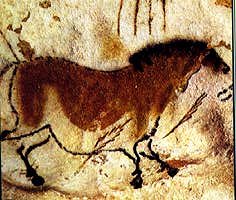
    I’m actually somewhat uncomfortable calling Paleolithic renderings “art” – not because they don’t meet some standard set of criterion, but because of the very nature of the ‘calling’ itself seems to go against the experience of the makers of the art.  See, there again, an assumption: “the makers of the art”, which includes a dichotomy between the producer and the produced.  Our modern language is so full of this type of construction that it is almost impossible to get away from, or to recognize its influence on the content and method of our thinking – which is particularly problematic (at least if unrecognized) when we attempt to consider something like the inner experience of the people in the cultures which produced the images on the rock walls so long ago.

    Paleolithic Art 2
    Paleolithic Art 2

    Van James, in his book Spirit and Art, paints a picture (in the consciousness of the reader) of the process by which the art was created, including its cultural context, indicating that it had to do with a shift from participatory consciousness to one that had the seeds of self-recognition, and thus self-abstraction, as an essential component.   I find this interesting because many artists throughout history, including today, mention something about the way in which one gets lost in the process of creating.  This experience of the space between “me” and “my art” asymptotically approaches zero, leaving the artist with an experience of creation without “A” creator.  Only retrospectively may an artist whose creating occurs in this state attribute the work rationally to some specific time period, place, and personality; but this knowledge does not need to be held in consciousness during the actual process of creation itself, and (as many artists know) may actively interfere with what might otherwise be brought forth.
    Paleolithic Art 3
    Paleolithic Art 3

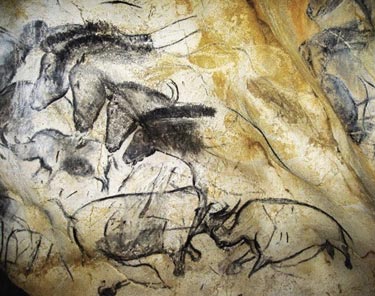
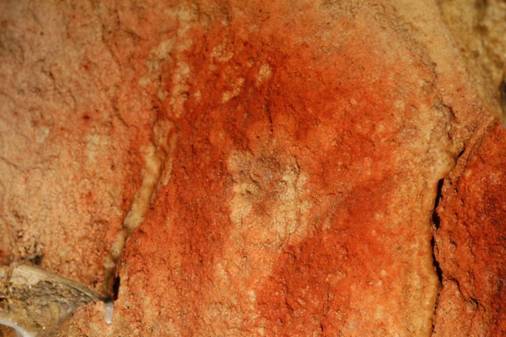
    So I wonder if this experience – or LACK of experience, as the case may be – which characterizes some part of the process of artistic creation even today, may be something that was the ‘cutting edge’ of consciousness in the Paleolithic period.  Jean Gebser’s “magic structure” (cf. The Everpresent Origin) speaks of this in a way similar to that of Van James, indicating that the art of this period was indicative of human beings waking up to themselves.  Before this stage, (Gebser’s “archaic”), it is not possible to really speak of art at all, of creations “of” humans, because the consciousness was in identity with the world.  It is only by transitioning to a consciousness of “unity” that art even becomes possible, because in “unity” is already contained the indication of multiplicity, as multiplicity is required in order for unity to be brought about (otherwise one simply has identity).  Thus Paleolithic art may exemplify this transition in consciousness from identity to unity, which gives expression to sensory and magical experience in a form that takes this experience even further, strengthening it recursively through the very act of its creation.  The painting of animals, of human figures, and of stenciled human hands may serve as a ‘catch’ for consciousness, by which it can step outside its mode of identity (akin to dreamless sleep) and into a mode which recognizes the beginning of division between the human being and the world (akin to dreaming sleep).
    Paleolithic Art hand
    Paleolithic Art hand

    So perhaps the pictures of animals and such on the cave walls are not really pictures “of”, but are rather more like techniques for transforming consciousness.  We moderns are taught to pay more attention to things rather than processes, so we tend to see the results of some activity as the most important ‘thing’ to consider, i.e. the art itself.  But maybe this was not always the case; maybe Paleolithic art was ‘something’ primarily in its making, in the process of its unfolding (such as in Tibetan sand mandalas, or Native American healing mandalas), and not so much in its product, the image on the wall.  But, recursively, the production of the images may lead one who views it but does not create it, into a different space of consciousness – a space which invites both a ‘connection to’ and a ‘disconnection from’ at the same time.  Maybe the Paleolithic viewer of Paleolithic art was both put into connection with the cultural significance of the art in an experience of magical unity with the forces identified by the culture, while also being called to experience the art in a way that called forth something from within that necessitated a concurrent experience of the without.  The very experience of one’s unity with the world perhaps awakened the first seeds of dis-unity, of separation between what would eventually be one’s “self” and “the world”.

     

  • Social Networking and Consciousness

    I would like to say that the quite frankly astonishing rise of social-networking tools clearly points to an unmet need in the ‘wired’ populace at large.  We increasingly live in a fragmented society, where our friends and family are scattered across the globe.  Many of use no longer, for economic, personal, or many other reasons, choose to live in the same place for our entire lives, where we could build up a local network of family and friends.  And even if we do so, the demands of modern life and our cultural habits tend to erode (it seems) many opportunities for face-to-face gatherings over a long time period; such things now require real effort and are not a de facto part of everyday life.

    So it seems that a way of assuaging the erosion of the human need for contact, and just as importantly, a context within which such contact can be meaningful, can be found through the social networking tools.  These tools are not designed, and cannot really take the place of repeated face-to-face interactions, but what they DO provide is a way to ‘keep the door open’ to people who you might otherwise lose track of or only communicate with very rarely.  By having, for example, a Facebook page, you put yourself in a position of taking moments out of your day to have a conscious connection with people who would otherwise likely not enter your thoughts that day.  The immediacy and digital ‘nearness’ provided by the technologies allows for and creates a different kind of interaction than has heretofore been possible on the planet.  On the one hand, these technologies constrict certain kinds of communication; but it opens up others at the same time, and allows a thread of connection that can later be followed up by a more present, face-to-face, or otherwise soul-ful type of communication.

    This is something of the positive side of these tools, but they can also be used for pure ego-stroking, for bullying, for economic reductionism, etc.  Such is the way of any tool.  For me it’s always a question of how the tool is used, and I am convinced that humans have the power to make tools like this (and other technologies) work in a positive way for the benefit of themselves and the planet.

    It’s true: there is no substitute for real face-time.  I would simply point out that Facebook and such tools are NOT actually substituting for face-time.  In fact, the reverse might be true: the immediacy and ubiquity of social networking tools may actually increase the potential for two or more people to get together IRL (in real life)–there must be a study on this somewhere… if not, any takers?

    My feeling is that the use of such tools lessens both perceived and actual gaps between individuals, while also allowing individuals to discover more potential relationships that might otherwise be missed.  Increasingly human beings are going to have to learn how to deal with the instant availability of essentially infinite data.  In the pre-wired-era, the available data was restricted to your immediate sensory neighborhood, and you had no choice about this, notwithstanding the influence of books and letters.  Now, we have a choice, and can access a whole variety of types and fields of information literally out of thin air.  It opens up a whole different set of possibilities for human creativity and interaction….

    But obviously I’m not yet giving a well-rounded picture.  I should also point out that the way that these technologies lead human consciousness around may be problematic in a number of ways, and the identification and harmonizing of these regressive or sclerotic tendencies should be addressed up front.  But to speak of these would require an even longer discussion — one including talk about the inner life of the soul.

    Below:  a diagram depicting connections between a single user’s Facebook friends.

    my facebook friends

  • horse –> herd –> cybernetics


    A friend of mine said:

    “… Concerning self-correction, can we say that the system corrects itself toward a state of homeostasis (feedback—-correction—-goal) OR toward maintaining the integrity of the closed system? Is it o.k. to look at this in terms of homeostasis?  

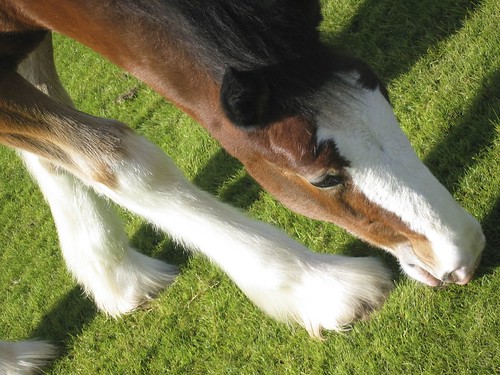
    Reason why I’m asking is that I’ve been looking at the socialization behavior of horses in the herd, and how they “process” emotions. The processing looks very much like a feedback loop with a self-correcting mechanism – I see it as an infinity symbol.  The interaction produces an action which takes the herd back to a state of “stability” or I call it homeostasis.  

    Anyway, this was a good experience for me because I read in that way – when I don’t get something I have a piece of paper and I draw to try to put the words into some visual.”

    I said:

    In the obvious case of the thermostat, there is a ‘goal’ – a temperature that is set by the second-order system (the human being).  But now with horses you get something more obviously complexificated (i like coining ridiculous words).  The horse is a system, the herd another, the environment another, and perhaps even another may be the system of “Horse” (i.e. ALL horses) thought about over a vast time period (that is, thinking about time from a second-order perspective – i think).

    In this case, when we want to talk about homeostasis, what variables are tending towards sameness?  If there are closed systems within closed systems within closed systems (as mitochondria are closed systems within each cell, which is another closed system…), then do we need to speak of a goal for each closed system?  And is there only one goal per system (as in the thermostat), or can there be multiple goals which overlap from system to system?  Or even multiple conflicting goals within a single system?  Or is this not even possible from an cybernetic standpoint… or would it just be a double bind?  Can you create a thermostat which simultaneously is tending towards TWO temperatures?  How would it behave – oscillate in some frequency set by the speed of the feedback loops? Tend towards some intermediate value? Runaway?

    Maybe symbiosis (which is an interesting concept to think about cybernetically) is the holding of multiple goals, one of which at least overlaps with another system?  I’m just spitballing here.

    Individual horse behavior —> herd qualities —> individual horse behavior (your infinity sign)

    So if you can detect the processing of emotion in an individual horse, do you see also a higher-order processing of emotion that does NOT take place at the individual horse level but ONLY at the herd level?  Is this a distinct process?  Or is the herd’s processing so completely bound up with the individual horse’s processing that it is impossible to tell apart?  

    20060107-120_2015