It's Elemental

Tag: Spirit

  • An Esoteric Guide to Spencer Brown’s Laws of Form #6

    An Esoteric Guide to Spencer Brown’s Laws of Form #6

    (New readers will want to start with the first installment.)

    We ended the last installment by discussing the esoteric nature of the injunction.  We continue this exploration, and bring this series to a close.

    LoF p. 81

    • In the command “let the crossing be to the state indicated by the token” we at once make the token doubly meaningful, first as an instruction to cross, secondly as an indicator (and thus a name) of where the crossing has taken us. It was an open question, before obeying this command, whether the token would carry an indication at all. But the command determines without ambiguity the state to which the crossing is made and thus, without ambiguity, the indication which the token will henceforth carry.

    This re-affirms that the mark has both a first and second-order character: it names the state of its content (its indication), and it is an instruction (its injunction) to mark that name, to make that distinction which yields that state. Thus every mark is both an indication and an injunction.  It is an indication of a content and an injunction on how to get there.

    LoF p. 82

    • We may consider how far, in ordinary life, we must observe the spirit rather than the letter of an injunction, and must develop the habitual capacity to interpret any injunction we receive by screening it against other indications of what we ought to do. In mathematics we have to unlearn this habit in favour of accepting an injunction literally and at once. This is why an author of mathematics must take such great pains to make his injunctions mutually permissive. Otherwise these pains, which rightly rest with the author, will fall with sickening import upon the reader, who, by virtue of his relationship with respect to the author, may be in no position to accept them.)

    All this actually relates to the task of the esoteric teacher, who (more…)
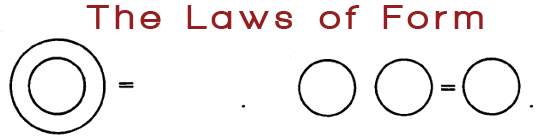
  • An Esoteric Guide to Spencer Brown’s Laws of Form #1

    An Esoteric Guide to Spencer Brown’s Laws of Form #1

    (A full PDF of this article can be had here.)

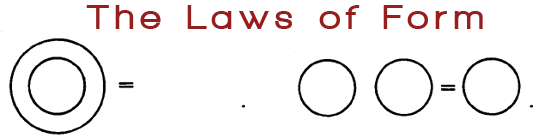
    George Spencer Brown (in his spirit, I would like to say: “Let George Spencer Brown = GSB”), a logician, engineer, and teacher, wrote a curious little book called Laws of Form, that inspired countless interesting people of widely varying backgrounds.  The book is not a book of mathematics, nor is it a book of logic, although if you were to read it this is likely what you’d say.  It is, rather, an attempt to enact something prior to both.  Indeed, GSB feels that his work actually forms (meaning both “is” and “shapes”) “the basic forms [same double-meaning] underlying linguistic, mathematical, physical, and biological science” (p. v of the 1972 edition).

    If you haven’t read Laws of Form (LoF), I quite recommend it, and it is actually quite short.  Even if you don’t want to follow along with the meaty theorems and proofs, the prose and context is definitely worth chewing on.  What is fascinating to me is that the work can also be read with an esoteric eye, which is to say, with a sensitivity to the form and nature of spiritual experiences.  This is not at all a departure from what GSB intended: in his other works he quite openly discusses this connection (see Only Two Can Play This Game published under his pen name, James Keys).  Even in LoF he prefaces the preface with this quote from Blake:

    “Tho’ obscur’d, this is the form of the Angelic land.”

    So what I would like to do is to show that within the LoF are a number of coherent relations to principles that are rightly considered esoteric: they are (more…)

  • Transformative Learning

    Transformative Learning

    “What is the connection between a transformative learning approach and the sense of one’s own spirituality? In what way does transformative learning nurture the spirit any more than any other learning style does?”

    There are many styles of transformative learning. In general, however, one key aspect of transformative learning the explicit recognition that learning is not an activity that only takes place at a specified time and place built specifically for “learning”. Rather, learning is understood to be a life activity, and as such should be connected to all aspects of life in an integral way. The old, medieval style of education based on disciplinary structures that still dominates Western culture is fraying at the edges — thankfully.

    Much of traditional academia is dominated by approaches where one learns “about” topics and ideas. In transformative learning, one learns “with” and “through” ideas by embodying them outside the classroom, in one’s daily life and work. The best transformative learning closes the loop by reciprocally inviting one’s outside activities into the classroom. This sets up a recursive relationship that helps unlock avenues for creative, integral inquiry that otherwise get stifled by a need to fit within an established epistemology, such as the kind implicit in most traditional educational offerings.

    Transformative learning styles nurture the spirit because room is made both implicitly and explicitly for what we could call the appearance of the unknown. What you know limits your knowing, and making space for the arising of what is beyond one’s current understanding is central to any transformative process. You can’t fill a cup that is already full, and transformative learning styles take advantage of this wisdom directly by integrating opportunities for unknowing. What is spiritual in the human being is nurtured more by unknowing than by the addition of data to an already established way of being. Transformation occurs not when we change our ideas, but when we change how we know. Learning styles that are transformative in nature utilize this principle directly.

    “Is there a place in the workforce for transformative learning? In what way might it be applied on the job?”

    What we have to realize is that transformative learning is not just another system of facts and ideas that can be “applied on the job” without a recursive feedback effect on the business itself. It’s not like you can go to work and have an isolated “moment of transformative learning” to fulfill that week’s quota — transformative learning is more like an attitude than a specific system of ideas or practices, and as such it bleeds beyond borders. Most of the techniques and methods used in transformative learning approaches are designed to loosen us from our habitual ways of being in the world. They recognize, for example, that pretty much all the interesting stuff happens at the boundaries. This is where the juice is: where systems, ideas, events, and (most importantly) people meet and interact. Providing avenues for a greater diversity of interactions yields far more than a directed process where the outcome is dictated in advance. That’s good for building widgets, but not so good for the spirit. This has been known in some education circles (like Waldorf education) for about a century: play is not an activity for recess, but a core mode of learning that is, by its nature, transformative. A stick becomes a magic wand, a tent-pole, a sword, a sand-writing tool, and so forth in a dynamic flow. Only the adults, stuck with their more rigid, non-experimental epistemologies, see “just a stick”.

    My father, who has been a business consulting psychologist for 25 years with the top management of major corporations like Best Buy, summed up his entire job to me recently by saying that his most important function has been to help his clients learn how to learn. This is an explicit recognition of the difference between the first-order concept of “learning” and the second-order concept of “learning how to learn”, which Gregory Bateson identified decades ago as a key to understanding complex goal-directed systems. In second-order learning, the snake bends back to bite its own tail and in so doing initiates a process of self-digestion. This self-digestion is a part of what is necessary to create the space for something new to arise, and is a stage on the way to an “adult” way of playing that is called “creative inquiry” and “transdisciplinarity” in academic circles.

    Transformative learning invites higher-order transformation: not simply a change in what we think and do, but in how we think and how we carry out our actions. More businesses are starting to recognize the value of spaces (both physical and metaphorical spaces) that are not already locked into a pre-defined form, but which invite modification and multiplicity. This is a way of calling attention to and allowing human beings to bring forth the parts of themselves that get excited and passionate when they are simply given the space to be so. Some places, like Google, MIT, and other “big names” consciously utilize principles of transformative learning as a way to nurture diversity, openness, interaction, experimentation, and transformative involvement at various levels. The next level is when businesses begin to re-humanize their practices with the attitude that every “worker” or “employee” is first and foremost a whole human being. But to get there our whole understanding of business will have to transform as well…

  • Waldorf Educators: A Light on the Path

    The world has problems; LOTS of them.  But as long as there are people like my friend Nancy, who devote their lives and love to one of the most important and practical callings on the planet, education of our young, I have hope for the future.

    Let me give you a picture, in her own words, of what I mean, as an example of how Waldorf education tries to meet the challenging tasks of our time.  This is but a tiny picture of what is possible–today– for education:

    My class went to our auditorium today and entered in the dark.  The room was covered in pine boughs in the shape of a spiral path.  In the center of the path was one large glowing candle that sat upon a tree trunk covered by a blue cloth with gold stars on it.  It smelled like a pine forest.  The students entered in silence and proceeded to a semi-circular row of chairs to sit down.  Two women, playing penny whistle, violin, and cello began playing various musical selections.

    The first child approached me.  I was standing by a table filled with red apples, each holding a slim candle in a hole carved into it.  Then, one by one, each child took the spiral walk into the center where the light glowed.  Lighting their own small candle from that big central light, they each turned and began walking back out from the center.  At some place of their own choosing along the path, they each picked a spot to place their little light.

    When the last child had gone, I took my candle filled apple and walked the path among the little lights, to the center.  After lighting my own candle, I found a place along the way to place my own light among the others.  It was an extraordinary experience for us all.  The metaphors were flooding my mind as I watched each of these students proceed on this path.  When they were little, their kindergarten teacher or parent held their hand on the way.  Now, they seemed to have grown so tall, only third graders, yet I marveled at how they had gotten so big.

    As I looked at them, a veil was drawn back for me and I could see much more than I could usually see.  Everything was revealed to me in a moment.  It seemed to me, as they walked, that I could sense them as younger children, as who they were now, and even who they were going to one day become.  In the darkness, I really felt I could see their future before my physical eyes.

    When my turn came, I realized that in the last two years of first and second grade, I always had walked the advent spiral first – before they did – so that they could see how to do it again.  This time, they walked confidently alone without my example.  This time, I followed their example.  As I passed by each one of the lights on my way into the middle, I felt as if I were floating along in the starry heavens, each star one of these students of mine that I hold so dear.  Each star lighting my way into the center.  I was so humbled to place my small light, no bigger or smaller than the others, down on the path to join in lighting the room.  I could also feel how profound it was for the students to see their teacher walk this inward path.

    With each eye intently and silently upon me, I felt the connection, the gravity, the grace, the sacredness of the responsibility I carry on their behalf, but also I felt, “I am the so-called teacher this time, but I am really only one of you.  You, who have been my teachers, who will be my teachers in the future.”  What a privilege to live in such light.  Blessings on us all.

  • Rudolf Steiner and Sri Aurobindo: A Beginning Comparison

    Rudolf Steiner and Sri Aurobindo: A Beginning Comparison

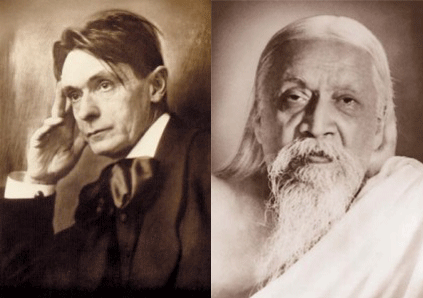
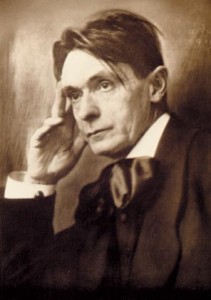
    Rudolf Steiner
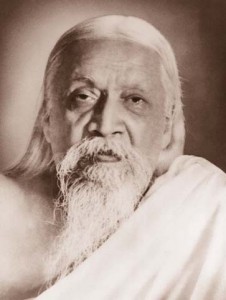
    Sri Aurobindo

    A cursory Google search (2009) didn’t turn up anything promising in regards to comparing Rudolf Steiner and Sri Aurobindo.  Hopefully this will help:

    Rudolf Steiner and Sri Aurobindo: A Beginning Comparison

    Summary:

    This longer essay summarizes the basic elements of the spiritual-cosmological worldviews of two of the most important modern, integrative spiritual thinkers: Rudolf Steiner and Sri Aurobindo. Upon this foundation a brief comparison is made between the two systems and the two men.

    See more of my work in the Articles Section of Elements.SpiritAlchemy.com.

    Special note:

    Thanks to John Elwyn Kimber for pointing me to this webpage where Pavitra, a disciple of Sri Aurobindo, records her meetings with him (see pages 4 and 5 specifically).  Pavitra and Aurobindo both say that they know some theosophists, and know of Steiner, and by Aurobindo’s responses I get the sense that he at least knew something about Steiner specifically.  However, it seems that he is being treated primarily in the same vein as theosophy (which would make sense from the “outside”), and the references are pretty quick so there is no way to gauge from this site how deeply familiar he was with Steiner specifically, but it is good to have confirmation that he at least knew of him.  Also in this text, Aurobindo states his sense that his vital plane corresponds with the theosophical astral plane, and gives his general impression of theosophy.

  • Evidence, science, and spiritual knowing: developing organs of spiritual perception

    Evidence can be gained through a variety of means.  Just as you would wish to use a sensitive detector of particular frequencies of light if you are doing x-ray crystallography, and not, say, an acoustic detector, so too we need to develop and use detectors that are appropriate to the realm in which we wish to gather evidence if we are to hope to gain any knowledge in that realm. 

    Thus, if we wish to develop knowledge of spiritual realms, we will need to develop organs of perception (for no material ‘device’ can do this for us) which are capable of perceiving in the realm of the spirit.  Not only that, but those organs, like any physical detector, need to be sensitized, tuned, and placed in the proper experimental setup for good evidence gathering to be likely.

    Of course, the basis for the spiritual organs of perception we are talking about here are rooted in our attention: it’s quality and rhythm.  For example, we lay people can only talk about all the fascinating stuff coming out of quantum mechanics in a second-(or third)-hand way, because we have ourselves not done the experiments in question, and our judgments and opinions on the matters are derivative of the interpretations of these experiments by those who have done them and their interpreters.  We would not expect an interested lay person to provide new information about quantum processes ex nihilo, but we can learn to conceptualize and come into closer relationship with those processes by virtue of our studies of what has been communicated about them by relative authorities.

    The exact same holds for spiritual considerations: those that have developed capacities to perceive spiritual realms can interpret and communicate these results to those of us that don’t, and we can study and learn about realms which we may not otherwise have access to as a consequence.  Moreover, just as we might, if we were really interested, take the necessary steps to learn the skills and concepts necessary to do research in quantum mechanics, so too we can take the steps necessary to learn the skills and concepts that allow one to do research in the spiritual worlds.

    Or does all this sound completely far-fetched?

    Unless we are scientific researchers in a particular field, we actually have very little direct evidence for our knowledge about quantum mechanical processes, chaos theory, and so forth; it’s almost completely anecdotal, yet we trust those that have done the research to provide us with a coherent and accurate picture of ‘what it is like’, and primarily on this basis we feel comfortable using the concepts and talking the talk.

    I’m only writing this because I wanted to point out that the scientific method in no way whatsoever excludes the non-physical, and that it is possible to have a clear understanding of how that is so; i.e. such a thing as spiritual science is possible.  Poor research is just as much of a problem in physical science as in spiritual science — and we must either rely upon ‘experts’ to let us know when this is the case or become an expert ourselves.

    Tree of the Wise
    Tree of the Wise
  • Projective Geometry – Harmonic Points Sequence

    Projective geometry offers a window into the human soul — not as a mere analogy, but directly: projective geometric processes are manifestations of the same archetypes that work through and within human experience.

    Doing projective geometry is to move your soul in accordance with these archetypes, and in so doing you start to train your soul so that it can begin to perceive the movement of these archetypes both in your own soul and in the world-processes around you.  In effect, projective geometry offers a path towards the development of organs of perception that operate not primarily in a physical way like your eyes or ears, but in a more subtle realm.  The development of these soul-organs opens up new realms to your perception, just as if you were in a dark room and then someone turned on a light: now you can see depth, color, and form, where before these were literally non-existent for you.

    In this spirit, I offer the following sequence of drawings that illustrate one process in projective geometry: that of Harmonic Points.  I suggest, before looking further, that you examine and follow the constructions on your own in this post:

    Harmonic Points and Lines, a Projective Geometric Exercise

    Once you have sufficient experience with the above, feel free to examine the following drawings.  Note the context given in this post and the above linked post, and see if you can discern, as an exact soul-perception, the moving gesture that accompanies the sequence, paying special attention to the ‘unique’ moments of the transformation.  Feel free to reply in comments to this post about your experience!

    Note: the drawings have been placed on a separate page, so that they can be presented unencumbered by the limitations of the blog theme.