With respect to ontology, let us say that there is no “it,” no independent reality that is exclusive of the observer. This is a basic insight from second-order cybernetics: the observer must always be included in the observed. Despite this, of course, we do have much talk and thinking about “it” that does not take the observer into account—we are very interested in the “what” of the universe, but have a fairly difficult time illuminating our own nature. But this is okay, because ultimately the talk about “it,” the pointing to “it,” (not the thought of the “it” itself) is more fundamental to “it” than anything else, because it is the relations that are primary. We can say that thingness is a subset of relatedness. Following Eugene Gendlin’s (1997, p. 22) process-concept of “interaction-first,” we can conceive of relations not as forming between two already-existing “things,” but rather as being recursively self-generated between other relations. In this sense, things are the precipitate of relations, a hardening out of a more fluid state.
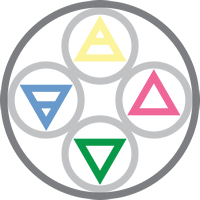
Going further than Gendlin, we can take a cue from the process-language of alchemy (Miller, 2008) to see how relations themselves are a precipitate of the tension between complementarily opposing potentials, made by a distinction out of the whole. This corresponds to the recursive ontological alchemical sequencing of the elements from Fire (the whole) to Air (polarity) to Water (relation) to Earth (thing), to Fire (a new, transformed whole). Relations are to opposing potentials of a distinction as things are to relations. Opposing potentials are themselves a precipitate of the whole by virtue of distinction (of Fire by Fire), and work alongside each other within the whole simultaneously. Each step from the whole is a kind of step-down transformation; ontologically we could say that beginning with level N, we move to level N-1. Each level is pulled out of simultaneity by an act of distinction within the whole, of the whole, by the whole. A cascading of levels of distinction thus yields the ontology of “things.” (more…)
Every moment of transformation enacts an epistemology. Part of what it means to be human is to have the potential to awaken to this fact, and more: to recognize that the recognition of the inescapable relation between action and epistemology leads to the unfolding of a life-long quest and question: how do I know? Exploration of this question, always implicitly present but seldom asked, yields consequences for the entirety of human life, from the most mundane actions to the deepest soul struggles. Once one sees that it is impossible, as a living system, to escape epistemological concerns at even the most trivial level, such concerns form an ever-present background to the unfolding of one’s life. (more…)
Evidence can be gained through a variety of means. Just as you would wish to use a sensitive detector of particular frequencies of light if you are doing x-ray crystallography, and not, say, an acoustic detector, so too we need to develop and use detectors that are appropriate to the realm in which we wish to gather evidence if we are to hope to gain any knowledge in that realm.
Thus, if we wish to develop knowledge of spiritual realms, we will need to develop organs of perception (for no material ‘device’ can do this for us) which are capable of perceiving in the realm of the spirit. Not only that, but those organs, like any physical detector, need to be sensitized, tuned, and placed in the proper experimental setup for good evidence gathering to be likely.
Of course, the basis for the spiritual organs of perception we are talking about here are rooted in our attention: it’s quality and rhythm. For example, we lay people can only talk about all the fascinating stuff coming out of quantum mechanics in a second-(or third)-hand way, because we have ourselves not done the experiments in question, and our judgments and opinions on the matters are derivative of the interpretations of these experiments by those who have done them and their interpreters. We would not expect an interested lay person to provide new information about quantum processes ex nihilo, but we can learn to conceptualize and come into closer relationship with those processes by virtue of our studies of what has been communicated about them by relative authorities.
The exact same holds for spiritual considerations: those that have developed capacities to perceive spiritual realms can interpret and communicate these results to those of us that don’t, and we can study and learn about realms which we may not otherwise have access to as a consequence. Moreover, just as we might, if we were really interested, take the necessary steps to learn the skills and concepts necessary to do research in quantum mechanics, so too we can take the steps necessary to learn the skills and concepts that allow one to do research in the spiritual worlds.
Or does all this sound completely far-fetched?
Unless we are scientific researchers in a particular field, we actually have very little direct evidence for our knowledge about quantum mechanical processes, chaos theory, and so forth; it’s almost completely anecdotal, yet we trust those that have done the research to provide us with a coherent and accurate picture of ‘what it is like’, and primarily on this basis we feel comfortable using the concepts and talking the talk.
I’m only writing this because I wanted to point out that the scientific method in no way whatsoever excludes the non-physical, and that it is possible to have a clear understanding of how that is so; i.e. such a thing as spiritual science is possible. Poor research is just as much of a problem in physical science as in spiritual science — and we must either rely upon ‘experts’ to let us know when this is the case or become an expert ourselves.
I’ve been thinking about the co-existence of multiple descriptions of reality lately. In particular, as someone who has taught high-school physics, I run up against a philosophical quandary when I’m presenting, say Newton’s laws of motion. Am I presenting a lie to the students, because quantum mechanics and general relativity replaced the Newtonian physics?
On the one hand, we can argue that classical physics is flat-out wrong in its basic foundations, and thus that all of the subsequent predictions of it’s theories are equally (and absolutely) wrong as well. For example, take the prediction of a cannonball’s trajectory. Classically this follows a simple parabolic curve… but there are a number of non-Newtonian complexifications to this story that are required for a ‘truer’ description of the event. First you have the non-linear, chaotic effects of friction, then you have general relativistic corrections (changes in space-time curvature vary with distance to the mass of the Earth, thus changes in momentum, and even the mass of the cannonball, plus time dilation and other flying pink elephants), and then quantum corrections (virtual particle interactions, uncertainty limits, kryptonite fragments).
But, as evidenced by the crumbling city walls, the cannonball hits them anyway, whether or not we take these things into account (well, friction is really pretty important, but that’s why things in physics-world are always frictionless to begin with). In other words, even though, in an abstract and theoretical sense, classical physics is complexly wrong, it is also simply correct. It will get you to the moon just fine, thank you, no relativistic corrections needed.
The issue may require some consideration of the shifting between an epistemological stance and an ontological stance (that confounded relationship again!).
Ontologically we must say that Newton’s physics provides only an approximation of more fundamental principles. We can thus think of the classical principles as “wrong” because if we are to look at the phenomenon in its more complete ontological situation, other principles are required. However, when we don’t look in this way, the classical principles are arguably just as “right” as the more fundamental principles that need to be introduced when you look at the situation more completely. In other words, questions about ontology can be taken in-situ, and not, as most philosophers would have it, absolutely. This is a big faux-pas, as it undermines the common meaning of ‘ontology’, which refers to the essence or real being of a phenomena.
But if we our queues from Whitehead, we realize that the idea of being may no longer require some kind of Parmenidean, unalterable and unchangeable essence that is just itself for all eternity. Essence-being-may rather have existence only as a process, as an ongoing creation, subject always to the bursting through of novelty.
Somewhat ironically, if we took this, rather than the Newtonian assumptions as a starting point, then it would not be problematic to see that Newton’s physics can indeed have an equivalent ontological status in certain circumstances as the relativistic and quantum laws do in other circumstances. There may be no ontological need to posit relativistic effects unless such effects create differences that impinge upon classically-based predictions.
Of course, the fact that just this does occur in some situations is exactly why people had to come up with relativity and quantum mechanics! But the establishment of new ‘laws’ may not obviate the ontological status of earlier laws when we don’t arbitrarily discount the importance of the evolving context within which any ontological consideration arises in the first place.
The situation becomes more apparent when we are no longer considering simple physical systems, but try to account for more complex phenomena: life, emotion, healing, consciousness, social effects, etc. In these cases, the ‘laws’ of physics are simply completely and utterly inadequate to the phenomena; they explain only a tiny fraction of each phenomenon. New ‘laws’, and other principles are required to make sense of these different realms. These laws may or may not be ultimately reducible to known physical laws, but that may not even matter!
What ‘exists’ for a given way of approaching a complex, embedded, extended, and recursive system may change on the basis of how that system is approached, i.e. by the ‘question’ that is asked of it. Which of course leads us to the insight, offered by Bohr, that just this is how the universe works: it answers questions (is something for us) by virtue of the questions asked of it, which is another way to say “How you pay attention changes what comes to your attention.”
Classical physics will never ‘go away’, unless human experience changes so radically as to no longer require its principles for explanation (this is highly unlikely). We should be careful of the classical assumptions about ontology, and of projecting an absoluteness onto ‘being’ that is not sensitive to the human act of in-situ knowing. To declare, because the fundamental principles of chemistry can be reduced to physical principles, that “chemistry is not needed” would be a folly; chemical principles, when unreduced, still operate in an ontologically satisfying way – for the chemist. The fact that those behaviors can be thought of in ‘more fundamental’ terms does not automatically privilege the more fundamental understanding in an ontological sense.
This does not lead to ‘state-specific sciences’ (ala Charles Tart), which are radically separate, in which every question may have its own unique ontology and epistemology. It appears that the universe doesn’t quite work this way, because principles from one realm don’t stay put; they leak out into other, seemingly unrelated disciplines, where they may find fruitful soil, even taking over the previous assumptions at times. The universe doesn’t seem to split itself up quite the way we do. In other words, we cannot hold onto an ontology that abstracts itself indefinitely, but we cannot also completely de-reify ontological considerations (the mistake of much of post-modernism) in favor of purely ‘constructed’ ontologies.
We are thus lead to consider an epistemology – an embedded, flexible, transformable epistemology – may be go hand-in-hand with a companion ontology – a process-oriented, non-reductive, complex ontology. The ontology is thus capable of shifting on the basis of epistemological concerns, but is not reducible to them. The epistemology is likewise capable of transforming on the basis of ontological considerations, but cannot be completely enslaved to them. Rather, the epistemology and the ontology co-exist in a creative dance of becoming, mutually reinforcing each other and destroying each other in a complex cybernetic loop.
It’s quite a dilemma – not being able to directly check much of what we are exposed to and presented as ‘knowledge’. Unless we begin to discover our own ways of knowing (a very difficult proposition, but I think possible), then we likely remain wanderers in the fog of our own (and other’s) unconsciousness.
Of course, at least in any near future, it doesn’t seem like subconscious situational effects can be avoided – nor do I think they should be. Much of what we enjoy as part of our everyday capacities for thinking, feeling, and willing are rooted deeply and complexly in unconscious processes. Indeed, what is normally conscious for us is perhaps one of the tiniest slices out of what can be potentially conscious, and perhaps the potentially conscious is just the tiniest slice out of the full depth and breadth of the universe as a whole – or not (because, in accord with what I just said, this is an impossible determination, requiring consciousness to take place).
In any case, pretty much EVERY modern study that follows the basic scientific practices is a study in obfuscation, requiring for its potential success a decided ignorance of as many ‘attenuating’, ‘circumstantial’, ‘probabilistic’, or ‘random’ factors as possible. The more willfully ignorant a study becomes, the more exact are its pronouncements, and the more its knowledge is sequestered from the whole. This is why all studies require additional work to be re-connected to the complex actualities of the world, necessitating interpretation, reframing, and recontextualization.
This suggests a different way of performing ‘studies’, discovered long ago by Goethe and others, in which the situatedness, the contingency, the circumstantial, are all necessarily included aspects of any attempt to work with and understand a phenomenon.
I have this feeling that appeals to functional equivalence (or even similarity) are somehow, well, disrespectful, or at least intrinsically misleading. Functional appeals ‘work’ because they abstract very specific relations from an otherwise fully real and completely embedded situation, and show how regardless of how those relations come about, if they do, then for the purposes of our inquiry, we are satisfied of their equivalence. In other words, if I want my taxes done, I don’t care whether it is done by a computer, a certified tax accountant, or a 5-year old prodigy, as long as I pay the same amount and get the same results.
My problem with functionalism (in all its forms, not just with respect to functional theories of the mind), is that function accounts necessarily reject aspects of a whole system which,given a different approach, would render any initial functional consideration of equivalence not equivalent.
In other words, given the example above, although considered solely and specifically for the very restricted purpose of ‘having my taxes done’, they three systems are functionally equivalent, the computer, the tax accountant, and the 5-year old are equivalent only in a functional sense. By being only functionally equivalent, and only in this very specific situation and for a very specific purpose, we see that a certain violence is being done with respect to the constancy of the respective wholes under (or rather not under) consideration. There are secondary, tertiary, and n-iary non-trivial effects consequent in each case that are different.
When seen as complex, relational wholes with inextricable and unique qualitative embeddedness in a multilayered and recursively evolving world dialogue, the functional relations identified by functional appeals are revealed as non-generalizable reflections of some particular set of distinctions which, if they were different, would necessitate different functional relations.
More simply, functionalism has no ontology and ignores epistemology.
This is not to say that appeals to functionalism are to be avoided. On the contrary, what makes functional appeals so powerful is precisely their ability to ignore everything that is determined to be unimportant for a given system in order to reveal some higher-order similarity. The problem arises in that functionalist explanations are not very good explanations, because they always avoid asking the question “Who?” That is, who is making the determination concerning the particular functional relation to be considered in a specific circumstance? There is always someone who must initially decide – upon a basis not explicable from within a functionalist standpoint – what the criteria are for a given system to meet a particular functional definition.
This functional blind spot is very similar to the way in which the classic scientific method includes an aspect which is manifestly non-scientific: the hypothesis. In giving a name to this undetermined, mysterious and non-controllable source from which all of its knowledge comes from and returns to, the logic of science seemingly ‘co-opts’ this ‘hole’ in its otherwise orderly workings through a process of more or less complete ignorance. Where hypotheses come from and what they consist of has nothing whatsoever to do with the scientific method, but determines every single piece of scientific knowledge it produces and the entire course of science as a whole. Functional explanations are similar in that they ignore the source of the distinctions upon which every functional identification rests. Science can only say that ‘given such and such a hypothesis, the following logical relations would hold’, just as functional explanations can only say that ‘given such and such a functional role, system A and system B have functional equivalence’. But because every system is non-arbitrarily intra and interconnected, the choice of what constitutes a given function has non-arbitrary consequences that are ignored at the peril of the coherence of the very functional similarity proposed.
Thus functionalism is disrespectful in that it does openly include and account for the source of its functional determinants. When functional appeals are used in a manifestly pragmatic way, I can forgive this oversight. But when functional appeals are used as explanations, I object, because in such cases functionalism begins to overstep itself by disingenuously posing itself in an ontological persona, leading to claims such as “if a computer functions in just the same way as a human being, then it must have a mind, because this is how we explain what a mind is.’ This is ontological violence pure and simple, and basically amounts to saying that to have a mind is to function as if one had a mind. But the hidden move here is one which necessarily already assumes – without any justification whatsoever – the particular distinctions (and not others) which account for what it means to ‘function as a mind’.
In other words, functional appeals are a mask for our ignorance. They are useful because when we are in a state of ignorance, they allow us to make distinctions which ground further thinking, but they outlive their usefulness when the relations they propose are ossified at the expense of the potential – always inherent in any real system – for multiply alternative distinctions to serve as the basis for completely different relations
WARNING: PROJECTIVE GEOMETRY MAY PUT HOLES IN YOUR BRAIN. YOUR MIND MIGHT LEAK OUT – IF YOU WANT YOUR MIND IN YOUR BRAIN STOP READING NOW.
Okay, here is a geometric exercise that I find very interesting (for some context about WHY it is interesting, look here).
It is, however, more complicated than the previous one and will likely require you to actually take out a pencil (not a pen, please, and go for mechanical – 0.5mm lead… do it for me), a ruler, and unlined paper.
HARMONIC POINTS – Phase 1
The short setup first, then construction hints, then process, then comments:


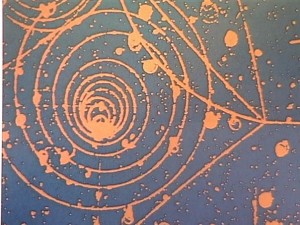 On the one hand, we can argue that classical physics is flat-out wrong in its basic foundations, and thus that all of the subsequent predictions of it’s theories are equally (and absolutely) wrong as well. For example, take the prediction of a cannonball’s trajectory. Classically this follows a simple parabolic curve… but there are a number of non-Newtonian complexifications to this story that are required for a ‘truer’ description of the event. First you have the non-linear, chaotic effects of friction, then you have general relativistic corrections (changes in space-time curvature vary with distance to the mass of the Earth, thus changes in momentum, and even the mass of the cannonball, plus time dilation and other flying pink elephants), and then quantum corrections (virtual particle interactions, uncertainty limits, kryptonite fragments).
 The situation becomes more apparent when we are no longer considering simple physical systems, but try to account for more complex phenomena: life, emotion, healing, consciousness, social effects, etc. In these cases, the ‘laws’ of physics are simply completely and utterly inadequate to the phenomena; they explain only a tiny fraction of each phenomenon. New ‘laws’, and other principles are required to make sense of these different realms. These laws may or may not be ultimately reducible to known physical laws, but that may not even matter!
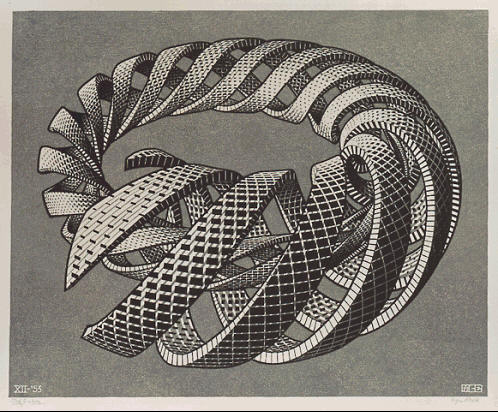
 We are thus lead to consider an epistemology – an embedded, flexible, transformable epistemology – may be go hand-in-hand with a companion ontology – a process-oriented, non-reductive, complex ontology. The ontology is thus capable of shifting on the basis of epistemological concerns, but is not reducible to them. The epistemology is likewise capable of transforming on the basis of ontological considerations, but cannot be completely enslaved to them. Rather, the epistemology and the ontology co-exist in a creative dance of becoming, mutually reinforcing each other and destroying each other in a complex cybernetic loop.