It's Elemental

Tag: Scales

  • Chaos theory and fractals: 4/4

    Chaos theory and fractals: 4/4

    4. I don’t understand how the butterfly effect looks like the structures seen in the book…a butterfly looking pattern.

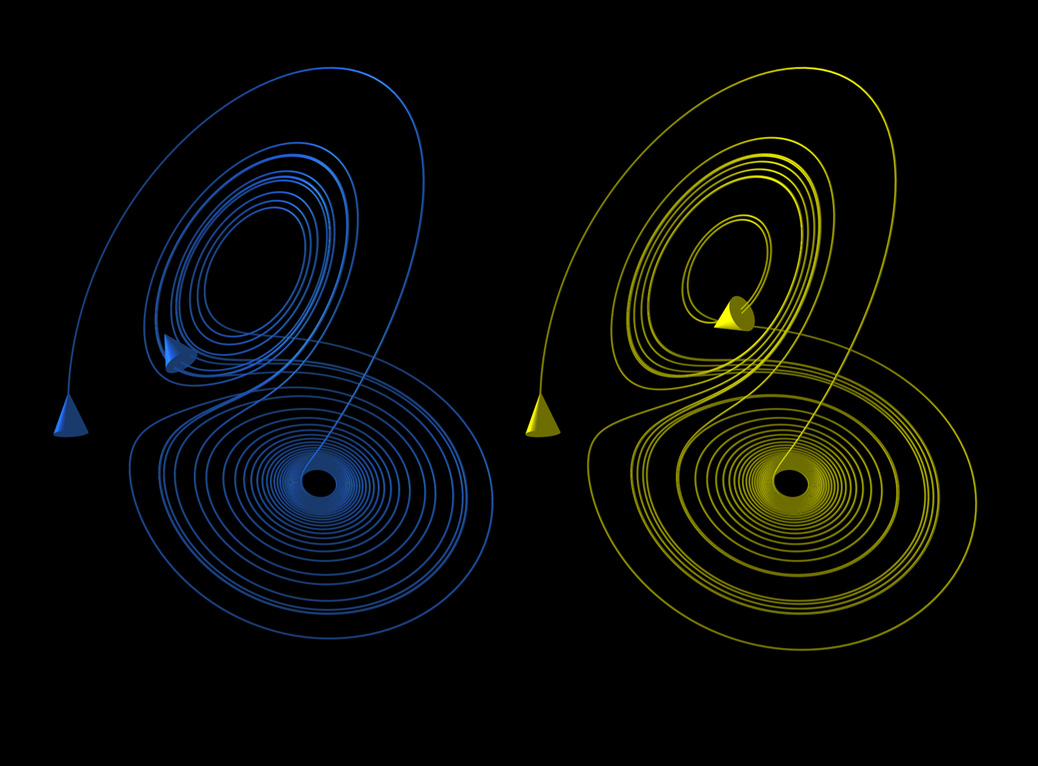
    The butterfly effect is just the name, slightly arbitrary, of the idea that complex systems exhibit the characteristic by which tiny tiny tiny (infintesimally tiny) changes in one part of the system have the potential (not always actualized) to transform THE ENTIRE system, on all its scales.  The Lorenz attractor kind of has the shape of a butterfly, and can be an image that is used to explain this sensitive dependence on initial conditions, but don’t worry about linking the Lorenz attractor specifically to ‘regular space’.

    Drawings like that are actually drawings in what is known as “phase space”, which is simply an N-dimensional space where each dimension is represented by a change in ONE variable.  The point of such diagrams is that they can incorporate simultaneous changes in many different variables at the same time (although visually there are limits on how to do this, because we are always projecting back into 2D space; holograms would help, but would only add 1 more spatial dimension in which to visualize, whereas there can be an INFINITE number of dimensions to map, depending on the phenomenon and how complex we get in our analysis).

    A dimension here is just the abstract space in which any single variable can be tracked, such as distance (up/down, left/right, forward/backward, yielding 3 dimensions that can be mapped in phase space), time (adding a 4th dimension in phase space), or anything else that we want to track, like ‘population number’ or ‘frequency/color’ or ‘subjective happiness rating’ or ‘distance from Antares’ or ‘fractal dimension’ or WHATEVER.

    If you wanted to plot two of those variables you could do it on a simple cartesian XY graph; this is a 2D phase space.  If you want to track three variable simultaneously, you need to add an extra axis, giving a 3D phase space.  But you can graph things in unique ways, for example by varying the color according to some rule that links the color with a variable, say temperature (you’ve all seen graphs and maps like this).  You can use more tricks to get more data in a phase space plot, but when it gets beyond 3 or 4 dimensions most scientists (and mathematicians especially) drop the visualization completely and just stick with the math — you get tables of numbers, each ‘row’ representing, for example, the state of the thing you are tracking, including all of its possible variables at that moment.  The next row would show the state at the next moment, and so forth.  Then you can just choose two or three of the possible N-dimensions and graph them against each other, and then take a new set, and so forth, until you see patterns.

    FROM WIKIPEDIA: BUTTERFLY EFFECT
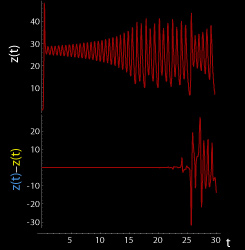
    These figures show two segments of the three-dimensional evolution of two trajectories (one in blue, the other in yellow) for the same period of time in the Lorenz attractor starting at two initial points that differ only by 10−5 in the x-coordinate. Initially, the two trajectories seem coincident, as indicated by the small difference between the z coordinate of the blue and yellow trajectories, but for t > 23 the difference is as large as the value of the trajectory. The final position of the cones indicates that the two trajectories are no longer coincident at t=30.

    Cool java applet showing the same principles: http://to-campos.planetaclix.pt/fractal/lorenz_eng.html


  • Chaos theory and fractals: 1/4

    Chaos theory and fractals: 1/4

    The following four questions (one per post) were posed in a recent class. My edited responses follow.

    1. So I understand that any shape in nature can be converted to a mathematical formula, right? Then you take that formula and plug in the variable related to that shape and feed the answer into the variable spot in the next equation, continuing that as many times as one wants (with potential infinite number of times).   Here is where I get stuck.  Does each answer produce a smaller version of the original shape or does the answer produce the snowflake-like shape of the whole, complex, product?

    We do not know how to find mathematical functions for every shape in nature; indeed this is still an area of active research.  Usually we can model (i.e. approximate) natural shapes with mathematical functions, but nature is a little more slippery and variable than the stark purity of mathematics proper, so we don’t get exact results.  This isn’t usually a problem, however, because the whole point is that we can occasionally find mathematical functions that provide something of the… essence of the form.

    For example your lungs are fractal in nature, branching and branching and branching… but they don’t do it in only one way.  Rather, they have different ‘stages’ of branching, each with a different ‘fractal dimension’, depending on how many previous branches lie before it (I can explain what a fractal dimension is if you wish in another post).  (Read a single page about this from the Cellular and Molecular Life Sciences journal – slightly technical but you can probably get the basic idea through a different lens, which is always useful: http://www.springerlink.com/content/q103206u70402617/)

    But to answer the question directly re: “each answer…”,  most fractals both occur and are described by the taking of a single set of relations (it may be a shape), and repeating that relation/shape on different scales, with rotations, translations (moving without rotating), etc.  In other words, you start with a thing and then put it through some sort of process, then take the new whole that results and do the same process to it again, and so forth.  What is interesting is that a pattern emerges out of the process… and the process is primary, NOT THE THING.  In fact, you can take ANY shape, and subject it to a specific process over and over, and you will get the SAME fractal form, regardless of the original shape.  So each iteration (“each answer”) is a further unfolding of the process, a more ‘detailed’ rendering of the pattern inherent in the unfolding of the process.

    So it’s not just a question of “smaller versions” or of reproductions of the “whole”; the pattern that defines the particular fractal is really the expression of an infinite process (usually based on some pretty simple and limited rules, like “rotate 36 degrees counter-clockwise and scale by a factor of 1/2”), which can be “reversed” (rotate 36 degrees clockwise and scale by a factor of 2) – so size has nothing to do with it, and you can start anywhere in the process with whatever you have, because the thing isn’t ‘the thing’ if you know what I mean: ‘the thing’ is the process.  This is very good for nature because nature can take whatever is there and do some pretty simple things and get some very complicated results.  It doesn’t have to start with a ‘grand plan’ that requires everything to be exact and fit in just the right way in order for it to ‘work’, but can just take whatever is there and MESS AROUND.  This isn’t the whole story but I’m just trying to relate this to fractals specifically.