It's Elemental

Tag: roots

  • An Esoteric Guide to Spencer Brown’s Laws of Form #4

    An Esoteric Guide to Spencer Brown’s Laws of Form #4

    (New readers will want to start with the first installment.)

    We ended the last installment having come to realize something of the esoteric significance of the taijitu, or yin-yang, form, in something of an extended tangent. We return now to the text.

    GSB himself seemed to understand the importance of the Laws of Form, even if there were some of these more subtle specifics which were not apparent to him (or at least which he did not explicitly recognize).  Having reached this point (literally we are still on page 1 of LoF), the vast majority of the rest of the work in LoF is seen to be secondary.  Yet there are many valuable indications which deserve connection to esoteric principles, and the point of this exploration is to show that such connections are not arbitrary. So, to return to the actual content of LoF now, after this long but foundational detour, we can note that he says:

    LoF p. 5

    • Let any token [of the mark] be intended as an instruction to cross the boundary of the first distinction.

    That is, every mark is an invitation to cross it; every distinction is a call to make that distinction, not to simply point it out, but also to DO it, to MAKE the distinction.  In other words, the whole thing is ACTIVE, not passive, it is not descriptive but PRESCRIPTIVE.  Of course, the esoteric significance of this should be obvious, because precisely what distinguishes esoteric work from, say, philosophy or other disciplines, is (more…)
  • Notes on the roots of epistemology in recursion

    Notes on the roots of epistemology in recursion

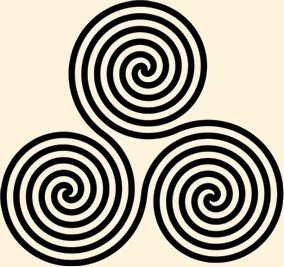
    threefold recursive spiral of knowing
    Unity in distinction, distinction in unity.

    There is a necessary recursion at the very heart of epistemology. Epistemology can never be founded upon a principle of linearity, where thinking traces its origin to something that lies before thinking, and somehow emerges or grows out of it, because the very existence of this “before”, whatever its nature, must always be assumed BY THINKING itself, as a distinction within thinking.

    Therefore, the only proper starting point for an epistemology is the fundamental distinction OF distinction itself, by thinking FOR thinking, which constitutes the basis of all further distinction, and is implicit in it. The fundament of epistemology must be the recursive distinction of distinction. The nature of this self-distinction (distinction of distinction by distiction) is implicitly infinitely recursive, and identifies the very nature of thinking to be at its root one of distinction. Its implicit infinitude is a key aspect of thinking’s foundation, with definite consequences. It means that thinking is fundamentally (not secondarily) FREE: its potential to distinguish is unlimited. There is nothing that lies outside of thinking’s potential.

    The consequences of this are more than epistemological, they are ontological. Thinking, infinite in its potential, is (more…)