Gregory Bateson (1991) famously said that we “cannot claim to have no epistemology. Those who so claim have nothing but a bad epistemology” (p. 178). Bateson is calling for self-reflection in our epistemology. He wants it to be recursive, so that in our production of knowledge we do not delude ourselves into thinking that the means of production is independent of what is produced. Bradford Keeney, cybernetic epistemologist, family therapist, modern day New Orleans-style shaman, and student of Gregory Bateson, notes that recursive epistemology has roots in second-order cybernetics and the recognition (1983) that “any distinction drawn is drawn by an observer. … An observer observes by drawing distinctions. … The starting point of epistemology is therefore an observer drawing distinctions in order to observe” (p. 24). This leads us to a fundamental recursion or non-linearity at the very start of any epistemological endeavor. While non-recursive epistemologies try to mitigate this kind of loopiness, cybernetic epistemology embraces it as the very heart of knowing, using it as a creative generator of change and transformation. Working with a non-lineal epistemology leads to a different kind of knowing, one which “emphasizes ecology, relationship, and whole systems. In contrast to lineal epistemology, it is attuned to interrelation, complexity, and context” (Keeney, 1983, p. 107).
The consequences of lacking a self-reflexive epistemology are dire, leading to real practical and ethical dilemmas. The structure of the sequence often goes something like this:
Knowledge is produced on the basis of a non-reflexive epistemology (Bateson’s “bad” epistemology). Ex: You performed an act found to be illegal.
The knowledge produced is thus assumed to be “objective” and “true” (i.e. independent of the means of its production; ignorant of its genesis). Ex: It doesn’t really matter why you did what you did, you are beholden to the law as written.
This tends to have a psychologically limiting effect with respect to alternative knowledge and especially alternative modes of knowledge production. One’s viewpoint becomes ossified. Ex: The judicial system limits its treatment of you as a whole human being only to what is allowable within the strictures that the law defines. You become identified with your act.
The unreflective assumption of the “truth” of the knowledge becomes justification for its projection, often forcefully, onto other people and processes in the environments surrounding the knower. A sense of conviction that the world is “like this” leads to inflexible protocols in our institutions and in our modes of interaction with others. In other words, outer processes are also ossified; they become sclerotic. Ex: Now, instead of being a whole human being who with a completely full and complex life that included the illegal act, your identity shifts to that of a criminal. Your identity shifts, and you are now identified with the label “criminal,” and the judicial system creates places called prisons designed largely to maintain this distinction of your new identity.
The unintended effects of this kind of lineal process knowledge production could fill multiple volumes, from the most subtle aspects of daily life to world-historical events. But recursive epistemology is not in opposition to lineal epistemology; it is rather meant to be a way of maintaining complexity and subtlety (and ideally, wisdom) by calibrating the linearity of standard epistemological practices through higher-order recursion.
Calibration and Self-Calibration.
But what does it mean to have a self-reflexive epistemology? The difference between the two types of epistemologies, non-self-relfexive and self-reflexive, can be described by the first and second order difference. A non-self-reflexive epistemology is a first-order epistemology, a process of creating knowledge that operates in a linear fashion. The knowledge it generates is not explicitly connected to the process of its generation, and thus does not act as a potential corrective to its mode of production. Epistemology is a tool for knowing; but with a non-self-reflexive epistemology, the tool’s operation does not change the tool, so that no matter what job it is called to do, it re-instances any new creations in the manner and style of its past processes—regardless of what might be new in the situation it encounters. The kind of newness that comes from a linear epistemology is (more…)
One thing that struck me as interesting was that feedback, as a concept, seems to assume two things (and probably more): 1) step-wise time (and thus some kind of “state” in which a system can be identified, and thus 2) some kind of ‘levels’ within and between systems, in part based on their “state”.
So feedback, at least in the way that I’ve been thinking about it up to now, is this idea that state A of a system precipitates state B in some way, but that state B has non-trivial links ‘back’ to processes that help create state A. But of course because we are talking about the evolution of systems, this idea of ‘back’ may be better understood inversely, as ‘forward’, in the sense that there is a real distinction between state A, state B(sub-A), which is the state of system B-as-influenced-by-A, and then state A(sub-B,sub-A) the state of A-influenced-by-B-which-is-already-influenced-by-A…. And this goes on, so we have something more like a system-of-relations (S) at various points, which are distinguished by virtue of the feedback relations between its states A and B.
Here’s an attempt at a table explicating the pattern of what we mean by “feedback”:
S1 A
S2 B(A)
S3 A(B(A))
S4 B(A(B(A)))
S5 A(B(A(B(A))))
You can see the pattern unfolding infinitely — the thing is that when we think about it in this way, the pattern that is unfolding is one that does so on the basis of these ‘moments’ (S1, S2, …). But these moments are always arbitrary; there doesn’t seem to be any ontological significance to them outside of the context of their actual identification by someone thinking about cybernetics. Our knowledge of the system becomes apropos when we question it, when a need for knowledge arises… and not otherwise.
If this is true, it’s kind of misleading to have the idea of “a system” that exists “in a state” and that this state influences some other system’s state, and so forth. It’s too reductive… and it seems to fall prey to Whitehead’s fallacy of misplaced concreteness. (Others familiar with quantum physics, and specifically the Einstein-Bohr debates may see some parallels with this line of thinking.)
When thinking about TIME and evolving systems, we run into some serious complexities, because different information flows through a given portion of a system at different rates depending upon the nature of that part of the system and the nature of the information being carried. Heat flows at one speed through a specific material, at another speed through another material. Information carried by light moves still differently, as does linguistic meaning, different types of sensation, etc. etc. etc.. Just about every ‘channel’ of information has its own unique set of variables in this regard, so there is no way to divvy up a given system into “state A” or “state B” with complete certainty, because at any arbitrary snapshot point, an important bit of information from one part of the system might be ‘on its way’ but not yet resulting in any modification elsewhere in the system in a significant way — in other words feedback has an analog character. We can create digital systems in which feedback appears to operate step-wise, but this is always an oversimplification… (perhaps not if we get to the quantum level, but even then I have a suspicion that something, perhaps not either analog or digital, has a role to play in what is now left out of the loop entirely, i.e. is attributed to ‘randomness’). In any case any macroscopic digital process always (?) includes analog processes (on higher and lower levels). The point is that it is misleading to speak of “states” at all.
So what? Well, our very ability to speak about feedback seems to presuppose a conceptual reliance upon “states”. Hmmmmm. What if we got rid of “states” and started to look more at the processes? What if we slipped out of the subtle reification of “statehood” and into the flowing of flows? The processes of processes? It seems then impossible to consider anything but the whole; everything is a whole, evolves-as-whole, is-always-whole-ing, and never ‘just is’.
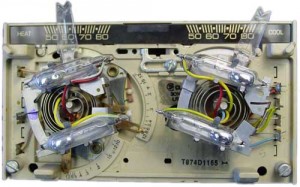
For example in an old-style mercury thermostat, the state changes from “on” to “off” to “on” again. The way it does this is through a process of feedback between the temperature of the room and the curvature of a bi-metallic strip. When the temperature is too cold (given a specific calibration point to begin with), the bimetallic strip curves in on itself, causing mercury (a conductive liquid)to fall to one side of its containing vial, where it closes an electrical circuit, making the heater go on. When the temperature is warm enough, the bi-metallic strip expands and causes the vial to tilt the other way, so that the mercury ends up in the other side of the vial, breaking the circuit and causing the heater to go off. Wash, rinse, repeat, over and over.
This is the ‘classic’ case of a feedback system. The system of the room+thermostat includes a feedback “mechanism” by which information ABOUT the “state” of the system is influential in determining the BEHAVIOR of the system. But there is something arbitrary about thinking of the system as composed of a room and a thermostat. We could divide things up into any number of different configurations, which would give slightly different perspectives on the whole. For example we can distinguish the temperature of different volumes of air, the internal components of the thermostat, the volume of air in the heating ducts and their placement, etc. “The thermostat” and “the room” are just cognitive shortcuts for more complex interrelations that, on the one hand, can be usefully summed up by such shortcuts, but which on the other hand deflects awareness from the process by which the making of the distinctions occurs, and its interactive, contingent, on-going nature. This is a general issue that crops up around epistemology.
Exploring a bit further, it would then seem that if we take such an idea to heart, it becomes much more difficult to speak of “levels” that are clear and distinct (to borrow a pithy and dangerous phrase from Descartes)–for the basis for any such distinction is some clarity about difference, and the basis for clarity is the distinction of difference. Alchemically, this is like the operation of precipitation, where a flowing, dissolving, ever-changing substance becomes punctuated by moments of particularly which separate themselves off from the activity of being-in-process with the rest of the solution. Identity becomes not only possible but fitting: here we have the formation of a crystal. It is here, it is this size, it is moving like this, it is not any of these other equally separate and identifiable crystals. (In terms of the alchemical language of process, this is the Earth element at work.)
In other words, the concept of feedback works well by virtue of its implicit reliance upon the tendency to make distinctions in complex wholes: this “part” of a system and that “part” of a system, this “state” at one time and some other “state” at another. Such distinctions may represent an a-ontological punctuation of difference within a field of activity that admits–without the activity of the distinguisher–of no such intrinsic difference. That is to say, distinctions have a certain amount of… freedom to them. Our distinguishing of one state or part of a system may not be rooted in some kind of ontologically independent “reality” which can, on its own hold up the validity of that distinction. Such validity always requires the situated contextuality of the distinguisher. (In terms of the alchemical language of process, this is the element of Water at work).
One can think of the thermostat/room system as a homeostatic one, which brings the room temperature towards some specific target through negative feedback. But this ‘stasis’ is somewhat illusory; it is accomplished by continual change. No matter how the system is constructed, it is change that creates the stasis. So it’s more accurate to think of the thermostat/room system as evolving around a cyclic attractor, where the temperature regularly fluctuates above and below a certain average (the ‘target’ temperature). It is also the stasis that creates change; the curling and uncurling of the bimetallic strip can only occur if the ambient temperature has some aspect that is constant (in this case, that the temperature STAYS above or below the target value–you’ll notice that this is a case of higher-order constancy, a constancy that is possible on the basis of change that maintains a difference).
So we sometimes make a distinction about levels: on a ‘higher’ level the system is essentially constant, while on a ‘lower’ level it is continually in flux. But again these are cognitive shortcuts for interweaving processes which do not admit of such self-distinction. The ‘levels’ are identified BY us FOR us. Just as the identification of ‘states’ is contextually contingent and not necessarily ontological, so it is with the identification of ‘levels’.
This is not to say that our distinctions are completely unguided or arbitrary–because we can’t overlook the fact that we ourselves are involved in any system by virtue of our interaction with it. Even if we are ‘just looking’ at a system, we cannot but help look with eyes that see only particularities that evolve with our ability to distinguish them. Even our seeing is cybernetic, involved in recursive looping between the ‘out there’ and the ‘in here’. The seeing is not either ‘objective’ or ‘subjective’, but partakes of both aspects, being guided by outer processes and inner processes simultaneously, and which affects the ‘seeing system’ in multiple ways, some of which may be inconsequential, and some of which may make all the difference in the world.
Goethean phenomenology acts as a transformative bridge between the researcher and a topic of inquiry. The method is unique not in that it attempts to work through the subject/object split, but rather in the WAY it attempts to do this.
Doing Goethean phenomenological research requires that one be completely open to what presents itself, while at the same time recognizing that one’s perceiving is an active force with regards to the topic of inquiry; the topic changes researcher, and the researcher change the topic.
The Goethean phenomenological method (GPM) asks that one address the topic in a complex way; it must be approached from many angles in order to gather as much potentially relevant data as possible. The data are continually taken inward and addressed, particularly with attention to the sequencing, timing, and subtle morphological differences. The goal is in part to be able to re-create, inwardly, an exact sensory imagination that moves with the same gesture as the phenomenon when observed ‘outwardly’.
Normally, one takes as an ‘object’ of inquiry some outer phenomenon such as a plant species, a location, or a natural form or process. This restriction is not required, however addressing the alternative does require the researcher to change somewhat the way in which the method has heretofore been conceptualized and practiced. It is possible to begin with a topic of inquiry that is not phenomenologically perceptible to the outer senses: love, for example, or relations between imaginary numbers. All the same methods are used to work with the phenomenon, but different challenges arise when taking an ‘inward object’ as the focus of inquiry.
The primary challenge arises due to the unequal stages of development of our outer and inner organs of perception. My eyeball provides visual information in a way that is highly correlated with the way in which your eyeball provides you with visual information. Despite the variety of potential sensory differences, on the whole physical human sensory capacities share a high degree of correlation, especially when compared with more subtle (non-physical) senses.
This is not as problematic as it may seem, because implicit in the GPM is a continual oscillation between the subject and the object, and likewise between conceptual and perceptual experience. In fact, part of the goal of the GPM is to create the capacity (we could call it what it is: a soul-capacity) that allows our soul to move with the gesture of the unfolding phenomenon, as if from the inside-out… and then to come ‘back’ to oneself in order to become aware of that experience in a way that is not available when you are ‘in it’. Dennis Klocek, a practitioner of this method, calls this process “soul-breathing.” which is a very accurate description of what is occurring. Indeed, the process of working phenomenologically in this way provides the very training necessary to develop one’s soul-capacities in a way that is commensurate with the phenomenon. The practice of Goethean phenomenology is thus recursive; its practice changes how one can practice it. This recursivity forms a conceptual and perceptual loop which forms the basis for the development of the soul-organ of perception that is keyed to the particular phenomenon in question.
Goethean phenomenology, as Goethe himself stated, is “delicate.” because the role of the inquirer is paramount in the endeavor; one cannot simply follow an established external protocol and expect results. Rather, results arrive through a process of mutual interactivity between one’s own development and the simultaneous ‘unfolding’ of the phenomenon in question.
This method, in many ways, embodies principles from participative inquiry, in that the method actually takes the ‘object’ as a ‘subject’, and treats it accordingly. The researcher is not the ultimate authority on the phenomenon, but rather attempts to give the phenomenon voice. We could actually say that the role of the researcher is to place him or herself in service to the unfolding nature of the phenomenon in all its complexity, so that it can live in an imagination that is exact with respect to the movement, transformation, and unfolding of the phenomenon (which is inseparable from the movement, transformation, and unfolding of the researcher); this allows the researcher to ultimately ‘speak for’ the phenomenon. In a way, the researcher’s agenda is to give up the agenda in favor of the unfolding of the phenomenon. This can only happen when the researcher becomes capable of perceiving in a way that is generally opposed to the dictates of normal human day-waking consciousness, which lives primarily in a constructed boundary called the “self” through which all experience is filtered.
Goethean observation softens this boundary, makes it a semi-permeable membrane, and allows part of our soul to live through its inner movements into the unfolding of the other. In this way, a real ‘dialogue’ begins to take place between the researcher and the phenomenon (rather than a purely self-relating inner dialogue where two aspects of oneself face each other, i.e. a monologue disguised as a dialogue). It truly feels like one is dialoguing with the phenomenon, just as one would with another human being, but through an expanded language of gestures, tones, and subtle feeling-movements, rather than explicit words. This allows for the creation of a shared ‘language’, consisting of inner soul movements that take the form of metamorphosing inner pictures (not simply visual, but tonal, gestural) which are exact analogues to the processes that the chosen ‘object’ of study move through.
In this way, Goethean phenomenology requires and precipitates the transformation of the researcher. Indeed it is only through transformation that a researcher can learn to hear the continual whispering of what Goethe called nature’s ‘open secrets’.