2. Does the fractal model also work for dynamic, fluid or changing shapes?
Yes, in fact this is it’s most ‘natural home’ I think. The reason is that fractals are about processes, not things, and processes are just that: descriptions of changes, not of things, and changes have a way of, well, being DIFFERENT the next time you look at them. So there are ‘orders’ or ‘levels’ of change, described by the number of levels of description required to get to the point where the pattern is invariant.
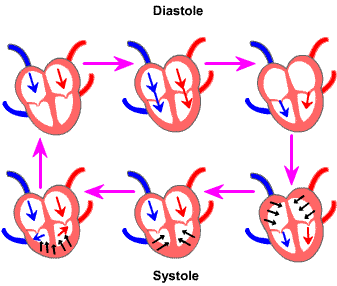
Your blood is constantly changing (systole, diastole), at this level of description there is no constant, because your blood pressure is constantly changing (lucky for us, or we’d be dead!). But at a higher level of description you get a pattern (high pressure, then lower pressure), that is invariant. You don’t get a systole and then another systole, or a succession of diastoles; they alternate. But this alternation is not constant either! The extent of the systole/diastole is ALSO constantly varying (also lucky for us, because this change, linked to what is known as ‘heart rate variability’, is strongly correlated with heart health), so it requires ANOTHER level of description to see how that is changing… and so on. At each level something ‘stays the same’ while other things ‘constantly change’. When we talk about change and constancy we have to be careful because we can never fully isolate one from the other; they are completely intertwined ‘all the way up and all the way down’.
This post is about bringing forth a different way of speaking about ethics, which is usually bogged down with a load of ridiculously unquestioned Western philosophical THOUGHT baggage, which keeps ethics locked nicely away in principles which themselves are never acted, only known.
For this reason, Varela’s idea that perception is based in ACTION is profound. Passive perception is not possible – we are not capable of being ‘only’ receivers; we are always embedded in our perception through its enactment. This enactment helps co-create the very world that is perceived through its selection — through recurrent sensori-motor feedback loops — out of the infinitely vast number of possible ways to perceive.
THEN: Thoughts are not divorced from the world either, but arise from the recurrence of sensori-motor feedback loops — the very same loops that constitute the enactment of our perception and the (re/co)discovery of the world, now not only perceptually, but CONceptually. The ability to perceptually guide action leads to the formation of CONCEPTS. !?!?!? “The cognitive self is its own implementation: its history and its action are of one piece.” (p. 54)
Hence: “experience both makes possible and constrains conceptual understanding across a multitude of cognitive domains.” (p. 16)
This provides the lynchpin by which Varela connects cognitive science to ethical know-how. The coupling between self-world-percept-concept that occurs within our sensori-motor feedback loops provides a habitual basis for our future interactions with ourselves and the world. We are autopoetical morphisms arising spontaneously in a given environment out of the evolving background of previous sensori-motor-cognitive couplings. We continually enact our enactment… Varela calls these microworlds and microidentities, because they are completely context-dependent; the type of action, the mode of thinking, the quality of sensation: all these are predicated on their past instantiation.
For this reason it is not enough to ‘think about’ ethics, for ethics can never be divorced from the acts which constitute it. Each microworld calls forth something new (or something old) from our microidentities, just as our microidentities uniquely call forth new microworlds. But to speak of microworlds and microidentities is too reifying. There are no such things, as Varela well knows.
Nevertheless, ethics requires cultivation. We are gardens in which seeds for ethical know-how must be planted and grown with care; we cannot depend solely upon the coupling strategies we have inherited from our own past. Cultivating ethical know-how is synonymous with the dispersal of our reliance upon these very couplings through the realization of their emptiness. We move from unknown knowing to known knowing, and onward to unknowable knowing. To get there (where there IS no there), requires practice. Not practice of injunctions, but of their essential dissolution into the same emptiness that the self no longer occupies.
How does this relate to ethical action? By allowing it to make its appearance out of the uniqueness of the moment. When we are full of everything that we have been, we obscure what we might be; because we always encounter more in the world than we have put there ourselves, it is not enough to remain oneself. By practicing the pattern of patternlessness, we become keyed to the unfolding of the uniqueness of the moment. It is a paradox: we must habitute ourselves to ahabituation, we must practice not practicing…
I wonder about the extent to which dichotomous thinking is either hard-wired or at least dependent on completely non-social forces. It seems almost to be a thermodynamic question, that is, a question of trying to optimize the amount of energy spent in thinking for a given situation. Thinking is a very expensive activity, physiologically speaking – it is essentially a catabolic process which relies upon the breakdown of molecules for their energy.
Evolution isn’t usually needlessly extravagant – in fact it’s kind of lazy, if you don’t mind the anthropomorphism. It seems that in a broad sense, there is a sort of law of diminishing returns for the energy investment required for thinking. In other words, if you encounter a situation in which some kind of action or distinction is called for, you get the most bang for your buck by quickly assessing things according to an either/or model. Identify one aspect, which automatically calls up some kind of opposite, and make a determination on the basis of this division. It’s quick, dirty, and effective for generating actions, feelings, and new thoughts. If the feelings, actions, etc. that result from this distinction are ‘good enough’ then there is little reason/pressure to continue the act of thinking about it in a way that calls into question the basic assumptions of the underlying duality. In other words, it’s easy to make and maintain the most basic of distinctions, those of duality.
So it seems to me that it is largely social factors that mitigate this tendency. Trying to think through the layers and layers and layers of connection that inevitably describe EVERY situation is simply not practical energy-wise, and thus requires very significant counter-pressure for its activation. We must run into situations in which our original duality is experientially shown to be inadequate for there to be a commitment to another round, or three or ten, of thinking over and through a given situation. At some point things seem to just get too complex and we give up, and the point at which we abandon the process relates to the level of depth and complexity we are able to experience.
This is why I really like Kwame Anthony Appiah’s appeal to respectful experience with people not like us, i.e. through conversation: “Conversation doesn’t have to lead to consensus about anything, especially not values; it’s enough that it helps people get used to one another” (Appiah, 2006, p.85). At a very basic level, time spent with others presents us with countless variations on the experience of discovering that our implicit or explicit distinctions are not always shared. This presents (often, but maybe not often enough?) a kind of social pressure to go through a second round of thinking about our primary distinctions, the effect of which at least sets up a greater likelihood that we can ‘get used to’ differences which before were causes for anxiety.
In any case, it seems that there is a certain amount of ‘going against the biological grain’ required to produce people like Morin, Bernstein, or Appiah. Luckily it’s not all biology! Of course, applying this little analysis to itself, I should be wary of relying upon the duality of biology/sociality, because, following Morin, ‘it isn’t quite that simple’. Round 1 over.