It's Elemental

Tag: Philosophy Of Mind

  • Musings on Paleolithic Art and Consciousness

    Musings on Paleolithic Art and Consciousness


    Paleolithic Art 1
    Paleolithic Art 1

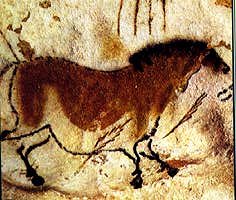
    I’m actually somewhat uncomfortable calling Paleolithic renderings “art” – not because they don’t meet some standard set of criterion, but because of the very nature of the ‘calling’ itself seems to go against the experience of the makers of the art.  See, there again, an assumption: “the makers of the art”, which includes a dichotomy between the producer and the produced.  Our modern language is so full of this type of construction that it is almost impossible to get away from, or to recognize its influence on the content and method of our thinking – which is particularly problematic (at least if unrecognized) when we attempt to consider something like the inner experience of the people in the cultures which produced the images on the rock walls so long ago.

    Paleolithic Art 2
    Paleolithic Art 2

    Van James, in his book Spirit and Art, paints a picture (in the consciousness of the reader) of the process by which the art was created, including its cultural context, indicating that it had to do with a shift from participatory consciousness to one that had the seeds of self-recognition, and thus self-abstraction, as an essential component.   I find this interesting because many artists throughout history, including today, mention something about the way in which one gets lost in the process of creating.  This experience of the space between “me” and “my art” asymptotically approaches zero, leaving the artist with an experience of creation without “A” creator.  Only retrospectively may an artist whose creating occurs in this state attribute the work rationally to some specific time period, place, and personality; but this knowledge does not need to be held in consciousness during the actual process of creation itself, and (as many artists know) may actively interfere with what might otherwise be brought forth.
    Paleolithic Art 3
    Paleolithic Art 3

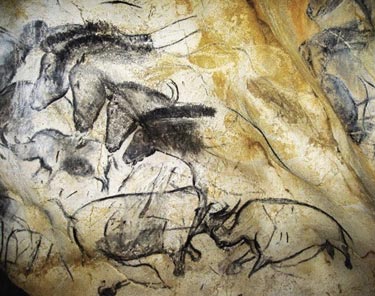
    So I wonder if this experience – or LACK of experience, as the case may be – which characterizes some part of the process of artistic creation even today, may be something that was the ‘cutting edge’ of consciousness in the Paleolithic period.  Jean Gebser’s “magic structure” (cf. The Everpresent Origin) speaks of this in a way similar to that of Van James, indicating that the art of this period was indicative of human beings waking up to themselves.  Before this stage, (Gebser’s “archaic”), it is not possible to really speak of art at all, of creations “of” humans, because the consciousness was in identity with the world.  It is only by transitioning to a consciousness of “unity” that art even becomes possible, because in “unity” is already contained the indication of multiplicity, as multiplicity is required in order for unity to be brought about (otherwise one simply has identity).  Thus Paleolithic art may exemplify this transition in consciousness from identity to unity, which gives expression to sensory and magical experience in a form that takes this experience even further, strengthening it recursively through the very act of its creation.  The painting of animals, of human figures, and of stenciled human hands may serve as a ‘catch’ for consciousness, by which it can step outside its mode of identity (akin to dreamless sleep) and into a mode which recognizes the beginning of division between the human being and the world (akin to dreaming sleep).

    Paleolithic Art hand
    Paleolithic Art hand

    So perhaps the pictures of animals and such on the cave walls are not really pictures “of”, but are rather more like techniques for transforming consciousness.  We moderns are taught to pay more attention to things rather than processes, so we tend to see the results of some activity as the most important ‘thing’ to consider, i.e. the art itself.  But maybe this was not always the case; maybe Paleolithic art was ‘something’ primarily in its making, in the process of its unfolding (such as in Tibetan sand mandalas, or Native American healing mandalas), and not so much in its product, the image on the wall.  But, recursively, the production of the images may lead one who views it but does not create it, into a different space of consciousness – a space which invites both a ‘connection to’ and a ‘disconnection from’ at the same time.  Maybe the Paleolithic viewer of Paleolithic art was both put into connection with the cultural significance of the art in an experience of magical unity with the forces identified by the culture, while also being called to experience the art in a way that called forth something from within that necessitated a concurrent experience of the without.  The very experience of one’s unity with the world perhaps awakened the first seeds of dis-unity, of separation between what would eventually be one’s “self” and “the world”.


  • Concerning functionalism

    I have this feeling that appeals to functional equivalence (or even similarity) are somehow, well, disrespectful, or at least intrinsically misleading.  Functional appeals ‘work’ because they abstract very specific relations from an otherwise fully real and completely embedded situation, and show how regardless of how those relations come about, if they do, then for the purposes of our inquiry, we are satisfied of their equivalence.  In other words, if I want my taxes done, I don’t care whether it is done by a computer, a certified tax accountant, or a 5-year old prodigy, as long as I pay the same amount and get the same results.  

    My problem with functionalism (in all its forms, not just with respect to functional theories of the mind), is that function accounts necessarily reject aspects of a whole system which,given a different approach, would render any initial functional consideration of equivalence not equivalent.  

    In other words, given the example above, although considered solely and specifically for the very restricted purpose of ‘having my taxes done’, they three systems are functionally equivalent, the computer, the tax accountant, and the 5-year old are equivalent only in a functional sense.  By being only functionally equivalent, and only in this very specific situation and for a very specific purpose, we see that a certain violence is being done with respect to the constancy of the respective wholes under (or rather not under) consideration.  There are secondary, tertiary, and n-iary non-trivial effects consequent in each case that are different.   

    When seen as complex, relational wholes with inextricable and unique qualitative embeddedness in a multilayered and recursively evolving world dialogue, the functional relations identified by functional appeals are revealed as non-generalizable reflections of some particular set of distinctions which, if they were different, would necessitate different functional relations.  

    More simply, functionalism has no ontology and ignores epistemology.  

    This is not to say that appeals to functionalism are to be avoided.  On the contrary, what makes functional appeals so powerful is precisely their ability to ignore everything that is determined to be unimportant for a given system in order to reveal some higher-order similarity.  The problem arises in that functionalist explanations are not very good explanations, because they always avoid asking the question “Who?”  That is, who is making the determination concerning the particular functional relation to be considered in a specific circumstance?  There is always someone who must initially decide – upon a basis not explicable from within a functionalist standpoint – what the criteria are for a given system to meet a particular functional definition.   

    This functional blind spot is very similar to the way in which the classic scientific method includes an aspect which is manifestly non-scientific: the hypothesis.  In giving a name to this undetermined, mysterious and non-controllable source from which all of its knowledge  comes from and returns to, the logic of science seemingly ‘co-opts’ this ‘hole’ in its otherwise orderly workings through a process of more or less complete ignorance.  Where hypotheses come from and what they consist of has nothing whatsoever to do with the scientific method, but determines every single piece of scientific knowledge it produces and the entire course of science as a whole.  Functional explanations are similar in that they ignore the source of the distinctions upon which every functional identification rests.  Science can only say that ‘given such and such a hypothesis, the following logical relations would hold’, just as functional explanations can only say that ‘given such and such a functional role, system A and system B have functional equivalence’.  But because every system is non-arbitrarily intra and interconnected, the choice of what constitutes a given function has non-arbitrary consequences that are ignored at the peril of the coherence of the very functional similarity proposed.  

    Thus functionalism is disrespectful in that it does openly include and account for the source of its functional determinants.  When functional appeals are used in a manifestly pragmatic way, I can forgive this oversight.  But when functional appeals are used as explanations, I object, because in such cases functionalism begins to overstep itself by disingenuously posing itself in an ontological persona, leading to claims such as “if a computer functions in just the same way as a human being, then it must have a mind, because this is how we explain what a mind is.’  This is ontological violence pure and simple, and basically amounts to saying that to have a mind is to function as if one had a mind.  But the hidden move here is one which necessarily already assumes – without any justification whatsoever – the particular distinctions (and not others) which account for what it means to ‘function as a mind’.   

    In other words, functional appeals are a mask for our ignorance.  They are useful because when we are in a state of ignorance, they allow us to make distinctions which ground further thinking, but they outlive their usefulness when the relations they propose are ossified at the expense of the potential – always inherent in any real system – for multiply alternative distinctions to serve as the basis for completely different relations