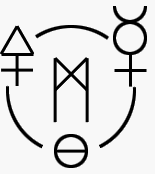
With respect to ontology, let us say that there is no “it,” no independent reality that is exclusive of the observer. This is a basic insight from second-order cybernetics: the observer must always be included in the observed. Despite this, of course, we do have much talk and thinking about “it” that does not take the observer into account—we are very interested in the “what” of the universe, but have a fairly difficult time illuminating our own nature. But this is okay, because ultimately the talk about “it,” the pointing to “it,” (not the thought of the “it” itself) is more fundamental to “it” than anything else, because it is the relations that are primary. We can say that thingness is a subset of relatedness. Following Eugene Gendlin’s (1997, p. 22) process-concept of “interaction-first,” we can conceive of relations not as forming between two already-existing “things,” but rather as being recursively self-generated between other relations. In this sense, things are the precipitate of relations, a hardening out of a more fluid state.
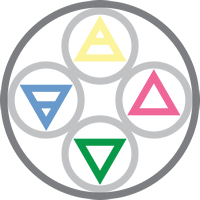
Going further than Gendlin, we can take a cue from the process-language of alchemy (Miller, 2008) to see how relations themselves are a precipitate of the tension between complementarily opposing potentials, made by a distinction out of the whole. This corresponds to the recursive ontological alchemical sequencing of the elements from Fire (the whole) to Air (polarity) to Water (relation) to Earth (thing), to Fire (a new, transformed whole). Relations are to opposing potentials of a distinction as things are to relations. Opposing potentials are themselves a precipitate of the whole by virtue of distinction (of Fire by Fire), and work alongside each other within the whole simultaneously. Each step from the whole is a kind of step-down transformation; ontologically we could say that beginning with level N, we move to level N-1. Each level is pulled out of simultaneity by an act of distinction within the whole, of the whole, by the whole. A cascading of levels of distinction thus yields the ontology of “things.” (more…)
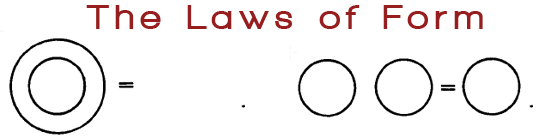
We ended the last installment with a recognition that the Laws of Form naturally led GSB to an understanding of both the necessity and importance of the realm of imaginary numbers. We will continue this elaboration.
You are likely familiar with the paradoxical sentence: “This sentence is false.” Is it false or true? The answer is yes, and it depends on when you ask me. It was this kind of paradox that drove Russell and Whitehead into creating their Theory of Logical Types, which was designed specifically to prevent this kind of thing from simply ever coming up in the first place. GSB is not so limited, and understands the importance of formally including paradox in his calculus. So how does he deal with this?
He points out that we are driven to a higher order of logic, one that includes re-entry. In the first Esalen lecture, GSB states that (more…)
Bifurcations are “splits” in the way a system develops from one state to the next. Think of them as two roads diverging in a yellow wood; one leads to some unknown mystery. The other leads to MILKSHAKES (stay tuned).
My understanding is that bifurcations are always relative (did that paradox slip by you?); depending upon how you look at the system you my find quite ‘steady’ states, or at least steady states within limits (which are generally set by the way you look at the system). Take a different look from a different perspective and you might find bifurcations going on at a different level while some OTHER level maintains its steadiness. This is the whole “order is maintained through change” and “change is maintained by order” song and dance. (Not familiar? Welcome to CYBERNETICS.)
Usually bifurcations occur when energy from ‘outside’ is introduced into the system. Bifurcations don’t occur just because “time passes”, but that as time passes you typically get changes in the amount of energy available for a system. The usual channels by which order is maintained through lower-level change can no longer handle the energy in the same old way… leading to a bifurcation where multiple new possible states result (but quite notably, NOT the ‘old state’–at least as far as I’m aware… Input anyone? Anyone? Beuller?). But those new states are usually less stable and more sensitive to changes in energy or initial conditions; drive the energy up even a little more and you get bifurcations of the bifurcations… and so on. But then, WHAM! More and more and more chaos produces… not more chaos, but suddenly ORDER… a very FEW possible states that sort of ‘collapse’ all the previous activity into a limited set of possibilities. WEIRD. The upshot? Add energy/action/motivation/enthusiasm/motion to a system and things can get a lot more interesting… and FAST. You know this because you have some friend who always takes things one step too far at parties.
by Garrick Besterwitch
Now this does not describe all chaotic systems, at least as far as I am aware, but does give a good picture of how chaotic systems can evolve in general. Now a friend of mine was wondering (he’s not a normal guy; he’s WAY cooler, you can tell because his name is SNAKE) whether humanity as a whole is wasting a lot of time thinking about transforming when we should just take a cue from the caterpillar, who sets up a chrysalis and can just hang out, because transformation is just going to HAPPEN, without having to do anything to produce it. Despite the fact that this is something of a bastardization of his point, it serves my purpose here.
Now it would be nice if we could just sit back and watch humanity transform like a caterpillar into a beautiful soaring butterfly… but more likely if we sat back to watch the show we’d end up with some kind of oozing slime-mold, or “Twilight“. Ummm, I could be wrong about the slime-mold thing, they are actually pretty awesome. The POINT is that a caterpillar changing into a butterfly takes a LOT of energy; it’s not a ‘quiet, relaxing period’… but one where the caterpillar more or less EATS ITSELF (“Ouroboros, table for two, I mean one?”). Have you ever tried to digest yourself? Well you do every day. Eat a big lunch and get the afternoon sleepies because your liver just got slammed with an order to break down a milkshake so it doesn’t end up in your blood, clogging your arteries. “Too much to do here!” says your liver to your consciousness. “You need to get outta here cause you are holding up my work.” Zzzzzzzzzzzzzz.
From your perspective you didn’t have to “do” anything to digest your lunch. But on a systemic level we are talking serious amounts of activity… it’s just that the activity is occurring on the basis of processes that are not readily available to your consciousness (even if you remained awake). The system as a whole is changing its state — bifurcating, if you will — because 720 calories of ice cream is a LOT of energy, which drives the system from its previous ‘steady’ state.
Now we can eat milkshakes for lunch (for the record, I have… okay DEFINITELY done this before) and have the systemic relationships activate which result in our loss of ability to influence the system effectively, or to even be aware of where it is headed… Or we can maybe snack on some almonds (or at least eat a reasonable meal–from your liver’s perspective; THINK OF YOUR LIVER!!!) and help steer the context towards one that can more robustly handle the higher-level situations (boss yelling at you, papers to write, world peace and such), which you can’t do very well when your consciousness gets kicked out by your much more powerful digestive processes.
There is some sort of dynamic harmony (not really BALANCE, which is too static) here; you need enough energy to keep the system from stagnation and ossification, but not too much energy that you drive it too fast, yielding bifurcations too quickly (cancer), which pushes the system into a new steady state by virtue of undesirable transformation (death).
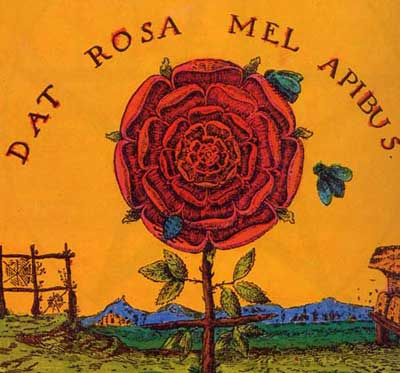
As the Rosicrucians were fully aware, you can’t avoid death, BUT YOU CAN DIE BEFORE YOU DIE. By consciously approaching these processes (rather than them approaching you–too late!), they discovered that we could have ‘little deaths’ that allow us to experience the world in a more engaged and subtle and effectively wise way. This was a form of conscious suffering.
And these sorts of processes DID have some order. There were various stages, and it was VITALLY important not do to things out of order; this could ruin the whole work. Alchemists discovered quite a few different processes (every “stage” is really a process), but to boil it all down and oversimplify it you have something like this:
1) Undifferentiated unity (prima materia) 2) Differentiation into parts 3) Purification of parts 4) Integration of parts into a new unity (what I call a “differentiated unity”)
And all of THAT can be summed up in one nice Greek word (perhaps coined by Paracelsus): Spagyrics, from spao, to tear open, + ageiro, to collect.
So in terms of alchemical processes, the WHOLE THING can be understood as a big cycle of taking apart and putting together, with the purification of the parts implied by the fact that they can be put back together again. Thus, at the very least, this is the most important and significant ‘order’ to any alchemical process. All the other sub-processes are, shall we say, bifurcations of this large gesture into smaller and smaller sub-cycles.
Now if you want to get real alchemical about it, it might be worth pointing out that there were three basic ‘gestures’, which was another way to understand this process. They were called Salt, Sulfur, and Mercury.
The Salt corresponds to the taking apart, the Mercury to the purification, and the Sulfur to the re-integration. You’ll find these three processes ALL OVER alchemy, precisely because they represent the WHOLE WORK. These three physical substances exhibited properties–really qualitative transformations, which we usually call ‘processes’ because we like to think we are scientific–which embodied in the material realm the qualities that were found to describe essentially ANY transformation, and came to stand for the higher-level ‘gesture’ of a three-fold transformation of unity into unity.