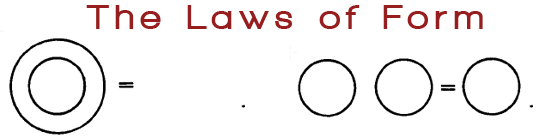
We ended the last installment with a recognition that the Laws of Form naturally led GSB to an understanding of both the necessity and importance of the realm of imaginary numbers. We will continue this elaboration.
You are likely familiar with the paradoxical sentence: “This sentence is false.” Is it false or true? The answer is yes, and it depends on when you ask me. It was this kind of paradox that drove Russell and Whitehead into creating their Theory of Logical Types, which was designed specifically to prevent this kind of thing from simply ever coming up in the first place. GSB is not so limited, and understands the importance of formally including paradox in his calculus. So how does he deal with this?
He points out that we are driven to a higher order of logic, one that includes re-entry. In the first Esalen lecture, GSB states that (more…)
Every conversation can lead to conversion; to a new context, a different way of perceiving, a step out of habitual patterns of thinking that we unknowingly carry with us or alternately identify as self. As one who attempts to live with Morin’s “new way of thinking”, one is never converted; one can only be continually in conversion, or rather, in continual oscillation between stasis and motion. Once we see things from a new vantage point, it is not enough to simply adopt that vantage point, for every vantage point is only a brief resting place from which we cast off again into the unknown.
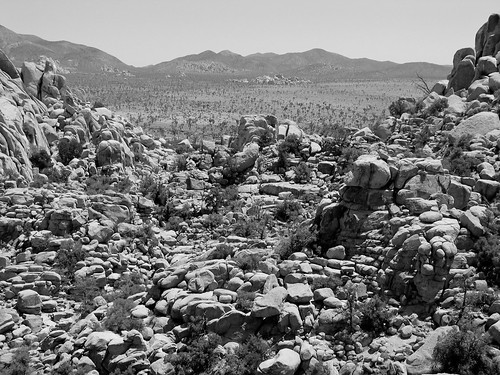
((When I was 12 years old, and lived right at the exact place where the dusky plains of Colorado met the surging foothills in a meeting of two geographical worlds, I would come home from school and occasionally foray into what seemed to be the wilderness to my young mind. There was one particular mountain, which I dubbed Coyote Mountain for the small coyote den tucked in some rocks at its base, which had been calling out for climbing. I had spied out my route over the previous hours by looking at its face through my bedroom window. Once I was on the mountain things were different. After a steep and breathless climb I sensed I was nearing the summit, as I could see only sky above where the mountain rose in front of me a few hundred yards away. My focus was increased and I rushed to the top… only to realize that I had only made it halfway up! The major portion of the mountain lay ahead of me, having been blocked by its lower half; a situation that of course only happens when one is ON the mountain. From my perch at home it seemed the whole thing was laid out neatly before me, but I was unable to account for what it would really be like once I was actually “in conversation” with the mountain directly, and not surveying it from afar. Now, I realized that a whole new part of the mountain was available to me, and in a completely new way that reorganized my previous knowledge. It was possible to see in a new way.))
But conversion is not linear, it doesn’t proceed nicely. It retroacts upon itself, so that one’s new perspective modifies the way in which we used to perceive; our perception becomes perceived, and is thus modified in the act. ((On the mountain I learned something not just about the mountain; I learned something about my perception, and saw the same world in new ways.))
Not only this, but one does not merely experience conversion passively; for one’s movement is also the movement of the other, i.e. one converts and one is converted, simultaneously. We cannot escape that our change is also a change in the world, available to the world for new conversation. And likewise this converting is also retroactive; it too, changes how we perceive our own perception, because we see that our perception is not merely passive, but active as well. It thus becomes impossible to say what “I” think or perceive (if, following Bohm, thinking is a complex order of perception), because I am in the world, and the world is in me. To claim that such and such a thought is “mine”, or that “this is MY pain”, is a form of totalitarian hubris, for we do not know very much about what this “I” is, or rather where it has come from or where it is going. The “I” is constantly stymied by the fact that it cannot find its own boundaries. All boundaries of the self, when approached by the self, recede as a horizon, a limitless limit. In George Spencer Brown’s calculus of distinction, the “I” is the space within the mark, which makes the mark in order to be what it is, but in so doing necessitates the space outside the mark, the unmarked, which is to the mark as the horizon to a traveler. In this case, the unmarked is precisely that which is not available to the “I” – the infinite pleroma.
There are always more horizons to explore. We could also say there are more verizons to explore as well, which lead us not outward so much as upward, and from which our perspective of the horizon, as in leaving the Earth, recedes into its own circle. This circle of the Earth is now perceivable in its entirety as Brown’s mark, but from a new vantage point. Now, a completely new set of horizons become apparent, of a different order than the initial horizon; yet all horizons are as equally unreachable as they are infinitely approachable.
All of these are conversations, all are conversions. Transdisciplinarity is the art of staying in the conversation. It is the art of living constantly between horizons, as if on the boundary of a fractal. The fractal is always a temporary horizon, never an absolute place to rest. It is living always with the question: does this point on which I stand lie inside or outside the form? This question is never resolved if we stay on the boundary; its solution can only occur if we abandon the never-ending process of iteration, of self-recursion, and then the answer is always trivial. Just as the answer to Ramana Maharshi’s entreaty to live ever on the boundary through the continual asking of the recursive question “Who am I” is equally trivial: it is “I”. The point is not to answer the question, but is rather to keep from ever answering it!
Thus, transdisciplinarity is in the unfortunate position of having been identified as such. To the extent that this is the case, it has stepped off the boundary. We see transdisciplinarity outside our window and we survey it, we think we see a path, and we make plans. Then we step foot on the soil and now we must walk what hitherto we have only thought. The order of our plan meets the disorder of the real environment; if we have fixed our view of transdisciplinarity, we cannot reach the summit. Our view of transdisciplinarity, as Morin points out, is “antagonistic, concurrent, and complementary.” We must continually be able to stay in communication, in a dialogic relationship, so we can continually recontextualize, globalize, and re-globalize again our relationship with transdisciplinarity.
In this way, our view of transdisciplinarity becomes transdisciplinary. The cause acts on the effect, and the effect acts on the cause. Our emergent view continually alters the emergence of our view, which thus emerges anew. This is transdisciplinarity not squared, but circled. But the marking of the circle is never permanent. We must learn both how to make the mark and to unmake it. This always occurs through the making of a new mark, a new distinction, which itself calls out for unmaking. Transdisciplinarity is the art of this making and unmaking.
((Sitting in my room, I now see the mountain anew. It is both more and less than before. I am both more and less than before. We are both more and less than before.))
The drawing of a distinction is a formative act.Drawing a distinction FORMS the space, constellates the infinitely possible unknown into spaces which are shaped by the particular WAY in which the distinction is drawn.The resulting spaces can not help but take the complementary shape of the distinction that defines them.
The drawing of a distinction is an INformative act.Drawing a distinction INFORMS the observer to distinguish the space like this.The resulting shape of any possible knowledge within the space cannot help but be informed (formed-in) by the particular way in which the distinction is drawn.
The distinction is an epistemological act that creates itself, and in so doing, is also the creation of the space in which the distinction occurs, as well as of the observer who makes the distinction.
There are levels of distinction; distinctions can be made about distinctions, and distinctions can be made about those distinctions…
Distinctions are atemporal and aspatial.They are the primitive act.The distinction between the distinction, the space, and the observer are all formally equivalent, just as the three interior angles of a triangle are all formally equivalent.In other words, they are interchangeable in any process that specifies ANGLE.
The only process that specifies distinction, space, and observer is DISTINCTION.The form (which is the same thing as the LAW of form) is an ouroboros.
Consciousness is the consciousness of distinction.That is to say, consciousness is distinction; it cannot be other than consciousness of distinction.Therefore consciousness is co-extensive with all distinction.What is distinguished is conscious of its distinction; this is why there is distinction; this is why there is consciousness.
Time is a higher order distinction that requires recursivity.It is a distinction about a distinction.Time is dependent upon the oscillation of distinction between two states made by that distinction.Time is the injunction to cross the boundary between the states, and once crossed, to cross again.The crossing is atemporal.Only the distinction of the crossing is temporal.The distinction of the crossing of the distinction is time.
<—————-distinction—————->
Now, I have no idea if any of the above is sensible or insensible <crossing boundary: its sensibility or insensibility is only possible on the basis of the distinction as such.In itself it is neither sensible nor insensible, but what it would be if it could> but it has raised some questions for me:
Is distinction ONLY binary?Is distinction always between this state and that state, that is, between one and another?Is it possible to distinguish not just between one:one, but between one:many, between one and another+another+another?In other words is this a binary reductionism? <crossing boundary: yes, if this binary distinction is made.now make another distinction.>
Okay, but what about the, um, distinction in quantum mechanics of the possible eigenstates of the wave function?There are an infinite number of possible eigenstates for any given system (even the simplest), and they must ALL be taken into account (their probabilities must be worked in to the equation).Then, out of the whole field of possibilities, ONE is observed.In the observation, all the other possible values have a probability of zero, while the observed value has a probability of one.This sounds an awful lot like the idea that the fundamental act of distinction creates the space and thus the values of any distinction in the space thus created.Does this have any validity, either as an analogue or at least a metaphor? <X: Do you distinguish it as such?>
…
Okay I have another question.What happens if we DON’T DISTINGUISH?I mean, we don’t un-distinguish and we don’t distinguish.Without distinction… what happens?Is this (GSB language) a marked empty mark?
Crap!And can making a distinction of a distinction actually be the same as not making a distinction in the first place?