With respect to ontology, let us say that there is no “it,” no independent reality that is exclusive of the observer. This is a basic insight from second-order cybernetics: the observer must always be included in the observed. Despite this, of course, we do have much talk and thinking about “it” that does not take the observer into account—we are very interested in the “what” of the universe, but have a fairly difficult time illuminating our own nature. But this is okay, because ultimately the talk about “it,” the pointing to “it,” (not the thought of the “it” itself) is more fundamental to “it” than anything else, because it is the relations that are primary. We can say that thingness is a subset of relatedness. Following Eugene Gendlin’s (1997, p. 22) process-concept of “interaction-first,” we can conceive of relations not as forming between two already-existing “things,” but rather as being recursively self-generated between other relations. In this sense, things are the precipitate of relations, a hardening out of a more fluid state.
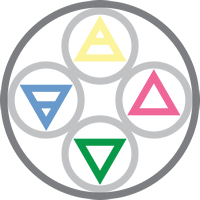
Going further than Gendlin, we can take a cue from the process-language of alchemy (Miller, 2008) to see how relations themselves are a precipitate of the tension between complementarily opposing potentials, made by a distinction out of the whole. This corresponds to the recursive ontological alchemical sequencing of the elements from Fire (the whole) to Air (polarity) to Water (relation) to Earth (thing), to Fire (a new, transformed whole). Relations are to opposing potentials of a distinction as things are to relations. Opposing potentials are themselves a precipitate of the whole by virtue of distinction (of Fire by Fire), and work alongside each other within the whole simultaneously. Each step from the whole is a kind of step-down transformation; ontologically we could say that beginning with level N, we move to level N-1. Each level is pulled out of simultaneity by an act of distinction within the whole, of the whole, by the whole. A cascading of levels of distinction thus yields the ontology of “things.” (more…)
All the qualities of the physical world exist through the interrelations of things to each other. What Moleschott says is correct for physical existence: ‘All existence is an existence through qualities. But there is no quality that does not exist through a relation.’ Just as everything of a soul nature contains something in itself by which it points to something outside itself, so conversely, a physical thing is so constituted that it is what it is through the relation to it of something outer.
(Rudolf Steiner, Riddles of the Soul, Mercury Press, 1996, p. 69.)
For such a philosophy, the relations that connect experiences must themselves be experienced relations, and any kind of relation experienced must be accounted as ‘real’ as anything else in the system.
(William James, Essays in Radical Empiricism, Cosimo, Inc., 1912/2008, p. 20)
In aesthetic epistemology, notions of “reality” are replaced by “patterns in process.” “Things” are (ontologically) patterned processes. We mistake the nature of the universe when we presume that “things,” to be, must “be” from the bottom up: on the basis of some “substance,” which THEN interacts in processes to yield what we experience (the first coherent expression of this began with the atoms in the void hypothesis of Leucippus and Democritus in Ancient Greece). We assume that it is silly to speak of patterns of process without some kind of “thing” that we can point to as an indicator that the process is proceeding. Because of the way our senses are involved in cognition, we tend to count as “real” only what can be made apparent to us through our senses (or their extensions via instruments). This is a huge presumption on our part. What if we tried to conceive of “substance” as a secondary phenomenon? What if process (thing-less process) is more primary? In this view, things are precipitates (momentary nodes, relatively ‘still’ areas of patterned processes) of higher-order relations… not relations between THINGS but relations qua the activity of relating. This may sound abstract, but this is because we are trained to think of reality in terms of substances (sub-stances: the “underneath-standings,” the bits from out of which a universe gets built).
The best example of one way that this can look is given in the field of mathematics. Mathematics has no atoms, not even metaphorical atoms; it is entirely substanceless. Rather, mathematics has, at its base, processes and their relations. Even numbers aren’t the basis of mathematics, (more…)
– There is no “it”, but there is talk about “it”. Ultimately the talk about “it”, the pointing to “it”, is more fundamental to “it” than anything else, because it is the RELATIONS that are primary: thingness is a subset of relatedness. Relations are not between two “things” but are recursively self-generated between other relations – things fall out of relations (things = Earth, relations = Water). Relations themselves are a precipitate of tension between complementarily opposing potentials (Air). Relations are to opposing potentials as things are to relations. Opposing potentials are themselves a precipitate of the whole, and work alongside each other within the whole simultaneously. Each step from the whole is a step-down transformation, we could say that beginning with level N, we move to level N-1. Each level is pulled out of simultaneity by an act of distinction within the whole, of the whole, by the whole. A cascading of levels of distinction yields the ontology of “things”, and simultaneously an epistemology of “knowing” activity, which together yield the whole of cosmology.
– This can be approached in another way. We can begin first with a problem of the modern condition, made apparent most strongly by both postmodernism and deconstructionism. The problem is that language is (more…)
Everyone dreams, but few people find sufficient interest in their dreams to move beyond mere curiosity at their strange contents. Even many who work with dreams as a part of a transformative practice usually concentrate on their content, and only more rarely question their form, ontology, and origins. Exploring these aspects, however, can help provide a context that helps orient dreamers to some of the esoteric underpinnings of dream etiology (their meaningful origins), and can help enliven dream-based transformative practices. This article is an attempt to show how a spiritually-oriented understanding of the makeup of the human being gives a context for understanding different types of dreams, their origins, and some associated consequences for dreamwork.
The language of spiritual science, also called anthroposophy (human wisdom) will be of help in this endeavor, because it maintains its cogency across multiple phenomenal realms (such as those of sleeping and waking), and because it has as its aim the ability to make clear and coherent processes which work within the physical realm but have their source beyond it, in the spiritual worlds. Fundamental anthroposophical terminology will not be explained in this article for reasons of space, and neither will the basic anthroposophical view of dreaming in general. For a brief introduction, I highly recommend that readers peruse this article: Sleep and Dreams in Anthroposophy, which provides the context (more…)
I’ve been thinking about the co-existence of multiple descriptions of reality lately. In particular, as someone who has taught high-school physics, I run up against a philosophical quandary when I’m presenting, say Newton’s laws of motion. Am I presenting a lie to the students, because quantum mechanics and general relativity replaced the Newtonian physics?
On the one hand, we can argue that classical physics is flat-out wrong in its basic foundations, and thus that all of the subsequent predictions of it’s theories are equally (and absolutely) wrong as well. For example, take the prediction of a cannonball’s trajectory. Classically this follows a simple parabolic curve… but there are a number of non-Newtonian complexifications to this story that are required for a ‘truer’ description of the event. First you have the non-linear, chaotic effects of friction, then you have general relativistic corrections (changes in space-time curvature vary with distance to the mass of the Earth, thus changes in momentum, and even the mass of the cannonball, plus time dilation and other flying pink elephants), and then quantum corrections (virtual particle interactions, uncertainty limits, kryptonite fragments).
But, as evidenced by the crumbling city walls, the cannonball hits them anyway, whether or not we take these things into account (well, friction is really pretty important, but that’s why things in physics-world are always frictionless to begin with). In other words, even though, in an abstract and theoretical sense, classical physics is complexly wrong, it is also simply correct. It will get you to the moon just fine, thank you, no relativistic corrections needed.
The issue may require some consideration of the shifting between an epistemological stance and an ontological stance (that confounded relationship again!).
Ontologically we must say that Newton’s physics provides only an approximation of more fundamental principles. We can thus think of the classical principles as “wrong” because if we are to look at the phenomenon in its more complete ontological situation, other principles are required. However, when we don’t look in this way, the classical principles are arguably just as “right” as the more fundamental principles that need to be introduced when you look at the situation more completely. In other words, questions about ontology can be taken in-situ, and not, as most philosophers would have it, absolutely. This is a big faux-pas, as it undermines the common meaning of ‘ontology’, which refers to the essence or real being of a phenomena.
But if we our queues from Whitehead, we realize that the idea of being may no longer require some kind of Parmenidean, unalterable and unchangeable essence that is just itself for all eternity. Essence-being-may rather have existence only as a process, as an ongoing creation, subject always to the bursting through of novelty.
Somewhat ironically, if we took this, rather than the Newtonian assumptions as a starting point, then it would not be problematic to see that Newton’s physics can indeed have an equivalent ontological status in certain circumstances as the relativistic and quantum laws do in other circumstances. There may be no ontological need to posit relativistic effects unless such effects create differences that impinge upon classically-based predictions.
Of course, the fact that just this does occur in some situations is exactly why people had to come up with relativity and quantum mechanics! But the establishment of new ‘laws’ may not obviate the ontological status of earlier laws when we don’t arbitrarily discount the importance of the evolving context within which any ontological consideration arises in the first place.
The situation becomes more apparent when we are no longer considering simple physical systems, but try to account for more complex phenomena: life, emotion, healing, consciousness, social effects, etc. In these cases, the ‘laws’ of physics are simply completely and utterly inadequate to the phenomena; they explain only a tiny fraction of each phenomenon. New ‘laws’, and other principles are required to make sense of these different realms. These laws may or may not be ultimately reducible to known physical laws, but that may not even matter!
What ‘exists’ for a given way of approaching a complex, embedded, extended, and recursive system may change on the basis of how that system is approached, i.e. by the ‘question’ that is asked of it. Which of course leads us to the insight, offered by Bohr, that just this is how the universe works: it answers questions (is something for us) by virtue of the questions asked of it, which is another way to say “How you pay attention changes what comes to your attention.”
Classical physics will never ‘go away’, unless human experience changes so radically as to no longer require its principles for explanation (this is highly unlikely). We should be careful of the classical assumptions about ontology, and of projecting an absoluteness onto ‘being’ that is not sensitive to the human act of in-situ knowing. To declare, because the fundamental principles of chemistry can be reduced to physical principles, that “chemistry is not needed” would be a folly; chemical principles, when unreduced, still operate in an ontologically satisfying way – for the chemist. The fact that those behaviors can be thought of in ‘more fundamental’ terms does not automatically privilege the more fundamental understanding in an ontological sense.
This does not lead to ‘state-specific sciences’ (ala Charles Tart), which are radically separate, in which every question may have its own unique ontology and epistemology. It appears that the universe doesn’t quite work this way, because principles from one realm don’t stay put; they leak out into other, seemingly unrelated disciplines, where they may find fruitful soil, even taking over the previous assumptions at times. The universe doesn’t seem to split itself up quite the way we do. In other words, we cannot hold onto an ontology that abstracts itself indefinitely, but we cannot also completely de-reify ontological considerations (the mistake of much of post-modernism) in favor of purely ‘constructed’ ontologies.
We are thus lead to consider an epistemology – an embedded, flexible, transformable epistemology – may be go hand-in-hand with a companion ontology – a process-oriented, non-reductive, complex ontology. The ontology is thus capable of shifting on the basis of epistemological concerns, but is not reducible to them. The epistemology is likewise capable of transforming on the basis of ontological considerations, but cannot be completely enslaved to them. Rather, the epistemology and the ontology co-exist in a creative dance of becoming, mutually reinforcing each other and destroying each other in a complex cybernetic loop.
 On the one hand, we can argue that classical physics is flat-out wrong in its basic foundations, and thus that all of the subsequent predictions of it’s theories are equally (and absolutely) wrong as well. For example, take the prediction of a cannonball’s trajectory. Classically this follows a simple parabolic curve… but there are a number of non-Newtonian complexifications to this story that are required for a ‘truer’ description of the event. First you have the non-linear, chaotic effects of friction, then you have general relativistic corrections (changes in space-time curvature vary with distance to the mass of the Earth, thus changes in momentum, and even the mass of the cannonball, plus time dilation and other flying pink elephants), and then quantum corrections (virtual particle interactions, uncertainty limits, kryptonite fragments).
 The situation becomes more apparent when we are no longer considering simple physical systems, but try to account for more complex phenomena: life, emotion, healing, consciousness, social effects, etc. In these cases, the ‘laws’ of physics are simply completely and utterly inadequate to the phenomena; they explain only a tiny fraction of each phenomenon. New ‘laws’, and other principles are required to make sense of these different realms. These laws may or may not be ultimately reducible to known physical laws, but that may not even matter!
 We are thus lead to consider an epistemology – an embedded, flexible, transformable epistemology – may be go hand-in-hand with a companion ontology – a process-oriented, non-reductive, complex ontology. The ontology is thus capable of shifting on the basis of epistemological concerns, but is not reducible to them. The epistemology is likewise capable of transforming on the basis of ontological considerations, but cannot be completely enslaved to them. Rather, the epistemology and the ontology co-exist in a creative dance of becoming, mutually reinforcing each other and destroying each other in a complex cybernetic loop.