It's Elemental

Tag: observer

  • Observing the Observer: Exploring a Cybernetic Epistemological Recursion

    Observing the Observer: Exploring a Cybernetic Epistemological Recursion

    All epistemologies are observer-dependent; i.e. there is no single epistemology that applies to all possible observers, because every observer is unique in some way.  The necessary inclusion of the observer in any description of the world is a deeply obvious and yet profound principle.  It was neatly expressed in Heinz von Foerster’s article Cybernetics of Cybernetics, where he builds off of Humberto Maturana’s phrase “Anything said is said by an observer,” by indicating that “Anything said is said to an observer” (2003, p. 283) (figure 1).  This is in contrast to the view that anything said is simply… said, as if into a vacuum.  This older view, championed by the scientific revolution, took up the principle that statements could simply be true or false, and were about the world but not really of the world (the roots of these two views can be traced back to Plato and Aristotle).  Cybernetic epistemology modifies this assumption by re-introducing the observer as a part of the world.
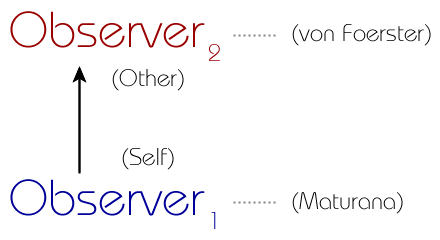
    Figure 1: Observers 1 and 2
    Figure 1. A cybernetics of description following Heinz von Foerster. There are two different observers involved in any description; observer 1 is the describer, and observer 2 is the one to whom the description is directed.

    (Side note: it is important to indicate that perspectives on just what this word “observer” might mean can be helpfully explored also through esoteric methods.  In an significant way a central—perhaps even the central—aspect of esoteric practice involves the closing of the loop of observation.  Esoteric practice in general (always with caveats) can be thought of as the experiential exploration of the cybernetic epistemological injunction that no description of reality can be complete without an integration of the describer in the description.)

    While von Foerster links the principle explicitly to the social realm (2003, p. 284) by distinguishing (more…)
  • observing the observer

    So then to begin in the middle I have many questions: 
      
    What constitutes an observer? How do we think about what an observer is/does? Is it as simply complex as the recursive: “An observer creates distinctions; distinctions create observers.”? 
      
    What is a distinction? In order for it to occur, does it require only an observer, or is there also an ‘observed’? If so, what constitutes the observed if we are speaking of it before the act of observation? Or is there no such thing as an ‘observed’ before its being observed? Is it possible for the specific distinction within the observed to be meaningless before observation while still maintaining on a higher order level that there is a realm of the ‘unobserved-observed’? 
      
    I mean to think about this issue as much as possible without the benefit of assumptions, knowing this is impossible. 
      
    Does the concept of the complementarity of field/wave in quantum physics help conceptualize this problem? Physicists can speak of descriptions of … using words that evoke particulate metaphors or wave-like metaphors. The … is always …, although some like to speak of wavicles to try and express the idea that beneath (?) the individual descriptions of what happens in particle physics experiments as either particle-like or wave-like, some more encompassing ‘reality’ is manifesting in an either/or fashion while remaining singular in itself. 
      
    The epistemological issue of the observer/observed qua cybernetics thus seems analogically exact to the epistemological dilemmas raised in our attempts to understand the quantum mechanics. Both point to some aspect of recursion as a central feature of any potential ordering of knowledge.

    There's a Light Inside