It's Elemental

Tag: Mathematics

  • Reality, Process, and Mathematics

    Reality, Process, and Mathematics

    All the qualities of the physical world exist through the interrelations of things to each other. What Moleschott says is correct for physical existence: ‘All existence is an existence through qualities. But there is no quality that does not exist through a relation.’ Just as everything of a soul nature contains something in itself by which it points to something outside itself, so conversely, a physical thing is so constituted that it is what it is through the relation to it of something outer.
    (Rudolf Steiner, Riddles of the Soul, Mercury Press, 1996, p. 69.)

    For such a philosophy, the relations that connect experiences must themselves be experienced relations, and any kind of relation experienced must be accounted as ‘real’ as anything else in the system.
    (William James, Essays in Radical Empiricism, Cosimo, Inc., 1912/2008, p. 20)

    In aesthetic epistemology, notions of “reality” are replaced by “patterns in process.”  “Things” are (ontologically) patterned processes.  We mistake the nature of the universe when we presume that “things,” to be, must “be” from the bottom up: on the basis of some “substance,” which THEN interacts in processes to yield what we experience (the first coherent expression of this began with the atoms in the void hypothesis of Leucippus and Democritus in Ancient Greece).  We assume that it is silly to speak of patterns of process without some kind of “thing” that we can point to as an indicator that the process is proceeding.  Because of the way our senses are involved in cognition, we tend to count as “real” only what can be made apparent to us through our senses (or their extensions via instruments). This is a huge presumption on our part.  What if we tried to conceive of “substance” as a secondary phenomenon?  What if process (thing-less process) is more primary?  In this view, things are precipitates (momentary nodes, relatively ‘still’ areas of patterned processes) of higher-order relations… not relations between THINGS but relations qua the activity of relating.  This may sound abstract, but this is because we are trained to think of reality in terms of substances (sub-stances: the “underneath-standings,” the bits from out of which a universe gets built).

    The best example of one way that this can look is given in the field of mathematics.  Mathematics has no atoms, not even metaphorical atoms; it is entirely substanceless.  Rather, mathematics has, at its base, processes and their relations.  Even numbers aren’t the basis of mathematics,  (more…)
  • Form and content – two levels of change

    Form and content – two levels of change

    Form and Content

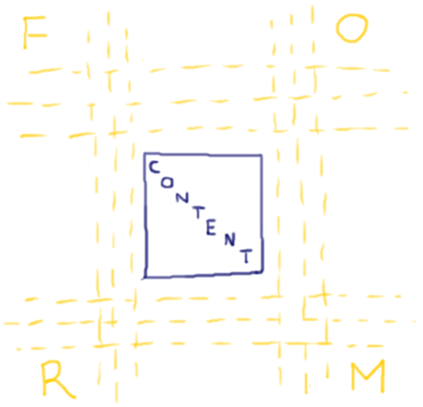
    Understanding change is a very difficult task. No aspect of our world, either experienced outwardly through our senses or inwardly through our feelings and thoughts, seems exempt from the paradoxical rule that the only constant is change. It is possible to examine the way change occurs at many levels. At the “lowest” level of examining change, we generally tend to focus on what can be called the “content.” The particular identified content (we’ll see in a minute why it is important to note that this content is “identified”) depends upon the arena in which the transformation is being studied. Generally, however, the content is the “thing” that is undergoing change, and is usually the overt focus of our attention. For example, in a chemical situation, the content would be the physical elements, such as hydrogen and oxygen in electrolysis. In a therapeutic setting, the “thing” might be one’s thoughts and feelings (in psychology), one’s bones (in chiropractics), or a family system (in family therapy).

    The content level is always present; it is always a part of the way that we encounter change. Yet in addition to looking at the content-level, we can also examine change in a different way: we can examine patterns of change. That is, we can place our attention on the way that changes in content unfold, and seek to identify similarities and differences in such patterns in order to get a deeper understanding of the “rules” that inform what happens at the content level. Paying attention to this level of change is paying attention to the process of change, rather than just its results.

    Form and Content

    This way of examining change takes place one level removed from the content level, and can thus be understood as a “higher” level. It is more abstract than the first, and because it provides the contextual rules that inform the unfolding of the processes as they appear at the content level, we can call this second level that of “Form”, or even better, “Forming”. This is spelled with a capital “F” to distinguish it from “form”, in the sense of a static outer shape or configuration. A given quadrilateral has a definite individual form, and there are an infinite number of quadrilaterals, such as the square and trapezoid. But every possible quadrilateral shares the same Form. This is the same relation between a set and an element in formal logic. The Form is a way of indicating (more…)

  • An Esoteric Guide to Spencer Brown’s Laws of Form #6

    An Esoteric Guide to Spencer Brown’s Laws of Form #6

    (New readers will want to start with the first installment.)

    We ended the last installment by discussing the esoteric nature of the injunction.  We continue this exploration, and bring this series to a close.

    LoF p. 81

    • In the command “let the crossing be to the state indicated by the token” we at once make the token doubly meaningful, first as an instruction to cross, secondly as an indicator (and thus a name) of where the crossing has taken us. It was an open question, before obeying this command, whether the token would carry an indication at all. But the command determines without ambiguity the state to which the crossing is made and thus, without ambiguity, the indication which the token will henceforth carry.

    This re-affirms that the mark has both a first and second-order character: it names the state of its content (its indication), and it is an instruction (its injunction) to mark that name, to make that distinction which yields that state. Thus every mark is both an indication and an injunction.  It is an indication of a content and an injunction on how to get there.

    LoF p. 82

    • We may consider how far, in ordinary life, we must observe the spirit rather than the letter of an injunction, and must develop the habitual capacity to interpret any injunction we receive by screening it against other indications of what we ought to do. In mathematics we have to unlearn this habit in favour of accepting an injunction literally and at once. This is why an author of mathematics must take such great pains to make his injunctions mutually permissive. Otherwise these pains, which rightly rest with the author, will fall with sickening import upon the reader, who, by virtue of his relationship with respect to the author, may be in no position to accept them.)

    All this actually relates to the task of the esoteric teacher, who (more…)

  • An Esoteric Guide to Spencer Brown’s Laws of Form #5

    An Esoteric Guide to Spencer Brown’s Laws of Form #5

    (New readers will want to start with the first installment.)

    We ended the last installment with a recognition that the Laws of Form naturally led GSB to an understanding of both the necessity and importance of the realm of imaginary numbers.  We will continue this elaboration.

    You are likely familiar with the paradoxical sentence: “This sentence is false.”  Is it false or true?  The answer is yes, and it depends on when you ask me.  It was this kind of paradox that drove Russell and Whitehead into creating their Theory of Logical Types, which was designed specifically to prevent this kind of thing from simply ever coming up in the first place.  GSB is not so limited, and understands the importance of formally including paradox in his calculus.  So how does he deal with this?

    He points out that we are driven to a higher order of logic, one that includes re-entry. In the first Esalen lecture, GSB states that (more…)

  • An Esoteric Guide to Spencer Brown’s Laws of Form #4

    An Esoteric Guide to Spencer Brown’s Laws of Form #4

    (New readers will want to start with the first installment.)

    We ended the last installment having come to realize something of the esoteric significance of the taijitu, or yin-yang, form, in something of an extended tangent. We return now to the text.

    GSB himself seemed to understand the importance of the Laws of Form, even if there were some of these more subtle specifics which were not apparent to him (or at least which he did not explicitly recognize).  Having reached this point (literally we are still on page 1 of LoF), the vast majority of the rest of the work in LoF is seen to be secondary.  Yet there are many valuable indications which deserve connection to esoteric principles, and the point of this exploration is to show that such connections are not arbitrary. So, to return to the actual content of LoF now, after this long but foundational detour, we can note that he says:

    LoF p. 5

    • Let any token [of the mark] be intended as an instruction to cross the boundary of the first distinction.

    That is, every mark is an invitation to cross it; every distinction is a call to make that distinction, not to simply point it out, but also to DO it, to MAKE the distinction.  In other words, the whole thing is ACTIVE, not passive, it is not descriptive but PRESCRIPTIVE.  Of course, the esoteric significance of this should be obvious, because precisely what distinguishes esoteric work from, say, philosophy or other disciplines, is (more…)

  • An Esoteric Guide to Spencer Brown’s Laws of Form #1

    An Esoteric Guide to Spencer Brown’s Laws of Form #1

    (A full PDF of this article can be had here.)

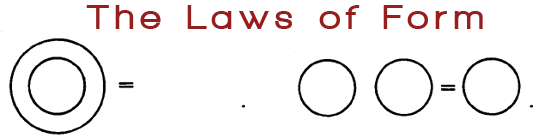
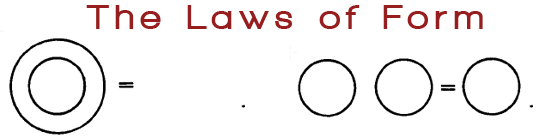
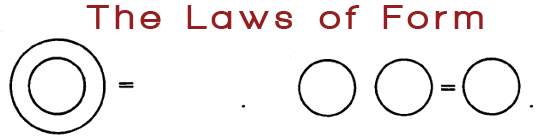
    George Spencer Brown (in his spirit, I would like to say: “Let George Spencer Brown = GSB”), a logician, engineer, and teacher, wrote a curious little book called Laws of Form, that inspired countless interesting people of widely varying backgrounds.  The book is not a book of mathematics, nor is it a book of logic, although if you were to read it this is likely what you’d say.  It is, rather, an attempt to enact something prior to both.  Indeed, GSB feels that his work actually forms (meaning both “is” and “shapes”) “the basic forms [same double-meaning] underlying linguistic, mathematical, physical, and biological science” (p. v of the 1972 edition).

    If you haven’t read Laws of Form (LoF), I quite recommend it, and it is actually quite short.  Even if you don’t want to follow along with the meaty theorems and proofs, the prose and context is definitely worth chewing on.  What is fascinating to me is that the work can also be read with an esoteric eye, which is to say, with a sensitivity to the form and nature of spiritual experiences.  This is not at all a departure from what GSB intended: in his other works he quite openly discusses this connection (see Only Two Can Play This Game published under his pen name, James Keys).  Even in LoF he prefaces the preface with this quote from Blake:

    “Tho’ obscur’d, this is the form of the Angelic land.”

    So what I would like to do is to show that within the LoF are a number of coherent relations to principles that are rightly considered esoteric: they are (more…)

  • Chaos theory and fractals: 1/4

    Chaos theory and fractals: 1/4

    The following four questions (one per post) were posed in a recent class. My edited responses follow.

    1. So I understand that any shape in nature can be converted to a mathematical formula, right? Then you take that formula and plug in the variable related to that shape and feed the answer into the variable spot in the next equation, continuing that as many times as one wants (with potential infinite number of times).   Here is where I get stuck.  Does each answer produce a smaller version of the original shape or does the answer produce the snowflake-like shape of the whole, complex, product?

    We do not know how to find mathematical functions for every shape in nature; indeed this is still an area of active research.  Usually we can model (i.e. approximate) natural shapes with mathematical functions, but nature is a little more slippery and variable than the stark purity of mathematics proper, so we don’t get exact results.  This isn’t usually a problem, however, because the whole point is that we can occasionally find mathematical functions that provide something of the… essence of the form.

    For example your lungs are fractal in nature, branching and branching and branching… but they don’t do it in only one way.  Rather, they have different ‘stages’ of branching, each with a different ‘fractal dimension’, depending on how many previous branches lie before it (I can explain what a fractal dimension is if you wish in another post).  (Read a single page about this from the Cellular and Molecular Life Sciences journal – slightly technical but you can probably get the basic idea through a different lens, which is always useful: http://www.springerlink.com/content/q103206u70402617/)

    But to answer the question directly re: “each answer…”,  most fractals both occur and are described by the taking of a single set of relations (it may be a shape), and repeating that relation/shape on different scales, with rotations, translations (moving without rotating), etc.  In other words, you start with a thing and then put it through some sort of process, then take the new whole that results and do the same process to it again, and so forth.  What is interesting is that a pattern emerges out of the process… and the process is primary, NOT THE THING.  In fact, you can take ANY shape, and subject it to a specific process over and over, and you will get the SAME fractal form, regardless of the original shape.  So each iteration (“each answer”) is a further unfolding of the process, a more ‘detailed’ rendering of the pattern inherent in the unfolding of the process.

    So it’s not just a question of “smaller versions” or of reproductions of the “whole”; the pattern that defines the particular fractal is really the expression of an infinite process (usually based on some pretty simple and limited rules, like “rotate 36 degrees counter-clockwise and scale by a factor of 1/2”), which can be “reversed” (rotate 36 degrees clockwise and scale by a factor of 2) – so size has nothing to do with it, and you can start anywhere in the process with whatever you have, because the thing isn’t ‘the thing’ if you know what I mean: ‘the thing’ is the process.  This is very good for nature because nature can take whatever is there and do some pretty simple things and get some very complicated results.  It doesn’t have to start with a ‘grand plan’ that requires everything to be exact and fit in just the right way in order for it to ‘work’, but can just take whatever is there and MESS AROUND.  This isn’t the whole story but I’m just trying to relate this to fractals specifically.