It's Elemental

Tag: Logic

  • Embracing the paradox of Being: A relational view of epistemology, ontology, logic and difference.

    Embracing the paradox of Being: A relational view of epistemology, ontology, logic and difference.

    Let’s get right to it, shall we?

    With respect to ontology, let us say that there is no “it,” no independent reality that is exclusive of the observer.  This is a basic insight from second-order cybernetics: the observer must always be included in the observed.  Despite this, of course, we do have much talk and thinking about “it” that does not take the observer into account—we are very interested in the “what” of the universe, but have a fairly difficult time illuminating our own nature.  But this is okay, because ultimately the talk about “it,” the pointing to “it,” (not the thought of the “it” itself) is more fundamental to “it” than anything else, because it is the relations that are primary.  We can say that thingness is a subset of relatedness.  Following Eugene Gendlin’s (1997, p. 22) process-concept of “interaction-first,” we can conceive of relations not as forming between two already-existing “things,” but rather as being recursively self-generated between other relations.  In this sense, things are the precipitate of relations, a hardening out of a more fluid state.
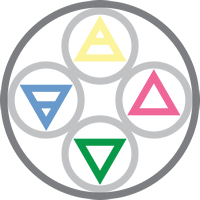
    Elemental Cycle

    Going further than Gendlin, we can take a cue from the process-language of alchemy (Miller, 2008) to see how relations themselves are a precipitate of the tension between complementarily opposing potentials, made by a distinction out of the whole.  This corresponds to the recursive ontological alchemical sequencing of the elements from Fire (the whole) to Air (polarity) to Water (relation) to Earth (thing), to Fire (a new, transformed whole).  Relations are to opposing potentials of a distinction as things are to relations.  Opposing potentials are themselves a precipitate of the whole by virtue of distinction (of Fire by Fire), and work alongside each other within the whole simultaneously.  Each step from the whole is a kind of step-down transformation; ontologically we could say that beginning with level N, we move to level N-1.  Each level is pulled out of simultaneity by an act of distinction within the whole, of the whole, by the whole.  A cascading of levels of distinction thus yields the ontology of “things.” (more…)
  • Form and content – two levels of change

    Form and content – two levels of change

    Form and Content

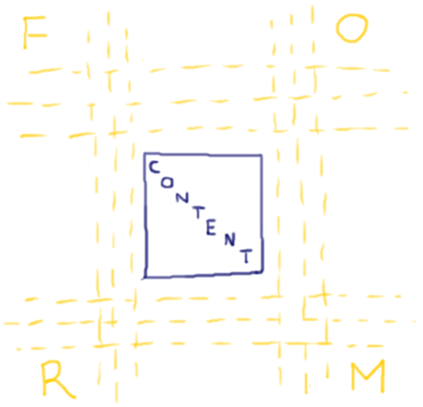
    Understanding change is a very difficult task. No aspect of our world, either experienced outwardly through our senses or inwardly through our feelings and thoughts, seems exempt from the paradoxical rule that the only constant is change. It is possible to examine the way change occurs at many levels. At the “lowest” level of examining change, we generally tend to focus on what can be called the “content.” The particular identified content (we’ll see in a minute why it is important to note that this content is “identified”) depends upon the arena in which the transformation is being studied. Generally, however, the content is the “thing” that is undergoing change, and is usually the overt focus of our attention. For example, in a chemical situation, the content would be the physical elements, such as hydrogen and oxygen in electrolysis. In a therapeutic setting, the “thing” might be one’s thoughts and feelings (in psychology), one’s bones (in chiropractics), or a family system (in family therapy).

    The content level is always present; it is always a part of the way that we encounter change. Yet in addition to looking at the content-level, we can also examine change in a different way: we can examine patterns of change. That is, we can place our attention on the way that changes in content unfold, and seek to identify similarities and differences in such patterns in order to get a deeper understanding of the “rules” that inform what happens at the content level. Paying attention to this level of change is paying attention to the process of change, rather than just its results.

    Form and Content

    This way of examining change takes place one level removed from the content level, and can thus be understood as a “higher” level. It is more abstract than the first, and because it provides the contextual rules that inform the unfolding of the processes as they appear at the content level, we can call this second level that of “Form”, or even better, “Forming”. This is spelled with a capital “F” to distinguish it from “form”, in the sense of a static outer shape or configuration. A given quadrilateral has a definite individual form, and there are an infinite number of quadrilaterals, such as the square and trapezoid. But every possible quadrilateral shares the same Form. This is the same relation between a set and an element in formal logic. The Form is a way of indicating (more…)

  • An Esoteric Guide to Spencer Brown’s Laws of Form #5

    An Esoteric Guide to Spencer Brown’s Laws of Form #5

    (New readers will want to start with the first installment.)

    We ended the last installment with a recognition that the Laws of Form naturally led GSB to an understanding of both the necessity and importance of the realm of imaginary numbers.  We will continue this elaboration.

    You are likely familiar with the paradoxical sentence: “This sentence is false.”  Is it false or true?  The answer is yes, and it depends on when you ask me.  It was this kind of paradox that drove Russell and Whitehead into creating their Theory of Logical Types, which was designed specifically to prevent this kind of thing from simply ever coming up in the first place.  GSB is not so limited, and understands the importance of formally including paradox in his calculus.  So how does he deal with this?

    He points out that we are driven to a higher order of logic, one that includes re-entry. In the first Esalen lecture, GSB states that (more…)

  • An Esoteric Guide to Spencer Brown’s Laws of Form #3

    An Esoteric Guide to Spencer Brown’s Laws of Form #3

    (New readers will want to start with the first installment.)

    We ended the last installment noting that the first distinction must be of distinction, but this must be considered as a complex, recursive creation and simultaneous crossing of a boundary that is just precisely the boundary between that very activity of its creation and the fact of it as created.

    To get at this another way, we can point out that the Glanville has actually hit on elements in this direction already, but (it seems) hasn’t quite put it together in the same way.  Remember that the whole time we have been talking about the first distinction we are also talking about “the observer”, which we could call a “self”.  It may even be worth revisiting some of the above text with that implicit translation in mind.  I remind you of this because, Glanville, in his essay The Self and the Other: The Purpose of Distinction, is exploring solutions to the problem of infinite regression that arise when the mark doesn’t distinguish itself from its value, and he uses “self” and “other” to hold the logic of “mark” and “value”, which is perfectly fine.

    Glanville notes that we have a set of relations that are implicit in each other: that between self and other: “the fundamental distinction between self and other [read: between the mark and its value] cannot be more fundamental than the distinction of the self, nor can it be less so: another circularity, another reduction of hierarchy” (p. 3).

    Except that this isn’t a reduction of hierarchy. It is actually (more…)

  • An Esoteric Guide to Spencer Brown’s Laws of Form #1

    An Esoteric Guide to Spencer Brown’s Laws of Form #1

    (A full PDF of this article can be had here.)

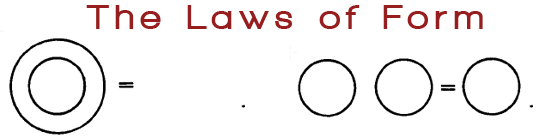
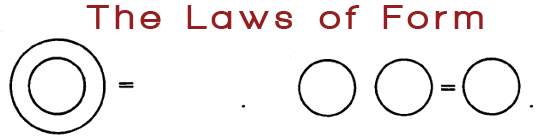
    George Spencer Brown (in his spirit, I would like to say: “Let George Spencer Brown = GSB”), a logician, engineer, and teacher, wrote a curious little book called Laws of Form, that inspired countless interesting people of widely varying backgrounds.  The book is not a book of mathematics, nor is it a book of logic, although if you were to read it this is likely what you’d say.  It is, rather, an attempt to enact something prior to both.  Indeed, GSB feels that his work actually forms (meaning both “is” and “shapes”) “the basic forms [same double-meaning] underlying linguistic, mathematical, physical, and biological science” (p. v of the 1972 edition).

    If you haven’t read Laws of Form (LoF), I quite recommend it, and it is actually quite short.  Even if you don’t want to follow along with the meaty theorems and proofs, the prose and context is definitely worth chewing on.  What is fascinating to me is that the work can also be read with an esoteric eye, which is to say, with a sensitivity to the form and nature of spiritual experiences.  This is not at all a departure from what GSB intended: in his other works he quite openly discusses this connection (see Only Two Can Play This Game published under his pen name, James Keys).  Even in LoF he prefaces the preface with this quote from Blake:

    “Tho’ obscur’d, this is the form of the Angelic land.”

    So what I would like to do is to show that within the LoF are a number of coherent relations to principles that are rightly considered esoteric: they are (more…)