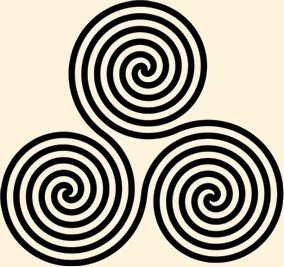
There is a necessary recursion at the very heart of epistemology. Epistemology can never be founded upon a principle of linearity, where thinking traces its origin to something that lies before thinking, and somehow emerges or grows out of it, because the very existence of this “before”, whatever its nature, must always be assumed BY THINKING itself, as a distinction within thinking.
Therefore, the only proper starting point for an epistemology is the fundamental distinction OF distinction itself, by thinking FOR thinking, which constitutes the basis of all further distinction, and is implicit in it. The fundament of epistemology must be the recursive distinction of distinction. The nature of this self-distinction (distinction of distinction by distiction) is implicitly infinitely recursive, and identifies the very nature of thinking to be at its root one of distinction. Its implicit infinitude is a key aspect of thinking’s foundation, with definite consequences. It means that thinking is fundamentally (not secondarily) FREE: its potential to distinguish is unlimited. There is nothing that lies outside of thinking’s potential.
The consequences of this are more than epistemological, they are ontological. Thinking, infinite in its potential, is (more…)