It's Elemental

Tag: Interaction

  • Object and Process oriented languages and human development

    (Note, the Blackfoot people have a process-oriented language, which is much more strongly verb-based, while English and most other languages are object/noun based.)

    Blackfoot Indian Brave
    Blackfoot Indian Brave

    A friend of mine asked:

    Do the Blackfoot people go through a phase where they need to have conceptual boxes, and then learn to transcend the need to reify these artificial demarcations, or do they simply use a different process all together from the very start? So much of western development theory assumes that moving beyond nice neat conceptions is a phase that we can move beyond, but assumes it is a necessary phase; perhaps it is only necessary for those who are raised to think in a linear fashion?

    Which prompted the following response:

    I have this feeling that on a macrocosmic scale, humanity does have to “go through” a stage of categorical reification and abstraction in order to develop certain potentials relating to our “task” if you will, of becoming beings of freedom and love.  However, this doesn’t mean that every single human being has to do this, or in the same way (ex: the West has played such a huge role in this particular part of the human drama, while other areas have different things to bring to the play).

    I imagine that it would be possible to ‘use different processes from the start’, and while there will be similarities in developmental stages, these won’t always match up exactly depending upon what is being brought forth by the language, culture, and individual elements, and so forth.  It’s not like a Blackfoot can’t identify ‘a chair’ if they don’t want to… it’s just that doing so is a reduction or rather abstraction from a different way of understanding, just like if I were to reduce you to a particular image I had of you that came from one specific interaction, and then communicated only this aspect of you when I spoke about you to others or thought of you myself.

    Both the ‘objective’ or reified view of we weirdo Westerners, AND the process or time-sensitive view of people like the Blackfoot are ‘correct’.  The question is more, to me, about the overall appropriateness of each view given microcosmic and macrocosmic pictures of individual and collective development.  Sometimes, identifying “this chair” as a completely abstracted and separate, non-evolving object is appropriate.  Sometimes, seeing the flow of events that entwine themselves into the constantly becoming activity and relations that make up the chair through time is more appropriate.

    BUT, the imporant thing is that we develop the capacity to have both these (and other) options open to us, so we aren’t locked in by our habits of perception.  We — humanity as a whole — has won the capacity to objectify the world through a long and arduous and pain-filled path.  It is something that we shouldn’t abandon — rather we need to learn how to use this capacity responsibly, ultimately in service to the development of our freedom to become beings who can love not by virtue of a given nature (this would describe an angel), but through what has come to us only by virtue of the path we have walked, i.e. in freedom.

    Of course, this just a picture, a way to imagine.

  • Social Networking and Consciousness

    I would like to say that the quite frankly astonishing rise of social-networking tools clearly points to an unmet need in the ‘wired’ populace at large.  We increasingly live in a fragmented society, where our friends and family are scattered across the globe.  Many of use no longer, for economic, personal, or many other reasons, choose to live in the same place for our entire lives, where we could build up a local network of family and friends.  And even if we do so, the demands of modern life and our cultural habits tend to erode (it seems) many opportunities for face-to-face gatherings over a long time period; such things now require real effort and are not a de facto part of everyday life.

    So it seems that a way of assuaging the erosion of the human need for contact, and just as importantly, a context within which such contact can be meaningful, can be found through the social networking tools.  These tools are not designed, and cannot really take the place of repeated face-to-face interactions, but what they DO provide is a way to ‘keep the door open’ to people who you might otherwise lose track of or only communicate with very rarely.  By having, for example, a Facebook page, you put yourself in a position of taking moments out of your day to have a conscious connection with people who would otherwise likely not enter your thoughts that day.  The immediacy and digital ‘nearness’ provided by the technologies allows for and creates a different kind of interaction than has heretofore been possible on the planet.  On the one hand, these technologies constrict certain kinds of communication; but it opens up others at the same time, and allows a thread of connection that can later be followed up by a more present, face-to-face, or otherwise soul-ful type of communication.

    This is something of the positive side of these tools, but they can also be used for pure ego-stroking, for bullying, for economic reductionism, etc.  Such is the way of any tool.  For me it’s always a question of how the tool is used, and I am convinced that humans have the power to make tools like this (and other technologies) work in a positive way for the benefit of themselves and the planet.

    It’s true: there is no substitute for real face-time.  I would simply point out that Facebook and such tools are NOT actually substituting for face-time.  In fact, the reverse might be true: the immediacy and ubiquity of social networking tools may actually increase the potential for two or more people to get together IRL (in real life)–there must be a study on this somewhere… if not, any takers?

    My feeling is that the use of such tools lessens both perceived and actual gaps between individuals, while also allowing individuals to discover more potential relationships that might otherwise be missed.  Increasingly human beings are going to have to learn how to deal with the instant availability of essentially infinite data.  In the pre-wired-era, the available data was restricted to your immediate sensory neighborhood, and you had no choice about this, notwithstanding the influence of books and letters.  Now, we have a choice, and can access a whole variety of types and fields of information literally out of thin air.  It opens up a whole different set of possibilities for human creativity and interaction….

    But obviously I’m not yet giving a well-rounded picture.  I should also point out that the way that these technologies lead human consciousness around may be problematic in a number of ways, and the identification and harmonizing of these regressive or sclerotic tendencies should be addressed up front.  But to speak of these would require an even longer discussion — one including talk about the inner life of the soul.

    Below:  a diagram depicting connections between a single user’s Facebook friends.

    my facebook friends

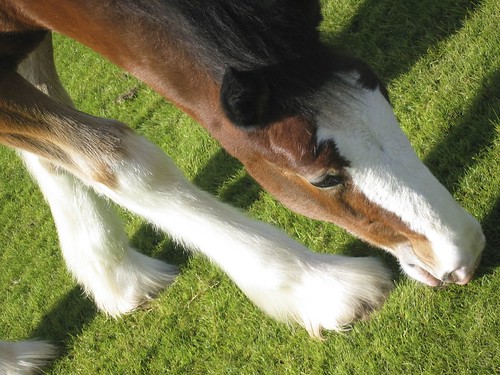
  • horse –> herd –> cybernetics


    A friend of mine said:

    “… Concerning self-correction, can we say that the system corrects itself toward a state of homeostasis (feedback—-correction—-goal) OR toward maintaining the integrity of the closed system? Is it o.k. to look at this in terms of homeostasis?  

    Reason why I’m asking is that I’ve been looking at the socialization behavior of horses in the herd, and how they “process” emotions. The processing looks very much like a feedback loop with a self-correcting mechanism – I see it as an infinity symbol.  The interaction produces an action which takes the herd back to a state of “stability” or I call it homeostasis.  

    Anyway, this was a good experience for me because I read in that way – when I don’t get something I have a piece of paper and I draw to try to put the words into some visual.”

    I said:

    In the obvious case of the thermostat, there is a ‘goal’ – a temperature that is set by the second-order system (the human being).  But now with horses you get something more obviously complexificated (i like coining ridiculous words).  The horse is a system, the herd another, the environment another, and perhaps even another may be the system of “Horse” (i.e. ALL horses) thought about over a vast time period (that is, thinking about time from a second-order perspective – i think).

    In this case, when we want to talk about homeostasis, what variables are tending towards sameness?  If there are closed systems within closed systems within closed systems (as mitochondria are closed systems within each cell, which is another closed system…), then do we need to speak of a goal for each closed system?  And is there only one goal per system (as in the thermostat), or can there be multiple goals which overlap from system to system?  Or even multiple conflicting goals within a single system?  Or is this not even possible from an cybernetic standpoint… or would it just be a double bind?  Can you create a thermostat which simultaneously is tending towards TWO temperatures?  How would it behave – oscillate in some frequency set by the speed of the feedback loops? Tend towards some intermediate value? Runaway?

    Maybe symbiosis (which is an interesting concept to think about cybernetically) is the holding of multiple goals, one of which at least overlaps with another system?  I’m just spitballing here.

    Individual horse behavior —> herd qualities —> individual horse behavior (your infinity sign)

    So if you can detect the processing of emotion in an individual horse, do you see also a higher-order processing of emotion that does NOT take place at the individual horse level but ONLY at the herd level?  Is this a distinct process?  Or is the herd’s processing so completely bound up with the individual horse’s processing that it is impossible to tell apart?  

    20060107-120_2015