A response to the question: “How is chaos theory non-determinant?”
This is an interesting question, because I think it might normally be asked in the opposite way: “How is chaos theory DETERMINANT?”, because chaos theory is, well, chaotic, so it seems more logical to connect chaos with non-determinancy than with determinancy.
So to explore the question that wasn’t really asked:
The techniques which we have discovered that allow us to analyze systems that exhibit chaotic behavior are completely deterministic: they are mathematical in nature, having the feature of acting like an Ouroboros, where the output becomes the input in a recursive cycle. We can start with even very very simple systems, and show how chaotic behavior results when the system evolves, when that system’s evolution takes place in ways describable by this type of recursive mathematics (not all systems are so describable). Really the MATH isn’t the thing here, it’s rather the RECURSIVE PROCESS, RULE, or PROTOCOL that is important. The math is just a really nice and clean way of expressing the essence of what happens when a system evolves by following a recursive rule.
 So chaos THEORY is determinant in that the rules which it utilizes to describe evolving systems have the potential to be calculated EXACTLY from iteration to iteration. In other words, if we had a computer that could deal with an infinite number of digits we could theoretically pinpoint the next iteration describing the state of a system at the next moment with complete precision. BUT, there are serious caveats to this when applied to anything beyond the purely mathematical formulations themselves. REAL systems may be more or less calculable, more or less complex, and more or less willing to submit to the precision capable in theory. The determinacy of chaos theory is therefore more like a theoretical determinacy, having a dubious ontological status. I won’t get into the very crazy and amazing philosophical arguments that whirl around such things, to your immense relief. Suffice it to say that THE WORLD IS MYSTERIOUS, and we have to be careful when dealing with the connection between our thinking and our observing.
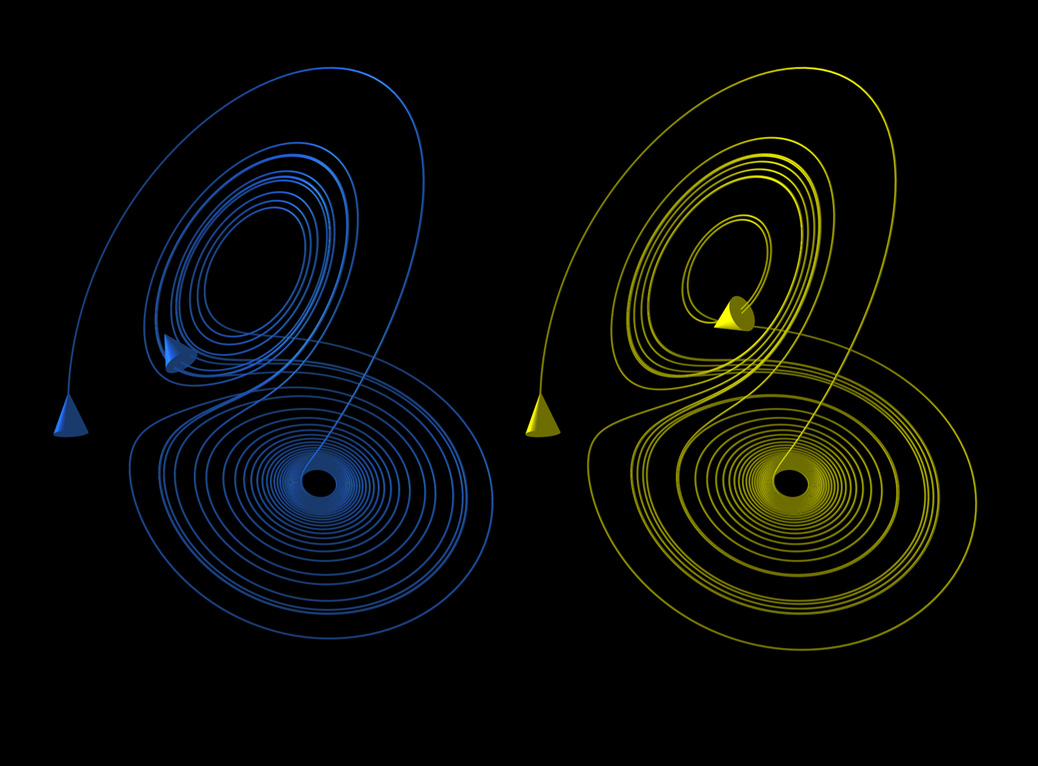
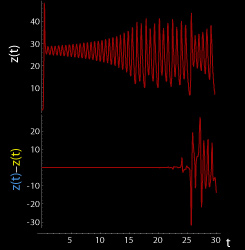
The ‘problem’ with chaos theory is that we can’t observe closely enough to know where to START our calculations, so we ALWAYS know that they are ‘wrong’ when dealing with the actual observable world. This is that ‘sensitive dependence upon initial conditions’ thing again: there is no lower limit at which a difference does not potentially make a difference, even ALL the difference. In other words, even the smallest possible change cannot be ignored. The thing is that we can never know ahead of time when such a difference may be either influential or inconsequential – we have to let the system evolve in actuality in order to find out. We can’t calculate the future states of the system (which are theoretically determined!) with much success because (depending upon the system’s complexity and initial state) as soon as we get a few iterations under our belts our calculations tend to diverge from other initial states that were infinitesimally close to the one we are actually calculating. So our results tend to be so far off from what we will later actually observe that we start calling the whole thing a theory of CHAOS, even though every step in the process is ‘determined’; hence “deterministic chaos”. So even today a large bulk of weather predictions are based not off of complex theories of high pressure and low pressure zones, temperature gradients, moisture content, and such, but rather simply off of a comparison with past ACTUALITIES. Predictions START with a comparison of the averages for a particular place for that same day in previous years, because this is often a better predictor than if we were to try and start with vastly incomplete current data. The best predictions, of course, blend the two methods, but you’ll notice that nobody (okay, this isn’t true, but such people have completely different methods for prediction) is giving weather predictions much beyond a week or two at best. This isn’t just a fault of our weather theory, but is a consequence of the RECURSIVE NATURE OF NATURE.
So what is interesting is that our understandings from quantum physics put us in the strange position of having to admit that WE CAN NEVER HAVE PERFECT KNOWLEDGE of the state of any system – no matter how simple. So we can’t even hold on to some ‘theoretical’ exactness that would be possible if only we had better instruments, or more complete observations. THERE IS NO SUCH THING AS A COMPLETE OBSERVATION — at least in the sense of what had been the promise and holy grail of physics before the s**t hit the fan with relativity, quantum mechanics, Gödel, and chaos theory. It turns out we live in a dirty universe, which is much more crazy and mysterious than we had imagined or hoped.
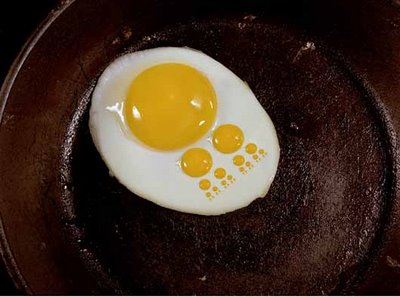
But what is key here is that chaos is not a result of linear progressions, but is more or less inherent (in systems with almost any level of complexity) when the Ouroboros steps in and finds its tail: recursion yields chaos. I find this fascinating, because so many (all?) parts of the natural world utilize recursion as a technique — particularly in the living realm, but even in the purely mineral realm as well. Whenever nature comes up with a new process it tends to repeat itself if the conditions allow it. This repetition can easily become recursive, where some aspect of the process acts upon or is acted upon by some other aspect of the process. When this happens you usually either get a complete breakdown or cessation of the process (a sort of suicide process, sometimes through growth), or you get emergent complexity, homeodynamic systems, self-regulating organization, and the basis for higher-level recursions.
At the same time, every recursive process is — although perhaps potentially infinite — embedded in a contextual situation that provides limits and boundaries to the system’s evolution. Sometimes it happens via a law of physics, sometimes as a consequence of mathematical relations in the context of physical laws (as in the increase in volume with the cube and the surface area with the square), and sometimes it’s just the seemingly contingent facts of context (it doesn’t rain that year, the food runs out, the salinity changes slightly, and so forth). The point is that these contextual limitations are not usually a part of the chaotic models proper. Rather, the chaotic models become themselves modified by through a corresponding synthetic analysis of contextual facts. The Mandelbrot fractal is what it is because it does not have to evolve in the context of anything REAL; it is an ideal form through and through. This is why we only find approximate fractals in nature, forms which approach the self-similar repetition of mathematical models. But rather than say that nature’s forms approximate mathematical laws, maybe we should say that our mathematical laws approximate nature’s forms. Maybe the laws we use to think about these forms are one of the ways that nature involves itself in a sort of grand recursion; the mathematical laws are like a high-level iteration of a process which at a lower level is much more messy and dynamic, but now has the benefit of taking place completely within the consciousness of a human being, thus allowing it to reach a new level of emergent complexity, i.e. the laws of emergent complexity themselves.