It's Elemental

Tag: Image

  • Universal developmental stages? – A continuation

    A friend continued:

    Does this mean there is no universal developmental stages that we each pass through simply due to the fact that we are all human? What are the underlying strata, the ground upon which both these explicate perspectives emerge? What is the implicate order regarding human development?

    Prompting the response:

    As for universal developmental stages… yes and no.  I guess I would point to the process of recapitulation.  You, as a physical being, go through stages in development which are a unique recapitulation of stages that have individually been achieved over vast timescales.  But, as modern beings, because what was achieved so long ago by (or rather ‘with’ and ‘through’) our ancestors (going ALL the way back, here) no longer requires the same kind of attention that it did when the developments were being worked out, we speed through these stages without any cognizance.  We also don’t have to experience the full drama of the development of those stages; we only get something like the form of an image of those stages, more like a hint or better a ‘gesture’ of those past stages.  The result is that instead of, say, having to develop anew the ability to breath air from scratch, we simply find ourselves with a capacity for breathing.

    The particular capacities we are thus ‘given’ are not “universal” in the absolute sense that ALL beings do this.  But it is close to universal when considering humans.  We are the ongoing unfolding of our past — all of our past.  And some capacities require more of us now than they will in the future, and others require less of us not than they did in the past.  Thus, we are no longer challenged so much by the development of breathing, but have a more difficult time with upright walking.  It is easier to have a mental picture than it is to dissolve a mental picture into nothing.  It is easy to feel rage, but much more attention is required to feel compassion.  These are tracings of past and future capacities, and we’re constantly in the flow of their development (and there is also a process of dissolution of capacities… but we’ll not go into that). 

    Physical Recapitulation
    Physical Recapitulation

    And there are always exceptions.  Some people who are born now are actually working out dramas that the bulk of humanity dealt with eons ago, and others are born who are dealing with developing capacities that the bulk of humanity will likely encounter only in the future.  So it’s not a simple question of everyone being equal.  Diversity is everpresent.

    Additionally, some of the capacities that have been given through our long history are only partially so.  Or rather, their development has only proceeded to a certain stage, beyond which any development or progression depends upon actions taken here and now.  The fulfillment of these capacities is not a given, but requires actual work on our part.  For example the capacity for free ethical action that comes from within the individual; this is not something that just everyone ‘has’ — it requires a certain amount of work.  So too the capacity to perceive accurately in the spiritual worlds requires individual work; it’s not yet capable of being given as an already-developed gift to the whole of humanity (like vision is) because the work required for that is still being done.

    The upshot of all this is that the situation is very complex and intertwined with multiple streams, working from the past and (sorry for sounding weird) from the future.  There is no ‘one-size-fits-all’ when it comes to these things, because we’re constantly dealing with a whole variety of interpenetrating levels and times.  Nevertheless, there are ‘global’ patterns at work, which can be perceived if one knows how to look.  David’s books very directly hint at this.  Also examine Richard Tarnas’ book The Passion of the Western Mind.  These are works in the popular domain which point to the sense of ongoing, non-random, directional development of consciousness and human beings.  (Of course, one could find a much more direct treatment of this aspect if one has the desire to look into more esoteric sources, such as Steiner.)  This is where you start to find a way into the question of the Implicate Order with respect to human development…
  • Organs of Perception

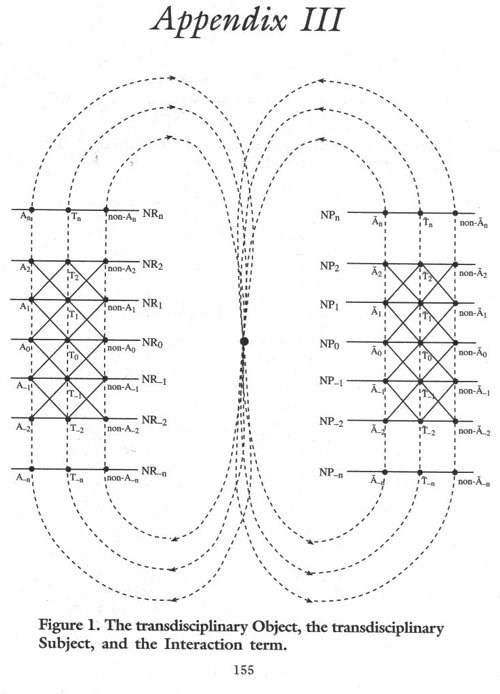
    Basarab Nicolescu is a physicist and proponent of transdisciplinarity.  In the book of the same name (which he edited), he speaks of multiple “levels of Reality”, which are accompanied by multiple “levels of perception”. These two complementary duals form, on the one hand, what he calls the “transdisciplinary object” and on the other the “transdisciplinary subject”.  These are united by a flow of “nonresistance to experience” he calls the sacred, which moves through all the levels.  See the picture from his book below:

    Transcendent Object/Subject and Sacred
    Transcendent Object/Subject and Sacred

    Although this view is a bit schematic, one of the things that Nicloescu includes which is often very lost in modern discussions about these sorts of things is the necessity for a corresponding “level of perception” when encountering various levels of reality.

    Specifically, this is something verifiable in my own experience: that it actually takes not just some kind of intellectual shift to see things from a new perspective, but rather the rhythmic development of new organs of perception in order to perceive new realities.  I’m speaking of ‘organs of perception’ because they are strictly analogous to real organs like our eyes and ears, but without physicality — they are, if you will, organs made ‘on the fly’ in the soul, which are capable of resolving details in a situation that otherwise would be lost.  Their constituency relies entirely upon the way in which they are themselves created — they form in the image of what they can thus perceive.  For example, a Waldorf teacher I know has developed in her contemplative work with children a soul-organ which can perceive movements of ‘warmth’ in ways that offer specific and practical information and actions regarding individuals — this is something experienced as eminently real and subtle, which would be lost on anyone who hadn’t done the same rhythmic work to create the relevant capacity for experience to hold that kind of perception.

    It seems we often expect that such perceptions should be contingent upon a primarily intellectual shift in understanding — and an understanding of outer phenomena in particular — as if it were only a question of having the right ideas about things that would allow us to perceive newly.  I think this is an error;  that kind of change is only preparation and accompaniment, but cannot fully constitute the necessary basis for actual perception of new realms.

  • on destruction

    The role of destruction, and of the working out of polarities, is a subject that has been dealt with an the alchemical tradition for a very long time.  Alchemically, it is understood that the issue you are dealing with, in which you find yourself (the prima materia) MUST go through a process of putrefaction, of fermentation… the individual elements cannot by themselves produce a work of lasting value (a Great Work), but must be destroyed in order to be refined.  The refined elements then have the capacity to ‘marry’ the other elements to form a higher, more integrated, more complex and simple unity which ennobles and embodies the transformation of the worst parts of ‘the matter’.

    All diagnoses are misdiagnoses because they stay at the level of the overt fact, and do not take into account the necessary inclusion of relationshipreversal, and the whole.  The image of the fireweed and the pinecone are examples in nature of the aspect of the Fire element in which destruction is required for new life.  In this sense, the destruction is viewed not as a negative process but as a transformative one, in which the potentials of the lower state are realizable only through their passing away, and indeed, it is their very passing away which creates the space (Air element) into which the potential new state can flow, because room is made for it.

    The same pattern occurs in the human being all the time – we do not transform without the heat of the Fire, also known as the Will – but not a will directed towards a specific absolute (an Earth), but what is known as an ‘open will’, which is just the part which maintains itself by transforming itself through its own death into a new state…

    20050601-img_3750