It's Elemental

Tag: Fundamental Distinction

  • An Esoteric Guide to Spencer Brown’s Laws of Form #3

    An Esoteric Guide to Spencer Brown’s Laws of Form #3

    (New readers will want to start with the first installment.)

    We ended the last installment noting that the first distinction must be of distinction, but this must be considered as a complex, recursive creation and simultaneous crossing of a boundary that is just precisely the boundary between that very activity of its creation and the fact of it as created.

    To get at this another way, we can point out that the Glanville has actually hit on elements in this direction already, but (it seems) hasn’t quite put it together in the same way.  Remember that the whole time we have been talking about the first distinction we are also talking about “the observer”, which we could call a “self”.  It may even be worth revisiting some of the above text with that implicit translation in mind.  I remind you of this because, Glanville, in his essay The Self and the Other: The Purpose of Distinction, is exploring solutions to the problem of infinite regression that arise when the mark doesn’t distinguish itself from its value, and he uses “self” and “other” to hold the logic of “mark” and “value”, which is perfectly fine.

    Glanville notes that we have a set of relations that are implicit in each other: that between self and other: “the fundamental distinction between self and other [read: between the mark and its value] cannot be more fundamental than the distinction of the self, nor can it be less so: another circularity, another reduction of hierarchy” (p. 3).

    Except that this isn’t a reduction of hierarchy. It is actually (more…)
  • Notes on the roots of epistemology in recursion

    Notes on the roots of epistemology in recursion

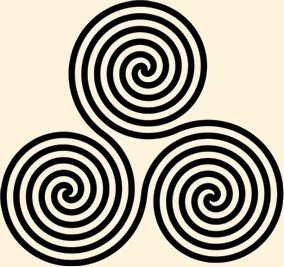
    threefold recursive spiral of knowing
    Unity in distinction, distinction in unity.

    There is a necessary recursion at the very heart of epistemology. Epistemology can never be founded upon a principle of linearity, where thinking traces its origin to something that lies before thinking, and somehow emerges or grows out of it, because the very existence of this “before”, whatever its nature, must always be assumed BY THINKING itself, as a distinction within thinking.

    Therefore, the only proper starting point for an epistemology is the fundamental distinction OF distinction itself, by thinking FOR thinking, which constitutes the basis of all further distinction, and is implicit in it. The fundament of epistemology must be the recursive distinction of distinction. The nature of this self-distinction (distinction of distinction by distiction) is implicitly infinitely recursive, and identifies the very nature of thinking to be at its root one of distinction. Its implicit infinitude is a key aspect of thinking’s foundation, with definite consequences. It means that thinking is fundamentally (not secondarily) FREE: its potential to distinguish is unlimited. There is nothing that lies outside of thinking’s potential.

    The consequences of this are more than epistemological, they are ontological. Thinking, infinite in its potential, is (more…)