It's Elemental

Tag: First Installment

  • An Esoteric Guide to Spencer Brown’s Laws of Form #6

    An Esoteric Guide to Spencer Brown’s Laws of Form #6

    (New readers will want to start with the first installment.)

    We ended the last installment by discussing the esoteric nature of the injunction.  We continue this exploration, and bring this series to a close.

    LoF p. 81

    • In the command “let the crossing be to the state indicated by the token” we at once make the token doubly meaningful, first as an instruction to cross, secondly as an indicator (and thus a name) of where the crossing has taken us. It was an open question, before obeying this command, whether the token would carry an indication at all. But the command determines without ambiguity the state to which the crossing is made and thus, without ambiguity, the indication which the token will henceforth carry.

    This re-affirms that the mark has both a first and second-order character: it names the state of its content (its indication), and it is an instruction (its injunction) to mark that name, to make that distinction which yields that state. Thus every mark is both an indication and an injunction.  It is an indication of a content and an injunction on how to get there.

    LoF p. 82

    • We may consider how far, in ordinary life, we must observe the spirit rather than the letter of an injunction, and must develop the habitual capacity to interpret any injunction we receive by screening it against other indications of what we ought to do. In mathematics we have to unlearn this habit in favour of accepting an injunction literally and at once. This is why an author of mathematics must take such great pains to make his injunctions mutually permissive. Otherwise these pains, which rightly rest with the author, will fall with sickening import upon the reader, who, by virtue of his relationship with respect to the author, may be in no position to accept them.)

    All this actually relates to the task of the esoteric teacher, who (more…)
  • An Esoteric Guide to Spencer Brown’s Laws of Form #5

    An Esoteric Guide to Spencer Brown’s Laws of Form #5

    (New readers will want to start with the first installment.)

    We ended the last installment with a recognition that the Laws of Form naturally led GSB to an understanding of both the necessity and importance of the realm of imaginary numbers.  We will continue this elaboration.

    You are likely familiar with the paradoxical sentence: “This sentence is false.”  Is it false or true?  The answer is yes, and it depends on when you ask me.  It was this kind of paradox that drove Russell and Whitehead into creating their Theory of Logical Types, which was designed specifically to prevent this kind of thing from simply ever coming up in the first place.  GSB is not so limited, and understands the importance of formally including paradox in his calculus.  So how does he deal with this?

    He points out that we are driven to a higher order of logic, one that includes re-entry. In the first Esalen lecture, GSB states that (more…)

  • An Esoteric Guide to Spencer Brown’s Laws of Form #4

    An Esoteric Guide to Spencer Brown’s Laws of Form #4

    (New readers will want to start with the first installment.)

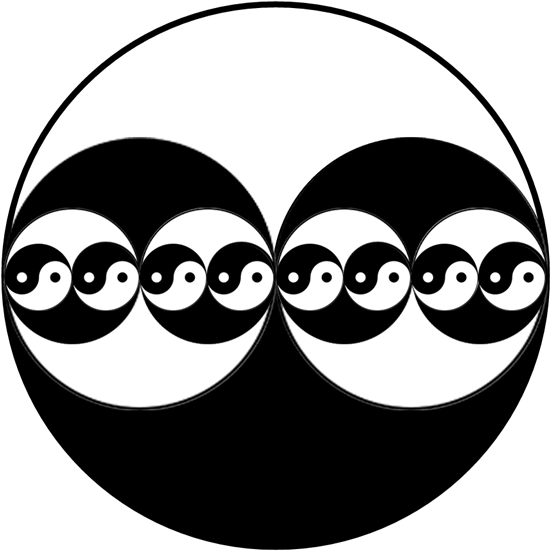
    We ended the last installment having come to realize something of the esoteric significance of the taijitu, or yin-yang, form, in something of an extended tangent. We return now to the text.

    GSB himself seemed to understand the importance of the Laws of Form, even if there were some of these more subtle specifics which were not apparent to him (or at least which he did not explicitly recognize).  Having reached this point (literally we are still on page 1 of LoF), the vast majority of the rest of the work in LoF is seen to be secondary.  Yet there are many valuable indications which deserve connection to esoteric principles, and the point of this exploration is to show that such connections are not arbitrary. So, to return to the actual content of LoF now, after this long but foundational detour, we can note that he says:

    LoF p. 5

    • Let any token [of the mark] be intended as an instruction to cross the boundary of the first distinction.

    That is, every mark is an invitation to cross it; every distinction is a call to make that distinction, not to simply point it out, but also to DO it, to MAKE the distinction.  In other words, the whole thing is ACTIVE, not passive, it is not descriptive but PRESCRIPTIVE.  Of course, the esoteric significance of this should be obvious, because precisely what distinguishes esoteric work from, say, philosophy or other disciplines, is (more…)

  • An Esoteric Guide to Spencer Brown’s Laws of Form #3

    An Esoteric Guide to Spencer Brown’s Laws of Form #3

    (New readers will want to start with the first installment.)

    We ended the last installment noting that the first distinction must be of distinction, but this must be considered as a complex, recursive creation and simultaneous crossing of a boundary that is just precisely the boundary between that very activity of its creation and the fact of it as created.

    To get at this another way, we can point out that the Glanville has actually hit on elements in this direction already, but (it seems) hasn’t quite put it together in the same way.  Remember that the whole time we have been talking about the first distinction we are also talking about “the observer”, which we could call a “self”.  It may even be worth revisiting some of the above text with that implicit translation in mind.  I remind you of this because, Glanville, in his essay The Self and the Other: The Purpose of Distinction, is exploring solutions to the problem of infinite regression that arise when the mark doesn’t distinguish itself from its value, and he uses “self” and “other” to hold the logic of “mark” and “value”, which is perfectly fine.

    Glanville notes that we have a set of relations that are implicit in each other: that between self and other: “the fundamental distinction between self and other [read: between the mark and its value] cannot be more fundamental than the distinction of the self, nor can it be less so: another circularity, another reduction of hierarchy” (p. 3).

    Except that this isn’t a reduction of hierarchy. It is actually (more…)

  • An Esoteric Guide to Spencer Brown’s Laws of Form #2

    An Esoteric Guide to Spencer Brown’s Laws of Form #2

    (New readers will want to start with the first installment.)

    Let us continue our beginning:

    LoF p. 1

    • We take as given the idea of distinction and the idea of indication, and that we cannot make an indication without drawing a distinction. We take, therefore, the form of distinction for the form.

    If this doesn’t strike you as having a “mystical” flavor, then you are drinking the wrong concoction.  I’m not going to try to explain this, but rather I’m going to try to re-frame it; you could say, in GSB-approved language, that I’m going to re-mark it.  The important thing to note about this, the very first “official” sentence of the LoF, is that it is recursive.  Let’s be clear: the Laws of Form (not the book, the LAWS) are only possible because of a recursion, a throwing back on itself of itself.  But a throwing back of what onto itself?

    Well, “nothing”, of course; but nothing understood as what everything would be if it were.

    But of course nothing doesn’t remain nothing (well, it does, but it doesn’t), because here we are.  The question GSB is really attempting to get at is the question: (more…)